20040315
=======
A big decision on March 15, 2004 ……
A big decision for the people of Taiwan
When Taiwanese go to vote on
Saturday, they will be deciding the future course of their society
By Lee Chang-kuei
On Saturday, the people of Taiwan will decide who their president will be for the next four years. Through a referendum on the same day, which will be the first of its kind in the history of Taiwan, the people will decide whether to take a path of political development toward peace and stability, and choose between freedom and totalitarianism. After fierce competition between the pan-green and pan-blue camps in the presidential campaign over the past six months, the difference in support for the two camps has narrowed so that they are now running neck and neck. Soon we will know the winner.
Since the Lunar New Year holiday, the two camps have been competing for the support of the swing voters who make up 30 percent of the electorate. In the social structure of Taiwan, core pan-blue voters make up 38 percent of the electorate and core pan-green supporters 32 percent. These are sure votes for the two camps that the other camp cannot reach. The number of voters in Taiwan is approximately 16.5 million. Of these, 42 percent live in the north, 25 percent in central Taiwan, 29 percent in the south and 4 percent in the east. In the north and east, the pan-blue camp has the edge, while in the south the pan-green camp has a strong lead. In central Taiwan the two camps are in a tie.
Paranoia and hatred
The race between the two camps is
more competitive than in a previous election. Both camps are now driven by
paranoia and hatred, having lost their rationality in the political bickering.
The four major political and economic campaign platforms of President Chen Shui-bian
are the rewriting of the constitution, the conducting of the first referendum
in Taiwan's history, continuing political reforms and striving for economic
development. On the other hand, the pan-blue camp has been unable to come up
with any realistic policy proposals. It has resorted to paying lip service to
economic revival and uses mud-slinging to counterattack. They attack Chen's
ability to govern and his so-called "black gold," or corrupt,
politics. They fiercely condemned Chen for advocating a new constitution and
the referendum. They even call on the voters to boycott the referendum. In an
attempt to destroy Taiwan's democracy, the KMT-PFP alliance's presidential
candidate Lien Chan and vice presidential candidate James Soong have resorted
to personal attacks throughout the entire election campaign, seriously
disregarding the fundamental rules of a democratic race and basic courtesy.
They have gone as far as calling Chen a "traitor" of the country.
The campaign strategy of the pan-green camp highlights an identification with Taiwan's native culture. Last year, former president Lee Teng-hui headed a campaign to rectify the name of Taiwan, which was justified by the fact that the "ROC on Taiwan no longer exists." The campaign targeted both swing voters and members of academic and political circles. Through a series of academic seminars and conferences, efforts were made to awaken the Taiwanese consciousness of the swing voters. On Sept. 16 last year, a large rally of 150,000 people in Taipei shocked the pan-blue camp, triggering panic, chaos and frictions within the alliance. Moreover, the campaign inspired the unity and passion of the 32 percent of the electorate who are traditional pan-green voters.
Chen's campaign to call for support for deepening political reforms and writing a new constitution initially targeted the south, including Kaohsiung City. On Oct. 25 last year, around 200,000 people enthusiastically took part in this campaign to draft a new constitution by joining an unprecedented rally. This further shook the pan-blue camp. In response, Lien and Soong moved to blacken Chen's name, fabricating allegations of incompetence and "black gold" politics. They further used former Tuntex chairman Chen Yu-hao, now a fugitive, to fabricate accusations that President Chen took illegal political donations. The goal was to make up a story about Chen's practice of using "black gold" politics and undermine his image.
The pan-blue camp intensified its attacks, focusing on blackening Chen's character. However, these efforts have failed to resonate with swing voters. Lien and Soong also refuse to speak openly about their support for the "one China" principle and "one country, two systems." This is because the "one China" principle has lost just about all its appeal as the name-rectification campaign and the drive for a new constitution have taken over. Lien and Soong have failed to propose any political and constitutional reforms, merely pitching empty calls for economic reforms which have failed to win over the hearts of swing voters. This is because in the fourth quarter of last year Taiwan's economy grew 4 percent, and the unemployment rate fell to 4.6 percent. With the revival of the economy and the stock market, no wonder the pan-blue camp's slogans on economic development have been unable to reach the hearts of the swing voters.
After the KMT and the PFP established their alliance, the pan-blue camp nominated Lien as the presidential candidate and Soong as the vice presidential candidate. However, the inherent ideological conflicts between and within the two political parties give cause for concern. The PFP supports "one country, two systems," while the KMT endorses the "one China" principle. Yet the localization faction within the KMT feels very uneasy about the marriage of convenience between the two, undermining the will of the alliance's campaign team to fight. In the campaign so far, the pan-blue camp has held 62 large rallies. However, of these, fewer than 10 had more than 10,000 people. In contrast, the pan-green camp has organized more than 50 rallies attended by President Chen that attracted more than 10,000 people. The pan-green camp has conducted 50 smaller rallies and has been in lead in terms of such mobilization.
The 228 Hand-in-Hand Rally of Feb. 28 -- which urged the public to support the referendum -- included more than 2 million individuals who formed a more than 500km-long human chain from the north to the south of Taiwan. Even more important is the fact that through the event the people of Taiwan expressed a determination to refuse Chinese subjugation and decide for themselves the future of Taiwan.
The people of Taiwan said "Yes" to themselves and "No" to China and the 496 Chinese missiles it has deployed across the Strait from Taiwan. The fact that the rally was held on the 228 Memorial Day also served to demonstrate the people's discontent with the pan-blue camp and its "one China" principle. They are fed up with past military totalitarianism under then KMT rule. As a result of the success of the rally, President Chen's popular support immediately climbed by about 5 percentage points, suggesting that around 700,000 moderate voters had decided to side with the pan-green. President Chen's popular support surpassed that of Lien and Soong as a result.
Many already have a good idea what the outcome of the election will be. Among the 4 million swing voters between the ages of 20 and 29, many people have already discovered, based on the conduct of Lien and Soong since the election campaign began, that the pair have the authoritarian characters of totalitarian old men. Many have as a result decided to support President Chen. The pan-green's political reforms to deepen democratization, the campaign to rewrite the Constitution and support for the referendum have won the support of localized voters and attracted the swing voters. It is predicted President Chen will win more than 50 percent of the votes cast, approximately 52 percent to 55 percent.
Rally flip-flop
As part of the pan-blue camp's mud-slinging election campaign strategy, it had initially planned to mobilize around 1 million supporters for an anti-black-gold rally last Saturday. However, such a rally would have made Lien look bad, since he had become the center of "black gold" allegations by former Taiwan Pineapple Group vice chairman Huang Tsung-hung. Therefore, the theme of the rally was changed at the last minute to a protest against President Chen. It is unlikely that such an appeal can attract swing voters. However, the rally at least serves the purpose of fortifying the support of traditional pan-blue voters.
In the election campaign thus far, the pan-blue camp has remained in a passive and defensive position, while the ruling pan-green camp has adopted an aggressive approach of initiating all the campaign issues and spearheading all the associated debates. In the last week before election day, the pan-green camp will have three more large-scale rallies. President Chen, who is in his early 50s and therefore at the prime of his life, will attend at least two rallies each day to pitch for his ideals and political reforms, a new constitution and the referendums. All these should boost support for the pan-green camp in this last week. It is true that the pan-blue camp also staged a demonstration on March 13 in an attempt counter the pan-green camp's efforts. However, the pan-green camp is best-known for its massive mobilization. The result of the two camps' mobilization race should ensure Chen's re-election and the security of Taiwan.
Lee Chang-kuei is president of the Taipei Times and professor emeritus
at National Taiwan University.
-----------------------------------------
On March 15, 2004 ……
Unregulated temples vex ecologists
"People's silence might assist
in an environmental crime." --- Yang Ping-yu,
executive-general of the Takao Hill Park Association
FENG SHUI: Environmental groups have joined the controversy surrounding the proposed Religious Groups Act, saying that temples are destroying natural resources
By Chiu Yu-Tzu, STAFF REPORTER
A recent controversy stirred up by Buddhist Master Wei Chueh about the link between religion and politics led to severe criticism not only from other Buddhist leaders, but also conservationists, who said unregulated temples run by arbitrary religious groups are the most devastating killers of fragile ecological systems in mountainous areas.
"All stakeholders' efforts to preserve the environment here will be eventually neutralized if the government tolerates eco-unfriendly activities cloaked by religious purposes," said Lai Wei-chieh, secretary-general of the Green Citizens' Action Alliance (GCAA).
Huge temples and ossuary towers built on hills are common in Taiwan.
For decades it has been widely known that temple managers tend to have private roads to monasteries or cement retaining walls constructed without applying for permits from the government.
An old accusation that religious groups are damaging natural resources all over Taiwan was raised again last week -- this time by a religious leader. Last Tuesday, Wei Chueh, who heads the Chung Tai Chan Monastery in Puli, Nantou County, gave a hearty welcome to the pan-blue camp's presidential candidate, Chinese Nationalist Party (KMT) Chairman Lien Chan, and his running mate, People First Party (PFP) Chairman James Soong.
Wei Chueh not only called on Buddhists to vote for Lien and Soong on March 20, but also encouraged his followers to boycott the referendum to express their opposition to the Democratic Progressive Party (DPP).
In addition, Wei Chueh said the proposed Religious Groups Act, which was drafted by the Executive Yuan as part of a DPP initiative, would infringe on religious groups' independence concerning financial and personnel matters. He said the passage of the proposed law would further "destroy religionists."
Two days later, Buddhist Master Shih Chao-hui condemned Wei Chueh's behavior as "inappropriate" at a press conference, accusing him of delivering false information about the proposed act in order to maintain the privilege he enjoys.
"Wei Chueh arbitrarily carried out constructions illegally and refused to be swayed by the government, because he disregards all laws and regulations," said Shih, who is also an associate professor at Hsuan Chuang University.
Shih said that Wei Chueh harbored a burning animosity toward the proposed law, because it would regulate privileges that religious groups have enjoyed for too long.
According to Lin Pen-hsuan, an assistant professor in religion and sociology at Nanhua University, the Religious Groups Act should be passed as soon as possible to put an end to religious administrations' exemption from most existing laws.
"We have never known how much they charge people for entrusting them with cinerary caskets, and how many people are involved, or how much money disciples dedicate," Lin said.
The Religious Groups Act, which is aimed at regulating "religious corporate organizations," would help to tackle problems such as illegal construction, occupation of state-owned lands and exemption from taxation, according to Lin, who helped draft the law along with representatives from five major religions about three years ago.
The current draft of the law, which is awaiting the approval of the Legislative Yuan, is based on common sense and has been endorsed by members of a religious counsel under the Ministry of the Interior, Lin said.
The Legislative Yuan's evaluation of the proposed act has been suspended because some opposition lawmakers would like to see another version of the bill implemented, which would enable dishonest religious groups to dodge the requirements of financial transparency and illegal construction, Lin said.
"No matter what, society needs sound regulations to watch over non-profit religious groups, whose actions have been tolerated by both the public and the government beyond logical thinking," Lin said.
Before sound regulations can be set up, attention must be given to religious groups lacking concern for the environment, said Yang Ping-yu, executive-general of the Kaohsiung-based Takao Hill Park Association.
Yang said a huge temple on Takao Hill -- a 330m-high hill that has long been home to rare plant species in Kaohsiung City -- has bowed to pressure from both the Kaohsiung City Government and environmental groups.
"The result came after years of residents' persistent fighting against those religious overlords, who have good political connections," Yang said.
For decades the hill has been popular among hikers due to its accessibility and the antics of a large population of Formosan rock macaque monkeys that live on the hill. Since the early 1990s, residents of Kaohsiung have been urging the local government to designate a clear scope inside which all development activities are prohibited. This goal was reached in 1999, when the local government issued regulations on an area that includes the temple.
"People's silence might assist in an environmental crime," Yang said.
Activists of the Taipei-based Green Formosa Front (GFF) carried out many community-based reconstruction projects in areas affected by the 921 earthquake in Nantou County.
GFF chairman Wu Tung-jye said that many religious groups followed "feng shui," the ancient Chinese philosophy that governs spatial arrangement, to build temples on hills.
"Their inappropriate development activities inadvertently hurt ecological systems. Ironically, safety can't be assured at all," Wu said.
Wu said environmentalists look forward to the establishment of the Religious Groups Act, which is based on the promotion of sustainable development.
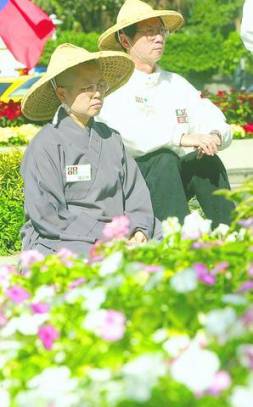
Buddhist Master Shih Chao-hui, left, executive committee member of the Nuke-4 Referendum Initiative Association, and former Democratic Progressive Party legislator Chien Hsi-chieh, right, attend a sit-in outside the KMT Central Committee office yesterday to demand that the KMT deliver on its promise of creating a nuclear-free Taiwan.
-----------------------------------------
On March 15, 2004 ……
Taiwanese democracy helps US
By Lo Chih-cheng
A few days ago, US Secretary of State Colin Powell gave a lecture on Asian democracy and US foreign policy at the Heritage Foundation, an important US think tank. Although Powell's lecture was mainly a general discussion of the US view of and assistance for the development of democracy in the Asia-Pacific region, the part dealing with the cross-strait relationship was significant in that it revealed some important information.
When recounting the direction of US efforts in the Asia-Pacific region, Powell stressed that the US will help Asian nations build representative democratic governments, and that the US role in regional security can be thought of as an important shield behind which democracy can develop. Based on this understanding, Powell proposed a few focal points for future efforts, also mentioning the cross-strait relationship.
He stressed that even though the US wants to see a rising China, it should also be a responsible China. At the same time, the US does all it can to keep peace and ensure stability in the Taiwan Strait and adheres to its one-China policy as defined by the three US-Sino communiques and the Taiwan Relations Act. Powell said that, "We do not support Taiwan's independence, and we oppose moves by either side to unilaterally change the status quo."
He also stressed that, "In this regard, we also strongly oppose the use of force or its threat across the Taiwan Strait. China's military build-up opposite Taiwan is destabilizing. We urge a posture more conducive to the peaceful resolution of existing disputes."
We are very clear on the fact that China has internationally labelled Taiwan's referendum and other measures to deepen democracy as attempts at changing the status quo in the Taiwan Strait, while pretending to be an innocent, peace-loving nation and concealing the fact that its missile deployment is the actual unilateral threat to the peaceful status quo. It was also Beijing's diplomatic and propaganda attacks that forced US President George W. Bush to say, in front of Chinese Premier Wen Jiabao, that he was concerned that the words and actions of Taiwan's leader might be an attempt at unilaterally changing the status quo, a statement that led to heavy international pressure on Taiwan.
However, following strong efforts by Taiwan's government to communicate with the US and the announcement of the actual referendum questions, Washington has taken a more neutral approach towards the referendum, publicly neither opposing nor supporting it.
Simply put, the US does not believe that Taiwan's referendum is an attempt to change the peaceful status quo. On the contrary, Powell in his lecture specifically referred to China's military deployments and said he believed them to be destabilizing. From this perspective, the US is gradually returning to a more balanced view instead of placing all pressure and responsibility on Taiwan.
More important, one of the main goals when initiating the peace referendum was the hope to use it to alert the international community and particularly the US to the fact that China's missile threat against Taiwan should be taken seriously. Powell's criticism of China's armed threat proves that the efforts to initiate the peace referendum are beginning to have an effect internationally and that the first positive reactions are appearing.
Another part of the lecture worth noticing was that Powell said that Taiwan is one of Asia's model democracies. Although this is not a new formulation from Washington, and although Powell himself has said that Taiwan is not a troublemaker but an example of success, the timing of the statement is very significant.
First of all, the Taiwan-US relationship has indeed been at a low point in the recent past, and Taiwan has also had to withstand a lot of US criticism and pressure. Powell's public praise for Taiwan's democratic achievements at this point in time shows that the US-Taiwan relationship is gradually warming up again.
Second, whether by chance or
deliberately, the timing of Powell's lecture coincided with major political
activities on both sides of the Taiwan Strait. In Taiwan, it was of course the
intense presidential election campaign and referendum debate, and in China, it
was the National People's Congress (NPC) and the Chinese People's Political
Consultative Conference (CPPCC).
Compared to Taiwan, where the people can elect their president and vote in referendums, both the NPC and the CPPCC are but the Chinese dictatorship's rubber stamp. This is exactly the reason why Powell, by publicly praising Taiwan's democratic achievements and pointing out that the goal of last year's 500,000-strong demonstration in Hong Kong was to win basic human rights, also highlighted the lack of democracy in China and the Chinese government's destruction of freedom.
In fact, the 2003 Human Rights
Reports published by the US Department of State earlier this month denounced
China, saying that its human rights record has deteriorated on every point. The
Chinese government has been severely criticized by the US for things such as
persecuting the Falun Gong religious organization, not allowing its people the
freedom of association, suppressing religious freedom and human rights in
Tibet, and for causing democratic government to regress in Hong Kong.
During Powell's testimony in Congress, he further said that the US is considering the introduction of a resolution in the UN condemning China for its suppression of human rights. In contrast, the human rights reports affirmed Taiwan's political human rights, pointing out that the Democratic Progressive Party (DPP) government has made good progress in its efforts to eliminate corruption and vote-buying and mentioned that President Chen Shui-bian has signed into effect a Referendum Law.
To sum up, with Taiwan in the final countdown toward a presidential election, Powell's lecture expresses a positive and balanced position. Democracy is indeed an important basis for Taiwan as it continues its quest for international support and recognition. This is also why the presidential election and the referendum are not only a necessary foundation for deepening democracy domestically, but also a necessary tool enabling Taiwan to promote its international diplomacy, a tool that the Taiwanese people should value and put to good use.
Lo Chih-cheng is executive director of the Institute for National
Policy Research.
-----------------------------------------
On March 15, 2004 ……
KMT: reactionaries, mostly thieves
The use by the pan-blues of Adolf Hitler in their campaign ads is beneath contempt but we hope that in the last week of the election campaign it might serve to focus people's minds on the choice they have to make. For what was Hitler's government but the capture of the institutions of the state by a criminal gang? And what is the pan-blue alliance but a criminal gang seeking to capture the institutions of the state?
For those who find even this analogy in questionable taste let us remind them that during its period of government in China the Chinese Nationalist Party (KMT) murdered some 10,075,000 people -- ordinary innocent people, we stress, as this figure does not include war deaths. It is often forgotten that Chiang Kai-shek was also a mega-murderer. Nor did murder cease to be an instrument of KMT policy in 1949. The pace slowed a little in Taiwan, but the death toll is undeniable.
Times have changed, say the pan-blues. Perhaps so, but the fact that the pan-blues have never shown even the slightest contrition for what they have done -- and hard-liners were in fact incensed when in the late 1990s former president Lee Teng-hui apologized on behalf of the government for the 228 massacre -- suggests that they gave up the habit of killing not because of some Damascene conversion in their moral outlook but simply because it was expedient to do so.
What the pan-blues have never given up is their propensity for theft. Their presidential candidates are themselves mired in this culture of theft. People First Party Chairman James Soong even stole from his own party -- no honor amongst thieves there. KMT Chairman Lien Chan is the head of a family which has ruthlessly manipulated its government role to line its pockets for two generations. But in this respect Lien and Soong are true products of KMT culture. After all, the party itself stole up to US$20 billion during its time in office.
Thieves leading a party of theft -- hardly an edifying prospect for a future government. Which makes Saturday's mass turnout for the pan-blues rather depressing. Why would people want to vote for a party whose principle skill is looting? It is truly amazing that anybody can fail to see the pan-blues' desire for power as anything other than the desire of confidence tricksters to persuade the people to leave the cookie jar in their care. Voting for the pan-blues is simply queuing up to have one's pocket picked.
This election has been characterized as a fight between pro-Taiwan and pro-China forces. It has been described as a battle between progressive forces, with an agenda that stresses democratic choice and popular sovereignty, and the forces of reaction, with their record of political exclusion and their current rejection of democratic choice -- a rejection best summed up as "you can vote, but only for the things we allow you to vote for." Both of these characterizations are correct.
But there is one more way of looking at the election. It is between those who have had a vision of how to make Taiwan a better society and have tried to actualize that vision, and those who see political power as a means only to enrich themselves. The pan-blues are not interested in making Taiwan a better place to live in. They are interested in expanding their real-estate portfolios in the US at our expense. What amazes is that Lien and Soong's prostrating themselves on Saturday did not cover them with ridicule. After all, if they love Taiwan so much, why did that make sure their sons dodged military service? Why do they have so much property and so many family members overseas? Can Taiwanese really fall for these crooked charlatans? Do turkeys really vote for Christmas?
-----------------------------------------
On March 15, 2004 ……
-----------------------------------------