20040316
=======
Taiwan 100 on March 16, 2004 ……
The winding path to a referendum
"Even now, if the government
were to hold an independence referendum, it is likely less than half of the
voters would support independence." --- Lee Yung-chih, a history
professor at National Taiwan University
Saturday's nationwide poll marks the triumph of a long-cherished dream by advocates of Taiwan's democratization, but will the referendum be a success?
By Lin Chieh-yu, STAFF REPORTER
The process of developing a referendum law in Taiwan represents the difficult progress of the country's efforts to decolonize itself and establish an awareness of its sovereignty.
Although there is still a powerful opposition which is trying to ensure the failure of Taiwan's first nationwide referendum, many political analysts believe that the referendum on Saturday will succeed.
These analysts say the coming referendum is an important opportunity for the people of Taiwan to break the mold of partisan conflict, ethnic division, and bickering about independence or reunification.
Further, referendums could become a fundamental tool in the routine operation of Taiwan's democracy, and the major method Taiwanese adopt to handle domestic differences about cross-strait issues.
"President Chen Shui-bian tied the referendum to the presidential election to gain a campaign advantage, but we believe that after the election, the two issues will be separated, because the referendum has a much wider applicability in democratic processes than does a presidential election, the essence of which is conflict," said Hsu Yung-ming, an assistant research fellow with the Institute of Social Sciences at Academia Sinica.
"The consensus brought by the referendum is greater than the conflict the elections bring, so no matter who wins the presidential election, referendums will become a common asset shared by all parties, just like the slogan `Love Taiwan. Referendums will become something all parties use, promote and adopt," he said.
Hsu pointed out that if Chen won a second term, he would continue to use referendums to smooth out differences about major public policies, such as the destiny of the Fourth Nuclear Power Plant, the formulation of a new constitution and deciding how the Taiwanese government interacts with China or the US.
On the other hand, Hsu said, if Chinese Nationalist Party (KMT) Chairman Lien Chan wins the election, then the DPP could concentrate on using the referendum to fortify Taiwan's sovereignty without fear of international pressure as it assumed the role of an opposition party. The DPP could then monitor and prevent the pan-blue administration from getting too cozy with China.
"If Chen loses, the referendum will not be considered to be the cause of Chen's failure, because the referendum enabled Chen to close the gap in his standing in the polls in six months, from trailing by 20 percent to a race too close to call," Hsu said.
"Now the KMT and the People First Party [PFP] dare not oppose the referendum under any circumstance, as the public will keep examining Lien or Chen in the future to see whether they continue to respect the referendum," he said.
Looking back
The history of the referendum law in Taiwan parallels the experiences of other countries which had been colonized before and during World War II as the former colonials fought, either politically or physically, to achieve their country's independence. Holding a referendum on the topic of independence was even a method promoted by the UN for former colonies to determine their international status.
After Japan lost the war in 1945, Taiwan was taken over by China's KMT regime.
But after the alien regime brutally massacred thousands of Taiwanese in the 228 Incident in 1947, people became disappointed with China and its turmoil as well as the KMT government. These people had new notions about Taiwan's status as a country.
As early as the 1950s, some people started to argue that there was a lack of consensus on Taiwan's international status based on the San Francisco Peace Treaty and urged the country to decide its international status via a referendum.
However, under the Martial Law period of the warlord Chiang Kai-shek (蔣介石), political dissidents could only appeal to the public to oppose the KMT, to terminate one-party politics and establish a democratic system. Establishment of a country and the issue of sovereignty became a platform advocated only by a few radical dissidents, and talking about holding a referendum became taboo.
"Originally the referendum was considered to be the sole purview and ultimate goal of the political dissident movement, but because of that it has been difficult for the referendum to become a topic of casual discourse," Hsu said.
"The support for the referendum
only started to grow during the late 1980s when Chiang Ching-kuo died suddenly
and Lee Teng-hui took over. But Lee cleverly adopted the DPP's platform for
reform, and the then-leaders of the DPP also worked with Lee to proceed with
systemic reform. The governing party and the opposition parties entered a
period of electoral competition, and the referendum has been transformed from a
political appeal to a social one. It has become a means of solving
controversial public policies or construction projects," he said.
During this period, a few referendums were held, including the Fourth Nuclear Power Plant referendum, held by former Taipei Country Commissioner Yu Ching in 1994, and a referendum on the same topic held by then-Taipei-Mayor Chen Shui-bian in 1996, and again by former Ilan County Commissioner Liu Shou-cheng. Referendums at a local level have been occurring since 1990.
Lee Yung-chih, a history professor at National Taiwan University, said that when the Taiwan Professors Association -- a staunch advocate of Taiwan's independence -- was established in 1990, referendums had been the most important issue they promoted, and they viewed the eventual goal as achieving Taiwan's independence via referendum.
Under the Lee administration, there were intellectuals in academic, religious and medical circles promoting referendums but in the political circle, there was only "Referendum Chai" or Trong Chai, the former chairman of the Formosan Association for Public Affairs (FAPA), promoting the issue on his return to the country and gaining a seat as a legislator.
"Everyone was concerned with mild reforms such as legislative procedures, mayoral and commissioner elections and constitutional amendments," Lee said.
"The referendum was still considered to be something that would incite Beijing and make trouble, and there did not seem to be a future for it," Lee said.
"Even now, if the government were to hold an independence referendum, it is likely less than half of the voters would support independence. But the reason for the KMT's opposition to the referendum in the 1990s was to deprive the public of the right to participate in politics," he said.
"This is exactly the same mentality the KMT had in its opposition to the re-election of legislators, mayors and commissioners, directly electing the president and constitutional amendments. It is a mentality of refusing to release power," he said.
In 1995, some DPP members started to criticize then-chairman Hsu Hsin-liang for being too reconciliatory with Lee Teng-hui, and they could not identify with the transformation of the DPP promoted by Hsu and Sisy Chen.
They decided to leave the DPP and formed the Taiwan Independence Party (TAIP) to insist on a more radical platform of reform and independence.
"The referendum then started to enjoy higher visibility in Taiwan, but because TAIP only had one legislative seat, its strength was too little," said Lee, who once served as TAIP's spokesman.
Taiwan's fourth terrestrial TV station, Formosa Television, was established on June 15, 1997, and Chai, who lost his legislative seat in 1995, was the man behind the scenes. He became the station's chairman, and then promoted the referendum utilizing the station's ability to reach the public. The station produced in-depth programs to explain about referendum experiences in other countries, held referendum forums and hosted talk shows to elaborate on the referendum.
"We even held an 11-day fast in front of the Legislative Yuan in March 1999, trying to get the KMT to work with the DPP and pass the referendum law," said Chai, now a DPP legislator again.
"But in the end, we could only receive promises which did not have any legal effect," he said.
Willpower
Chai and the two academics emphasize that the reason why the referendum will focus society's attention on politics is certainly that it is only happening at all because in the first half of last year, Chen decided to stake his personal credibility on it and make it the flagship policy on which the DPP's continuation in power would hinge.
Last May 20, on the third anniversary of his inauguration, Chen called on the opposition parties to support his call for a "Join the World Health Organization" referendum. Later, as he took part in the "Nuclear-free Homeland Conference" on 27th June, he announced that this year, either on or before the presidential election, there would be a referendum on the Fourth Nuclear Power Plant.
Later still, on Sept. 28, at the DPP's 17th anniversary celebrations he further announced that he would be promoting a new constitution and that the draft of that new constitution would be approved by referendum in 2006.
"Political analysts saw Chen's great referendum plans as the turning of fiction into fact, because none of his senior aides had considered a referendum to be the focal point of the presidential election at that time," said political columnist Hu Wen-huei.
They even said that the referendum announcement was made to satisfy former DPP chairman and anti-nuclear activist Lin Yi-hsiung, who was respected as a party elder as well as a crucial figure in realizing the handover of power in 2000, said Hu.
"But they hadn't counted on the people reacting so enthusiastically, much less on the progress of KMT-PFP negotiations, and they underestimated the extent to which the people's wishes have changed. Chen was able to take the lead in all policy areas by talking about referendums, so much so that the pan-blue camp, having first tried to steal the limelight by attacking the state of the economy, had to keep changing tack to keep up with him. Chen mocked them for `honoring him with incense.' Referendums became a battleground in which Chen demonstrated his willpower and his creativity, and both inside and outside the party, no one had any choice but to enter the fray," said Hu.
The DPP had, in the space of two short years, changed from being cold, frightened and suspicious towards referendums to winning a 70 percent majority backing a national referendum. Lee Yung-chih believes that this hinged on Chen achieving breakthroughs on the world stage, illustrating the importance of Taiwan's international standing and strengthening the people's recognition of the pressure placed on Taiwan by China, resulting in their gradually grasping the theory of using referendums to protect Taiwan.
"Moreover, the DPP's failure to announce the stoppage of construction on the Fourth Nuclear Power Plant in 2000, causing three months of political turmoil, prompted a strong desire on the part of the people for a collective, final expression of their will to decide the matter," said Lee.
Political developments can be transformed in the twinkling of an eye, and international developments were the decisive factor in the next stage. When the pan-blue camp decided to take part in the referendum and finally found a strategy that enabled it to go on the offensive, rather than the defensive, it did so by using its majority in the Legislative Yuan.
On Nov. 27, after Chen returned victoriously from the US, having only recently overtaken Lien and Soong in the opinion polls, they announced that the KMT would introduce a "bird cage" referendum bill in the legislature on the one hand to meet the expectations of the people, and on the other to place a restriction on the amount of time within which the government would have to hold the referendum, further illustrating the pressures on Chen to take the battle to China without offending the US.
"On this occasion, Chen again used his determination, seizing the window of opportunity presented by interpreting Article 17 of the Referendum Law to call a referendum in order to protect the country and announcing that he was indeed calling `defensive referendum' to be held at the same time as the presidential election. He later changed the term to `peaceful referendum' in order to temper sensitivities. But it attracted international concern, including US disapproval, making Taiwan a `troublemaker' in an instant," Hsu Yung-ming said.
"And at that stage," Hsu said, "The pan-blue camp, which had committed itself fully to referendums, saw the change in the international position and abandoned the referendums it had previously advocated on education, public construction, the economy and so forth."
But Chen refused to withdraw. One reason for this was that the referendum had already become the central issue in the DPP's campaign; to abandon it at this stage would mean failure. He came to terms with the situation, effused goodwill and modified the wording of the referendum questions, restoring the US and Japanese governments' faith.
In February this year, when international pressure dissipated, the pan-blue camp was nevertheless unable to play it down. They had to return to the fray but focus their attack on the legality and constitutionality of the referendum plan.
"By that point the question had become not `yes' or `no' to a referendum, but whether or not to participate in it," said Hsu. "The referendum had finally become a fact of life, confirmed by the Taiwan people."
Trong Chai describes as "unavoidable" the change from his original position that the issue decided by Taiwan's first referendum should be "Oppose one China," and "One country on either side of the Taiwan Strait," to opposing increases in China's missile build-up and calling for mechanisms for peaceful cross-strait negotiations.
"The significance of the first referendum lies in the message it sends to the international community, in consolidating the will of the people, and in setting out on a precise route on which there can be no return. But the impact of the referendum will depend on how high the turnout is," said Chai.
Looking to the future
The Executive Yuan has been deprived of the right to call a referendum; people cannot launch any referendum to change the constitution; and any kind of "public affairs" referendum initiated by people must be examined by a "Referendum Review Committee" comprising figures from all political parties, to discuss whether the issue can in fact be implemented.
This type of decree, which inhibits the free expression of the will of the people, will only be outlawed when the DPP finally secures a majority in the legislature, says Chai.
"The crux of the matter is the resolve of the leader. But with Lee Teng-hui having been in power for 12 years and Chen for four years, the people of Taiwan should already have learnt that impatience leads to defeat, and instead develop a desire for moderation," Chai said.
"Before a new constitution has been drafted, it is too early to talk about Taiwan independence," he said.
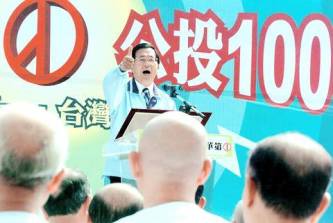
President Chen Shui-bian speaks to a group of 100 bald men at a rally in Taipei yesterday. The Chinese word for ''bald'' is homonymous with ''referendum.'' The number 100 refers to number one, which is Chen's candidate number, and two ''agree'' votes for the referendum.
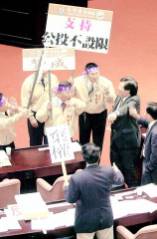
Legislators from the pan-green and pan-blue camps haggle over the Referendum Law in this file photo from last November.
-----------------------------------------
On March 16, 2004 ……
The KMT is in trouble, win or lose
`Given that pan-blue integration is being carried out of concern for the continued existence of party and nation, the division of power between Lien and Soong and the power conflicts between the KMT and the PFP have gradually been put aside while awaiting a return to power.'
By Chin Heng-wei
This year's presidential election can be described as the greatest battle in 50 years.
The reason I'm saying 50 years and not 400 is that just over 50 years have passed since Chiang Kai-shek's army was defeated and had to escape to Taiwan to establish a base from where to retake the mainland, until the 2000 presidential election, when the Chinese Nationalist Party (KMT) was defeated in a democratic election and had to relinquish its hold on power.
In this year's election, the KMT is attempting a comeback using the slogan "A Second Transfer of Power."
With the Democratic Progressive Party (DPP) denouncing it as an attempt at bringing about "The Restoration of the Old Power" while making "A Deepening of Democracy" its own slogan, a blue-green struggle has taken a dramatic new shape.
For the KMT, the transfer of power in 2000 seemed to mean the end of the party and the death of the nation, and this year's presidential election could be thought of as a last effort to support a collapsing structure.
There is a strong sense of crisis within the pan-blue camp, which knows that if it is unable to unite, it only has Chiang's prediction to look forward to: "This retreat leaves us without a resting place."
It was this sense that forced the present cooperation between KMT Chairman Lien Chan and People First Party (PFP) Chairman James Soong.
A Lien-Soong presidential pairing, which used to be considered a mission impossible, was finally achieved. Although the candidates and the KMT and PFP have their own separate designs on power, there is a common wish to recreate the party-state entity.
This is also why the KMT and PFP, as soon as they joined up, dusted off former president Chiang Ching-kuo, and why Lien and Soong ironed out the "one China" concept, which some call the "one China consensus" and others the "one China roof" framework. They even jointly stressed the need for a "one China constitution," thus displaying the pan-blue camp's very deep sense of crisis concerning the party's continued legitimacy.
Given that pan-blue integration is being carried out of concern for the continued existence of party and nation, the division of power between Lien and Soong and the power conflicts between the KMT and the PFP have gradually been put aside while awaiting a return to power.
Once that happens, they will begin dividing the territory.
For the DPP, President Chen Shui-bian's victory in the 2000 presidential election meant that localization forces for the first time had a hold on government power.
Of course, this happened thanks to the split in the KMT, or, rather, thanks to Soong's insistence on snaring the top post, and was also the reason why former president Lee Teng-hui chalked the win down to fate.
What would the chances have been of the DPP winning power if Soong had been content with standing behind Lien in 2000, as he is today?
The DPP would not have stood a chance, and it would have seriously reduced the possibility of a transfer of power this year or in 2008.
However, following the 2000 election, Lien put pressure on Lee, who gladly stepped down from his post as chairman of the KMT only to found the Taiwan Solidarity Union (TSU) in time for the 2001 legislative elections.
KMT voters supporting Lee shifted their support to the DPP, thereby greatly expanding the green camp's voter base, as was seen in the number of votes it generated in the 2001 legislative elections and the 2002 Kaohsiung mayoral election.
But this year's presidential election is a competition between two candidates, and the DPP has to get half of all votes if it is to win the election. This is a hard win, and the secretary general to the Presidential Office did not exaggerate when he called it a cutthroat battle.
Today, the situation is split 50-50 between the two camps, and it is not at all certain that the pan-blue camp will win. Almost 2 million people participated in the 228 Hand-in-Hand Rally and support for Chen is on the rise.
In addition, it is worth noticing the change in public opinion in Taiwan between 2000 and this year. In proposing one country on each side of the Taiwan Strait, the referendum, and the writing of a new constitution, Chen has felt the pulse of Taiwanese society. He has used this to square off the blue/old against the green/new. If the green ticket wins, Taiwanese identity will grow stronger, and the two main strands in this awareness -- democratization and localization -- will become integrated.
If the Lien-Soong ticket wins, it will be impossible to return to a pre-Lee style party rule, but it is also a certainty that there will be fierce conflict with forces favoring localization.
Such polarized opposition, with the addition of the power struggle between green and blue parties, will lead to increased turbulence in Taiwanese society.
There are other problems attached to a Lien-Soong win.
The first problem is that Lien and
Soong are backed by the KMT and the PFP, respectively, and that the PFP holds a
certain number of seats in the legislature. Behind the "empty post"
of a vice president, Soong would have real legislative support. How should
power then be divided between president and vice president?
The second problem relates to the question of whether the KMT and the PFP are two parties or one. If two, then how should all the graces be divided? How should Cabinet posts be divided to avoid infighting? In the year-end legislative elections, the two parties will be fighting for the same voters. Should the president campaign for KMT candidates while the vice president campaigns for PFP candidates? If they form one party after the election, then who should take over the chairmanship, and how should power be divided within the party?
The third problem is that Taipei
Mayor Ma Ying-jeou and legislative speaker Wang Jin-pyng share the No. 2
position within the KMT, and their supporters have already split up into
factions. If the KMT once again becomes the ruling party, it will not be able
to handle its internal problems, and it will also have to deal with the PFP
factor.
We can only imagine the intensity of the power struggles that would ensue.
Lien, Soong, the KMT and the PFP insist on putting the issue of the power formula aside. If they lose the election, Lien and Soong will no longer be able to run their parties, Lien in particular, and they will have no choice but to retire.
The KMT's localization faction will grow stronger and the KMT will have to deal with tension resulting from being forced by circumstance to desinicize and localize.
A defeat may not only cause the KMT to collapse, but the handling of party assets, party-run businesses and the remaining huge body of retired staff will pose difficult problems in future.
Soong's PFP must give priority to three issues.
First, will they be able to survive without Soong's leadership? Second, should they merge with the KMT in order to defeat the DPP and the TSU? Third, what strategy should they adopt in the year-end legislative elections? Since Lien and Soong joined hands, PFP supporters have shifted their support to the KMT. Will the PFP get another lease on life?
Regardless of whether the DPP manages to remain in power, the TSU will be the biggest winner in this year's election. If the DPP wins and the KMT disintegrates, the TSU will, on the one hand, be able to attract what the DPP calls "fundamental votes."
On the other hand, the TSU will also attract voters supporting the KMT's localization faction, and they may even be able to attract politicians from that faction. The TSU will then have the chance of growing into a major party in the year-end legislative elections.
If Chen's re-election bid is successful, the DPP will have laid the foundation for a long-term hold on power. If the DPP, which only commanded 40 percent of the political map in 2000, manages a win this year, it will not only be a matter of great quantitative growth, but it will also signify a qualitative change showing the Taiwanese people's determination to cast off 50 years of KMT rule.
A victory for a Taiwanese localization government will inevitably mean the beginning of the legislative election campaign and a legislative majority for the DPP and the TSU. At the same time, it will also signal the start of DPP-TSU interparty competition.
Regardless, Taiwanese development will enter a new historic process and China will have
to rethink its strategies. In particular, defeat for the KMT would mean that the civil war framework connected to the KMT and the Chinese Communist Party (CCP) would collapse, and the CCP would have to make changes to its "one China" principle.
The US' "one China" policy would also be challenged.
A win by the Lien-Soong ticket would leave Chen with two choices: continue as chairman of the DPP and try again in 2008, or retire from politics and assist the DPP from the outside. The DPP has Taipei County Commissioner Su Tseng-chang in the north and Kaohsiung Mayor Frank Hsieh in the south, and a new generation will bring new people.
The DPP and the TSU would both compete and integrate. Relying on a flourishing Taiwan awareness, the green camp is already becoming difficult to stop. As time goes by, it will grow, not shrink, and put heavy pressure on the KMT.
This year's presidential election represents a major choice for the people of Taiwan. Will the winner be a China-toting KMT or a DPP using "Taiwan" as its slogan?
We will know the answer on March 20.
Chin Heng-wei is the editor in chief of Contemporary Monthly magazine.
-----------------------------------------
On March 16, 2004 ……
Black gold was always blue
The bizarre thing about this election campaign is that the most vehement attacks against President Chen Shui-bian are coming not from Chinese Nationalist Party (KMT) Chairman Lien Chan or People First Party Chairman James Soong but from fugitive tycoon Chen Yu-hao. By any standard, this is an election novelty: a disgraced businessman on the lam fighting an asymmetrical war against a president.
The former Tuntex boss' accusations against the president do not hold water. He said he donated money to Chen Shui-bian's campaign for Taipei mayor, which the president readily admits. Receipts were also issued to the fugitive as required by law. Chen Yu-hao also donated large sums to the KMT and to Soong.
There is no way to regulate such donations while the Political Donations Law is stuck in the legislature, so they do not constitute illegal acts. But if they were problematic, the KMT and Soong would have far bigger problems explaining themselves, having received far larger amounts from Chen Yu-hao. Yet the media have turned a blind eye to the donations made to the KMT and Soong, while dogging first lady Wu Shu-chen on trivia such as whether Chen Yu-hao visited the presidential residence. This has turned an issue of propriety into a question of correct memories. Predictably, the dispute is now seriously out of focus.
Political donations are different from bribery in that one makes donations to parties and individuals that one favors to help them enact policies. Bribery also involves a cash transfer, but in this case the donor hopes to extract an illegal favor or benefit in return.
In the case of Chen Yu-hao, the Democratic Progressive Party (DPP) government did not bail out his troubled company, as a previous KMT administration would have been expected to do. Instead, the DPP government put him on the most-wanted list for embezzlement and illegal investment in China. Put simply, there is no give-and-take relationship between Chen Yu-hao and this government.
But the claims made by Chen Yu-hao -- via fax, from overseas -- have caused some damage. The TAIEX yesterday slumped an irrational 164 points, prompting a number of Taiwanese and foreign journalists who have a superficial understanding of the issue to ask, "Is the Chen Shui-bian government corrupt?"
We would not dare offer a guarantee that no one in this government is involved in bribe-taking, but unlike former KMT governments, with their intricate and formidable networks of collusion with gangsters and business conglomerates, "black gold" does not pose a structural problem for the DPP. There are only isolated cases, and minor at that.
Moreover, much of the civil service is still pro-KMT. This creates an enormous monitoring force against the DPP. With 50 years of experience in government and corruption, the pan-blue camp's sympathetic elements in the public service would have easily exposed any corrupt behavior on the part of DPP officials by now.
Chen Yu-hao's accusations, safely hurled from overseas, may mesmerize some people for a while, but voters should be able to identify the purveyors of genuine "black gold" when they have their say on Saturday.
-----------------------------------------
On March 16, 2004 ……
-----------------------------------------