20040317
=======
Reported on March 17, 2004 ……
DPP campaign to focus on building national identity
By Chang Yun-ping, Staff Reporter
Shrugging off accusation by fugitive Chen Yu-hao, the Democratic Progressive Party (DPP) said yesterday it will focus on national awareness in the run-up to Saturday’s presidential election.
“The recent accusations made by fugitives showed that the campaign is a war between black-gold politics and anti-black-gold politics,” Chiou I-jen, the DPP’s campaign executive director, said yesterday.
“What is more important is that we raise Taiwan-centric awareness and make voters feel strongly about it in the run-up to Saturday’s election,” he said.
Branding the recent attacks by fugitives against the DPP as the last-ditch efforts by remnants of black-gold politics, DPP campaign spokesman Wu Nai-jen said the accusations by Chen, a former chairman of Tuntex Group, were within the party’s expectations.
“As we expected, those remnants of black-gold politics made their final attacks in the last few minutes before the election and did everything they could do attack President Chen Shui-bian,” Wu said.
He said the fugitives Chen Yu-hao, former Chinese Nationalist Party (KMT) Kaohsiung City Council speaker Chu An0hsiung and the former Chairman of the Bank of Overseas Chinese, Liang Po-hsun, were popular businessmen during the KMT era and had embezzled a total of NT$89.1 billion from Taiwan.
Wu said that Chen Yu-hao, Chu and Liang had embezzled about NT$56.6billion, NT$26.3billion and NT$6.2billion, respectively. He said the value of the money these people had stolen amounted to NT$12,600 for each household watching the live TV broadcast of Chen Yu-hao’s press conference.
“The reason these people would make their final attacks on the ruling party in the last few days before the election is because they want to beat President Chen. They have placed their hopes on the presidential ticket of [Chinese Nationalist Party Chairman (KMT) Lien Chan and [People First Party Chairman] James Soong,” Wu said.
As for the whereabouts of DPP Legislator Shen Fu-hsiung, who has been missing since Monday when Chen Yu-hao disclosed that Shen had accompanied him to visit for first lady Wu Shu-chen to offer political donations, Chiou said he is worried that Shen’s disappearance would impact the party’s dim electoral prospects in Taipei City.
Shen is the DPP’s campaign director for the city.
Meanwhile, Chen Shui-bian said yesterday that China had used to opportunity to conduct joint naval exercises with France off China’s eastern coast to sway the result of Taiwan’s presidential election.
He also lambasted France for siding
with authoritarian China and opposing Taiwan’s democratic referendum to sell
weapons to China.
“France is a problematic country,” he
said.

A pan-green supporter kisses a Chen Shui-bian doll as he watches Chen canvassing for votes on the streets of Taichung yesterday. The DPP said yesterday it would focus on building a Taiwanese consciousness in the final days of the campaign.
-----------------------------------------
On March 17, 2004 ……
Military on alert ahead of poll
"This is aimed at providing a
secure and stable environment for the public to cast their votes on the
election day." --- Major General Huang Suei-sheng, spokesman for the
Ministry of National Defense
SECURITY: The armed forces will
increase patrols before and during the election period to keep a close eye on
China's ballistic missile and submarine deployments.
By Brian Hsu, STAFF REPORTER
The military will strengthen its air and sea patrols in the lead-up to Saturday's election while keeping a close eye on China's ballistic missile and submarine deployments, the Ministry of National Defense announced yesterday.
"The armed forces will stay on alert around the clock during the election period. This is aimed at providing a secure and stable environment for the public to cast their votes on the election day," ministry spokesman Major General Huang Suei-sheng said at a weekly press conference yesterday.
"Election day has been declared a day for `focused alert.' Our focus on that day and days before will be on air and sea patrols. Check and identification of targets is to be one of the priority tasks," Huang said.
"There is no sign to show that the Chinese military has any unusual deployments across the Taiwan Strait. But we will keep a close watch on the Chinese military, especially its ballistic missile and submarine forces," he said.
"The ministry has already in place rapid-response plans for any unusual deployments of the ballistic missile and submarine forces of the Chinese military," he said.
Huang, however, played down the significance of a joint Sino-French military exercise held off the coast of Qingdao, Shandong Province, yesterday.
"Two French warships were at Qingdao between March 12 and March 16 for a visit. The two ships then participated in an exercise with the Chinese navy," Huang said.
"The exercise is on maritime search and rescue, falling into the category of humanitarian aid. It is a basic and entry-level maneuver," he said.
The arrival of the French warships in the region coincided with the presence of the USS Kitty Hawk in the waters between China and Taiwan earlier this month. The ministry has declined to comment on the motives behind the Kitty Hawk presence.
However, the aircraft carrier's presence carries strong indications that the US does not want to see any conflict break out between the two sides of the Taiwan Strait at this moment.
Huang confirmed media reports that the military police has already deployed the Avenger pedestal-mounted Stinger anti-aircraft missile in Taipei. The Stinger is among the best man-portable surface-to-air missile in the world.
"The deployment started in December. It was part of the normal arms build-up," Huang said, declining to connect it with the election.
Yesterday was the first time the ministry made public its security plans for the election and officials appeared confident of providing a secure environment for election day.
-----------------------------------------
On March 17, 2004 ……
China accused of interfering in election
By Melody Chen, STAFF REPORTER
The Ministry of Foreign Affairs yesterday accused China of trying to influence Saturday's election and referendum by staging a large joint exercise off Qingdao with Chinese and French warships.
"China launched the massive military drill with France just four days before Taiwan's 11th presidential election and first-ever national referendum, intending to intimidate our country and influence election and referendum results," the ministry said in a statement.
The ministry said Beijing's attempt at influencing the election was "absolutely unacceptable."
The joint exercise marked the largest naval drill China has ever conducted with a foreign country, according to Chinese state media and officials.
The foreign ministry said it also deeply regretted France's decision to take part in the naval exercise when Taiwan's presidential election and referendum are so close.
The ministry said this followed recent French remarks and actions against Taiwan, including President Jacques Chirac's public opposition to the referendum in January and France's proposal that the EU lift its ban on weapons sales to China.
"The present timing is sensitive because of the presidential election and referendum. France did not consider the sensitive timing, instead deciding to carry out the largest and most complicated naval drill it has ever had with China," the ministry statement said.
Remarking that the government could not understand why France was taking an anti-Taiwan stance, the ministry said it expressed its "serious concerns and dissatisfaction" to the French Institute in Taipei last night.
"We demand the French authorities offer a reasonable explanation of this [the naval drill]," according to the statement.
China's foreign ministry said it "disagreed with" the accusations that the naval drill with France was in any way related to Taiwan's election.
"In recent years, the development of relations between the two countries [China and France] and the two militaries has been growing smoothly," China's foreign ministry spokesman Liu Jianchao said yesterday.
-----------------------------------------
On March 17, 2004 ……
Pan-blues aim to win election on their knees
By Mac William Bishop
The past few days have seen so many bewildering and inexplicable events relating to the presidential campaign that one despairs of making head or tail of it. But more than any other, there is one question which sticks in the mind. Why must the pan-blue alliance continually obfuscate the truth?
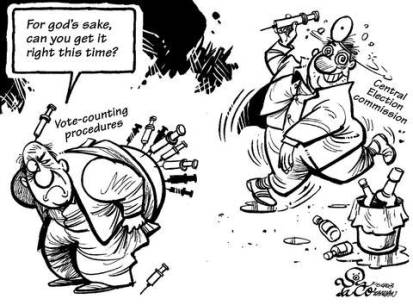
As if it weren't bad enough to run five full-page ads in Chinese-language newspapers equating President Chen Shui-bian with Adolf Hitler, People First Party (PFP) Chairman James Soong then proved his utter contemptibility in a statement on Friday regarding the Central Election Commission's decision to count misplaced presidential ballots.
"If Chen insists on counting ballots placed in the wrong ballot boxes as valid, then he is acting just like that dictator, Hitler," he declared.
Such a patently absurd claim deserves to be heaped with ridicule. Comparing the Chen administration to the Nazi regime is, at best, a total misrepresentation of historical fact or, at worst, malicious and offensive libel.
The pan-blues have once again proven their compulsive hypocrisy and craven amorality.
You needn't be exceedingly familiar with the history of Taiwan to judge which political party's past most closely resembles the genocidal violence and fascist oppression of Hitler's National Socialist Party.
The murder, torture and persecution of political dissidents and minority ethnic groups by the Chinese Nationalist Party (KMT) under Chiang Kai-shek are matters of record. The use of assassination, the employment of brutal thugs to assault opposition members, the repression of free speech, the quashing of political dissent, the use of torture, sham trials and summary executions are all characteristics of the KMT during the White Terror.
It would be irresponsible and unethical to claim that the modern KMT still employs such tactics. But surely its shift toward a more benign style of politics is a result of the efforts of people such as Chen -- a longtime democracy activist, former human-rights lawyer and victim of KMT oppression -- to make the government accountable to the people.
During last Saturday's 313 Rally, Soong fell to his knees in Taichung and kissed the ground to "show his love for Taiwan." Not to be outdone, Lien later prostrated himself before the Presidential Office and kissed the ground as well. How these gestures will be interpreted by the electorate is not clear, but it is clear that Lien and Soong will do anything, even abase themselves in public, to gain power.
Lately, the pan-blue camp has been running a series of TV advertisements in which it has attempted to equate Lien with former US president Franklin Delano Roosevelt and former UK prime minister Winston Churchill. But it seems that when the alliance was studying up on these leaders, there was an error in translation.
Roosevelt said: "We, and all others who believe in freedom as deeply as we do, would rather die on our feet than live on our knees." Apparently the pan-blues have translated this as, "It is better to win on your knees than lose on your feet."
The pan-blues should be ashamed of adopting such cheap, indefensible theatrics. It would be easier to respect the policies and leadership of the KMT and the PFP were they to refrain from making such spurious and feckless declarations. But it is too much to expect the pan-blues to use truth in their campaign.
For were they to tell the truth about their shadowy financial dealings, their connections to the underworld, their corruption, their pandering to Beijing and their subordination of Taiwan's welfare in their quest to quench their thirst for power, no one would vote for them.
Mac William Bishop is a political commentator based in Taipei.
-----------------------------------------
On March 17, 2004 ……
DPP in south promises victory
By Lin Chieh-yu, STAFF REPORTER
The Democratic Progressive Party (DPP) yesterday said that, according to the party's seven heads of local governments in southern Taiwan, President Chen Shui-bian will beat his opponent, the pan-blue camp's Lien Chan, by at least 600,000 votes in the upcoming presidential election.
"We are confident that President Chen will lead Lien by at least 15 percent of the vote and if the turnout is higher than 82 percent, we may win by over 650,000 ballots," said Kaohsiung City mayor Frank Hsieh.
"We are strongly optimistic about the success of President Chen's reelection bid as well as the referendum. Negative campaign tricks employed by the pan-blue camp may affect voters in northern Taiwan, but only serve to provoke the grassroots voters in southern Taiwan and mobilize more voters to support the DPP," said Pingtung County Commissioner Su Chia-chuan.
The DPP yesterday gathered its heavyweights in southern Taiwan, including civic leaders from Kaohsiung City, Kaohsiung County, Tainan City, Chiayi County, Pingtung County and a representative of Tainan County, to call on voters to return to their places of birth on March 20 for family reunions as well as to cast their ballots in the nation's first-ever referendum.
"The DPP government has successfully balanced development and resources allocation between northern and southern Taiwan during the past four years, which has brought outstanding progress in this area, especially in infrastructures in the seven counties and cities," said Pingtung County Commissioner Su Chia-chuang.
"We hope that our fellow villagers or townspeople, who now have jobs in central or northern Taiwan, will return home to see the DPP government's achievements," Su said.
Hsieh said that to awaken supporters' passion and expand Chen's voter base, heads of local government have scheduled to launch big parades simultaneously in Kaohsiung City and County in the last three days leading up to election day.
"We visited almost every house in our city and county and people's reactions are much more positive than we expected," said Kaohsiung County Commissioner Yang Chiu-hsin.
"What we are concerned about now is how the Chinese Nationalist Party (KMT) is proceeding with its vote-buying plan," Yang said.
Tainan City Mayor Hsu Tien-tsai said that grassroots support of the DPP in southern Taiwan is now reaching a historical high.
"Therefore, we are confident that Tainan County, President Chen's hometown, and Tainan City will win at least 300,000 to 350,000 votes."
"In Tainan County, our goal is to get over 70 percent of votes, or five percent more than the record DPP support rate notched up by former commissioner Chen Tang-shan," said deputy campaign executive of the DPP's Tainan County campaign headquarters, Yen Chun-tsao.
As to the referendum, the DPP stalwarts said that, unlike in northern Taiwan, the blue camp dare not advocate giving up the referendum ballots in the south. The referendum vote would possibly receive even more support than that of President Chen, they said.
Su Chia-chuan and Chiayi County Commissioner Chen Ming-wen both said that the media always adopted a "northern perspective" in covering election activities and reported news events with a strong bias.
"The media on purpose ignore the fact that Lien Chan's family has evaded tax and hid their assets in foreign countries, but rather focus on whether the first lady, Wu Shu-chen, is involved in the stock market," Su said.
"Even the allegations made by former Tuntex Group chairman Chen Yu-hao have only stimulated the DPP's grassroots support," Su said.
"We are wondering why certain media support a fugitive and we don't know whether people in northern Taiwan believe Chen Yu-hao or not," Su said.
"However, in southern Taiwan, people would not agree with a criminal and the fugitive's allegation will only repel people," he said.
Commenting on the pan-blue camp's huge rally on March 13, Su said that the rally did not reflect the reality because the KMT paid for people to participate in its march.
"We are sure that the pan-blue camp gave money to mobilize people and therefore our supporters also attended the rally -- to get the money," Su said.
-----------------------------------------
On March 17, 2004 ……
Choosing the future or the past
Three days from now, voters will be making a choice between the ticket of President Chen Shui-bian and Vice President Annette Lu and the ticket of Chinese Nationalist Party (KMT) Chairman Lien Chan and People First Party Chairman James Soong.
But the significance of this time's vote goes beyond choosing the country's leadership for the next four years.
In light of the differences between the China policies of Chen and Lien, Saturday's vote will determine the nation's future relations with China. It will determine whether Taiwan will leave China's shadow behind and walk its own path, or whether walk backwards to past KMT rule -- and have its Taiwanese awareness suppressed by the pan-blue camp and accept Beijing's manipulation.
The DPP's campaign headquarters also has decided to focus the final days of the campaign on Taiwanese awareness and opposition to "black gold" politics.
Lien and Soong prostrated and kissed the ground last Saturday in an attempt to prove their love for Taiwan and win over the hearts of middle-of-the-road voters. But their pretension was hardly convincing. In its editorial yesterday, the Chinese-language Liberty Times [the Taipei Times' sister paper] minced no words about Lien and Soong's behavior. The editorial asked whether the two men kissed the land of Taiwan, or did they kiss the land of a province of China? Would a politician ever need to kneel down and kiss the ground to show his love for Taiwan if he or she has fought for the construction of Taiwanese awareness, or if he or she has taken to the streets to join hands with others in protest against Chinese missiles?
After 2 million people took to the streets to say no to China on Feb. 28, the KMT-PFP camp immediately began organizing rallies for last Saturday in an attempt to kiss up to China. The message that the pan-blue camp sent to Beijing was: "Master, you need not worry that the Taiwanese people may resist you. Look, we have more people loyal to China. We can show them what we are made of." So they prostrated themselves and kissed the land of Taiwan Province, China; they have always viewed this nation that way.
In another sign of apparent desperation, fugitive tycoon Chen Yu-hao has been making muddled overtures toward the Democratic Progressive Party. Even though he continues to accuse various officials of malfeasance, he now says the donations he made to the party were perfectly legal. He says he just wanted to prove who was lying about the donations. But he has never mentioned the NT$100 million he donated to Lien and Soong during the last election. Perhaps he doesn't care if they lie.
Another dubious character who has popped up to back the pan-blue ticket is Chu An-hsiung, the disgraced ex-speaker of the Kaohsiung City Council. He also took part in a pan-blue rally last Saturday. Chu, who has been convicted of embezzling several hundred million NT dollars from his company, was once a KMT member. This means about the same thing as Chen Yu-hao's attacks against President Chen Shui-bian. These two men hate the DPP because it opposes the corruption that allowed them to prosper for so long. They know that their only hope for a new lease on life is if Lien and Soong win.
Saturday's election comes down to the choice between a vote for a future for Taiwan or a vote for the past.
-----------------------------------------
On March 17, 2004 ……
Pan-blue win will hold Taiwan back
`Lien's statement about setting aside sovereignty amounts to giving up sovereignty. This is because the other side has never put sovereignty aside. It is only a matter of wishful thinking. Therefore, Lien's policy will only cause Taiwan to face difficulties at every step as it did before.'
By Cao Chang-ching
The outcome of Taiwan's third direct presidential election will determine its next step -- whether it will deepen its democracy and move toward truth, or maintain its current falsity. Whether the blue camp or the green camp wins will make a significant difference in the direction the nation will take over the next few years.
If the blue camp, represented by Chinese Nationalist Party Chairman Lien Chan and People First Party Chairman James Soong wins, Taiwan's development will slow down -- or even regress -- in at least four areas.
First, in terms of sovereignty, Lien and Soong have not presented any attractive vision or proposal. They still stress the "one China" principle or "one China rooftop," and continue to insist that one China is the Republic of China (ROC). The Lien-Soong campaign team has also said that there is "one country on each side of the Taiwan Strait," but that statement was clearly prompted by electoral pressure. It was not their real political platform or clear understanding of the future.
A government with a fuzzy view of Taiwan's future will not bring change and progress to the nation. It can only keep Taiwan in a "one China" illusion.
Second, in diplomacy, the Lien-Soong camp's identification with "one China" not only renders Taiwan unable to expand its diplomatic space, but also benefits Beijing. This is because China emphasizes "one China" the most.
"One China," which means the Peoples Republic of China is the sole legitimate representative of China, is the core of former Chinese president Jiang Zemin's eight-point Taiwan policy platform. Beijing is a permanent member of the UN Security Council, no matter how hard Lien and Soong emphasize internationally that "one China" means the ROC.
Also, because of China's rapid economic development, a vast majority of countries and people in the world now recognize that Beijing represents China. Not many people believe that Taipei represents China. Therefore, to stress the "one China" principle is to set limits on oneself and harm Taiwan internationally. At the same time, it is also political propaganda that effectively benefits Beijing.
Lien has proposed not to argue with Beijing over which side represents China. He also said during the first election debate that he would "put sovereignty aside." But Beijing has always stressed that it is the sole representative of China. Lien's statement about setting aside sovereignty amounts to giving up sovereignty. This is because the other side has never put sovereignty aside. It is only a matter of wishful thinking. Therefore, Lien's policy will only cause Taiwan to face difficulties at every step as it did before. There will be no new progress whatsoever.
Third, in terms of cross-strait relations, a Lien-Soong victory could increase tension in the Strait because their "one China" dictum will give Beijing more room for fantasy. As long as the Taiwan government agrees to "one China," Beijing will believe that Taiwan may accept "one country, two systems," and thereby increase pressure on the Lien-Soong government. However, if the pair are elected, they cannot possibly give in to Beijing's pressure and make any compromise.
The situation in Taiwan won't allow this. On the contrary, the pan-blues may display an even more resistant attitude toward Beijing than President Chen Shui-bian's administration has done, thereby leading to commotion in the Strait and making the cross-strait relations even more uncertain.
China fired missiles to intimidate Taiwan in 1996, primarily because then US president Bill Clinton said his "three noes" to Taiwan during a visit to China. This gave the Chinese dictators room for fantasy. Political fantasy can most possibly lead to disaster. The Lien-Soong camp's "one China" dictum happens to give Beijing such an opportunity.
Fourth, in terms of domestic politics, a Lien-Soong administration will clearly generate a power struggle because there's no other country in the world where the presidential and vice presidential candidates not only belong to different parties, but also used to be opponents who publicly abused one another. James Lilley, a former US ambassador to China, said he thought it was unthinkable for Lien and Soong to become running mates.
In South Korea, Kim Yong-sam and Kim Dae-jung were long-time opponents who hurled abuse at each other. They would certainly have defeated the incumbent, Roh Tae-woo, if they had joined hands in those years. But both wanted face and dignity. Neither wanted to show their ugly sides by building an alliance for the sake of political interests. Eventually both became president.
In Taiwan, the Lien-Soong union obviously is aimed at gaining power. Once they gain power, however, infighting will immediately surface and political stability will be hard to come by.
Re-election of the Chen-Lu ticket will be beneficial for Taiwan's further progress in the above four areas.
First, the Chen administration has further deepened Taiwan's democracy and has proposed a concrete timetable for constitutional amendments. It no longer identifies with the "one China" illusion. Rather, it identifies with "one country on each side" and highlights Taiwan's sovereignty. Taiwan's future outlook is clearly visible [here].
Besides, as democracy deepens in the future, everything illusory -- including the ROC flag, which symbolizes the oneness of the KMT and the state, the national anthem, which represents the party's dominance, and the name of the country, which does not fit into reality -- will be gradually reformed. These reforms will clearly give the people of Taiwan a new outlook.
Second, the Chen-Lu ticket emphasizes "one country on each side." They will highlight Taiwan's sovereign status in the international community and will not fall into Beijing's "one China" trap. Such efforts are undoubtedly difficult, but at least one does not put oneself in an embarrassing situation. Only when Taiwan's sovereignty status is assured can one provide greater possibility for it to further expand its international space -- including joining the UN.
Third, in terms of cross-strait
relations, the Chen-Lu ticket will not give Beijing any room for fantasy
because they insist on "one country on each side." On the contrary,
they may promote stability in the Strait. This can also be seen from the
changes in Sino-US relations.
During the Clinton era, the US adopted an appeasement policy toward Beijing. That caused Beijing to fantasize and a crisis emerged in the Taiwan Strait as a result. Since US President George W Bush came to power, the US has adopted a pragmatic approach toward Beijing. This has instead forced Beijing to return to reality and thereby led to what both sides view as the most stable period in Sino-US relations since the Tiananmen Square massacre.
Chen's re-election will force Beijing to come back to reality. It will no longer fantasize about "one China" or "one country, two systems." It will no longer suppress Taiwan so strongly because Taiwan will only move toward independence more rapidly if Beijing continues to suppress Taiwan. This will force Beijing to talk to Taipei.
After Chen won in 2000, Beijing's top leadership secretly him sent a "slip of paper" to communicate with him. Beijing will send him a big scroll and adopt a realistic approach if he is re-elected.
Fourth, the close cooperation between Chen and Lu during their four years in office suggests that no Lien-Soong style infighting will emerge if they are re-elected. This will promote internal stability, the deepening of its reforms and the development of its economy.
Today, anyone who is not politically blind can see clearly that there is no possibility whatsoever of unification between authoritarian China and democratic Taiwan. Even if China becomes a democratic country in the future, the two sides cannot simply be "unified" because if China implements democracy, the Chinese people, who have finally gained freedom after experiencing numerous hardships, cannot possibly allow the KMT, a party once very corrupt, to parachute into China with assets worth tens of billions of dollars and take over the country, or to become a major political party there.
Much less will Taiwan -- which will have held many elections, moved toward a more well-rounded democracy and economic prosperity, and long won widespread recognition from the international community for its national sovereignty -- agree to become a province of a democratic China.
Therefore, the future cross-strait relationship can only be a state-to-state relationship. If this step has to be taken sooner or later, the earlier it is taken the sooner it will benefit peace and stability across the Strait as well as friendly cooperation in the current and future generations.
The reality in Taiwan today is that the green political parties are asking for a move further toward reality and accelerating its democratization. The blue political parties, meanwhile, are closing the floodgates with all their might. This has not only stunted Taiwan's progress but also caused serious harm to the nation because of the pull of the opposing forces.
The US, due to its terrorism worries, trade with China and other reasons -- had no choice but to raise a "pause" sign toward the Chen government, which had been hitting the accelerator. But everyone knows clearly that the US is standing on the side of democratic, sovereign Taiwan. In other words, the US is no doubt siding with the green camp, which represents such values.
China, meanwhile, is supporting the pan-blue camp due to nationalist ideology and the need to maintain communist rule. It is very clear which side -- in light of China's and the US' values -- represents the unstoppable tide of history.
I do not believe a majority of the Taiwanese people will opt for a power supported by the Chinese Communist Party and abandon the values supported by the US.
The acceleration of democracy is driving Taiwan toward a future with sovereignty. It promises a dignified tomorrow for the Taiwanese people. Therefore, even though the floodgates have been temporarily closed a few times, Taiwan's democracy bandwagon will proceed, inevitably and unstoppably, toward reality and sovereignty.
Cao Chang-ching is a writer and journalist based in New York.
-----------------------------------------
On March 17, 2004 ……
-----------------------------------------