20040318
=======
Light up pro-China? On March 18, 2004 ……
DPP says it will `light up Taiwan' on election eve
ELECTION EXCITEMENT: The ruling party will hold a series of rallies and campaign events on the eve of the election in an attempt to boost their supporters' morale
By Chang Yun-ping, STAFF REPORTER
On Friday, the eve of the presidential election, the Democratic Progressive Party (DPP) will hold a series of "light up Taiwan" campaign activities around the nation as a grand finale to President Chen Shui-bian's re-election bid.
The activity will involve four large campaign rallies to be held simultaneously in Kaohsiung, Taichung, Taoyuan and Taipei.
People at the rallies will be asked to bring things such as flashlights, fluorescent sticks and firecrackers for a light show at 8:08:08pm as the climax of Chen's campaign.
DPP Deputy-Secretary General Lee Ying-yuan yesterday said: "The `light up Taiwan' campaign aims to brighten up Taiwan in the campaign for a historic referendum, which is being closely watched by the world."
"This is Taiwan's first time to hold a referendum, and we want the world to see clearly our work here," Lee said.
As well as highlighting the importance of the referendum, the "light up Taiwan" campaign was also aimed at "wiping out the `black-gold' politics" of Chen's opponents, Lee said, referring to political corruption.
Former president Lee Teng-hui, Chen, Vice President Annette Lu and leading DPP politicians will take the stage at the four rally sites across the nation.
Of the four rallies, the DPP views the one in Taipei City as the most important.
The party is hoping to attract a half a million people people to Taipei's Chungshan Soccer Stadium to counter the pan-blue camp's rally of 300,000 people at the Chiang Kai-shek Memorial Hall the same night.
Chen and Lu are expected to tour the rallies in Taichung, Taoyuan and Taipei on Friday night. Lee and Taipei County Commissioner Su Tseng-chang will participate in the rally in Taipei, DPP Secretary-General Chang Chun-hsiung will supervise the rally in Taoyuan, Premier Yu Shyi-kun will manage Taichung's rally, and Kaohsiung Mayor Frank Hsieh and first lady Wu Shu-chen will rally for Chen in Kaohsiung.
-----------------------------------------
On March 18, 2004 ……
DPP says Tuntex fugitive dances to Beijing's tune
DAMNING EVIDENCE: The party says Chen Yu-hao used a PRC passport to enter the US and that proves that the thorn in the party's side is a tool of Beijing
By Chang Yun-ping, STAFF REPORTER
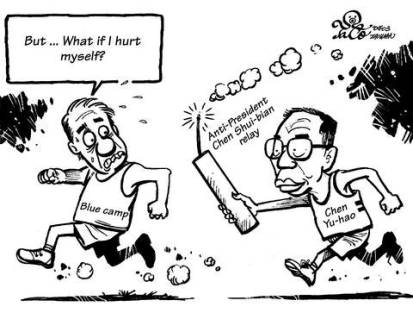
The Democratic Progressive Party (DPP) yesterday accused former Tuntex chairman Chen Yu-hao of being a tool of China to sway the presidential election after it said Chen used a PRC passport to enter the US.
DPP campaign spokesperson Wu Nai-jen said yesterday that Chen entered the US last month on a PRC passport with an E2 visa, which is used for commercial visits and is valid for two years.
"This is hard evidence that Chen is indeed a tool of China to sway the election," Wu said.
Wu said that China has long tried to help nurture a pro-Beijing political power in Taiwan and to achieve that, it has used all possible means to influence the results of Taiwan's presidential elections.
Wu said China failed in 1996 and 2000 to defeat the presidential candidates it disliked through military exercises and intimidating rhetoric. In this year's election, he said, China has used various methods to try to prevent President Chen Shui-bian's re-election.
First, Wu said, China has allowed the pan-blue Taiwanese businesspeople in that country to publicly campaign for the pan-blue presidential ticket. It has also helped with the mobilization of Taiwanese businesspeople to return home to vote for Chinese Nationalist Party (KMT) Chairman Lien Chan.
Second, he said, China has labeled Chen a "separatist" for trying to undermine its "one China" principle by holding a referendum.
Third, he said, it has used such
threatening rhetoric as "the referendum will lead to a war across the
Taiwan Strait" and "China's ballistic missiles are no threat to Taiwan."
Fourth, Wu said, China has tried to
use the reports of the arrests of alleged Taiwanese spies and accusations made
by Chen Yu-hao to attack the president.
-----------------------------------------
On March 18, 2004 ……
Xinhua likens Hong Kong's Martin Lee to Chinese traitor
AFP , BEIJING
China's government mouthpiece yesterday compared Hong Kong's leading democracy campaigner Martin Lee to one of the most notorious traitors in Chinese history.
The invective lodged at Lee indicated Beijing was still fuming over his recent mission to the US to promote democracy in the territory.
The Xinhua news agency said Lee was like Wu Sangui, a Ming Dynasty general who surrendered to the ethnic Manchu minority's armies of the Qing Dynasty, bringing about the demise of the Ming Dynasty which was controlled by the majority Han Chinese.
"What's shameful is Martin Lee relied on foreign forces and willingly became the foreign forces' pawn," said the Xinhua commentary.
"It's not at all excessive that Hong Kong people scolded Martin Lee and his followers as `Wu Sangui' and `traitors' ... He will eventually be cast aside by Hong Kong people," the commentary said.
Wu is considered one of the biggest traitors in Chinese history partly because his surrender was motivated by his desire to rescue his concubine.
The commentary said that by going to the US to testify in a Senate hearing on Hong Kong's political situation, Lee was "degrading himself" by "lying" to foreigners about Hong Kong's situation.
Lee's action "only hampers the development of Hong Kong democracy," the commentary said.
"Hong Kong society will realize that what will make Hong Kong's democratic development not be undertaken smoothly are actually these people who are shouting democratic slogans," it said.
But the under-fire Lee shrugged off the criticism yesterday.
"I didn't lie," he told Hong Kong Cable TV of testimonies he and three other campaigners gave to the US Senate's East Asian and Pacific Affairs sub-committee.
"We told them what the public wants and their concerns about the Chinese government because it rejects Hong Kong people's wishes for democracy," Lee said.
"I went there to give Americans the true picture ... and they [China] are still criticizing me. There is nothing more I can do," he said
-----------------------------------------
On March 19, 2004 ……
Pan-blue hospital chief out of line, say doctors
By Joy Su, STAFF REPORTER
Leading doctors yesterday affirmed the medical profession's traditional support for the pan-green camp, describing a recent pro-blue camp advertisement featuring former National Taiwan University (NTU) Hospital superintendent Yang Ssu-piao as political bribery.
"NTU hospital has always been like a Democratic Progressive Party support community. I'd say the ratio of [President] Chen Shui-bian supporters to [Chinese Nationalist Party Chairman] Lien Chan supporters is about nine to one," said Ko Wen-je, director of the Surgical Intensive Care Unit.
The medical community has traditionally been viewed as a stronghold of the pan-green camp.
However, in the advertisement on the front page of Monday's edition of the Liberty Times, Yang wrote:
"The Republic of China and the People's Republic of China are both a part of China. They are not two separate countries, nor are they two countries on each side of the Taiwan Strait."
Yesterday, around 60 prominent members of the medical community, including Foundation of Medical Professionals Alliance president Wu Shuh-min, former Department of Health (DOH) head Twu Shiing-jer, Cathay General Hospital superintendent Chen Kai-mo and Mackay Memorial Hospital vice superintendent Huang Fu-yuan held a press conference to state that Yang's views did not represent those of the NTU staff nor those of the wider medical community.
"If he paid for the advertisement himself, then I might be able to respect him a little more. However, I suspect that is not the case here," Twu said.
"I love my old teacher, but I love truth more," he said.
Twu also said that he spoke for the views of former DOH head Lee Ming-liang, who was unable to attend.
While Yang's wife told reporters yesterday that he had shelled out a total of NT$200,000 for the advertisement, the Liberty Times advertising department said that the advertisement had been sold for NT$600,000.
"I wrote the open letter that was published in the newspaper because I have been very disappointed with the Chen administration these past four years," Yang said.
"I definitely did not take money from anyone to do this," he said.
He added that if Lien did not perform well in office it would be appropriate to support another candidate in the future.
But Yang's comments did not satisfy one medical professional.
"Yang is the medical community's equivalent of Buddhist Master Wei Chueh," said Chang Gung University's Liao Yun-fan.
"And as such, I trust that his attempts will backfire just as they did for the monk," he said.
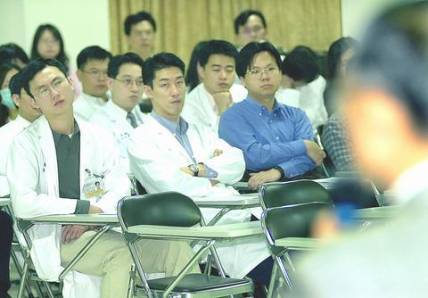
Doctors from National Taiwan University Hospital hold a press conference yesterday to criticize the publication of a pro-blue camp newspaper campaign advertisement by Yang Ssu-piao, a former superintendent of the hospital.
-----------------------------------------
On March 19, 2004 ……
Lien, Soong court international media, blast Chen
By Charles Snyder, STAFF REPORTER
Chinese Nationalist Party (KMT) presidential candidate Lien Chan and his People First Party (PFP) running mate James Soong told a group of foreign journalists yesterday that a key link between the 2000 presidential election and this year's vote is the corruption charges alleged against both incumbents during the two election campaigns.
The KMT-PFP candidates seemed to say they expect history to repeat itself, with DPP President Chen Shui-bian losing just as the KMT lost in 2000, when former president Lee Teng-hui was still the party's chairman.
Lien and Soong returned repeatedly to the corruption theme during a 90-minute press conference with foreign reporters who are in Taiwan to cover the election, and Soong repeatedly blamed Lee for the KMT's 2000 loss.
The pair showed up half-an-hour late to the press meeting because, Soong said, earlier campaign appearances ran late, including a hand-shaking appearance at a local market.
Soong blamed the KMT's 2000 loss on Lee. Comparing then and now, Soong said that "four years ago, the KMT government was replaced for the very reason that the incumbent president was: facing criminal charges for `black gold.' Our incumbent president and the first family are facing huge charges of not only insider trading, but also the first lady has been fined for dishonest reporting of her financial transactions."
"It's ironic that four years ago, Chen Shui-bian accused Lee Teng-hui of being corrupt, and now the current president is facing judicial investigations. On Feb. 28, the incumbent president, as candidate of the DPP party, joined hand-in-hand with the ex-president," he said.
Asked how Lien and Soong expect to coexist if they win, given the fact that both laid sharp charges against the other in their losing 2000 election bids against Chen, Soong said, "When Lien is elected, he is the president. I'm only a spare part."
He said the two would cooperate "for the sake of the country."
On defense issues, the pair denied that their parties had impeded the buildup of defense spending and weapons purchases, especially from the US. Soong accused the DPP of trying to smear the image of the KMT-PFP alliance by saying it is against enhancing defense.
"This is totally untrue," he said.
He said the pan-blues are "very much concerned that the United States continue to honor its commitment to Taiwan's defense."
Soong said that the KMT-PFP alliance is committed to buying Kidd-class destroyers, AEGIS battle management systems and anti-missile equipment.
In April 2001, US President George W. Bush agreed to sell a hefty package of weapons systems to Taiwan, including the Kidds and other weapons with anti-missile capabilities. While Bush refused to sell AEGIS, there have been repeated reports since then that the US has changed its mind.
Soong said Taiwan should consult with
top American leaders on weapons sales, "not just to buy anything that the
seller is trying to offer us. We should put our defense capability in the
context of mutual defense, in the sense that the United States is going to come
to our aid."
"We must put our defense
capability in the context of overall US-Taiwan relations vis-a-vis the
PRC," he said.
-----------------------------------------
On March 18, 2004 ……
China's Taiwan solution: Anschluss
`The Austrians appear to have thought that Austria would retain a considerable degree of separateness and only be absorbed gradually by Nazi Germany. The Austrians, however, turned out to be wrong.'
By Chen Ching-chih
On March 13, 1938, Austrians were preparing to vote on whether Austria should be annexed by Nazi Germany. Unfortunately, they did not get to exercise their fundamental right due to the fact that Adolf Hitler's storm troopers had entered and occupied an independent, sovereign Austria the day before the vote.
Sixty-six years later in Taiwan, there is a national "defensive" referendum scheduled simultaneously with a direct presidential election on Saturday. The referendum issue has, however, become the most debated issue in the nation. Opposing the referendum, the pan-blue alliance of the Chinese Nationalist Party (KMT) and People First Party(PFP) has essentially called for a boycott. Their rationale is that there is no need for a defensive referendum at a time when China's military threat is not imminent.
When will it be the right time for a "defensive" referendum? When Beijing is ready to invade or has already started the military attack as the pan-blue camp has suggested? Will that be way too late? Maybe we can come up with some sort of an answer by reviewing Germany's Anschluss, or annexation, of Austria before World War II.
When Austria was annexed by Nazi Germany in 1938, Austria had been a republic for only 18 years. Like today's Taiwan, where there are people who support unification with or annexation by the People's Republic of China, there were Austrians who were working for Nazi Germany's annexation of Austria. In 1935, an Austrian pro-Nazi gang murdered then-Austrian chancellor Englebert Dollfuss. In spite of the murder, the German-inspired coup attempt failed. At the time Italy was Austria's protector and Dollfuss, who had vowed to keep Austria independent of Germany, was pro-fascist and friendly with Benito Mussolini. When Dollfuss was killed, Italy sent troops to the border as a warning to Hitler to stay out of Austria. The Italian move effectively helped to kill the coup.
Kurt von Schuschnigg became Dollfuss' successor as Austria's chancellor. In February 1938, Hitler was ready to move against Austria. He presented von Schuschnigg with a list of demands, including that Austrian Nazis be left unrestricted and that top Austrian Nazis be included in Austria's government.
Germany would invade Austria if von Schuschnigg failed to act immediately.
Abandoned by Italy, which had became Germany's ally in 1937, and without hope of support from England or France, von Schuschnigg decided to give in to Hitler's demands. But he was still determined to keep Austria separate from Hitler's Germany.
On March 7, he contacted Mussolini, seeking opinion on a plebiscite. Mussolini warned that it would be a mistake to do so.
But von Schuschnigg ignored the warning and on March 9 called a national vote for March 13 to resolve the question of Anschluss once and for all.
On March 12, German troops, accompanied by Hitler himself, entered Austria, which quickly became and remained a German federal state until its liberation by the Allied Forces in 1945.
Hitler naturally would not allow Austrians to decide if they wanted Austria to be part of the Third Reich. It is also understandable that, being Hitler's ally after 1937, Mussolini discouraged Schuschnigg from holding a plebiscite. As for the rest of the major powers, the US had opted for diplomatic isolation after World War I, and Britain had chosen to appease Hitler while France was incapable of unilateral military action. Nazi Germany consequently had its way in the annexation of Austria.
Is history repeating itself in the case of Taiwan? Beijing has made it abundantly clear that China is determined to annex Taiwan. It is opposed to Taiwan's having a referendum of any sort and has strived to pressure the international community to oppose Taiwan's referendum plan. Yielding to China's diplomatic pressure and economic inducements, many countries, including the US, Japan and France, have made it known that they do not support Taiwan's referendum. For their short-term interest, these countries have buckled under Chinese pressure. It is, however, utterly impossible to imagine that Taiwan's pan-blue camp would call for a boycott of a defensive referendum designed to strengthen Taiwan's defenses against China's missile threat.
So, when will it be the right time to call for a defensive referendum in Taiwan if not when Beijing already has nearly 500 missiles targeting the nation? The planning of Saturday's referendum in Taiwan has taken close to three months, if not more. Is it possible for Taiwan to have a defensive referendum when Beijing is ready to invade Taiwan? History has shown that it was far too late for Austria to have a national plebiscite as Hitler massed troops along the Austrian border to march on Vienna.
On April 10, 1938, in order to establish his legitimacy over Austria, Hitler held his own plebiscite, and 99.7 percent of Austrians who voted were allegedly in favor of the Anschluss. It was of course an outcome secured under coercion. In addition, the majority of Austrians most likely believed that ties with Germany might promise economic revitalization for an economically depressed Austria. The Austrians appear to have thought that Austria would retain a considerable degree of separateness and only be absorbed gradually by Nazi Germany. The Austrians, however, turned out to be wrong, just as the people of Hong Kong are now realizing that they do not have much say as to how much autonomy and democracy Hong Kong will be allowed to have under Beijing's so-called "one country, two systems" framework.
On Feb. 28 over 2 million Taiwanese, or one in 10 people in Taiwan, participated in the historic Hand-in-Hand Rally to show their support for Taiwan and peace. That spectacular rally has made the world aware of the Taiwanese people's determination not to be part of the PRC. They must have their ultimate right of officially expressing their decision as to what kind of relations Taiwan is to have with China. If the time should come that a peaceful unification with or annexation by the PRC, for instance, is to be decided, the people of Taiwan should be the ones to have the final say. This, after all, is the 21st century, the century of human rights and popular democracy.
People of the democratic world ought to support the right of the Taiwanese to have a defensive referendum. However, it is sad to learn that today's Germany, under Beijing's pressure, has been urging Taiwan to forget about the referendum. Have the German leaders forgot that it was Germany that denied Austrians the right to a plebiscite and forcefully annexed Austria in 1938?
Saturday's referendum will establish that fundamental right of the people and a precedent. Even under Beijing's threat, freedom-loving Taiwanese have no reason not to participate in the referendum vote. As for the political leaders who have called for voters to boycott the referendum, they are either ignorant of historical facts or willfully irresponsible.
Chen Ching-chih is professor emeritus of history at Southern Illinois University at Edwardsville and a research fellow with the Los Angeles-based Institute for Taiwanese Studies.
-----------------------------------------
On March 18, 2004 ……
Fickle love, lack of vision
Lee Long-hwa, United States
In a dramatic gesture on March 13, Chinese Nationalist Party (KMT) Chairman Lien Chen and People First Party Chairman James Soong lay prostrate on the ground, kissing it. They said this showed they truly love Taiwan. If it did, it is fickle love at best. It is more likely the gesture was a symbolic move intended to show China they know exactly how to work with it to achieve peace -- capitulate on all fronts, so long as the KMT remains the only party in power in Taiwan (except of course the Communist Party).
The KMT does not long for democracy, nor for freedom for the people. It believes it knows best for everyone, and to be certain, it knows how to line its pockets. It does not yearn for Taiwan to be free, it yearns to be in power.
The fickle love for Taiwan that Lien and Soong have is the love one has for something one can control completely.
[Lien and Soong, your love for Taiwan] is the love for your business that brings so much money to you. It is the love for a game that you always win. It is the love for an idea that is yours alone, a possession that only you have, a one-of-a-kind bauble that is in your vault. It is the love for an adherent that puts you on a pedestal, exalting you above all else. It is love for the feeling of unbridled power.
It is not the love of the idea of freedom and democracy. It is not the love of an independent nation, an economic power among nations, a nation of freedom among nations, a nation of free Taiwanese people. It is not a love for a nation of equality and vision, of spirit and vitality, a symbol of liberty for all in the world to marvel at.
Their vision is a submissive Taiwan, a part of a greater China, in some less-than-sovereign form, a servant of China. They see themselves as the rulers of a special administrative region of the world's most populous nation (despite the awful experience of Hong Kong, which has a contract for democracy that Beijing has already torn up). They somehow believe this is better than a free Taiwan.
Lien has no vision. His vision for Taiwan, as he has stated, is to leave the vision for other generations. His platform is actually to have no platform. His approach to Taiwan's position in the world is to have no position. How pathetic. How truly pathetic.
How can anyone in Taiwan, other than die-hard KMT supporters who would themselves benefit from the return of "black-gold" politics -- those who would subjugate the true Taiwanese people -- vote for a man who has proclaimed that he deliberately has no vision for the future of Taiwan?
His only vision is money, at any cost. He promises oodles and oodles of money -- hmmm ... wonder what he intends to sell? Taiwan, maybe?
-----------------------------------------
On March 19, 2004 ……
-----------------------------------------
On March 18, 2004 ……
Municipalities ordered to follow referendum policy
"At this historic moment,
however, we see some people are opposed to the referendum simply because they
are opposed to the DPP administration." --- Premier Yu
Shyi-kun
UNCOOPERATIVE: The Cabinet threatened village and township officials with jail terms of up to five years if they refuse to distribute referendum notices to households
By Ko Shu-ling, STAFF REPORTER
The Cabinet yesterday called on township and village offices to hand out referendum notices to families or face punishment.
Township and village offices must hand out referendum notices to eligible voters two days before a national referendum is mounted according to the Referendum Law. With the referendum due to be held on Saturday, the deadline falls on today. Those failing or refusing to do so are subject to a jail term of up to five years, according to the penal code.
Cabinet Spokesman Lin Chia-lung told a press conference held after the weekly Cabinet meeting yesterday morning that the Cabinet took media reports that some townships and villages were refusing or failing to hand out referendum notices seriously.
They include Hsinchu County, Miaoli County, Taichung County, Taichung City and Yunlin County, all governed by the pan-blue alliance.
Lin said that that they had also received several phone calls complaining that people had either been intimidated or asked not to vote in the referendum or told that they'd be fined or thrown into jail if they erroneously cast the referendum ballots in the ballot box for president and vice president.
Voters who had not yet received the referendum notice were welcome to report the situation to the Central Election Commission by calling 02-2356-5458, Lin said.
Vice Premier Lin Hsin-i, who filled in for Premier Yu Shyi-kun at yesterday's Cabinet meeting, instructed the election commission to oversee local commission chapters to ensure township and village authorities fully cooperated and mete out punishment if necessary.
Responding to a TV station's plan to conduct the first nationwide exit poll for Saturday's election, Lin said that the Cabinet hoped the station would change its mind.
"We fear that such behavior might disturb the voting process and the result might cause controversy if not handled properly," he said. "We're also concerned about its accuracy and possible extreme responses the two competing camps might have if the result of the exit poll runs at odds with that made available by the CEC." However, since no existing laws bans exit polls, Lin said that the government could only hope the station would drop the idea.
The cable news channel has planned to show the results of a poll of at least 16,500 people at 4:01pm on Saturday, one minute after polling stations close. The station said, however, that it might withhold the results if they appeared inaccurate.
In related news, the premier's office yesterday issued a press release calling on the public to vote in the first national referendum, which is scheduled to be held alongside the presidential poll.
Yu said that the nation's democratic development would make a giant leap forward on Saturday as the people became the nation's genuine lord and master by exercising direct democracy.
"At this historic moment, however, we see some people are opposed to the referendum simply because they are opposed to the DPP administration," he said. "It not only gives China an opportunity to ridicule us, but also makes the international community doubt our resolve in pursuing democracy and fighting against China's hegemony."
If the referendum succeeds, Yu said that China would know more clearly about Taiwanese people's will and realize that a military buildup would not help cross-strait development nor correspond to people's interests.
"We hope everyone cherishes this golden opportunity and see politicians put aside their selfishness to march forward with us as well as the people," he said.
-----------------------------------------
On March 18, 2004 ……
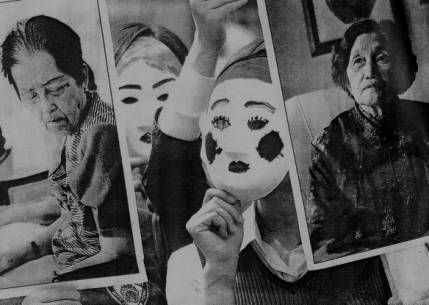
Women's solidarity
Some of Taiwan's ``comfort women'' -- who were forced by Japanese troops to provide sexual services during World War II -- and representatives from the Taipei Women's Rescue Foundation wave photos of dead comfort women during a protest in front of Japan's representative office in Taipei, the Interchange Association, yesterday. The activity was held to show their support for South Korea's comfort women, who were holding their 600th protest yesterday.
-----------------------------------------
On March 18, 2004 ……
Lee wants Soong's seized funds given to the public
EMBEZZLEMENT: The former president wants the NT$248 million related to the Chung Hsing Bills Finance scandal released by the courts and returned to the people
By Chang Yun-ping and Jimmy Chuang, STAFF REPORTERS
Former president Lee Teng-hui sought yesterday to remind voters of People First Party (PFP) Chairman James Soong's role in the Chung Hsing Bills Finance scandal.
Lee asked his lawyer to file an application with the Taipei District Court's Civil Department to hand over to him the NT$248,380,089 in Soong's bank account that the court had frozen as evidence in the scandal.
"The former president said the money belongs to the people so it should be returned to the people," lawyer Chuang Po-lin said.
"The money was entitled to the Chinese Nationalist Party [KMT] chairman. Since Lee is not the chairman, he asked me to file the application for him," Chuang said.
According to Chuang, the money was deposited by Soong and was frozen by the court as evidence for the case in 2000.
Chuang said the case was about Soong's stealing money from the KMT.
"Since Lee is no longer the chairman of the KMT, he hoped that the court will make this amount of money payable to him so he can carry out what he was planning to do," Chuang said.
Taiwan Solidarity Union (TSU) Legislator Lo Chih-ming, a close aide of Lee's, said the former president would try to return the money to the people.
"Since money came from the public, the former president would return the money to the people as part of the drive to return the KMT's [stolen] assets to the people," Lo told the Taipei Times.
"It highlights the fact that James Soong embezzled the KMT's money," he said.
"Lee said he never authorized Soong to keep the illicit money as Soong had claimed. Soong, then secretary-general of the KMT, was the highest authority responsible for the party's finances, including all sorts of fundraising, which wouldn't have gone through the chairman," Lo said.
Lo said that of the NT$248 million, NT$100 million was donated by former Tuntex chairman Chen Yu-hao, while NT$80 million was donated by Liang Po-hsun, a fugitive accused of embezzling from the Overseas Chinese Bank.
Chen Yu-hao's targeting of President Chen Shui-bian since being listed as one of the nation's 10 most wanted fugitives, Lo said, raises questions about whether he had made some kind of deal with Soong when he made the donation.
-----------------------------------------