20040319
=======
Taiwanized democracy on March 19, 2004 ……
Politicians answer to Taiwanized democracy
By Lo Chih-cheng
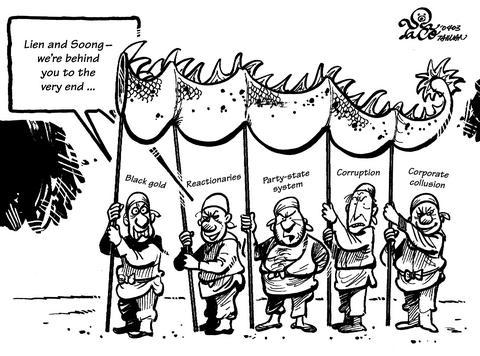
Regardless of its impact on the presidential election, the dramatic gesture of kneeling down and kissing the ground, displayed by Chinese Nationalist Party (KMT) Chairman Lien Chan and People First Party Chairman James Soong during their March 13 nationwide campaign rally, will surely have important implications for the future of the nation's politics and cross-strait relations.
It also clearly reflects how in due course democratization in this country has effectively come to be "Taiwanization." In other words, our politicians are compelled to show to the people that they see this country as their homeland and understand that they should be loyal to it.
This dramatic gesture by Lien and Soong was by no means an emotional and instantaneous response to the unexpected number of pan-blue supporters who participated in the rally.
On the contrary, it was a well-calculated act designed by the pan-blue campaign strategists.
Some leaders in the pan-blue headquarters went so far as to proudly admit that to make the event more surprising and dramatic, the candidates themselves were not informed until the last moment that they would be prostrating themselves and kissing the ground. So in that case, what exactly is this calculation trying to achieve?
To start with, ever since the beginning of the presidential campaign, the pan-blue candidates have met with much criticism over their lack of loyalty to Taiwan. Voters have their doubts about the pan-blue camp's loyalty to this country, mainly because of its upholding of the unificationist agenda.
Moreover, many surveys have indicated that more people believe that President Chen Shui-bian is able to guard and protect the country's interests than believe Lien has this capability. In addition to this, almost all the polls have shown that more and more people identify themselves as Taiwanese, while fewer and fewer people see themselves as Chinese. In other words, arguing for "reunification with China" at this point would appear suicidal for politicians hoping to be elected.
Add to this the unexpected success of the 228 Hand-in-Hand Rally, which sent a strong signal to the pan-blue team, and one begins to get a clearer picture. At this historic rally, over 2 million people formed a human chain across the nation to protest China's threats. Not only did the rally demonstrate the mobilization skills of the pan-green team, but the theme of the rally, "Say yes to Taiwan, say no to China!" was highly appealing to many of the non-traditional pan-green supporters.
Quite suddenly, the pan-blue camp seemingly discovered an ironclad fact: While there are still a few people who regard China as their motherland, there are more and more people in Taiwan who see this nation as their one and only homeland.
This also explains why, right after the pan-blue camp's March 13 rally, Lien made the following announcement: "The Republic of China is a sovereign state, which we cannot and will not allow to be swallowed, merged or united with the People's Republic of China."
Soong echoed Lien by saying to the crowd, "Taiwan should not bow to the pressure of the Chinese mainland."
There was also similar talk in Lien's campaign pledges, to the effect that during his term there would be no unification of the two sides of the Taiwan Strait.
Apparently, like it or not, "our group versus their group" and "Taiwan versus China" have gradually become mainstream opinion. And it is this mainstream trend that spells out the pan-blue camp's calculation: The candidates simply have to demonstrate that they love this land and they are answering the calls of the people.
In fact, there is another angle to this turn of events.
Many analysts tend to see the dynamics of Taiwanese politics from a "top-down" perspective. That is, politicians mobilize voters to support their vision and their agendas. However, the 228 Hand-in-Hand Rally and Lien and Soong's theatrical gesturing instead suggest that we may need to take a "bottom-up" view of the politics of this country.
Simply put, it is not so much about how politicians manipulate the people but rather how people might and should dictate to the politicians.
Democracy has pressured politicians into responding without ambiguity and into putting forth their vision for this country, particularly with respect to its current status and its future.
After decades of separation of the two sides of the Taiwan Strait, and due in large part to the democratization of Taiwan, this country has developed its own ethnically and politically unique identity. Thus, "one China" has become a myth for the Taiwanese and the "one country, two systems" model simply has no market here.
If the above characterization of recent developments in this country is correct, the message that is being sent across the Taiwan Strait is surely very profound. Leaders in Beijing have repeatedly said that they want to listen to the hearts and minds of the people in Taiwan. But the sad fact for China to face is this: It is slowly but surely losing the hearts and minds of the Taiwanese people.
China's continuing military intimidation and diplomatic isolation can never succeed in winning Taiwan back.
As is becoming more evident, these hawkish positions and heavy-handed policies will only dishearten the people here and drive Taiwan further away.
More importantly, since democratization has resulted in Taiwanization, it naturally follows that any sound Taiwan policy developed by Beijing has to accommodate this fact.
Finally, it is worthwhile to conclude with this question:
Will the US and the international community be prepared to accommodate not only a democratizing Taiwan but also a Taiwanizing democracy?
Lo Chih-cheng is the executive director of the Institute for National
Policy Research.
-----------------------------------------
On March 19, 2004 ……
Election fever
With campaign activities at their climax, people young and old have been flocking to political rallies, donning some unusual attire and showing their commitment to their favored candidates. Beyond the muckraking that has come to dominate the run-up to the election, campaign rallies reveal a festive spirit, a passion for politics and a love of democracy.
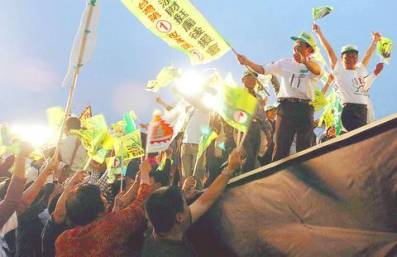
Crowds cheer at a Democratic Progressive Party evening rally in
Kaohsiung.
-----------------------------------------
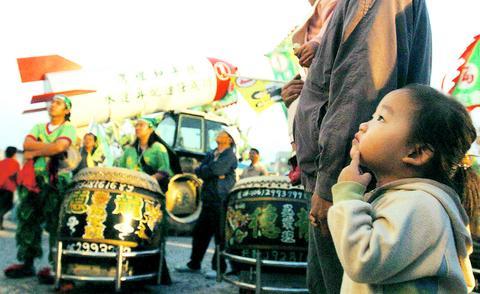
A girl looks at a model of the ballistic missiles China has aimed at Taiwan, during a Democratic Progressive Party campaign rally in Tainan yesterday.
-----------------------------------------
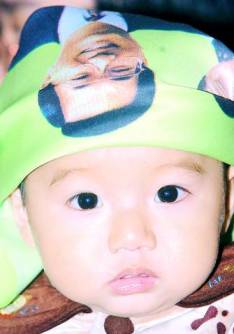
A baby wearing a headband featuring President Chen Shui-bian attends a Democratic Progressive Party rally in Tainan last night.
-----------------------------------------

A man blows a horn to show support for the presidential ticket of Chinese Nationalist Party Chairman Lien Chan and People First Party Chairman James Soong, during a campaign rally in Tucheng.
-----------------------------------------
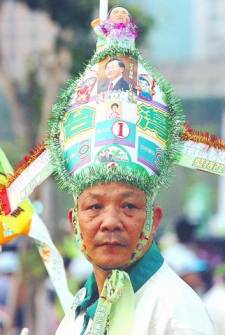
A man wears a hat to show his support for President Chen Shui-bian
during a Democratic Progressive Party campaign rally in Kaohsiung.
-----------------------------------------
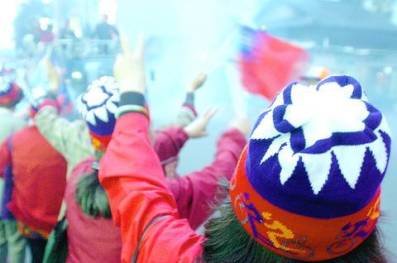
Supporters wearing hats designed to look like the national flag wave to Chinese Nationalist Party Chairman Lien Chan - the blue camp's presidential candidate - during a visit by Lien to Changhua County.
-----------------------------------------
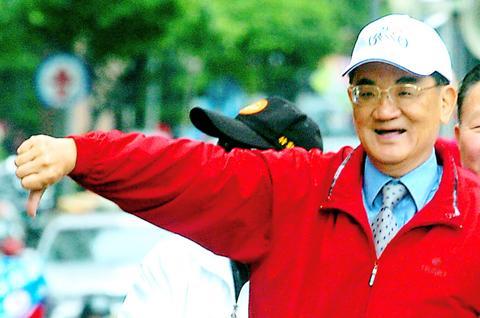
The pan-blue camp's presidential candidate, Chinese Nationalist Party Chairman Lien Chan, gives the thumbs-down sign during a visit to Taipei County, urging voters not to support his opponent, President Chen Shui-bian.
-----------------------------------------
On March 19, 2004 ……
DPP confident of election victory
OPTIMISTIC: The director of the DPP's
Public Opinion Survey Center, Chen Chun-lin, yesterday predicted that President
Chen Shui-bian will win by about 160,000 votes.
By Chang Yun-ping, STAFF REPORTER
The Democratic Progressive Party (DPP) yesterday said that President Chen Shui-bian will win the presidential election by about 160,000 votes against the opposition pan-blue presidential ticket featuring Lien Chan and James Soong.
Optimistic about the election, the
director of the DPP's Public Opinion Survey Center, Chen Chun-lin, yesterday
estimated the DPP's Chen-Annette Lu presidential ticket will win a total of
50.6 percent of the votes against 49.4 percent of the blue camp's Lien-Soong
ticket.
"The DPP is expected to beat the
Chinese Nationalist Party (KMT) and People First Party (PFP) alliance by
167,707 ballots, a 1.2 percent vote difference," Chen said yesterday.
Chen estimated there would be an 80 percent voter turnout from among the nation's total of 16,504,179 eligible voters.
In the major six electoral districts around the nation, Chen said that the DPP would lose in northern Taiwan's Taipei City and Taipei County by 291,187 votes, as well as in the Taoyuan, Hsinchu and Miaoli areas by some 270,035 votes.
In central Taiwan's Taichung, Changhua and Nantou areas, the DPP is drawn in a tight match with the KMT and is estimated to lose by some 4,408 votes.
However, in the DPP's stronghold in southern Taiwan, the party will win with an estimate of 467,722 votes over the pan-blue alliance in Yunlin, Chiayi and Tainan counties and by another 371,925 votes in the Kaohsiung and Pingtung areas.
As for eastern Taiwan's Ilan, Hualien and Taitung counties and the offshore islands, the DPP predicted that it would lose by about 106,309 votes against the blue alliance.
Regarding public support for the referendum, DPP campaign executive director Chiou I-jen yesterday said that, according to an internal poll conducted by the party, some 55 percent of the public said they will pick up their referendum ballots. The poll by the Cabinet's Research, Development and Evaluation Commission said 59.1 percent of the public will vote in the referendum.
Chiou yesterday also disclosed that the KMT has tried to bribe voters in southern Taiwan by purchasing identification cards -- required personal IDs to cast votes, and promised free tours to voters on election day.
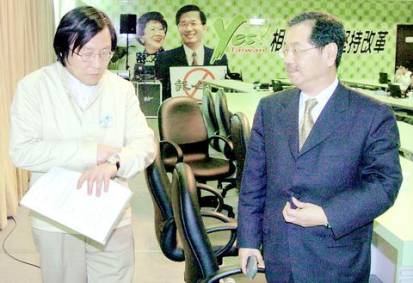
The Democratic Progressive Party's campaign executive director Chiou Yi-jen, left, and campaign spokesman Wu Nai-jen, right, exchange words as they leave a press conference yesterday.
-----------------------------------------
On March 19, 2004 ……
Referendum guru speaks on tomorrow's ballot initiatives
"It should be a basic thing that people should be free to vote as they want without somebody seeing what they are doing." --- Bruno Kaufmann, president of the Initiative and Referendum Institute Europe
EXPERT: Bruno Kaufmann of the
Initiative and Referendum Institute Europe has advised the government over the
last year on referendums. This week he's in town for the voting and he sat down
to talk about the referendum with the `Taipei Times'.
By Melody Chen, STAFF REPORTER
Taipei Times: Can Taiwan's referendum
be a way toward independence? If Taiwan has a referendum on independence, will
it cause big trouble in the region?
Bruno Kaufmann: The international community, especially countries like France, the US and Germany, is so concerned about stability in the region due to conflicts in North Korea that they see Taiwan as a disturbance.
Taiwan is a disturbance to their strategy to develop long-term business and political connections to China.
They don't understand anything about what's really going on here. Or they don't want to understand it because they are under such big pressure from Beijing.
The situation now is that Taiwan is not free to [have a referendum on independence].
Its external security is based on international politics and on bilateral agreements with other countries, such as the US. It would be more sensible to develop the referendum to deal with other issues, not just with the independence problem.
TT: US officials questioned Taiwan's
referendum plan and said they did not see a need for the vote. Does the
Taiwanese government need to ask its people whether it should strengthen
anti-missile defense and whether it should establish a "peace and
stability framework" with China?
Kaufmann: If you already have high consensus [on an issue], you don't need a referendum. If there are issues that really have to be discussed, you need more clearness -- then it is good to have a referendum.
I can see the US government's position. They see the vote as an unnecessary thing because they think, "What can the referendum change?"
But the important thing is that these issues [be discussed] by the people. The question is: Is the referendum really leading to a big discussion and a big debate?
There is a big risk that these issues are not really being discussed and that the referendum is seen more as the political parties and political leaders' play.
[This sort of referendum] does not really give the people a big say.
Still, I would say it is better to use the tool now than not to use it, because if you never use it, you cannot learn to make it better next time.
Low turnout for the referendum could be seen by China [as evidence] that the Taiwanese people are not so concerned about these issues.
That may be the biggest risk.
TT: The opposition Chinese
Nationalist Party (KMT) and People First Party called for voters to boycott the
referendum, accusing the ruling Democratic Progressive Party (DPP) of
manipulating the vote to boost President Chen Shui-bian's chances in the
election. Could the opposition parties cause a setback in Taiwan's
democratization? Do you find anything improper in the DPP's calling the
referendum?
Kaufmann: First, opposition lawmakers [partly] decided on the Referendum Law.
This Referendum Law is far from a good law.
It does not really give citizens a lot to decide [or choice about what] to introduce. It is more a law that gives the government and the parliament [ways] to play with the referendum instrument.
The government is now using the Referendum Law in its way. There are two main [motivations] for using it. One is that the DPP is always in favor of having referendums [on the China issue]. They want to use the opportunity. This is understandable, because you never know what will happen after the election. Maybe the referendum will not be possible anymore.
The other thing is the vote is linked to the election. They use it in a way that it has an additional [implication] for the election. This is not very good.
We, from our institute, normally do not recommend putting a referendum and an election together, because then you mix up issues and personal questions.
That's a problem. But I would say it is not right for the opposition parties to say the referendum is illegal, because they have made the law and the president is using the law.
The opposition did not put the referendum to judicial testing when it was proposed. It is not credible to say now the referendum is illegitimate and illegal.
The problem of the government's using the referendum is the timing. There's far too little time to really conduct the referendum in a good way.
The electoral committee is still discussing things about how to conduct the referendum, and it is only three days ahead of the vote. That's not a very good conduct of the referendum. That will not help [provide] a good experience of the referendum.
On the other [hand], I would say [tomorrow's] referendum is not really free. When you see how the layout of local election and referendum places will be, people will have to vote for the president first and then the referendum.
Everybody will see who is not going. People may feel controlled by some local politicians who know them. It is not real secrecy in the vote. It should be a basic thing that people should be free to vote as they want without somebody seeing what they are doing.
TT: What is the significance of
Taiwan's referendum in the course of Asian countries' democratization?
Kaufmann: By understanding that referendums and initiatives play a role in democracy, Taiwan has a very a mature democracy. But I think the referendum will be seen as a very difficult first experience. It is quite normal that [the first experience] is like that.
Looking back at the referendum, such things have to be assessed: Was it rushed? Was it really done in a sufficient way?
In political reality, the parties are much less interested in having the citizens in power.
There is a lot of rhetoric [about doing so]. But in practical everyday politics, it is much harder to really give the people the right. I really hope the parties here and the future president will be ready to do the referendum better and develop the tool, rather than saying they are just testing it.

-----------------------------------------
On March 19, 2004 ……
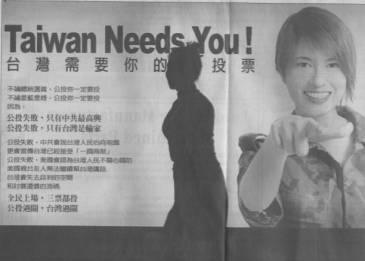
TAKE A STAND
A woman walks past a government and asking people to vote in the referendum. The referendum, this country’s first, will ask whether Taiwan should boost its defenses by buying more anti-missile armaments. It will also ask if Taiwan and China should open government-to-government talks. President Chen Shui-bian and the government want people to vote in the referendum and to say “Yes.”
-----------------------------------------
On March 19, 2004 ……
Commentators back referendum: China made referendum an international
problem
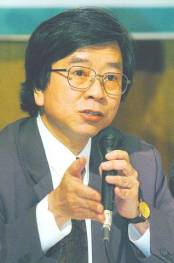
"The Taiwan issue used to be a
domestic issue, but now China is going door-to-door." --- Michael
Hsiao, policy advisor to President Chen Shui-bian
Four years ago, journalists and academics from around the world came to observe a presidential election in a budding democratic nation. Now, four years after the nation's first transfer of power, the dynamism of Taiwan's democracy has been enhanced by the holding of the nation's first referendum. The 'Taipei Times,' along with Taiwan Heart, the Taiwan Foundation for Democracy, and the Institute for National Development, yesterday hosted the symposium ``Implications of the presidential election and referendum for Taiwan's democracy'' to provide foreign political observers and media representatives with an opportunity to analyze these crucial steps in Taiwan's political history.
By Joy Su, STAFF REPORTER
China is no longer treating
tomorrow's referendum as an internal matter but as an international one,
according to political experts speaking on the impact of tomorrow's elections
and referendum on cross-strait affairs.
"For so many years, Beijing's
attitude was [the referendum] is an internal affair, or they would say [it] was
an internal matter with international implications. But now, they're going
around asking everyone to interfere in their internal affairs," said
Thomas Gold, an associate professor of sociology at the University of
California at Berkeley.
Michael Hsiao, a policy advisor to President Chen Shui-bian, said that China had facilitated the internationalization of the referendum and cross-strait issues.
"The Taiwan issue used to be a domestic issue, but now China is going door-to-door. China is going to the European Union, Japan, Southeast Asia, saying Taiwan is upsetting the status quo. Thus, China has helped to internationalize this issue, and it will not be international for just one month. The issue is now international in [its own] context," Hsiao said.
However, international pressure, especially from the US and China, had also been a factor in shaping the final wording of the referendum questions.
"They've really watered down the language [of the questions] ... The struggle over that language is a way of trying to present a more acceptable policy to the people of Taiwan and to the outside world. They want a policy which is more acceptable but also encapsulates what they want to get across -- that Taiwan is independent," Gold said.
"Taiwan is limit-testing. They are testing limits and seeing what they can get away with," Gold said.
However, John Clark, director of the Center for Central European and Eurasian Studies at the Hudson Institute, pointed out that the process of the referendum itself, whatever the result, was China's primary concern.
"From the point of view of
China, the small aspects of democracy are not as important. It is the very idea
of a referendum that they are opposed to," Clark said.
Clark also expressed doubts that the
results of tomorrow's election could lead to pressure from China similar to
that exerted before the 1996 poll.
As to the impact of a pan-blue win in the election, experts highlighted the restrictions that Chinese Nationalist Party (KMT) Chairman Lien Chan and People First Party Chairman James Soong would face as democratically elected leaders.
"Beijing is mistaken in assuming that if the pan-blue camp wins then that is going to open the door to a resolution of cross-strait relations. Taiwan is a democracy and no leader of Taiwan can unilaterally just decide on behalf of the people here what Taiwan's relations are going to be with the mainland, [not on] such a serious issue as that," Gold said.
"In order to be elected here you have to walk a delicate balance, proving you're bona fide, that you're legitimate, that you qualify to speak on behalf of the people here. You have to show that you have roots," Gold said.
Hsiao also argued that the referendum would facilitate negotiations with China, giving clarity to Taiwan's stance on the issue.
"The DPP [Democratic Progressive Party] is very clear on the cross-strait issue. China is very clear too. But Lien and Soong don't want to show their stance," Hsiao said.
"If China is banking on Lien and Soong for a milestone in cross-strait negotiations, I'd say it's a myth," Hsiao said.
However, whether the referendum would lend legitimacy to Taiwan's leaders in cross-strait affairs depended on whether it received the required response.
"I think if the referendum is invalid, the DPP will have to give it a political cast rather than say independence is no longer legitimate. They'll have to say that the pan-blue camp subverted the issue," Clark said.
Gold said that even an invalid referendum result would not be the end of the matter from the point of view of the pan-green camp.
"Even if the referendum is
invalid, if the majority votes in favor of the referendum, [Chen] can say
`there has been a certain amount of confusion, but among the people who did
vote, there is strong support for our policies,'" Gold said.
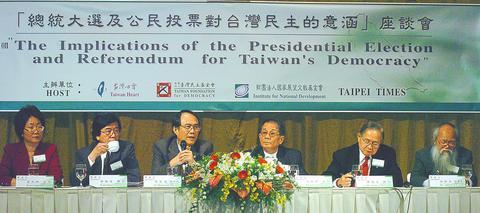
Speakers at the conference held at the Taipei Westin Hotel yesterday.
-----------------------------------------
On March 19, 2004 ……
Commentators back referendum: Referendum: a precious, if unusual, human right
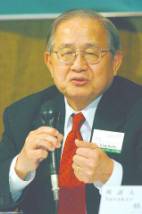
"Through the referendum vote,
the Taiwanese people are seeking freedom from fear, which is a human right
taken for granted by people all across the globe." Chen Lung-chu,
policy advisor to President Chen Shui-bian
By Caroline Hong, STAFF REPORTER
The referendum is an opportunity for the Taiwanese people to exercise their basic human right of self-government, said presidential advisor Chen Lung-chu yesterday.
"The referendum is a part of plebiscite law and a form of direct democracy," Chen said at yesterday's symposium.
"The UN charter itself emphasizes the right to self-determination and that the right to rule comes from the people," he said.
"Through the referendum vote, the Taiwanese people are seeking freedom from fear, which is a human right taken for granted by people all across the globe", said Chen, who is also the president of the New Century Institute.
He added that the Chinese Nationalist Party's (KMT) opposition to the referendum was an attempt to curtail human rights. Chen expressed concern for the future should the pro-blue camp win the election.
The reaction of international representatives to Chen's position was mixed. On Chen's remarks about the referendum being a natural exercise of human rights, Eric Hyer, an associate professor at Brigham Young University in Utah, noted that while in theory a people should have the right to referendum and self-determination, in practice this was not often the case.
"Just take the example of the South during the Civil War in the United States. The Union didn't acknowledge the South's wish to separate in that case," said Hyer.
"However, I think that most people in the US would support the Taiwanese right to the referendum and independence. The executive, on the other hand, has to consider international implications," he said.
On KMT opposition to the referendum, Bruno Kaufmann, president of the Initiative and Referendum Institute Europe, agreed with Chen that KMT actions could be seen as a curtailment of human rights. "Their motivation is clear," said Kaufmann.
Kaufmann said the format of the referendum would invade the right to privacy of the voters.
"With the current agreement where voters need to line up separately to vote in the referendum, voters will be forced to reveal whether they support the referendum or not to others at the voting stations. This is a procedural problem that needs to be addressed," he said.
When asked what would happen should the referendum fail, Kaufmann said: "If the referendum fails and the KMT wins the election, then we can expect that future moves for referendums will be hindered," he said.
-----------------------------------------
On March 19, 2004 ……
Commentators back referendum: Referendum a credible move in world's eyes
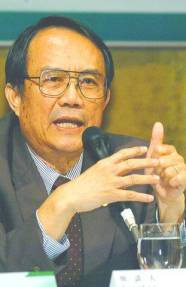
"We are designing a system to
prevent the change of status quo and defend the status quo." ---
Michael Ying-mao Kau, vice minister of Foreign Affairs
By Stephanie Wen, STAFF REPORTER
China's attempts to turn world opinion against Taiwan met with some success, but President Chen Shui-bian's administration countered this by explaining that the referendum was about securing the status quo, a senior government official said.
Vice Minister of Foreign Affairs Michael Ying-mao Kau, also the president of the Taiwan Foundation for Democracy, re-stated the government's position that tomorrow's referendum is a "peace" referendum.
"Leaders of the world toned down [their criticisms] after we had the opportunity to explain about our referendum, that in fact our design is not as sinister as they suggested," he said.
"We are not aiming at changing the status quo with the March 20 referendum. We are designing a system to prevent the change of status quo and defend the status quo," he said.
Jaw-Liang Joann Chang, a research fellow at the Academia Sinica's Institute of European and American Studies, said that the referendum was a critical opportunity for Taiwan to make its voice heard worldwide, and an opportunity for China to hear the voice of the Taiwanese people.
"In the last few days, international media such as the Wall Street Journal have published articles saying that it doesn't matter if Chen is elected or if the referendum is [successful], Chen's legacy will continue," she said.
"This is this context that we hope the US administration will be able to look at. There are several very positive motivations for the referendum," Chang said.
Rather than seeing the referendum as a means to deter China from using force, it should be seen as motivated by a wish to encourage China to use peaceful means in dealing with cross-strait issues.
Chang said that if China hadn't persisted with its military threats, there would have been no need or opportunity for Chen to make use of Article 17 invoking the referendum.
A second motive for the referendum was to strengthen the nation's very weak bargaining position in negotiating with China, Chang said.
"Security is like oxygen: you don't notice it until it's gone. But we can't wait till our oxygen is gone. People power lies in our peaceful means of voting," she said.
Chang said she hoped this message would spread throughout the international community.
"Of course I cannot exclude the motives of the election. But electioneering is a common motive around the democratic world," she said.
Foreign observers agreed.
"Democratic politics includes
referendums," said Steven Baker, president of the Monterey Institute of
International Studies in California.
"[The referendum] is seen as electioneering. It is seen fairly as electioneering and that is a typical thing," he said.
Baker, whose state of California has just held a referendum to recall its governor, said that Taiwan's referendum should be seen as an affirmation of national identity.
"But it is an affirmation of national identity that favors a particular political party. The referendum we just had in California favored a particular political party.
"And the people will decide on the issue depending on their preference with the political parties. And that is a normal thing," he said.
-----------------------------------------
On March 19, 2004 ……
Unification can only follow democratization
`For its part, Taiwan needs to calm down. Its leaders must understand that ... [it] is a small, vulnerable island, and China an emerging superpower.'
Taiwan may have the right to pursue
independence, but regional peace and democratization of China are far more
important and worthy outcomes.
By Orville Schell
Why is Taiwan's relationship with China so intractable an issue? Why, when they share common economic interests -- 1 million Taiwanese live in China, working in some 50,000 firms in which Taiwanese have invested over US$400 billion -- does China aim 500 short-range missiles at Taiwan?
The run-up to the presidential election tomorrow is one current source of tension. President Chen Shui-bian has initiated a referendum process that might someday be used to ask Taiwanese if they want to formalize today's de facto independence. This infuriates China.
After all, as Mao Zedong told Edgar Snow in 1936, "It is the immediate task of China to regain all our lost territories," explicitly including "Formosa." Since then, China has sought to make good on Mao's pledge.
China's new leadership often evinces a new judiciousness and moderation in its diplomacy. But Luo Yuan, a senior colonel at the Chinese Academy of Military Sciences, recently declared that if Taiwan's leaders "refuse to come to their senses and continue to use referendums as an excuse to seek independence, they will push [their] compatriots into the abyss of war."
In an age when national self-determination is a hallowed principle, how is it possible that Taiwan -- which has been part of China during only four of the last eleven decades, and has never been under the control of the PRC -- is shunned by every nation when it deigns to wonder aloud why it should not be allowed to go its own way?
The reasons have deep historical roots. When Mao and the Chinese Communists came to power in 1949, they promised "reunification of the Motherland," which included bringing Xinjiang (the Muslim desert regions of the West), Tibet, Mongolia, Hong Kong, Macau and Taiwan back under central government control. It became a matter of national pride for a country that had been guafen (瓜分), or "cut up like a melon," by predatory colonial powers, to end national feelings of humiliation by restoring itself to wholeness. Communist propaganda relentlessly proselytized for reunification as a "sacred" duty.
As Tibet, Hong Kong, and Macau returned "to the embrace
of the Motherland," Mao's commitment seemed close to realization. The fact that only Taiwan stands in the way makes unification all the more non-negotiable.
But, there is another dynamic at work. Over the last two decades, almost every other plank of the Communist Party's platform -- world-wide people's war, proletarian struggle leading to a classless utopia, a triumph over global capitalism, etc. -- has been abandoned. This leaves unification as the last tie to Mao's revolution and justification for one-party rule. China's leadership plays up this "revolutionary" commitment, for it helps generate nationalist sentiment, one of the few things -- besides strong economic performance -- that legitimizes the Communist monopoly on power.
China's leaders ought to reflect on the fact that their country is no longer the "sick man of Asia." It is increasingly powerful, globally proactive and economically robust. So it is a timely moment to reappraise its position and to begin acting from strength, not weakness. In short, it is time for China's leaders to change the chemistry of their long feud with Taiwan.
After all, China and Taiwan have struggled politically even as their economies become increasingly unified. In due course, they may well be able to become more unified on the political front -- if they do not push their disagreements too aggressively. For economic convergence, if allowed to ripen, could set Taiwan and the PRC on an evolutionary course toward common sovereignty.
How can such a scenario be realized? China must declare, loudly and clearly, that greater democracy, not mutant Leninism, is its ultimate political goal, and that as this evolutionary process takes place and the political climate becomes more congenial, they look forward to discussing how to better weave a political, as well as an economic, fabric with Taiwan. Such a declaration alone would give Taiwanese the ability to imagine that they may one day find it in their interest to be part of China.
For its part, Taiwan needs to calm down. Its leaders must understand that, even though "independence" may sometimes seem like a logical scenario, Taiwan is a small, vulnerable island, and China an emerging superpower. Even though Taiwan may have a "right" to independence, its leaders need to remind their people that provocative actions will gain them little.
In 1973, as Sino-US relations were thawing, Mao admitted to Henry Kissinger that, though he did not believe reunification would come peacefully, "We can do without Taiwan for the time being, and let it come after 100 years ... Why is there a need to be in such great haste?"
Mao's advice is not bad. China must take to heart its newfound dynamism and strength, and write a new scenario for its relations with Taiwan that emphasizes persuasion instead of missiles. For the first time in 50 years, China and Taiwan share real interests. What blocks matrimony is China's lack of democracy. Most Chinese would probably like to see this absence remedied as much as they favor full reunification. Only democracy in China can bring lasting peace to the Taiwan Strait.
Orville Schell is a historian of China and dean at the University of
California at Berkeley. Copyright: Project Syndicate
-----------------------------------------
On March 19, 2004 ……
From headache to migraine: why China can't really celebrate
`Even though most people embrace a Taiwanese identity, they are not unhappy with their country's ambiguous status of a de facto sovereign nation.'
By Sushil Seth
For Beijing, Taiwan is a perpetual headache, the pain of which only increases at election time. But whoever wins the presidential election, the Taiwan question will not go away because most Taiwanese are opposed to forsaking their political identity.
Beijing, on the other hand, insists that Taiwan is simply a renegade province and must be unified with the motherland by persuasion, coercion or by force, if necessary. It fears Taiwan becoming independent. If that were to happen, Beijing may well seek to bring about forcible unification.
Indeed, in 1996, when Taiwan held its first direct presidential election, China did stage a dramatic show of force in the Taiwan Strait to emphasize its intentions. At the time, Beijing regarded the holding of a presidential election as a move towards eventual separatism.
But the massive show of force didn't work. It galvanized the US into moving two of its aircraft carriers into the region to deter China. The presidential election went ahead. And former president Lee Teng-hui, whom Beijing hated the most, was confirmed as the nation's first directly elected president.
In 2000, Beijing again warned of dire consequences to prevent the election of Chen Shui-bian, who seemed to favor separatism. It was once again counterproductive, helping Chen to win the election and allow Taiwan's first transfer of power.
This time around Beijing is worried all over again. Chen appears committed, if re-elected, to push for a new constitution.
But Beijing is not making it easy for political moderates in Taiwan. For instance, its recent moves to silence proponents of democratic liberalism in Hong Kong by threatening to abandon the "one country, two systems" formula will only make Taiwanese more nervous.
China has been trying to lure Taiwan with the Hong Kong autonomy model. But seven years after regaining the territory from the UK, it is already talking of reviewing the 50-year autonomy agreement. Yet China appears unconcerned about the impact of this on Taiwan.
Beijing apparently hopes that "peaceful" unification will result from a progressive loss of internal cohesion and unity within Taiwan. For instance, Taiwan's business class is keen to expand investment and marketing opportunities in a growing Chinese economy. And its low labor costs and industrial stability make it a very competitive base for international exports.
As a result, powerful economic interests in Taiwan tend to advocate greater economic integration with China by neutralizing political issues.
At the popular level, even though most people embrace a Taiwanese identity, they are not unhappy with their country's ambiguous status of a de facto sovereign nation. They are concerned, though, when Beijing starts pointing missiles across the Taiwan Strait.
Interestingly, China's bellicosity has been muted lately. Beijing believes that the tide is turning in its favor. According to Current Events Report, a Communist Party publication, "we have basically contained the overt threat of Taiwanese independence since [President] Chen took office, avoiding a worst-case scenario and maintaining the status of Taiwan as part of China."
It also believes that "the balance of power in the [Taiwan] Strait continues to shift in our favor."
Beijing was also heartened by an implied rebuke of Taiwan in December from US President George W. Bush, who cautioned Chen against unilateral decisions "that change the status quo."
In the circumstances, Beijing is probably satisfied with the status quo. It hopes that unification will follow in due course, dictated by the logic of China's growing economy and Taiwan's need to be part of it.
Even though Taiwan is a democratic entity in its own right and a successful economy, its security is ultimately underwritten by the US. For instance, the 1979 Taiwan Relations Act requires the US "to resist any resort to force or other forms of coercion that would jeopardize the security, or the social or economic system, of the people on Taiwan."
Under the Bush administration, there
has been a progressive cementing of defense ties between the US and Taiwan,
notwithstanding Beijing's displeasure. It was Bush who said that the US would
defend Taiwan with "whatever it takes."
Indeed, Washington is keen to sell
billions of US dollars of advanced weaponry to Taiwan to defend against a
sudden Chinese attack. But Taipei is less than enthusiastic about spending all
that money. Besides, it doesn't want Washington to become complacent about
Taiwan's defense capability. It would rather have the US on the scene sooner,
rather than later, in case of military conflict.
If Beijing were only contending with Taipei, it would have annexed Taiwan much earlier. But it will have to contend with Washington if it were to use force. In the past it sought to test US resolve but didn't find it wanting. The signs so far from growing US-Taiwan defense ties and US strategic interests are that Washington will stand by its commitment.
But over-stretched as it is in Iraq and Afghanistan, and needing China's political support on terrorism and North Korea, the US could do without another military front. It is, therefore, not surprising that Washington is cautioning Taipei and urging it not to change the status quo. It doesn't want Beijing provoked into any rash military adventure.
At the same time, preoccupied as China is with its economic growth to become another superpower, it is likely to play a waiting game on Taiwan, believing that time is on its side. It probably hopes that the US other commitments will wear it down over a period of time, thus enabling China to step into the resulting vacuum by default.
In this scenario, Taiwan's fractious polity and internal disunity will do the rest, with people on the island reading the writing on the wall. Even a powerful US might not be able to salvage the situation in the event of an internal collapse.
But there is another scenario, which is that China could collapse before Taiwan does. Its communist regime is a superstructure built on political quicksand without any popular legitimacy. When the fall comes, like it did for the Soviet Union, there might not be any alternative institutional framework to fall back on.
Sushil Seth is a freelance writer based in Sydney.
-----------------------------------------
-----------------------------------------
On March 19, 2004 ……
Group of bankers tells Chen Yu-hao to stop hiding and pay his bad loans
DEADBEAT FUGITIVE: The former
chairman of the Tuntex group left behind more than NT$50 billion in debt, and
the banks want the cash back.
By Joyce Huang, STAFF REPORTER
Eleven banks yesterday urged former Tuntex chairman Chen Yu-hao, who has defaulted a syndicated loan of over NT$50 billion in Taiwan, to come up with a repayment plan soon.
"Chen Yu-hao's leaving huge debts behind in Taiwan has seriously damaged the nation's economic and financial orders," said a written statement released by the group of bankers during a press conference attended by senior bankers from including Tsai Jer-shyong, president of First Financial Holding Co, Lee Sheng-yann, president of the Bank of Taiwan and William Tseng, president of the Taiwan Cooperative Bank.
Manipulation
The bankers yesterday said that Chen Yu-hao has attempted to manipulate the presidential elections by accusing the president of accepting political contributions from him without returning any favors. Chen Yu-hao has made his allegations from the US while having done nothing to resolve his debts, they said.
They also accused Chen Yu-hao, who is currently in exile in the US, of setting a very bad example for other entrepreneurs, since the principle of entrepreneurship is to shoulder responsibility for business failures and show integrity and repay your debts.
Repayment plan
The bankers, therefore, urged Chen Yu-hao to return to Taiwan, shoulder his financial responsibilities and propose a feasible repayment plan soon.
In response, Chen Yu-hao yesterday said that he has been semi-retired for many years, and claimed to have no knowledge of the NT$50 billion worth of non-performing loans owed by his subsidiary companies.
Chen Yu-hao has been charged with embezzlement after allegedly stealing funds from his ailing companies after the Tuntex Group suffered huge losses when the nation's property market went into a slump a couple years ago.
-----------------------------------------
On March 19, 2004 ……
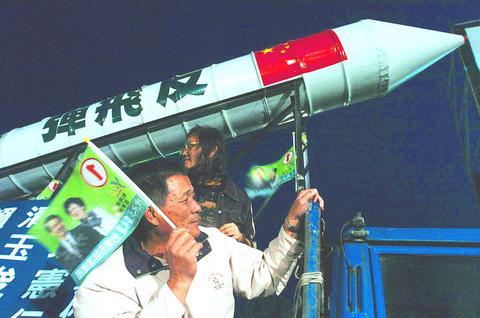
Mock missile
Pan-green supporters wave flags as a mock Chinese missile is displayed in the background to remind people about Beijing's military threat at a campaign rally held in Tainan last night.
-----------------------------------------