20040321
=======
Referendum’s failure on March 21, 2004 ……
Referendum results send a diluted message
The first-ever referendum in Taiwan's
history concluded late last night with rather less drama than the presidential
election -- and ended in a surprising disappointment. `Taipei Times' staff
reporter Stephanie Wen talked to Lo Chih-cheng, executive director of the
Institute for National Policy Research, on the significance and implications of
the referendum from an international perspective.
Taipei Times: The first-ever referendum in Taiwan failed to pass, with only 45.17 and 45.12 percent of the electorate voting for each question, rendering the controversial ballot invalid. What message do you think this sends to the international community?
Lo Chih-cheng: It shows that the pan-blue camp's boycott of the referendum was successful. A lot of people in Taiwan still make their decisions based on what is advocated by their preferred political party.
However a significant number of people did cast their votes in the referendum, and combined with President Chen Shui-bian's winning his re-election bid, the significance of the referendum voting should not be overlooked either.
Chen's winning re-election has given him a general mandate to carry out his cross-strait policies. The referendum would have given him a more specific mandate, had it been valid.
If the referendum had been valid, this would have been a positive and clear message to both the US and China that we have the will and resolve to defend ourselves against China's missile threats. But because not enough people voted in the referendum to make the results valid, the message that the referendum could have sent was weakened.
TT: Both support for and opposition to the referendum within Taiwan has been strong. How do you think the international media perceive the referendum in Taiwan? Do they see it as a necessary step toward democracy or do they see it as electioneering?
Lo: Most international media have interpreted the referendum in Taiwan as electioneering. So even with the referendum failing to pass, the international community and media are happy to downplay this first failure.
The opposition has criticized Chen for linking the referendum to the election. But just because the referendum is motivated by political motives doesn't make it dirty. I think that democratic countries should be able to appreciate the pressure to get re-elected an incumbent is under.
TT: The referendum was preceded by an
attempt to assassinate the president. How do you think this will affect the
international community's view of Taiwan's referendum and election?
Lo: First, both candidates had a responsibility to calm their supporters. Both Chinese Nationalist Party (KMT) Lien Chan's campaign staff and Chen's staff came out publicly to ask their supporters to remain calm and accept the election results.
That was the one thing that both candidates could have done to prevent a possibly bad impression of Taiwan's election.
TT: On the topic of cross-strait
relations, do you think this referendum will change the status quo in the
Taiwan Strait?
Lo: The term "status quo" is misleading. What is the "status quo" that everyone is referring to? China has been deploying its missiles for the last 10 years. Is that the status quo that we would like to maintain -- the increasing rate at which the number of missiles are targeted at us?
I think the referendum was trying to redress the imbalance in the Strait and was aiming to take the status quo back to when there were no missiles. It also points out that this status quo is unfavorable to Taiwan. It helps to point out the imbalance to the international community. Many countries in the world don't know that Taiwan is being targeted by hundreds of missiles.
The status quo is not the same as stability.
In fact, the status quo of China continually increasing the number of missiles targeted at us is destabilizing.
TT: Do you think the referendum
topics address the sovereignty issue, as was suggested in the debates leading
up to the referendum?
Lo: I think executing the referendum is itself a manifestation of sovereignty. It didn't need more specific wording to emphasize that we have sovereignty in engaging in talks with China.
TT: Do you think the relationship
between the US and Taiwan has been damaged in the last few months?
Lo: The US administration was quite negative regarding Taiwan's referendum in the beginning, but it softened its tone, and its opposition to unilateral changes has been directed not only toward Taiwan but also toward China. But trust will have to be won back now.
-----------------------------------------
On March 21, 2004 ……
Voting strengthened the nation's identity, but the referendum added
little
Chu Hei-yuan, a political observer
and sociology professor at National Taiwan University, spoke to `Taipei Times'
reporter Wu Yi-ju about the outcome of the nation's first referendum.
Taipei Times: Now that President Chen
Shui-bian has been re-elected by a narrow margin but the referendum topics have
not been approved, how will this impact the political development of Taiwan for
the next four years?
Chu Hei-yuan: The credibility of Chen as a leader under the circumstances is weakened and injured. This is not to mention the very dire consequences for the cross-strait relationship. The two sides of the Taiwan Strait will probably continue to be deadlocked and at an impasse, which is going to be hard to break. The Chen administration will now have even less confidence in handling the cross-strait relationship. It will be unable either to move forward or to backtrack, thus becoming trapped in a difficult position.
TT: What do you think are the
underlying reasons for the failure of the referendum topics to gather enough
votes to pass?
Chu: It was due to at least three things -- KMT and PFP opposition, Chinese opposition and the design of the referendum topics. In view of fact that both referendum topics have been defeated, despite Chen's re-election, Chinese pressure and intimidation seem to have worked on some people, even among Chen's supporters. As for the referendum questions, they have inherent problems. They are not only illogical and contradictory, but also irrelevant. This is especially true about the second topic, which is a two-part question. The Chen administration did not dare to ask the really important question -- should Taiwan declare independence or accept unification? Instead, they asked the wrong questions.
TT: Although the referendum topics
have been voted down, has Chen nevertheless established a special role or
position in the history of Taiwan as a result of pushing through the
referendum?
Chu: Had the referendum been on the unification-independence issue, then yes -- he may have attained a special role in history, regardless of whether the topics had been approved. However, since this referendum was no more than a symbolic gesture, due to the poor design of the questions, he is not likely to retain any special role in history for it. If, after this referendum and despite its defeat, one thing eventually leads to another and Taiwan achieves independence, then perhaps Chen may earn recognition in history.
TT: How will the referendum results
impact the future of referendums in Taiwan?
Chu: Regardless of the result, meaning even if the referendum topics had been approved, the referendum could become the last of its kind. Of course, success this time around might have somewhat facilitated the development of referendums. However, defeat now is certainly going to have a negative impact. After all, it should not be forgotten that Chen's government relied on Article 17 of the Referendum Law [which gives the president the power to call a referendum in the event of a threat to national sovereignty, without getting the approval of the Legislative Yuan], which is not something that can be easily repeated.
The substantive provisions of the law make it extremely difficult -- virtually impossible -- to hold referendums.
First and foremost, the legislative review committee, from which approval is needed in order to hold a referendum, might continue to be composed primarily of members of the pan-blue camp, which has been hostile to referendums to begin with.
The Taipei Society planned to push for the reform and restructuring of the Legislative Yuan through a referendum, but discovered that that this would be a major project, requiring the signatures of at least 700,000 people and the crossing of other hurdles as well.
TT: Will this all change if the power
balance between the pan-green and pan-blue camps in the Legislative Yuan
changes as a result of the legislative elections at the end of the year?
Chu: We might not have to wait that long for change. Now that Chen has been re-elected, he may be able to organize the "national security alliance" he has talked about. With the defeat of Chinese Nationalist Party (KMT) Chairman Lien Chan and People First Party (PFP) Chairman James Soong, a feud is likely to erupt between the two and their parties. Their cooperation is likely to end. Moreover, the native Taiwanese faction or camp of the KMT may defect to the Democratic Progressive Party (DPP) or otherwise form some sort of alliance with the DPP. If only a few -- maybe 10 or so -- pan-blue lawmakers join forces with the pan-green camp, the pan-green camp will have a legislative majority, and the power balance within the Legislative Yuan will shift. [Editor's note: the decision of the KMT-PFP alliance to ask for a recount of the votes in the presidential election has added a degree of uncertainty to developments concerning the interplay between the two parties, as well as within the KMT.]
TT: Had the referendum topics been
approved, what kind of message would have been sent to the world, and how might
that have impacted political developments and the cross-strait relationship
over the next four years?
Chu: It would have been a powerful, strong and clear declaration of Taiwan's sovereignty and identity, a call for a peaceful resolution to the Taiwan Strait issue and an announcement not only to China, but also to the world in general that Taiwan opposes Chinese missiles.
However, the result of such a declaration would have been unpredictable. Would the US, China and Japan have accepted the results? We may never know. The most critical thing would of course be China's stance toward Taiwan, which may either soften or harden. China might have hardened its position if it interpreted the election and referendum results as proving the inevitability of Taiwanese independence. Beijing might have escalated its military coercion and diplomatic blockade of Taiwan.
As for the US' attitude, it would have depended on the attitude of China. If China softened its stance, the US would try to push for a peaceful resolution of the cross-strait issue. If China hardened its position, the US would try not to upset or provoke China too much.
Of course, if US President George W. Bush was still the president -- that is, if he is re-elected, too -- the US may take a more hard-line position toward China. The attitude of the US would of course be important, because Taiwan depends on the US very much, and therefore there would be infinite ways for the US to exert pressure on Taiwan, be it economically, militarily or diplomatically.
-----------------------------------------
On March 21, 2004 ……
Controversial victory for Chen
"We hope Beijing will look at
the presidential election result and the referendum turnout rationally and
thereby accept Taiwan people's choice." --- President
Chen Shui-bian
President Chen Shui-bian scraped home in yesterday's presidential election but his opponent Lien Chan refused to concede and will seek the election's annulment; the referendum failed
By Lindy Yeh, STAFF REPORTER
Incumbent President Chen Shui-bian and his running-mate Annette Lu of the Democratic Progressive Party (DPP) yesterday won the 2004 presidential election against the rival ticket of Chinese Nationalist Party (KMT) Chairman Lien Chan and his vice-presidential candidate People First Party (PFP) Chairman James Soong by a narrow margin of 29,518 votes.
But the nation's first-ever referendum failed to get the number of voters necessary to make the result valid. Only 45.17 percent of eligible voters took part. The Referendum Law requires at least 50 percent of those eligible to cast votes to make the vote valid.
Voting, which took place from 8am to 4pm was peaceful with no major incidents reported, and only a few isolated cases of the electoral laws being broken.
Some 13,251,719 people voted in the presidential election, a turnout of 80.28 percent of the 16,507,179 eligible voters.
The DPP candidates won 6,471,970
votes, or 50.11 percent of the total cast, while Lien and Soong got 6,442,452
or 49.89 percent. Invalid votes totaled 337,297, representing 2.5 percent of
the those cast.
Speaking before an angry crowd in front of the pan-blue camp's election campaign headquarters in Taipei, Lien refused to concede defeat and said the alliance would file a lawsuit against the result announced by the Central Electoral Commission (CEC), claiming the election was invalid and demanding the result should be annulled.
"Such a thin margin is the result of the uncertainties left by yesterday's gunshots the truth of which has yet to be clarified," Lien said.
"It was an unfair election," said Lien angrily. "Therefore, we will file a lawsuit against the election result. We demand the CEC seal all ballot boxes nationwide immediately and wait for the authorities to recount the ballots."
"Prepare to annul the election," he told the frenzied crowd.
Chen and Lu were shot while greeting supporters on a jeep in Tainan City on Friday. The police are looking for a 170 cm-tall man aged about 40 whom they suspect fired the shots.
Chen suffered an 11cm-long and 2cm-wide wound on his belly and had 14 stitches, while Lu was shot in her right knee.
The National Police Administration has offered a NT$10 million award for information that leads to breaking the case. The Lien-Soong campaign headquarters has offered another NT$10 million, while the Tainan City Government has offered NT$3 million.
CEC Chairman George Huang announced Chen and Lu's victory last night, despite Lien's refusal to concede.
"I hereby announce that Mr. Chen Shui-bian and Ms. Annette Lu have won the election," Huang said.
When asked if the CEC would overturn the result since Lien had vowed a lawsuit against it, Huang said: "They [the pan-blues] have to follow the regulations as laid down by the Presidential and Vice Presidential Election and Recall Law".
According to this law, the pan-blue camp has to file its lawsuit with the Administrative Supreme Court within 15 days of the official promulgation of the result slated for March 26, and wait for the court's final decision after an investigation.
In his victory speech, Chen told tens of thousands of supporters gathered in front of the DPP campaign headquarters in Taipei that it was not a personal or party victory but a victory for all Taiwan's 23 million people.
"We will stick to our belief in uniting ethnic groups, believing in Taiwan, and insisting on continuous reform," Chen said.
"We also hope Beijing will look at the presidential election result and the referendum turnout rationally and thereby accept the Taiwanese people's choice in order to create peace and stability across the Strait," Chen said.
The CEC also organized a referendum simultaneously with the presidential election in the same polling stations.
In the referendum, voters were asked to vote yes or no on two questions:
First: The Taiwan people demand that the cross-strait issue be resolved through peaceful means. Should mainland China refuse to dismantle the missiles targeting Taiwan and to openly renounce the use of force against us, do you agree that the government should purchase more advanced anti-missile weapons to strengthen Taiwan's self-defense capabilities?
Second: Do you agree that our government should undertake negotiations with mainland China on the basis of a "peace and stability" framework for cross-strait interactions in order to build consensus and for the welfare of the peoples of both sides?
On the first question, 7,452,340 people picked up the ballots, representing 45.17 percent of the eligible, with 359,711 invalid ballots.
Among the valid ballots, 6,511,216 people voted yes, while 581,413 voted no.
On the second question, 7,444,148 ballots were cast, representing 45.12 percent of eligible voters, with 578,574 invalid.
Of the valid ballots, 6,319,663 voted yes, and 545,911 no.
Walking slowly into a polling station in Taipei with dozens of armed guards surrounding him yesterday, Chen, along with his wife Wu Shu-chen, appearing for the first time in public since Friday's shooting, cast his presidential and referendum ballots, saying afterward: "God wouldn't let me die, because he knew I hadn't participated in Taiwan's first-ever referendum."
On the pan-blue side, which had an official policy of not voting in the referendum, Lien did not pick up the referendum ballot papers.
"The target of the bullets were not specific persons, but democracy," Lien said, "but I believe the Taiwan people won't let the incident, whose real cause has yet to be found out, influence the election."
Soong did not pick up the referendum ballots, either, in yesterday's polling while Taipei Mayor Ma Ying-jeou, who has strongly argued that the referendum was illegal, refused to say whether he had cast a ballot or not.
As of press time yesterday, China remained silent about Chen's victory.
A Chinese Foreign Ministry spokeswoman reportedly declined to comment, only referring all queries to the Taiwan Affairs Office.
That office had no immediate comment, though one official reportedly said they were watching the election closely on television and officials were holding a closed-door meeting late into the night to decide how to respond.
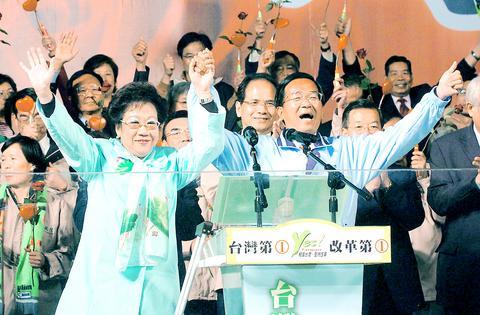
President Chen Shui-bian and Vice President Annette Lu announce their victory in yesterday's presidential election at the Democratic Progressive Party's campaign headquarters in Taipei last night.
-----------------------------------------
On March 21, 2004 ……
`Nation needs to stick together'
The president warned supporters to
remain calm and to accept the election victory with dignity
By Chang Yun-ping, STAFF REPORTER
President Chen Shui-bian yesterday promised to make every effort to unify all ethnic groups, strengthen belief in Taiwan and persist in reform after his successful re-election bid.
"[Vice President] Annette Lu and I will courageously carry on the great responsibility bestowed on us by the people," Chen said.
"We will make every effort to unify all ethic groups, to strengthen belief in Taiwan and to persist in reform. We will strive to make Taiwan a better place and enable our people to live better lives," Chen said.
Addressing a jubilant crowd in front of Democratic Progressive Party's (DPP) national campaign headquarters, Chen appealed to all of supporters not to demonstrate any arrogance and to refrain from any irrational or undemocratic behavior.
"The election is over and even though there are people who have different ideologies and beliefs, from now on we must all embrace each other, creating a harmonious and unified new Taiwan through our love and tolerance," Chen said. "The whole world is watching Taiwan's democracy, and the 23 million people of Taiwan will get a thumbs up from the world."
Party officials appeared concerned that emotions were running high and kept a low-key attitude in celebrating.
Winning a close election race against his -- Chinese Nationalist Party (KMT) Chairman Lien Chan and People First Party (PFP) Chairman James Soong by a margin of only 0.228 percent, Chen yesterday extended his respects to Lien and Soong and said his administration would engage in serious dialogue with the opposition parties.
"I want to thank the KMT and PFP parties for their criticism and suggestions during this campaign period. Over the next four years, I will continue to listen to different views and accept different suggestions.
Chen also appealed to Beijing leaders to respect the election results and to work toward mutual benefits across the Strait.
"We sincerely ask the Beijing authorities across the Strait to view the election result from a positive perspective and to accept the democratic decision of the Taiwanese people.
"Through mutual understanding, sincerity and goodwill, and with great wisdom and broad views, the leaders on both sides should jointly initiate new opportunities for peace, stability and mutual benefit," Chen said.
Meanwhile, Chen affirmed the democratic value of the referendum but said there was room for improvement.
"The people of Taiwan have once again written a new page in our history and taken a great step forward in democracy. Because it is the first time, some of our people have not fully understood the democratic value and implementation of this referendum. As such there is much room for future improvement," Chen said.
Although the referendum didn't pass, Chen once again appealed to China to understand the Taiwanese people's will in wanting democracy and peace and the removal of missiles deployed against Taiwan.
"We ask them to remove the missiles deployed against Taiwan, give up their military threat and instead let us together open the door to peaceful and stable cross-strait dialogue and negotiations," the president said.
In response to Lien and Soong's decision to file a lawsuit to nullify the election results, DPP Secretary General Chang Chun-hsiung said the party respects the legal right of the KMT-PFP alliance candidates to file such a lawsuit, but urged their supporters not to provoke a riot.
"We recognize Lien and Soong's right to file a lawsuit. After all, they are showing their disapproval of the election results within the legal system. But we condemn any provocations," Chang said.
As for whether Lien and Soong have sent their regards to Chen on his re-election, DPP campaign manager Su Tseng-chang said Lien and Soong had not made any phone calls nor made any other effort to congratulate Chen the president.
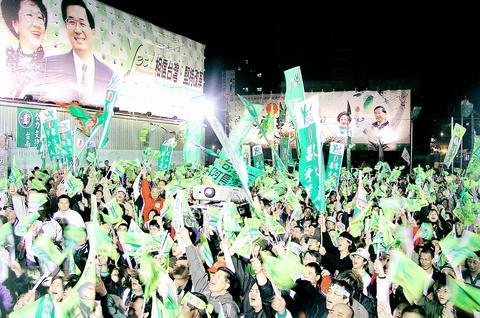
Crowds of cheering supporters of President Chen Shui-bian and Vice President Annette Lu gather outside the pan-green camp's Taoyuan campaign headquarters after Chen and Lu were declared winners in yesterday's presidential election.
-----------------------------------------
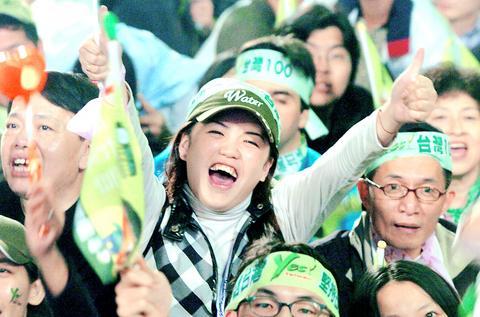
Supporters of President Chen Shui-bian that gathered in front of the DPP's election campaign headquarters in Taipei were overjoyed yesterday when they heard that Chen had been re-elected.
-----------------------------------------
On March 21, 2004 ……
Chen's election victory a boost for Taiwan's identity
China must come to terms with
Taiwan's desire to determine its own future, analysts said
By Chang Yun-ping, STAFF REPORTER
The re-election of President Chen Shui-bian represents the rise of the Taiwanese people's sense of national identity and will help to realize the nation's independence from China, political analysts said yesterday.
Lee Yung-chih, a history professor at National Taiwan University, said Chen's victory signifies the consolidation of a nativized awareness that recognizes Taiwan's identity as separate from China.
"The Taiwan-centered consciousness has ripened, and China will have to come to terms with the Taiwanese people's strong will to self-determination and self-governance," Lee said, adding that Chen's re-election will ring in a new phase in cross-strait interactions, as well as a more fair and equal relationship between the two countries.
"China has to respect the result of the election. China's hostility and its zero-sum-game approach to Taiwan will have to be overhauled," Lee said.
Chen's re-election also assures the continuation of the "A-bian Era," although the Chen administration will be faced with grave challenges.
One of the biggest difficulties that limited Chen's administrative performance over the past four years was a weak and chaotic constitutional framework governing the political system. How Chen will direct the rewriting of the Constitution and whether that change will deal with Taiwan's sovereignty issue has been a major concern to international observers.
Inside the country, Chen is faced with growing demands to amend the Constitution. However, he also has to allay international concerns about the direction of the new constitution and whether the country's name and territory will be affected.
Democratic Progressive Party (DPP) Legislator Hsiao Bi-khim said yesterday that the party will take these concerns into consideration.
Lee said the rise of a Taiwanese identity will further push Taiwan away from China.
"A Taiwanese identity is essential for the nation's independence from China, and it prevents Taiwan from being swallowed by China," Lee said.
A Taiwan-centered subjectivity will bring a more fair and equal dimension to cross-strait interactions, and would also ensure the autonomy of Taiwan's economy and technology, Lee said.
Hsieh Chih-wei, a professor of political science at Soochow University, said the election will force China to change its approach to Taiwan.
"It does not matter who Taiwan's next leader is -- China will have to come to grips with the Taiwan issue under international pressure. How to deal with Taiwan is not something China can decide on its own," Hsieh said yesterday.
Political commentator Pu Ta-chung said Chen's re-election, which gives the DPP a second mandate as ruling party, will be a positive lesson to the world's other young democracies.
Among the young democracies in Asia, Chen is the first opposition leader to win a second presidential term, defying previous doubts that a reformist DPP government would be a short-lived administration due to a domestic economic downturn.
Pu said a democratic exchange of power like the one brought about by the 2000 election is very difficult to survive in the early stages, especially when the young and inexperienced ruling party is faced with complicated national matters, such as problems with the economy.
These are the problems that Russia and its former satellite states such as Romania, Hungary and Poland faced when the Soviet regime collapsed and was replaced by democratic governments.
"Because of the lack of experience, the young democratic governments of these countries were soon faced with grave economic burdens, making the democracy a total debacle in these countries," Pu said.
"Economically the old power might be able to bring in stability, but politically it creates a setback to the democratic development," Pu said.
"It's a pity that the people in eastern Europe and Russia have lost their faith in democracy because of these problems," he said.
The importance of the DPP's second victory is that the whole world is watching whether Taiwan will be able to advance its democratization and pass through the painful process of transition. The question is whether the people of Taiwan can stand the test of time to consolidate democracy.
"Chen has to face a divided society after the election. How to mend the relations between the pan-green and pan-blue camps is a major task facing Chen's new administration," Lee said.
"We are at a crucial point in the history of our country. The country doesn't need irrational behavior and we hope the public could stay calm and rational in order to keep the society stable," DPP Secretary General Chang Chun-hsiung said yesterday.
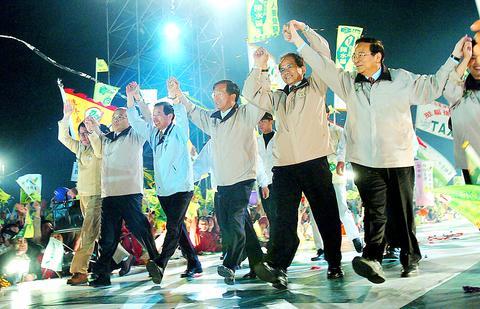
President Chen Shui-bian, third right, and the Democratic Progressive Party's ``five tigers'' responsible for campaign strategy, from right, DPP Secretary-General Chang Chun-hsiung, Premier Yu Shyi-kun, Kaohsiung Mayor Frank Hsieh, Taipei County Commissioner Su Tseng-chang and Secretary-General to the Presidential Office Chiou I-jen, greet a Taichung rally last Sunday. The five men will have the most to gain within the party hierarchy following Chen's election victory.
-----------------------------------------
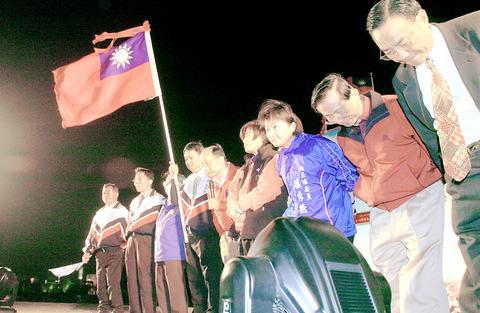
Taichung Mayor Jason Hu, fifth right, chief of the pan-blue alliance's Taichung campaign headquarters, leads his team to apologize to supporters for yesterday's election defeat.
-----------------------------------------
On March 21, 2004 ……
Election reaction is playing with fire
It would have been nice to write the editorial that we had planned, an upbeat piece about how, now President Chen Shui-bian had won the presidential election after a campaign so bitterly divisive that an attempt had even been made on his life, the people of Taiwan had to relearn how to get on with each other. Blue camp and green camp still have to share this country and the sooner the rifts created by the election healed the better.
Let us make it clear, this rapprochement must still take place. And in this light Chinese Nationalist Party (KMT) Lien Chan's behavior last night was criminally irresponsible. Lien deliberately sought to whip up the feeling of his disgruntled supporters to create a riot. There is no other possible explanation of his speech.
It was not a concession speech. It was not the speech that an honorable and responsible political figure would make telling his supporters that they had had to abide by the verdict of the ballot, go home and try again in four years time.
Instead Lien told his supporters that the election had been stolen, he demanded that it be annulled and tried his best to turn an election crowd into a vengeful mob. The message Lien gave his supporters was that until the assassination attempt on the president on Friday was cleared up, the election should not have gone ahead.
This is amazingly ironic given that it was the pan-blues who had said that the Democratic Progressive Party would try to find some pretext before the election to declare martial law and stop it from happening. Even with the president lying shot in hospital -- and let us reiterate that the idea that the president had himself shot in the stomach as a ploy to win the election can only be the product of minds unhinged by the irrationality and bitterness of the pan-blue campaign -- the DPP stood firm on its commitment to democratic practices. It is the pan-blues that now want the election, having taken place, annulled. Why? Simply because they lost.
The pan-blues reject the result of the election because they lost. Taiwan is apparently only allowed to hold elections that the pan-blues win. Thus the pan-blues show what their real attitude toward democracy is. Something perhaps like Joseph Stalin's who once said that the trouble with free elections was that you never knew who was going to win them.
Let us be frank: Today's pan-blues are yesterday's bunch of vicious, thieving, fascistic thugs who raped and looted Taiwan for half a century. They have been trying to give the impression that they are reformed, that they are democrats to the core and during the election campaign we at least tried to believe that this was so, even if we though their policies stank. But last night they reveled themselves in their true colors.
There was patently nothing wrong with the election -- it was honestly carried out and the vote tallying was impartial. That the DPP went ahead with it after Friday's shooting was none the less brave for being the sensible thing to do. We have no doubt that the challenge to the election will fail. But we now have to fear what mischief the pan-blues have up their sleeves.
Lien last night appeared to want to foment a state of civil insurrection. This is either because his mind has been unhinged by losing or because he seeks a pretext to invite China to intervene in Taiwan's affairs.
It is absurd to think this would not be resisted. Lien is either a case for psychiatric treatment or a two-time loser who would rather lead Taiwan into war than admit that, with a 20-point lead a year ago, the election was the pan-blues' to lose -- and they lost it.
-----------------------------------------
On March 21, 2004 ……
Chen will not get a honeymoon
`Democracy cannot please everyone. Half of Taiwan's population will be happy with this result, while the other half will be disappointed. However, the people's choice has been established, and everyone should respect the result. Lien announced that there were many doubtful aspects to the election process, that it was an unfair election and that he therefore will demand that it be invalidated. The confrontation of the election campaign will thus continue after election day, and the divisions in Taiwan remain as serious as ever.'
By Wang Yeh-lih
The presidential election has finally come to an end. President Chen Shui-bian, who succeeded in his re-election bid, will be sworn in for his second term in two months' time, on May 20. No honeymoon, no bandwagon effect.
As soon as his new term begins, Chen will be faced with many stern challenges.
Four years after the 2000 defeat of the Chinese Nationalist Party (KMT) after 50 years in power and the nation's first transfer of political power, to the Democratic Progressive Party (DPP), Chen and Vice President Annette Lu defeated KMT Chairman Lien Chan and People First Party (PFP) Chairman James Soong by a minuscule margin. This is the result of the deepening democracy in Taiwan.
The nation's party structure has experienced a fundamental change. Although the KMT and its allies still have a majority in the legislature, it has already been established that their supporters are in the minority in Taiwanese society.
The people of Taiwan have chosen reform and progress and closed the door on the KMT, a party with an authoritarian and corrupt past.
The new mainstream of Taiwanese society has been firmly established.
During the presidential election campaign, society has once again suffered due to the intense campaign process and the tense election situation, the sharp confrontation between the pan-blue and pan-green camps resulting from their partisan attitudes, excessive social mobilization and the broadening gap between different ethnic groups.
After the passion fades, it is imperative that society quickly return to normal.
The assassination attempt on the president and vice president on the eve of the election, which caught the attention of the international community, cast a shadow of violence over the election and added a black page to the history of democratic development in Taiwan. The attack shows that there still are people who do not understand Taiwanese democracy. They elevated a political election to the status of confrontation between enemies and adopted the strongest of methods to influence the outcome of the presidential election. Regardless of the motives behind the assassination attempt, the smooth and peaceful counting of votes has allowed the people of Taiwan to demonstrate to the international community that the Taiwanese democracy is vital and forceful.
Our political leaders, however, still lack sufficient maturity.
Democracy cannot please everyone. Half of Taiwan's population will be happy with this result, while the other half will be disappointed. However, the people's choice has been established, and everyone should respect the result. Lien announced that there were many doubtful aspects to the election process, that it was an unfair election and that he therefore will demand that it be invalidated. The confrontation of the election campaign will thus continue after election day, and the divisions in Taiwan remain as serious as ever.
Taiwan remain as serious as ever. Although Chen was re-elected by a majority, he must remain humble, because close to half the people of Taiwan do not support him.
This is an improvement on the minority position he has been in over the past four years, but the road ahead is full of political obstacles.
The first challenge of Chen's second term will be to set an example by actively pushing for reconciliation between the political parties, while also promoting ethnic harmony and the resolution of social conflict.
The second challenge facing Chen on the domestic front will be the year-end legislative elections. Soon after the presidential election, the major political parties will start nominating their legislative candidates.
This is something that will involve both the distribution of power within and the interaction between the different parties.
For example, internal KMT succession issues, as well as the question of whether the KMT and the PFP should merge or cooperate, will come to the surface during the legislative nomination process.
More important, the result of the year-end legislative elections will have a direct impact on future presidential power and policy implementation.
The biggest obstacle to Chen and his policy implementation over the past four years has been his inability to control a legislative majority.
This has been a source of much friction for the minority government when implementing policy. Because it still seems unlikely that the year-end legislative elections will produce a single majority party, the president will -- despite hoping to take advantage of a "coat-tail effect" to lead his own party to a legislative majority -- have to work hard to form a majority coalition in the new legislature in order to facilitate policy implementation and to avoid experiencing the problems faced by the minority government over the past four years. The question of whether the new government to be formed on May 20 will become the first true coalition government in the history of Taiwan will be a first test of the president's ability to control a legislative majority following the year-end legislative elections.
The initiation of constitutional and political reform will be another major challenge facing Chen. The issues of halving the number of legislative seats and introducing a single-district, two-ballot electoral system are closely related to the outcome of the year-end legislative elections.
So is the question of the implementation of Chen's campaign proposals -- a presidential system separating the three powers, a re-delineation of central and local government responsibilities and the time schedule for a new constitution, writing it in 2006 and implementing it in 2008.
The first diplomatic challenge of Chen's new presidency will be to mend the nation's relations with the US. Controversies surrounding the referendum have over the past few months put Taiwan-US ties in an unprecedented situation. Chen's first task will be to rebuild fundamental mutual trust between Taiwan and the US, pledge to maintain stability in the Taiwan Strait and win Washington's trust that Taiwan will not take the initiative to change the status quo or destroy the US' national interests in the region.
He will have to do all this in the shortest time possible.
The choice of the nation's new representative to the US and negotiations on weapons procurement are also related to these tasks, as it will influence the mending of Taiwan-US relations.
Next, once a new government has been formed, it must take a more active approach to the cross-strait relationship. From economic negotiations (such as opening up direct links) to political discussions (such as establishing a "peace and stability" framework for cross-strait interaction), Taiwan's leader must respond swiftly to changes at home and abroad.
Faced with a rising Taiwanese awareness, the question of whether the Beijing government will adopt a more flexible or a harsher attitude will also influence the new president's stance when dealing with the cross-strait relationship.
The survival of Taiwan has always depended on economic development. The Taiwanese people have been dissatisfied with the poor economic performance during the past four years of DPP rule.
In the next four years, the new government will still have to face many challenges to its economic policies. These challenges include reducing the overall unemployment rate, improving finances and balancing the budget, adjusting industrial policy, continued financial reform, adjustment of agricultural policy following Taiwan's entry into the World Trade Organization and enhancing international competitiveness. All of these are issues that the president has to face. In addition, it is impossible to completely separate cross-strait relations from Taiwan's economic development.
The direction of the new government's China policy will certainly have a significant impact on the future economic development of Taiwan.
Before the election, many political observers, both at home and abroad, viewed the election as a historical watershed in Taiwan's political development and cross-strait interactions.
The Taiwanese people have already made their choice, firmly establishing mainstream opinion. At this crucial moment in Taiwan's history, how can Chen, backed by the support of a majority of the Taiwanese people, lead Taiwan into a brighter future?
The challenge is just beginning.
Wang Yeh-lih is a professor of political science at Tunghai University.
-----------------------------------------
On March 21, 2004 ……
Taiwan wants its own identity, free of the KMT
By Huang Tai-lin, STAFF REPORTER
The election defeat of the Chinese Nationalist Party (KMT)-People First Party (PFP) alliance last night signified that Taiwan had taken the next step in realizing Taiwan's individual identity and conscience, according to political observers.
The pan-blue camp's defeat signifies Taiwanese people's determination to be rid of the KMT, said Chin Heng-wei, a political commentator and the editor-in-chief of Contemporary Monthly magazine.
However, after losing to President Chen Shui-bian by only 0.2 percent of the vote, the pan-blue camp's presidential candidate, KMT Chairman Lien Chan, last night said he would appeal for a recount.
The Democratic Progressive Party's (DPP) Chen sees Taiwan as independent, while Lien favors a conciliatory approach to China and has advocated setting the sovereignty dispute aside in favor of closer business ties, and leaving the political issue for future generations to decide.
The narrow defeat of the pro-unification KMT demonstrates a growing awareness of localization in Taiwanese society, political observers said last night.
"The pan-blue defeat means its `one-China' stance is not popular among the majority of the people in Taiwan," Chin said.
Ku Chung-hwa, executive member of the Taipei Society and a sociology professor at National Chengchi University, said the KMT-PFP alliance's defeat showed that "Taiwan is entering into a new era."
"The election result was a turning point for Taiwan. The fact that the electorate has dealt a second blow to the pan-blue camp suggests that the ideals advocated by the DPP and [former president] Lee Teng-hui have become part of mainstream thought in Taiwanese society," Ku said.
According to Ku, Beijing will now have to assume
a pragmatic and flexible approach in its dealings with Taiwan, as there is no longer any doubt that the DPP administration represents the nation's people.
Chin said that China will have to rethink its "one China" principle and face reality by engaging in dialogue with the DPP.
Ger Yeong-kuang, a professor of political science at National Taiwan University, attributed the pan-green camp's victory to "the DPP's superb campaign tactics."
Ger expects cross-strait relations under a DPP administration to be tense, as the pan-blue camp's second defeat in its bid to lay its hands on the keys to the Presidential Office will create a strong sense of crisis within the camp.
Pan-blue supporters' fears that the KMT and PFP might be sidelined after the green camp's victory will put pressure on the two opposition parties to merge, Ger said.
Another immediate issue facing the KMT is that it is now being forced to engage in "serious reform" and take stock of its own political position, Ku said.
"The Chinese Nationalist Party would have to transform itself into the Taiwanese Nationalist Party to avoid being rejected by the majority of Taiwanese," he said.
Lien and his running mate, PFP Chairman James Soong, will soon be faced with the difficult task of holding the KMT-PFP alliance together, Ku said.
He added that the 68-year-old Lien, having been defeated in two presidential elections, would no longer be able to run his party and will have to retire.
"As for the KMT, it will be faced with infighting on issues such as conflicting approaches of different generations within the party and the question of who would take over the party's leadership," Ku said.
Issues concerning the hand-ling of party assets could also cause problems for the KMT, according to Chin, who also said that another internal split in the party was certainly not out of the question.
"There is the likelihood that some members of the KMT's pro-localization faction could abandon the party and choose to seek a future elsewhere," Chin said.
The KMT will also be forced to reshuffle its leadership in the post-election period, Chin said.
Emile Sheng, a professor of political science at Soochow University, said that the PFP could be faced with a struggle for political survival following its election defeat.
-----------------------------------------
-----------------------------------------