20040323
=======
Washington’s statement on March 23, 2004 ……
All eyes on Washington for response to election
By Joel Meyer
As Taiwan's most important international ally, the US will be closely watched in the days and weeks ahead for its reaction to Chen Shui-bian's narrow electoral victory and the referendum's rejection. It seems unlikely, however, that Washington will significantly alter its approach to Taiwan. Many in Washington are pleased by the rejection of both referendum questions, though some may be worried by a second Chen term for reasons that become clear after a closer look at Washington's cross-strait calculus.
Allegations about corruption, economic management, manipulation of the election and all other domestic matters aside, the issue Washington most cared about in Saturday's elections were those relating to cross-strait tensions. The lens through which Washington views this issue cannot be easily characterized as pro-Taipei or pro-Beijing. Indeed, in the US there are advocates on all sides of the issue. Many members of the US Democratic Party take a poor view of China's human rights abuses and take a positive view of Taiwan's economic development and its democratic process, although that is being brought into question. Republicans, eyeing the tremendous upside of China's economy and emerging consumer market, tend to increasingly look toward Beijing, while also keeping a close watch on growing Chinese military power.
At the same time, the battle lines on this issue are not drawn solely along partisan lines. In fact, there seems to be a consensus, although a weak one, which encompasses Republicans and Democrats alike, that the best
US policy is to apply pressure on both sides of the Strait to maintain the status quo. As such, US President George W. Bush's recent rebuke of Chen's referendum, rather than being a sign of a pro-China sentiment in Washington, was more an indication of the administration's commitment to averting any possibility of a violent resolution to the issue.
While the US officially supports China's "one country, two systems" policy, its de facto approach is to advocate a peaceful resolution to the issue. Any action, from either Taiwan or China, that is viewed as upsetting the status quo would be opposed by Washington, and this is true regardless of whether there
is a second Republican Bush administration or a new Democratic John Kerry administration come January next year.
The bottom line is that while the US is bound by law to militarily defend Taiwan, military involvement is the least desirable option to US policymakers. Actions to provoke such a conflict from Taipei or Beijing are viewed as a threat to US national security. While some view the current cross-strait situation as unstable, most feel that while tense, the status quo is moving toward a peaceful resolution. US policy focuses on reassuring both sides that all options for the future remain on the table and that any other action is unnecessary.
In this context, it becomes clear why the referendum's rejection was greeted with a sigh of relief by most in Washington. It also becomes clear why Chen's narrow and disputed victory is worrisome. Many in the US hope that Chen will keep his promise of not abandoning any opportunity to negotiate with Beijing. The key question is how Chen will handle the referendum's rejection. Much depends on whether he takes the will of the electorate, as expressed in the referendum, to heart, or whether he pursues destabilizing policies despite the results.
In his victory speech, Chen thanked KMT Chairman Lien Chan and People First Party Chairman James Soong for their "criticisms and instructions." But will he pursue more conciliatory political and economic measures toward China? This is something US policymakers will be watching closely in the months and years to come.
Joel Meyer is program assistant at the Council on Foreign Relations in
Washington.
-----------------------------------------
On March 23, 2004 ……
Southern counties back to normal, for now
By Chiu Yu-Tzu, STAFF REPORTER
In spite of continuing demonstrations in the north, life in the south was back to normal yesterday. Local governments in the south adopted a low profile and carried out regular tasks as usual.
In Kaohsiung, Deputy Mayor Lin Yun-chien yesterday hosted a meeting to examine the results of a city-wide community-based cleanup project which had been launched on March 8.
City health officials said that a resident returning from India on March 15 had been diagnosed with a fever at Kaohsiung International Airport in Hsiaokang District. The resident was sent to a hospital nearby for examination and appeared to be healthy.
In the city, some street vendors supporting the green camp said that they felt energetic and happy to work because incumbent President Chen Shui-bian of the Democratic Progressive Party (DPP) had won the election.
Kaohsiung County Commissioner Yang Chiu-hsing said yesterday that it was time to go back to a normal daily life.
As for manifestations of the pan-blue camp's anger with the presidential election results, frustrated pan-blue supporters in Kaohsiung yesterday accused the local government of intending to destroy some ballots from the presidential election in a waste incinerator. But the accusation turned out to be an unfounded rumor.
Yesterday, suspicious pan-blue supporters gathered in front of a waste incinerator in Sanmin District, claiming that some ballots were on a garbage truck with ZN569 number plate. The venue was immediately closed off by the police.
Prosecutors checked the truck and found instruction leaflets for the presidential election. In addition, there was some used stationery and envelopes, prosecutors said. There were no ballots on the truck.
The examination was witnessed by officials from the city's election commission, Kaohsiung Deputy Mayor Lin Yun-chien and the press.
"Burning all materials pertaining to electoral affairs rather than recycling them is to avoid causing troubles," Lin told suspicious residents.
Lin urged citizens to accept the results and show understanding for public servants, who had worked very hard for days.
According to Lin Ching-jing, an official from the Kaohsiung City Election Commission, all ballots have been strictly accounted for and it would be impossible to be found somewhere else.
-----------------------------------------
On March 23, 2004 ……
Demagogue shows his face
By Lee Long Hwa, United States
Perhaps Taiwan is not ready for democracy -- half of Taiwan anyway. An election under the Constitution is what everyone started out with. In the end, dissatisfied with the result, a childish and petulant Lien Chan led his supporters on a night of troublemaking. I witnessed a frenzied and somewhat scary and disturbing exhibition of exactly what you never want to see in a democracy -- one side calling for essentially a mob to gather strength and inciting the people to violent emotions. In a mature democracy, the candidates know what is at stake in carrying out the constitutional mandated election procedures (even in a contested election), and they call for calm, not protests at the local DPP office.
What the Chinese Nationalist Party (KMT) did was to give a good idea of just what a KMT-led government would be capable of. Instead of contesting the election under the law (which he will do in any event), Lien vented his bad feelings in losing the election by chancing civil war or anarchy. He showed us the KMT way is the way of the mob: against reason, against law and against the Constitution.
Of course in a democracy there will be close elections. Of course there will be contested elections, and there will be recounts. Of course one side will be disappointed and the other jubilant. It is the way of a democracy. Of course the KMT is disappointed. If the Democratic Progressive Party (DPP) lost, its supporters would have been disappointed, too. But the good thing about democracy is the peaceful transition of government. Nothing in a democracy could have been accomplished by taking a 10,000-strong crowd, led by the pouting Lien, to the Presidential Office. The recount will not be advanced by a mob. It should not be performed under the pressure or intimidation of a mob. The election is a matter of voting and tabulating. There are emotions, but of course, a sensible party leader will keep his supporters in line, and make sure they do not disturb the Constitution, the law and the democracy. That is the point, isn't it?
Watching the frightening display tonight, which went into the wee hours, with a flowing mob confronting and attacking police, throwing bottles and driving trucks into barricades, it was clear the KMT supporters had been whipped into a frenzy that convinced them they would either succeed to power legally, or seize it by the mob if they didn't like the result. The KMT showed it would be perfectly satisfied with mob rule. I saw tonight that the KMT doesn't really like democracy -- it craves only power.
At the DPP celebration after the election, the 10,000 supporters gathered there were told it was a chance to show the world Taiwan's best face, its democracy in full order, its Constitution working. People were told to behave, and to show the world how a mature democratic people can be. At the KMT rally, Lien refused to concede the election and exhorted his followers in a teary, petulant speech to march to the Presidential Office and demand a recount.
Under the Constitution, all he has to do is ask. It's part of the election process and no mob scenes are required.
Watching Lien tonight sulking and pouting on the podium, it made me realize for the first time how close we have come to a violent overthrow of government. It appeared to me that Lien and many in the KMT believe they are letting the DPP rule at the KMT's pleasure (as if the DPP leased Taiwan from the KMT for four years), and if the KMT doesn't like what happens, they will step in and change it.
They might try the election first, but if that doesn't work....
It would not be a surprise to me to
watch Lien and his ilk plan and carry out such a move. It is people such as
this that are the tyrants and dictators in many oppressed countries throughout
the world. In fact, the more you look at it, the more the KMT looks like the
Chinese Communist Party.
How sad for Taiwan. One can only hope the recount doesn't spark a further embarrassing spectacle courtesy of the KMT if the result isn't what they want. It seems the KMT is simply not willing to be denied power for another four years.
-----------------------------------------
On March 23, 2004 ……
Experts weigh up post-election future
"Taiwan is now entering a very
difficult phase of its democratic consolidation. We are seeing signs that
Taiwan's election culture is perhaps not as stable as we are often led to
believe." --- Gary Rawnsley, of the department of politics of
the University of Nottingham
PREDICTIONS: The KMT might split internally and then with the PFP, but the DPP's narrow margin of victory will be difficult to translate into a mandate, academics say
By Charles Snyder, STAFF REPORTER
In the wake of their election defeat, the Chinese Nationalist Party (KMT) will split up and its alliance with the People First Party (PFP) will then collapse, presidential National Policy Advisor Michael Hsiao predicted.
"The marriage isn't going to survive for another six months," Hsiao told a seminar on the implication of the election and referendum results.
"My first scenario is that the KMT will split again, even if Lien Chan tries to hold onto his leadership in the next few weeks," Hsiao said.
"Then there will be another split between Lien Chan and James Soong for sure," he said at the seminar, which was sponsored by the Institute for National Policy Research along with the London School of Economics and Political Science and the Taiwan Foundation for Democracy.
First, the "Taiwan-conscious faction" within the KMT would bolt. "It is impossible for the KMT to be united again," Hsiao said.
The disintegration of the KMT and subsequently the pan-blue alliance, in Hsiao's eyes, would have serious implications for the Legislative Yuan elections coming up in December.
He expects the Democratic Progressive Party (DPP) to gain more seats in the legislature, but says that does not mean the party will "automatically" get a majority. For former president Lee Teng-hui's Taiwan Solidarity Union (TSU), prospects are that the party will also gain seats.
Another panelist, Dafydd Fell, a lecturer in Taiwan Studies at Britain's School of Oriental and African studies, however, disagreed with Hsiao.
"I think the KMT is likely to keep its alliance with the PFP. To not do so would be suicide," he said.
Fell added that the DPP would "struggle to increase its legislators by much," so the government would remain divided after the December vote.
Hsiao predicted that Premier Yu Shyi-kun would retain his position at least until December.
"He has worked so hard; if you kick him out it's not nice," he said.
Panelist Gary Rawnsley, of the department of politics of the University of Nottingham, portrayed Lien's electoral challenges as a last-ditch effort to retain power.
Noting that Lien is 68 years old and has lost two presidential elections, Rawnsley said, "What has he got to lose by complaining about election irregularities? It's not the greatest thing he could have done. But what has he got to lose? This is his last shot at the presidency."
Regarding the way Lien mounted his challenges, he said, "I don't think he's really done anything to give himself any credibility as being an important political leader in Taiwan."
Fell said that the failure of the referendum questions to pass would hurt President Chen Shui-bian, in view of the fact he used the referendum as an election tool.
"But the KMT's treatment of the referendum has probably been quite damaging to the trust in Taiwan's democratic institutions," he said.
Even though the referendum response fell short of the 50 percent threshold, "don't underestimate the 7 million voters who did vote for the referendum," Hsiao said.
While the 90 percent "yes" vote among those that picked up the ballots was not legally binding, the results "send a strong political message. No government, no president can take it lightly," he said.
Hsiao and other speakers seemed to consider a Taiwanese national identity coming to the forefront of Taiwan's politics to be the main impact and lesson of the election. As a result, Hsiao said, "no leader in the future can afford to take a very soft position vis-a-vis the PRC."
While speakers noted that Chen this time received a majority of votes, they said it might not be enough of a mandate to allow him to carry out some campaign promises.
"A 0.2 percent victory is difficult to translate into a clear mandate," Rawnsley said. "His narrow victory, together with the blue camp response, certainly weakens Chen's ability to embark on the kind of radical reform agenda" he outlined in the campaign.
The results, challenges and violence following the vote means that "Taiwan is now entering a very difficult phase of its democratic consolidation. We are seeing signs that Taiwan's election culture is perhaps not as stable as we are often led to believe," he said.
-----------------------------------------
On March 23, 2004 ……
Chen victorious is Taiwan's gain
`Lien Chan's post-election statement proved he lacks the competency to be president.'
By Bruce Jacobs
Saturday's presidential election had everything. The campaign had divisive and vilifying rhetoric. On the afternoon before the election, the incumbent president and vice-president were shot while campaigning. The campaign featured two referendum questions, which had China raving. The winner defeated the loser by 29,518 votes of 12.9 million cast that were valid. And,
to top it off, the loser proved he lacked leadership by challenging the result without providing any evidence of fraud.
Lien Chan's post-election statement proved he lacks the competency to be president. He reacted before the Central Election Commission announced the election results, calling the election unfair. Rather than simply saying the election was close and requesting a recount, he launched into questioning the horrific shooting of President Chen Shui-bian and Vice President Annette Lu. Then he and his running mate, James Soong, hung around the Chinese Nationalist Party (KMT) Central Headquarters, where they did nothing to induce calmness among their supporters.
Lien's imputation that the
assassination attempt was campaign trickery was ironic to hear for those with
long memories in Taiwan. Lien and Soong participated in high government and
party positions during the authoritarian period and it was during these periods
that the family of Lin Yi-hsiung was killed, Professor Chen Wen-cheng
"fell" to his death, the writer Jiang Nan murdered in the US and Wu
Shu-chen, President Chen's wife, repeatedly hit by a truck and left a paraplegic.
We know, thanks to the FBI, that Taiwan's security agencies committed Jiang
Nan's killing in the US and the inability to solve the other murders, even
after so long, suggests security agency involvement. If trickery was involved
in the recent assassination attempts then Lien and Soong are the more likely
perpetrators.
Lien and Soong also conducted an
extremely dirty campaign, aided by the pro-blue media. The lies and accusations
just kept coming. Lien and Soong told a foreign press conference that the campaign
was extremely dirty and that they hoped foreign journalists would know by the
end of the press conference who was committing this vilification. Yes,
President Chen was not a "pure angel" -- his allusion to Lien Chan
beating his wife was unnecessary and degrading. But, at the end of the press
conference, the foreign press knew the source of the filth was Lien and Soong
themselves.
What of the future? The court process will take place quickly and, unless Lien and Soong can prove the existence of skullduggery, President Chen and Vice-President Lu will have their re-election confirmed. In any case, the Democratic Progressive Party (DPP) has now achieved a true majority of votes, no matter how slim. This is a significant increase from 39.3 percent in the 2000 presidential election and an improvement on the 2001 legislative election. For the legislative election this year, the DPP and the Taiwan Solidarity Union will have to work together to nominate a slate that can win a majority of seats, which would improve government stability.
Hopefully, the dynamics in the KMT will force Lien and Soong from the political stage. At least some KMT supporters considered voting for Chen to help clear the stage of these "yesterday's men." Both have long records of government corruption and neither has shown evidence of any understanding of democracy either in the KMT or in government.
This would allow the Taiwanese members, such as Legislative Yuan Speaker Wang Jin-pyng, and the younger Mainlander leaders such as Taipei Mayor Ma Ying-jeou, Taichung Mayor Jason Hu and Taoyuan County Commissioner Chu Li-lun to come to the fore. These younger men, all in their early 50s or younger, have much more enlightened views of Taiwan and the world. Ideally, they would work closely with the second Chen administration to build a cooperative "win-win" situation in which all would benefit.
China and constitutional reform remain two key issues for the future. China must learn to deal with the reality of Taiwan. This is now an island where "Taiwan identity" has grown considerably at the expense of "China identity," which has declined precipitously over the past decade. China, however, has its own political problems and it may be that Chinese political forces will hamstring the Hu Jintao and Wen Jiabao leadership. For example, the conservative Chinese military benefits from a tense cross-strait situation as this gives it greater budgets and more military toys.
Constitutional reform is also important. The current Constitution was written in the late 1940s for a dictatorship of half a billion people. Some two-thirds of the Constitution's articles require revision to suit a democracy of 23 million people. Chen has declared such a new constitution would not change the national name, flag or anthem. That Lien Chan called for a new constitution even faster than Chen proposed (shortly after calling Chen's proposal "boring") indicates that the people in Taiwan widely seek such change.
A second Chen administration will also allow political reform to continue. The president can only appoint two or three people to each ministry, so the reform process has been slow. Many more people are beginning to understand the logic of these reforms.
The second Chen administration is a bonus for Taiwan. The old political leaders will leave the stage and a new Taiwan will continue to emerge. President Chen and his fellow leaders will need to work constructively and carefully to keep all interested parties, including foreign governments, on side. But the people of Taiwan, and the people of the Asia-Pacific region, will all benefit from Taiwan's continuing democratic development.
Bruce Jacobs is Professor of Asian Languages and Studies and Director of the Taiwan Research Unit at Monash University in Melbourne, Australia.
-----------------------------------------
On March 23, 2004 ……
Pan-blue poster likens Chen to bin Laden, Saddam
PROPAGANDA: A series of campaign posters depicts President Chen Shui-bian as the equivalent of both Osama bin Laden and Iraq's Saddam Hussein
By Martin Williams and Joy Su, STAFF REPORTERS
Chinese Nationalist Party (KMT) officials last night remained tight-lipped over campaign literature comparing President Chen Shui-bian to former Iraqi president Saddam Hussein and al-Qaeda terror figurehead Osama bin Laden.
Endorsed by the Taichung City KMT campaign headquarters, which is headed by Mayor Jason Hu, a former foreign minister, the glossy color poster features bin Laden with the caption: "I am terrorist leader bin Laden, and I admire Taiwan's A-bian!" It includes an image of one of New York City's World Trade Center buildings collapsing on Sept. 11, 2001, adding the words, "bin Laden's masterpiece."
On the reverse side of the undated poster, a headline states that the referendum ballot is sacred and should not be used as a campaign tool. However, at the bottom of the page, the flyer uses an illustration to indicate how voters can leave voting stations after casting only their election ballots.
The poster accuses Chen of stealing the dignity that referendums confer to the people: "This kind of tactic is an exact copy of election fraud committed by Hussein." To the left, a caption next to the former Iraqi dictator reads, "I am Hussein, and you will all do as I say."
Previously, a blue-camp advertisement that compared Chen to Adolf Hitler sparked criticism from both the Democratic Progressive Party as well as Taiwan's Jewish community. The ad was withdrawn after only one day in distribution.
When asked for comment, KMT spokesman Justin Chou told the Taipei Times that the poster was "very good," before adding that his official response was "no comment."
KMT-PFP alliance spokesman Pang Chien-kuo said he could not comment on the comparison of Chen to Hussein and bin Laden until he had seen the poster.
Hu is director general of the campaign headquarters, but a secretary in Hu's office said that Hu had not been not aware of the poster and had not authorized its distribution. Hu could not be reached for further comment.
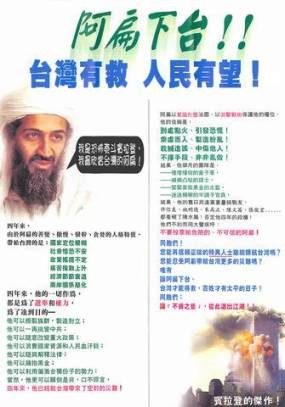
A scan of the poster issued by the Taichung City KMT campaign
headquarters.
-----------------------------------------
-----------------------------------------