20040324
=======
Recount on March 24, 2004 ……
China leaves human rights talks
`DOUBLE STANDARDS': A Beijing official responded to US criticism by saying his government cares more about its domestic human rights than any other country
REUTERS , BEIJING
China suspended its human rights dialogue with the US yesterday, saying it had no alternative after Washington proposed a resolution to the UN to condemn Beijing's rights record.
"The Chinese side cannot but immediately halt bilateral human rights dialogue and exchanges," Assistant Foreign Minister Shen Guofang told US Ambassador Clark Randt, according to a foreign ministry statement.
"The United States should bear all consequences that might arise from this," Shen said.
The US urged a UN watchdog on Monday
to condemn China's "backsliding" on human rights despite Beijing's
warning the move could affect warming Sino-US ties.
The US has said China made some improvements in 2002 but that last year its rights record deteriorated with such abuses as extra judicial killings, torture and the repression of religious and political groups opposed to the government.
Washington decided against such a censure last year and China told the US to "think three times" about introducing a critical resolution.
Shen said Washington went back on its word to "suddenly" announce the resolution amid consultations between the two.
"The United States' insistence on provoking confrontation has seriously damaged the foundation of our two countries' human rights dialogue and exchange," Shen was quoted as saying.
He accused the US of "double standards" and said China's government cared more about human rights domestically than any country. He also pointed out a host of legal steps China has taken recently in an attempt to better protect human rights, including a constitutional amendment.
A US embassy spokesman declined to comment.
While the US targets abuses of individual liberties, China insists that protecting basic human rights means sheltering, clothing and feeding its 1.3 billion people, and preserving social stability.
The US proposed the resolution at the annual session of the Geneva-based UN Human Rights Commission and sought to win supporters for its draft, particularly from the EU, State Department spokesman Richard Boucher said.
A condemnation from the 53-member commission in Geneva, which began its six-week session last week, brings no penalties but spotlights a country's behavior.
Ties between the US and China, often strained by disagreement over issues such as human rights, trade and Taiwan, have improved in recent years. Despite differences over rights Boucher said relations with China were the best they have been for decades.
-----------------------------------------
On March 24, 2004 ……
Pan-blues may be backed into a corner over recount
By Jimmy Chuang, STAFF REPORTER
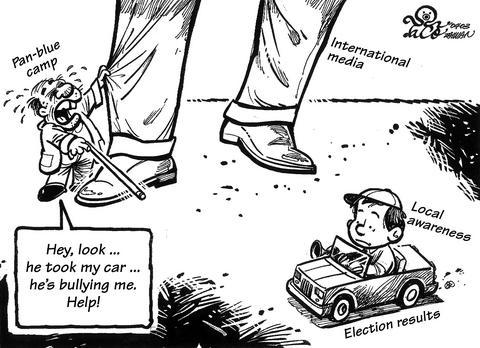
The reasons that the Lien-Soong camp proposed to request judges to recount the ballots after they lost the presidential election last Saturday may not be strong enough.
The pan-blue camp filed two suits asking to suspend President Chen Shui-bian and Vice President Annette Lu's re-election on the grounds of fraud after the election. The pan-blues based their suits on four arguments.
According to the first argument, Chen allegedly forced nearly 200,000 military and police personnel to stay at their posts, instead of going home to vote on Saturday, because he decided to implement the so-called "national security mechanism" after he and Lu were shot during a campaign activity in Tainan City one day before the election.
The blue camp said that the shooting in Tainan was an incident staged by the green camp to win more support in the election.
The more than 330,000 invalid ballots registered in the election was also an argument for the blue camp. They said that they had good reasons to believe that the green camp was trying to cheat during the process. The pan-blues did not outline what those reasons were.
In addition, the blue camp also complained that the referendum was against the law and further alleged that the referendum was also an important factor that might affect the result of the election since it had nothing to do with the presidential poll.
In response to the first argument, the Ministry of National Defense and the National Police Administration's (NPA) Criminal Investigation Bureau (CIB) had defended the president's response to the shooting and stated that no personnel had been prevented from going home to vote because of the emergency response system.
In response to the complaint that the shooting was a staged incident, the Presidential Office made public the pictures and the video of Chen and Lu's hospitalization shortly after the incident and said it was impossible to fake them all.
The CIB, although they still have not found the gunman or the weapon as of press time yesterday, said it had been working very hard to complete all necessary identification, research and investigation processes of the case within the shortest time and has held press conferences regularly to update the media with the latest developments.
"My colleagues and I are willing to endorse our work with our lives," said CIB Commissioner Hou You-yi in response to critics that questioned the CIB was helping Chen to cover up the truth behind the incident.
The Ministry of National Defense said that only 13,000 military servicemen, who were part of the normal combat alert status used during all previous elections, were required to stay at their posts instead of going home to vote after the "national security mechanism" was launched. NPA Director-General Chang Si-liang, when approached by reporters, said that he never ordered his fellow officers not to vote.
"We needed more manpower for the mechanism. However, all officers took turns voting, unless they voluntarily gave up that right. I never asked them not to vote," Chang said.
The key issue for Chinese Nationalist Party (KMT) Chairman Lien Chan and People First Party (PFP) Chairman James Soong to win the suits and get another shot at becoming president and vice president is how to persuade judges that there is a need to recount the ballots. There would also have to be more ballots in their favor after the recount. However, many judges were complaining that to recount all the ballots is a huge project and will waste lots of money and time.
"A rough estimate showed that it will cost at least NT$20 million to recount," said a senior civil judge at the Taipei District Court who wished to remain anonymous. "In addition, the project also requires at least 3,000 judges and prosecutors to complete the job."
Lai Yung-hua, a lawyer who was a former criminal judge at the Taipei District Court, said that recounting the ballots may not do any good for the blue camp.
"First of all, they have to persuade the judges that the way the Central Election Committee [CEC] employees recognize an invalid ballot is compromised. However, even if that is the case, they may not gain any more votes after judges recount the ballots," said Lai. "As for the rest of the arguments they proposed, they did not seem to be particularly persuasive to me."
The Alliance of Casting One Million Invalid Ballots Chairman Cheng Tsun-chi, who is a former Labor Bureau chief for the Taipei City Government, and independent Legislator Su Ying-kuei both believed the blue camp should not question the number of invalid ballots or accuse the green camp of cheating. What they should care about is the way the CEC recognizes an invalid ballot.
"To avoid possible cheating, the Ministry of Justice amended the Presidential Election and Recall Law on Oct. 29, 2003," said Su. "There are strict regulations in this law about recognizing an invalid ballot. That is actually the key to why there were so many invalid ballots this time."
Su believed that if judges decide the way the CEC recognizes invalid ballots is acceptable, the Lien-Soong camp would not be able to change anything using the suits.
As for the referendum, Cheng said that it had nothing to do with the blue camp's losing the election.
"The referendum actually failed this time. It means voters recognized that the referendum was one thing, and electing a president and vice president was quite another," Cheng said.
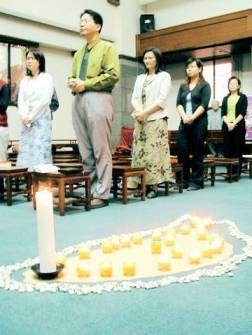
Staff and students of the Wenzao Ursuline College of Languages participate in a prayer meeting entitled ``A mass for peace in Taiwan'' yesterday.
-----------------------------------------
On March 24, 2004 ……
Kinmen official rules out ballot rigging
CNA , KINMEN
The large number of invalid ballots cast in the just-concluded presidential election could be attributed to the stringent regulations governing the way invalid ballots are identified, a Kinmen election official said Monday.
In Saturday's presidential poll, 337,297 ballots, or 2.5 percent of the total ballots cast, were counted as invalid. The unprecedented large number of invalid ballots has become one of the "suspicions" the opposition "pan-blue alliance" has raised in its moves to have the election annulled.
Among the country's 25 cities and counties, the frontline island of Kinmen registered the second-highest ratio of invalid ballots in the election, with 3.66 percent, or 1,069, invalid ballots. The highest ratio was recorded in Yunlin County, with 3.99 percent.
Lee Tseng-tsai, secretary-general of the Kinmen County Election Commission, said he believes that the high ratio mainly resulted from a revision to the President and Vice President Election and Recall Law that was passed by the Legislative Yuan last October.
According to the new provision, a vote is valid if the stamp is made in a box above the photo of the candidate. In the past, a ballot was valid if the stamp was made over the candidate's name or his or her ballot number.
Before the March 20 presidential poll, Lee said, the election commission clearly briefed all election staff on the new regulation regarding the identification of invalid ballots.
"I believe that the larger number of invalid ballots was related to this more stringent standard for valid ballots," Lee said, adding that he did not think any election worker would deliberately count a properly stamped valid ballot as invalid.
-----------------------------------------
On March 24, 2004 ……
Pan-blues need to change their tune
By Hsu Yung-ming
The shooting of President Chen Shui-bian marked a watershed in the election. Chen was the primary player in the election -- he had not only to fight a pan-blue ticket, but also had to pay a considerable political cost for promoting the referendum. Therefore, the imprimatur of the Chen Shui-bian era was already having an effect when Chinese Nationalist Party (KMT) Chairman Lien Chan and People First Party Chairman James Soong vowed to file an electoral lawsuit. The Lien-Soong era is facing an end even before it begins.
The election results have deepened this effect. Rather than wasting their efforts on a dispute over electoral defeat, the pan-blues must explore anew the direction of public opinion, give up election manipulation and face up to the transition in mainstream public opinion -- because it is a colossal process.
Compared to the unification-independence confrontation in the 2000 election, this election is about vying for leadership of the pro-nativization factions. This is because public opinion is moving toward a new national identity. The future pan-blue leadership must try to grasp this pulse. Otherwise, even a larger basic support base will not be able to bring election victory.
The pan-blue defeat is a perfect opportunity to give up the "big blue, small green" pretension. The basic support base theory is an excuse for laziness. It has been viewed as the glue keeping Lien and Soong together, as well as a feel-good narcotic in the campaign process. These, combined with the errors in opinion poll figures and repeated guarantees from polling experts, have caused the pan-blue policy vision to revolve around the basic support base. It is all about stabilizing and protecting what one has, completely blind to changes in the world affairs and unwilling to opening up new horizons.
The election merely revealed the new political landscape, in which the blues and the greens are neck and neck. This is the biggest change during Chen's four years in power. The pan-green camp's relative advantage in the south has evolved into an absolute advantage. Its weak position in central Taiwan has now changed to an equal split.
These shifts represent the permanent collapse of the traditional KMT-led structure. They also imply the rise of a new form of political competition. Even though the election this time was determined by a difference so small that it was as random as the toss of a coin, the structural change it will give rise to will be far-reaching.
However, the pan-green camp cannot evade the political consequences of the referendum's failure. Despite Chen's re-election, the implementation of referendum democracy has suffered a major blow. Internally, it must review the referendum legislation and the design of the referendum system. It should build a feasible and effective referendum system by seeking a majority in the year-end legislative election.
Chen's win does not mean a victory for the referendum. The failed referendum cannot provide persuasive turnout figures to refute international opprobrium of Taiwan for holding the referendum. Much less can it help Taiwan resist international interference in future referendums. This is the beginning of a chain of controversies, not the end.
The DPP must face up to the referendum's failure, which signifies a president who has won a majority but cannot shape a majority consensus. This is definitely a predicament. The lawsuit to invalidate the election is only the beginning. The Chen government must not overlook the voice of the other half of the public. There is much more room to build consensus in a democratic system. Referendum democracy should be a good mechanism for building consensus.
Hsu Yung-ming is an assistant research fellow at the Sun Yat-sen Institute for Social Sciences and Philosophy, Academia Sinica.
-----------------------------------------
On March 24, 2004 ……
Abiding by the law
President Chen Shui-bian's decision yesterday to strictly abide by the rule of law concerning the ballot-counting dispute was the right one. Chen also suggested that the Legislative Yuan immediately amend the Public Officials Election and Recall Law by adding a rule that the Central Election Commission must carry out an "administrative recount" if the gap between the top two candidates in an election is less than 1 percent, and that the amendment be made retroactive.
With such a legal foundation, the commission would be able to recount the votes at an early date, eliminating the need for a time-consuming judicial process. Such a move could help not only bring an end to the pan-blue-camp protests, but also eliminate the possibility of the problem reoccurring.
As for the other pan-blue complaints -- such as the questions about the timing of the shooting of Chen and Vice President Annette Lu and its impact on the election -- these are best left to be resolved through the judicial process.
Opposition politicians should stop trying to foment unrest by spreading rumor and innuendo and stirring the already intense emotions of the crowds that have protested in front of the Presidential Office since Saturday. They should be willing to resort to legal means to resolve their complaints. Otherwise, pan-green supporters may also demand a recount of ballots and file suit to annul the results if they were to lose the next election. Such actions would turn every presidential election into a farce and lead to serious political instability. This can surely not be the true purpose of turning Taiwan into a democracy.
Taipei Mayor Ma Ying-jeou yesterday legalized the protest in front of the Presidential Office and approved a request to extend the demonstration to 10pm this Saturday. If the protest were really a legal gathering he would not have felt the need to go there three times over the weekend to try to persuade the crowds to return home. Ma has been no more effective -- or convincing in his statements -- this time than he was four years ago when unhappy Chinese Nationalist Party (KMT) supporters pro-tested for days outside the party's headquarters.
If people demonstrate without the government's permission they are violating the law. Such illegal behavior cannot be legalized days later by the organizers asking for permission. With his legal background, Ma should know better than most that such post facto legitimation violates logic and convention. His actions make it seem as if he places the interests of the KMT before the dignity of the law. He should place his responsibilities as mayor above those of pan-blue alliance campaign manager and end the protest as soon as possible.
The pan-blue demonstrators' demand for a recount, however, is reasonable given the narrow margin of victory. With Chen already having given his consent and the Legislative Yuan having begun negotiations to pass the needed amendment, hopefully a recount procedure can be organized in the next few days.
What is not reasonable is the demand by KMT Chairman Lien Chan, People First Party Chairman James Soong and others in the pan-blue camp that Chen throw out the rule of law and issue an emergency decree in order to resolve the controversy. They are urging him to act like a dictator -- after spending the whole campaign attacking him for his supposed dictatorial ways.
That the pan-blues should feel comfortable trying to return Taiwan to martial law should come as no surprise. It should also be no surprise that Chen and other members of the Democratic Progressive Party, who spent a large part of their lives fighting the KMT's autocratic rule, are not willing to see a return to such tactics and want the rule of law to prevail.
-----------------------------------------
-----------------------------------------