20040326
=======
Ballots mean more than bullets on March 26, 2004 ……
MOFA says US won't interfere in Taiwan's affairs
By Melody Chen, STAFF REPORTER
The Ministry of Foreign Affairs said yesterday it did not know of any interactions between the opposition parties and the American Institute in Taiwan (AIT) when asked to comment on the pan-blue camp's appeal to the US for help in solving the election dispute.
After losing the presidential election by a wafer-thin margin, Chinese Nationalist Party (KMT) Chairman Lien Chan and his running mate, People First Party (PFP) Chairman James Soong, requested that US experts participate in an investigation of the shooting of President Chen Shui-bian on the eve of the election.
Victor Chin, director general of the ministry's Department of North American Affairs, said political parties do not need to communicate with US officials through the ministry.
"But I believe the US will adhere to its principle of not interfering in other countries' internal and election affairs," Chin said.
So far the US has made no comment about the failed referendum, he said.
The referendum, proposed by Chen, asked the public whether it wanted the government to strengthen the nation's anti-missile defenses and whether the government should establish a "peace and stability framework" with China.
When Chen won the 2000 presidential election, the White House sent him a congratulatory message. This year, however, the US government congratulated the Taiwanese people for conducting "a democratic election campaign." The message was issued by the State Department.
Asked to comment on the difference between the congratulatory notes from the White House and the State Department, Chin said the question should be addressed to the US government.
Ministry spokesman Richard Shih said governments and political dignitaries from 62 countries had sent congratulatory notes for Chen's re-election by last night.
Meanwhile, an advisory committee to the Mainland Affairs Council convened yesterday to discuss the post-election cross-strait relationship.
Regarding Chen's plan to write a new constitution, the committee suggested that the government, when starting constitutional reform, take into account not only local opinion but also international concerns, especially those of the US and China.
The committee also urged the government to repair its relationship with the US, which is believed to have been damaged in the course of the campaign due to issues such as Chen's plans for a new constitution and the referendum.
Jan Jyh-horng, director of the council's planning department, said the advisory committee suggested the council try to understand Beijing's attitude toward the election result.
Lacking official communication channels with the Chinese authorities, the council can only speculate on Beijing's response to the presidential vote by looking at the Chinese media's reports on the election.
Jan said that Beijing seemed to have been deliberately limiting media coverage of the presidential election, which made it particularly difficult for council officials to know what Beijing was really thinking about the vote.
The committee said Taiwan and China should encourage more cross-strait academic exchanges.
While Taiwanese and Chinese officials cannot freely exchange opinions, academics from both sides should be allowed to discuss whatever topics they are interested in and act as a bridge between both sides' governments, the committee suggested.
-----------------------------------------
On March 26, 2004 ……
US Congress sends letter to Chen, Lu
CONGRATULATIONS: Vice President Annette Lu said she hoped the White House would follow diplomatic protocol when the CEC certifies them the winners
By Lin Chieh-yu, STAFF REPORTER
The US Congress has congratulated President Chen Shui-bian and Vice President Annette Lu on their re-election.
The letter, dated Wednesday, states: "This is to congratulate you on your re-election as president and vice-president of Taiwan. Free and fair elections are the cornerstone to democratic government. Taiwan has exhibited true democracy. We look forward to working with your administration on a host of issues on behalf of the people of the United States and the people of Taiwan."
Lu had said earlier yesterday that the Presidential Office was expecting the US government to follow diplomatic protocol by congratulating the newly elected president when the Central Election Commission (CEC) formally announces the winner of the election today.
"We hope to receive the congratulatory message from US President George W. Bush before March 26, the day that the Central Election Commission will give certificates declaring President Chen and me the winners of the election," Lu said at a meeting with American Institute in Taiwan Director Douglas Paal yesterday morning at the Presidential Office.
"We also hope that the US government will send a special delegation, with higher-level officials than the delegation they sent four years ago, to attend the inauguration ceremony on May 20 to express its respect to the Taiwanese people's sacrifices and democratic achievements," she said.
Chen and Lu invited business leaders to a discussion yesterday about restoring social order and economic development. Lu briefed the guests about her meeting with Paal. She said that the country's people are displeased with the developments in the wake of the election. She said they are worried that the nation's achievements of the past five decades have been cast in a negative light by a few people who continue to make groundless allegations in the media, thereby damaging the image of the entire nation.
"President Chen has paid a heavy price in his political career and I have also suffered the pains of cancer, being jailed and even taking a bullet," Lu said.
The US' first reaction to the election came on Sunday, when the State Department issued a short statement to congratulate "the people of Taiwan" for having conducted a democratic election campaign and for having exercised their democratic voting rights in such large numbers. The statement did not directly mention Chen.
Chinese Nationalist Party (KMT) Chairman Lien Chan and People First Party Chairman James Soong have been loudly protesting the result of the election, and the US government has urged both camps to resolve the election dispute.
On Tuesday, State Department spokesman Richard Boucher said the Bush administration had refrained from congratulating Chen because it was waiting for the legal process to be completed.
"We're just comfortable waiting for those processes to work themselves out, and not for us to say who won, but for them to tell us who won," Boucher said.
The Presidential Office said yesterday that the Presidential and Vice Presidential Election and Recall Law stipulates that the CEC must formally announce the winners of the presidential election seven days after the poll was held.
"Once the commission certifies the result, the international community should respect Taiwan's legal system by making the appropriate diplomatic response to our new president and vice president," a high-ranking Presidential Office official said.
The official said that the High Court's rejection of the pan-blue camp's lawsuit seeking to overturn Chen's re-election was an endorsement of the legitimacy of their victory.
But the government is worried that the US' ambiguous attitude may encourage the pan-blue camp to expand their demonstration, according to the official.
"The Beijing authority and the pan-blue camp have been taking advantage of the US government's reaction to provoke supporters' anger, so that the illegal demonstrations can continue," the official said.
"The pan-blue camp's lawsuit against the commission and President Chen to have the election results annulled will drag on for months. The US government's hesitation in those months could cause disputes to worsen and further complicate the cross-strait situation, which the US government will also have to face," the official said.
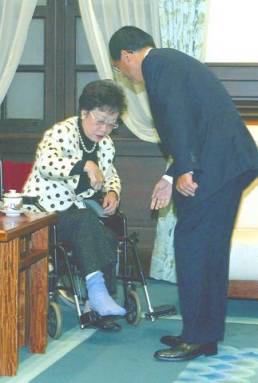
President Chen Shui-bian expresses sympathy for Vice President Annette Lu and asks about her knee injury at a press conference yesterday.
-----------------------------------------
On March 26, 2004 ……
US has no reason not to recognize Chen's win
By Liu Kuan-teh
In any democracy, electoral disputes should be settled through the judicial process and all parties should accept the court's verdict in the end. Regretfully, there is usually political maneuverings to bypass the legal mechanism, which has disastrous consequences for democracy. The controversy over Taiwan's presidential election is an illustration of this point.
The opposition's explicit attempts to use judicial means to achieve political ends demonstrated not only the reluctant acceptance of the election results by the pan-blue camp, but also a move by Chinese Nationalist Party (KMT) Chairman Lien Chan and People First Party Chairman James Soong to sacrifice the nation's hard-won democracy in favor of their political ambition.
While encouraging their hardcore supporters to take to the streets, Lien and Soong have made efforts to draw international attention, and especially the US' assistance, to extend the battleground. In this regard, the role of the US deserves special attention given the fact that the George W. Bush administration has taken a hands-off approach to the election so far. In its earlier response to the election results, the State Department addressed its congratulations to "the people of Taiwan," not to President Chen Shui-bian.
Later the US emphasized that it would not send a congratulatory letter to the winner of the election until all of the electoral disputes launched by Lien have been resolved.
The Bush administration's adoption of the wait-and-see approach toward Taiwan's post-election political change displayed a lack of respect to Chen as well as little understanding of Taiwan's election law.
According to the Presidential and Vice-Presidential Election and Recall Law, the Central Election Commission (CEC) has to certify the results of the election and the names of the president-elect and the vice-president-elect. The pan-blue camp's demand for a recount should not influence the commission's schedule to make its official announcement by today.
The final ruling of the Supreme Court on the election lawsuit would not have any influence on the CEC's certification. Since the lawsuit might drag on for as long as six months, Chen will be inaugurated and fulfill his duty as the 12th president of Taiwan. Chen will be discharged of his capacity as president only if the court concludes that Lien had won. During this period, Chen is procedurally the president. The challenges neither change the president-elect's status nor the timeline for his taking office. Hence, there is no justifiable reason not to recognize his presidency.
Whether or not Washington's ambiguous reaction to the election is being manipulated by the China or the pan-blue camp remains unknown, but such a vague gesture helps to reinforce the pan-blue camp's calls to invalidate the election. Both Lien and Soong have been telling their supporters that the US has not sent a message to Chen because it also has doubts about the legitimacy of the results. Is this the consequence of the US' non-involvement policy?
Moreover, Washington's delay in congratulating Chen will prolong the dispute and could jeopardize the very progress Taiwan has made in becoming a stable liberal democracy. If the US maintains this policy, it risks sending the wrong message to Taiwan and, potentially, to Bei-jing, that Washington does not recognize Chen's legitimacy. This would encourage both the pan-blue camp and the PRC government to sabotage Chen.
The US should send a congratulatory letter to Chen as soon as the commission certifies him to be the elected president. Do not let political considerations wound Taiwan's young democracy.
Liu Kuan-teh is a Taipei-based political commentator.
-----------------------------------------
On March 26, 2004 ……
Bordering on insanity
Eugene Liu, Atlanta, Georgia
The Chinese Nationalist Party (KMT) scored a new low in politics by issuing a poster comparing President Chen Shui-bian to al-Qaeda leader Osama bin Laden and ousted Iraqi dictator Saddam Hussein.
To my even greater disbelief, the KMT's Taichung City campaign headquarters actually endorsed it. And to think Taichung Mayor Jason Hu, once a foreign minister, did not say a word to criticize the poster for its poor taste -- that's bordering on insanity.
It's not only an insult to Chen and his administration, but also to freedom-loving Taiwanese, Americans and Iraqis that the KMT would use these tyrannical figures for its political gain. The KMT may be an old and wealthy political party, but it's certainly acting like a child in this case.
-----------------------------------------
On March 26, 2004 ……
Every ballot has meaning
Lin Yu-tang, Taipei
In the wake of a very close election result, there will be a temptation for both political camps to utilize spoiled ballots to recover a loss or consolidate a win. Neither should be allowed.
There are two kinds of spoiled ballots: unintentional and intentional. How ballots were unintentionally spoiled may be further divided into two types: through incompetence or carelessness.
Incompetently spoiled ballots are a result of not being able to understand or follow voting rules. The rules are not difficult: one, use the stamp provided; two, stay within the box provided. The box within which one places the stamp is many times larger than the stamp, so this task should be easy, even if one's dexterity is poor. One hopes that there were services available to allow those who are physically infirm to make it to a polling station and cast their ballots.
This standard does not appear difficult to meet and was agreed upon by all parties prior to the election. And assuming this country has no more than its fair share of mentally challenged voters, the percentage of spoiled ballots due to incompetence should be very small.
It is possible that the number of carelessly spoiled ballots is larger. These are produced by voters who are able to understand and remember the rules but believe they are not worth their trouble. They believe the rules are mere guidelines which do not necessarily apply to them, or that the voting process in particular is not worthy of their full attention. Should the votes of those with such little regard for the democratic process be counted? Hopefully, these only represent a small minority of spoiled ballots.
There is, however, an important category of intentionally spoiled ballots we should consider: the protest vote.
The voter casts a protest vote to show that he or she does want to participate in the democratic process but does not support any of the main candidates. Often, the protest vote is given to another candidate with almost no chance of winning. But this time, with only two high-profile camps fielding candidates, the only way to cast a protest vote was to cast a spoiled ballot.
Every eligible voter has the right to vote or not and the freedom to spoil their ballot or not. Give every voter credit for having the intelligence and the interest necessary to participate in the democratic process, and do not allow any political party to usurp the voter's right to be heard under the pretext of clarifying an election result.
-----------------------------------------
On March 26, 2004 ……
In from the cold
May Huang, Taipei
I feel sorry for the protesters sitting in such drizzly and cold weather in front of the Presidential Office. My father is a retired policeman who urged us to vote for the KMT in the 2000 presidential election, which we all did. At the time, former president Lee Teng-hui exhibited tremendous courage to accept his political fate and hand in his resignation as KMT chairman.
But what a stark contrast he is compared with present KMT Chairman Lien Chan, who we voted for four years ago. If this is the best Lien can do, then I am very relieved that this year we changed our mind.
Yes, we agreed with what Lien proposed for the nation -- truth, freedom and democracy. However, he forgot something more urgent and more pressing: we, as humble citizens, want stability. If the country is threatened with civil turmoil, then truth, freedom and democracy can be enjoyed by nobody.
I implore Lien and People First Party Chairman James Soong to tell us how they can find peace in their hearts at night, sleeping in their comfortable beds, while those poor protesters are still sitting out there in the cold. Does this lead us to think that they want to bring happiness to Taiwanese people? Does it lead us to believe that they would bring stability to this already unstable society?
-----------------------------------------
On March 26, 2004 ……
Ballots mean more than bullets
By Cao Chang-ching
The results of the election amount to an announcement to the world that the people of Taiwan reject China's missile threat, that they do not accept "one country, two systems" and that Taiwan will move toward a deepening of democracy and become an independent sovereign state worthy of its name. At a difficult time when an attempt had been made on the lives of President Chen Shui-bian and Vice President Annette Lu, the people used their votes to prove that democracy could overcome fear and ballots have conquer bullets.
Even though the Democratic Progressive Party won power in the previous presidential election, both Beijing and the pro-unification groups in Taiwan believed Chen won power on the cheap because of an internal split within the Chinese Nationalist Party (KMT). This time, however, Chen has won more than half of the votes, proving that a majority of the Taiwanese people have made their voice heard and made a choice. This will have several ramifications.
First, cross-strait relations must be redefined. The Chinese Communist Party's (CCP) media have always claimed that Chen and a small clique were trying to deceive the Taiwanese people and use "so-called democracy" to promote Taiwan independence. The election of the Chen-Lu ticket by a majority will demonstrate the reality of the Taiwanese people's demand for independent sovereignty to China and the world. This will make the CCP's propaganda war very difficult. And for many years a propaganda war has been the only war the CCP could fight.
With majority support, Chen's government can now face the CCP on a footing of public opinion, which is always more powerful than missiles. Taiwan's public opinion will force the CCP to change its policy in accordance with the reality in Taiwan.
Faced with the election results in Taiwan, the CCP can no longer carry on with the "one country, two systems" fantasy. Using the ballots in their hands, the people of Taiwan have said to China loud and clear: Taiwan is an independent, sovereign state.
The Taiwanese people do not accept the "one country, two systems" formula. Nor do they accept cross-strait relations under any "one China" framework. They have used ballots to send the illusory "one China" into history.
No matter how unwilling Beijing is, it must not ignore the reality. It can only adjust its policies on the basis of the election result. If it resorts to its past attempts and continues to pressure Taiwan, it will only push Taiwan toward independence and nation-building sooner.
Chen's re-election has shown Taiwan's real voice to the whole world. It is not reasonable to exclude the country's 23 million people from the UN. The international community must no longer ignore their voice. It is also a shock to the "one China" policy held by the US and other Western countries.
Although the US extended recognition when Mao Zedong and Chiang Kai-shek both claimed "one China," nobody in Washington has admitted in the past years that Taiwan is part of the PRC. The result of this election is a public declaration by Taiwanese people that they do not accept "one China." The public will undoubtedly challenge the US' one-China policy and push it to respect the Taiwanese people's choice.
At a meeting held on Feb. 26, the US Heritage Foundation concluded that if Chen was re-elected, Washington must "re-evaluate the US `one China' policy" and face up to the reality of "one China, one Taiwan."
Over a billion Asians are voting in democratic elections this year. India will hold elections in a month's time. By not restoring an old and corrupt force, the Taiwanese people's victory is sending a signal to other Asian nations saying that democracy is not on the wane in Taiwan, that reforms will continue, and that the voice of the Taiwanese people has become the mainstream.
In particular, Chen's re-election is a signal to the people of Hong Kong that Taiwan wants a president and not a chief executive, that the people of Taiwan want democracy and not missiles, that the Taiwanese people dare to say "No!" to the Chinese hegemony.
This will encourage and energize the people of Hong Kong to say an even braver "No!" to China's rulers, throw out the communist-appointed chief executive, and make still louder calls for a directly elected leader.
Chen's victory has also been a wake-up call for pan-blue supporters. It has made them realize that the voice of the Taiwanese cannot be ignored, and that continuing to stress "one China" cannot lead anywhere.
Unless the KMT is reformed, and unless it aims toward developing local roots, it will have no future. Support for Taiwan's development toward independence and nation-building has already become a mainstream value.
The only remaining possibility for the KMT if it wants to continue to exist as a party is to reform itself into the "Taiwan Nationalist Party."
The fact that Chen has been re-elected with a majority of the vote should make pan-blue supporters look at the nation from a new perspective. It should make them realize that the news fed to them on a daily basis by the pan-blue media has been neither correct nor accurate. Looking at Taiwan through the eyes of the pan-blue media is tantamount to looking at it through prejudiced eyes, which can only lead to misjudgments.
The historic significance of Chen's re-election for the deepening of Taiwanese democracy and Taiwan's move toward becoming a sovereign and independent nation will become increasingly evident with the passage of time.
Cao Chang-ching is a writer and journalist based in New York.
-----------------------------------------
On March 26, 2004 ……
Why the charade?
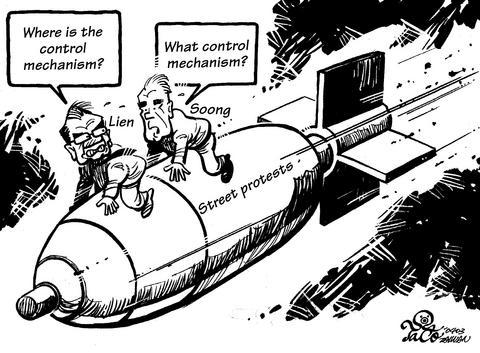
For the sake of Chinese Nationalist Party (KMT)-People First Party (PFP) alliance, some people within the camp should come up with the guts to tell KMT Chairman Lien Chan and PFP Chairman James Soong that their latest demand -- that a new election be held -- will likely work against them.
The pan-blue's offbeat performance after the election has not only provoked the resentment of the 50 percent of voters who voted for President Chen Shui-bian, but is increasingly trying the patience and even angering moderates who voted for the pan-blue ticket. Under the circumstances, Lien and Soong may be defeated by a much greater margin in a new election.
During this past week, two surveys conducted by pro-pan-blue Chinese-language newspapers released on Monday and yesterday indicated that the majority of the general public disagrees with the massive protest going on in front the Presidential Office. The poll released on Monday cited a figure of 65 percent, and yesterday's poll 59 percent.
Also, by Wednesday, virtually all major news media, including those that are pro-blue, began to urge the alliance leaders to accept the proposal offered by Chen to amend the Presidential and Vice Presidential Election and Recall Law, so that a provision on an administrative recount of all votes when the winning margin is less than 1 percent can be inserted and applied retroactively to the election.
The pan-blues have nothing to blame for this but their own ridiculous handling of their defeat. While their sense of disappointment and anger from losing on such a narrow margin -- 0.228 percent -- is understandable, their handling of the situation is not. Leaving aside the issue of the inherent danger in inciting tens of thousands of highly-volatile supporters to take to the streets in protest, the way that the pan-blues have repeatedly escalated and shifted their demands not only tries the patience of everyone, but reveals a very fundamental problem within the camp -- the absence of crisis-management and decision-making abilities.
On the evening of his election defeat, Lien stated that he wanted to file a "a lawsuit overturning the election result." That, of course, was entirely within his right, and very likely he will eventually be entitled to a judicial recount of the votes. However, once all the ballot boxes were sealed by the courts 12 hours after his speech, the pan-blues changed their mind and began to ask for an immediate administrative recount, because such a lawsuit could take months.
That was an impossible demand, since the law does not provide for administrative recounts. But when Chen agreed to amend the Presidential and Vice Presidential Election and Recall Law to have an administrative recount by next Tuesday, the pan-blues then refused the offer and also refused to review a bill that they themselves had submitted to the Legislative Yuan for that purpose earlier. Instead, Legislative Speaker Wang Jin-pyng, a KMT vice chairman, asked that a state of emergency be declared to make possible an administrative recount.
Then on Wednesday, sensing that a recount would be unlikely to overturn the election result, Lien and his supporters began to talk about holding a new election which is only possible if a verdict is entered, finding the past election to be illegal. This means that Lien and Soong will have to go back to square one -- filing lawsuits and seeking judicial relief.
So, can somebody from the pan-blue camp please explain to the rest of us what was the purpose of all the charades over this past week?
-----------------------------------------
-----------------------------------------