20040328
=========
Toward a culture of trust on March 29, 2004 ……
Toward a culture of trust
Lo Ming-cheng, Davis, California
Regarding the post-election turmoil, a lot has been said about what the leaders of each camp should do, but relatively little thought is spent on the role of the people. I think it is crucial for us to recognize that it takes a mature civil society to nurture democratic development, and that the growth of civil society depends much less on government action than it does on the contribution of the people.
If the people in Taiwan don't ask what we can do as a public at a time like this, but only focus on placing demands on political leaders, we will never become full-fledged citizens. There is more to democracy than choosing who we want to be ruled by. We think too little of ourselves by ignoring that fact.
What is placed on the shoulders of the Taiwanese people at this time is the great responsibility to generate and protect a heavy stock of civility for our society.
Civility, in turn, is a culture of critical thinking and social trust. Without the former, citizens are turned into blind, order-following drones; without the latter, political and social dialogue breaks down through endless second-guessing.
The unique situation of Taiwan is such that we have developed from an authoritarian system to a democratic one fairly quickly, and people who have inherited the legacy of being critical toward the government are now being rushed to learn the new culture of accumulating social trust. The great challenge we all face, regardless of our political preference, is to properly discern when to use our critical thinking and when to protect our social trust.
Only when we as a people learn to balance these two modes of thinking can we remain one society, above and beyond the manipulation of politicians. Candidates come and go, but as the people of Taiwan we collectively stand at a historical juncture.
We as [ordinary people] are being put to the test as to whether we are wise enough to be called citizens.
We need to speak up when we see questionable issues; we need to trust in the answer we get when it seems reasonable, even if it's not the answer we like.
If there is a question about President Chen Shui-bian's small margin of victory, ask for a recount of the ballots. If there is suspicion about Chen and Vice President Annette Lu's gunshot wounds -- the lack of compassion [evident] in such suspicions notwithstanding -- ask for a description and an analysis of what happened.
But to second-guess every answer that has been offered, to reject every piece of evidence in the name of a great conspiracy whose grounds have yet to be specified, to imagine that all the police, all the staff at all precincts, all the doctors and nurses at Chi Mei Medical Center, were bought off to cover up a lie -- this is to blindly accuse our neighbors, teachers, friends, cousins, of being corrupted, untrustworthy and easily manipulated.
The question, really, is not what we think about Chen and Lu and Chinese Nationalist Party (KMT) Chairman Lien Chen and People First Party (PFP) Chairman James Soong; the question is what we think about us.
The question is, in a nutshell, do we care more about what is being said or about who is saying it?
Until we have learned to recognize a reasonable answer as such, even when it is offered by someone we don't like, we cannot claim to be a democratic society.
Taiwan does not need more great-man or great-woman politics; Taiwan desperately needs a great citizenry.
-----------------------------------------
On March 28, 2004 ……
Taiwan found wanting
Benjamin Adams, New Zealand
The election campaign may have aroused emotions and divided families, but the real travesty is the feckless television media and the erosion of Taiwan's nascent democratic institutions by intense partisanship. An observer can only wonder: Is this the will of the Taiwanese people?
It is clear from watching the coverage of the campaign and the issues that the media in Taiwan have little interest in providing critical political coverage. The television media [outlets] in particular seem to believe that reporting consists of showing the latest pictures and covering, verbatim, the mouthings of politicians and officials without comment.
While this may enable the television media to present a politically neutral facade, there is little value in this approach as it eliminates the media's role as an independent voice and critic.
Moreover, this position has enabled, perhaps encouraged, a number of lawmakers and renegade fraudsters to make many potentially damaging comments without providing proof.
This has particularly been the case in this election, where the KMT and known sympathizers regularly slandered the incumbent [president]. Bizarrely, instead of the local media requesting proof of misdeeds, they hounded the accused, forcing them to provide proof of innocence.
In a mature democracy, the onus is on the accuser to provide evidence, not the accused.
Even after the election, the media never challenged the decisions of Lien and Soong to march to the Presidential Office and make their claims of illegality and electoral tampering. Instead of the rationale for this loutish behavior being challenged by the media, they provided a pulpit. Seen on air as unchallenged statements, their claims were legitimized in the public eye, and they spread and incited violence in Taichung and Taipei.
Another example of the media's lack of neutrality was Lien's claim that he was powerless to make his supporters cease protesting. The media assented.
There were no questions about the money the KMT and the PFP were spending on feeding the protesters outside the Presidential Office, and on providing tents and sleeping bags.
Nor was anything mentioned about the organized transportation of many more protesters to Taipei. In this instance, the KMT and PFP have gotten away with casting their partisan rabble-rousing as a spontaneous grassroots expression of disgust with the Democratic Progressive Party's win.
However, Taiwan's media did not create the recent instability; instead, they only exacerbated it.
Full responsibility rests with a small number of self-aggrandizing people and the people's willingness to follow them blindly without thinking.
The ability to think critically and to carefully weigh evidence must not be delegated to the media or to political leaders. Especially when the former abstains from doing their duty] and the latter abuse [their power.
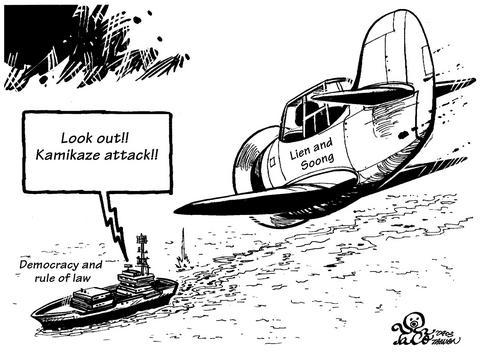
As a result, the question of whether Lien and Soong are democrats or not is now moot; for they are destroying the democratic process in this country by attempting to induce a state of fear, instability and mob rule.
Are they so obsessed with regaining the levers of power that they are prepared to destroy the mechanism itself?
So far, Taiwan has not demonstrated a desire to be democratic.
The media, powerful individuals and society itself have been found wanting over the last few days. It is time for Taiwan to ask itself: Does it actually want democracy or would it prefer to return to a regime of prosecution, totalitarianism and fear?
-----------------------------------------
On March 28, 2004 ……
Posters are a new low
Eugene Liu, Atlanta, Georgia
The KMT [hit] a new low in politics by issuing a poster comparing Chen to al-Qaeda leader Osama bin Laden and former Iraqi president Saddam Hussein. To my greater disbelief, the Taichung City KMT campaign headquarters actually endorsed the illustration.
And to think Taichung Mayor Jason Hu, once a foreign minister, did not say a word to criticize the poster's poor taste -- that's bordering on insanity. It's not only an insult to Chen and his administration, but also to freedom-loving Taiwanese, Americans and Iraqis, that the KMT would use these tyrannical figures for its political gain.
The KMT may be an old and wealthy political party, but it's certainly acting like a child in this case.
-----------------------------------------
On March 28, 2004 ……
Sunshine state
Lyle Morton, Longmont, Colorado
To my many Taiwanese friends: Please do not believe that in a mature democracy, such as the US, that losers do not pout, start demonstrations and vilify the declared winner.
Look only to the troubles in Florida in our last presidential election to see the similarities with your current election and [upcoming] recount. Fundamentally, we had the same problems as you currently have. Unfortunately for us, we had two sets of courts ruling on the election and that exacerbated the situation.
As we did, you will work your way out of this morass. Half the people will be happy with whatever outcome you get, the other half will be bitter and spiteful. That is the nature of close elections in a democracy.
The famous American author Mark Twain once wrote, "If we would learn what the human race really is at bottom, we need only observe it in election times."
-----------------------------------------
On March 28, 2004 ……
Lien: two-time loser
Yoshiko Tio, Houston, Texas
I wrote a congratulatory letter for the second term of Chen and Lu [after they] won the election. I am wishing for them to lead Taiwan to a much better position internationally for the freedom, prosperity and happiness of Taiwan as a sovereign independent country.
Since then, I read two of your editorials ("Election reaction is playing with fire," March 21, page 22 and "The referendum decided the election," March 22, page 8).
I am fully in agreement with your comments and would also hope that you might like to suggest to all of Taiwan's people that Lien badly requires psychiatric treatment. It seems he did not realize his own personal problem since he is a two-time loser and the people of Taiwan strongly feel that he is not qualified to lead Taiwan to more freedom, prosperity and happiness.
As you stated, the KMT controlled Taiwan for many decades. If it comes back, then the loser would be the people of Taiwan, unfortunately.
One thing that worries me is that the "internal enemy" seems to be much stronger than the "external enemy."
Nobody can save Taiwan's future except Taiwan's people themselves.
The failure of the referendum was a great shame for the people of Taiwan. It may imply the people of Taiwan could not speak in one voice to the international community. Many foreigners are confused about what Taiwan's people are searching for.
I pray things will be settled as soon as possible from this nonsense created by Lien. I hope he will withdraw and make a concession speech and let Taiwan's people move forward in peace for the country's survival.
-----------------------------------------
On March 28, 2004 ……
Beijing `crushes' HK's democracy
AP , HONG KONG
Beijing's plan to dictate policy on
political reform in Hong Kong will stifle the push for democracy and undermine
the territory's rule of law, critics charged.
"If they cannot twist people's wishes,
they will twist the law," said Law Yuk-kai, director of the Hong Kong
Human Rights Monitor, a non-governmental organization.
China stunned Hong Kong by saying
Friday night that its most powerful legislative panel would
"interpret" provisions of Hong Kong's mini-constitution that spell
out how the territory's leader and lawmakers are chosen.
That effectively means Beijing will set the pace for any political reforms. Pro-democracy figures believe Beijing is deliberately quashing their hopes that Hong Kong people could choose their leader and all lawmakers in the next few years.
"It completely kills the discussion on democratic reforms in Hong Kong," said labor activist and lawmaker Lee Cheuk-yan.
Pro-democracy activists plan a candlelight vigil on Thursday against Beijing's plan, while a small group of young people protested outside China's representative office in Hong Kong yesterday.
Hong Kong's people are demanding more democracy -- in a system that currently gives them no say on picking their leader though ordinary residents choose some lawmakers. Full democracy was set out as an eventual goal when Hong Kong was returned from Britain to China in July 1997, but there is no timetable.
The push for universal suffrage gained momentum on July 1, when 500,000 people marched and forced Hong Kong Chief Executive Tung Chee-hwa to withdraw an anti-subversion bill that many viewed as a threat to freedom.
The protest launched a "people power" movement that rattled Tung and left Beijing unsettled. Now, Tung and Beijing are fretting over legislative elections in September, when ordinary voters can fill 30 of the 60 seats, up from 24 last time.
Special interest groups choose the rest, an arrangement that previously has ensured the Legislative Council will support Tung's government. This time, it's possible Hong Kong will get a legislature that won't back Tung.
China's state-run Xinhua News Agency said Friday night that the powerful Standing Committee of the National People's Congress plans soon to "give interpretations" on Hong Kong's mini-constitution relating to the selection of the territory's leader and legislators.
Xinhua quoted a Chinese legal expert as saying the interpretation will have "the same kind of power as the Basic Law itself."
Tung had been informed just hours earlier, but he contended Beijing's involvement would provide a welcome resolution to the raging controversy over democracy.
"By doing this they will be able to help us to move forward in our discussion, to avoid endless wrangling," Tung told a brief news conference, flanked by his chief secretary, his justice secretary and his constitutional affairs secretary.
Beijing's plans to issue a legal "interpretation" of the law recalled its decision to overturn Hong Kong's top court in a 1999 immigration case.
-----------------------------------------
On March 28, 2004 ……
Lien, Soong are trying to save their own hides
`For a leader to react in this way, attempting to annul the election and hide behind his supporters, seems to be resorting to desperate measures.'
By Chin Heng-wei
President Chen Shui-bian's successful attempt to hold on to the reins of power in the election is all but fact, and by all appearances the defeat of his opponents, Chinese Nationalist Party (KMT) Chairman Lien Chan and People First Party (PFP) Chairman James Soong, is more or less certain. The most significant outcome of this election, however, is the change that it revealed in the political map, heralding a trend in which the majority support formerly enjoyed by the pan-blue camp seeps over to the pan-green camp. Given this, it is quite understandable how jittery the pan-blue camp has become.
But the question is: Has the pan-blue camp really grasped the crux of the problem? Evidently not. Lien and Soong have responded to their defeat by stirring up protest by their supporters, claiming that the election was unfair and invalid. This appears on the surface to be an attempt to overturn the results of the election, but it would do not to be deceived. The real motive for the protest is to transfer responsibility for the defeat away from Lien and Soong, riding on the wave of an emotional crowd. To put it another way, the pair's stirring up of the masses is designed to ensure their survival as leaders of the pan-blue camp.
It is equally understandable how difficult the defeat was to accept given the miniscule margin of only 0.228 percentage points. But did Lien and Soong really lose by only 29,518 votes? Again, this is far from the case. They went from collectively having 60 percent of the vote in the 2000 elections to a situation where, four years down the road, they are neck and neck with the pan-green camp. Shouldn't Lien and Soong shoulder the blame for this? The two men seem to be blaming the Democratic Progressive Party and Chen for the situation, bearing none of the responsibility for themselves.
This is hardly an isolated case as far as Lien is concerned. Consider his record. Following the 2000 election defeat he placed then-KMT chairman Lee Teng-hui firmly on the sacrificial altar and managed to hold on to his own party chairmanship after the poor results of the 2001 legislative elections.
Now we have seen the loosening of the KMT's hold on their domain. For a leader to react in this way, attempting to annul the election and hide behind his supporters, seems to be resorting to desperate measures.
Despite Lien's ability to wield the loyalty of his supporters to his own advantage like this, politics is both unforgiving and brutal. His much heralded "second transition of power" has proved to be nothing but pie in the sky, but there may be worse to come.
If the pan-blues lose seats in the year-end legislative elections, exacerbating their loss of power, this will be bad news not just for Lien but for the KMT and the PFP. Could it be that there is really an invisible hand acting behind the scenes of Taiwanese history?
Chin Heng-wei is the editor in chief of Contemporary Monthly magazine.
-----------------------------------------
On March 28, 2004 ……
Rally brings 468,000 Lien supporters
‘Sustain Justice’: The pan-blue repeated calls for a recount, while DPP Legislator Hsiao Bi-kim noted that Lien’s request had already been granted
By Huang Tai-lin, staff reporter
Thousands of tour buses flooded in form parts of Taiwan to Ketagalan Boulevard in Taipei yesterday afternoon in support of defeated presidential contender Chinese Nationalist Part (KMT) Chairman Lien Chan.
The crowd gathered to appeal for an immediate recount of the presidential ballots and the assembly of a special task force to investigate President Chen Shui Bian’s near assassination.
Democratic Progressive Party Legislator Hsiao Bi-kim expressed disappointment that Lien and his running mate, People First Party (PFP) James Soong, didn’t tell the crowd that the president has already agreed to a recount and an independent investigation.
Hsiao also noted that Lien and Soong didn’t say whether they’d accept the results of a recount.
“This is really regrettable,” she said.
At the rally, which entitled ‘sustain justice, salvage democracy and we want the truth,” Lien told the crowd that his appeals were not self-serving, but were part of his heartfelt concern over the entire country’s democratization.
“What we are striving for here is not about an individual’s position or a part’s success or failure,” Lien said. “We are here because we are concerned whether the country’s ruling government has acquired its power through trickery, and thus its authority is ineffective, not real and deserves no respect.”
Lien, who joined forces with Soong on a single ticket representing the KMT-PFP alliance, lost the presidential race to Chen by less than 30,000 votes, or a margin of only 02. percent.
Citing voting irregularities and questioning the official version of Chen’s assassination attempt, Lien called the election unfair and refused to concede defeat.
“While the formal election might have ended, it leaves a big question mark in terms of the country’s democratic history and development,” Lien said, while standing before a backdrop that read “Democracy is dead.”
Urging Chen to squarely face people who demand to know the truth about the assassination attempt, Lien said the KMT-PFP alliance will not cease its demonstration until their appeals have been addressed.
In rhetoric meant to underscore his support for Lien, Soong said he would give up his candidacy as the alliance’s vice presidential candidacy should a re-election be necessary once the whole ordeal comes to an end.
A 5-meter-tall “crying Statue of Liberty” was erected at the venue to kick off the rally at 2pm yesterday before KMT Legislative Speaker Wang Jin-pyng and Taipei Mayor Ma Ying-jeou led the crowd in singing the national anthem.
Between speeches bashing Chen, delivered by prominent pan-blue figures including New Party Chairman York Mu-ming and PFP Vice Chairman Chang Chao-hsiung, people in the crowd were led in a singalong by artists who performed popular and Taiwanese folk songs from the rally’s command truck.
Many protesters wore national flag stickers on their faces and on their outfits, while others held up placards with slogans written in Chinese and English, reading “Fraud” and “Immediate recount,” among others.
Under the lead of the rally host, mass protesters waving Republic of China flags and Lien-Soong campaign flags at the rally from time to time called out slogans in English, such as “Justice, now!” and “Truth, now!”
According to the Taipei City Government’s information, as of 5 pm yesterday the rally had drawn a crowd of approximately 468,000 people. Seventeen participants at the event were hospitalized due to exhaustion and fatigue, the Taipei City Government added.
In view of the events on Friday, in which scores of demonstrators scuffled with police and hurled bricks at the office of the Central Election Commission (CEC) to protest the official announcement of Chen as the winner of the election, police forces were a heavy presence around the Presidential Official, in addition to barbed wire barricades and numerous police vans for added security.
To everyone’s relief, the rally, with the exception of an attempt by a handful of demonstrators to remove the barbed wire barricades when the crowd was asked to leave at 6 pm, ended peacefully.
But police were tense, as a number of pan-blue legislators, mostly from the PFP, had warned prior to yesterday’s event that they would carry out “dramatic action” at the rally. PFP Legislator Liu Wen-hsiung even said he was planning to drive a bulldozer to the rally.
Pan-blue alliance spokesman Hwang Yih-jiau yesterday said that Soong, upon learning of party members’ intentions to carry out such actions, had spoken to these legislators individually themselves and remain rational.
Following the rally, many demonstrators relocated to CKS Memorial Hall and continued the alliance’s demonstration which has been held for the past seven days in front of the Presidential Office.
The Taipei City Government yesterday announced that it had permitted KMT Legislator Huang Chao-shun’s application to hold the demonstration at the CKS Memorial Hall from midnight today until next Saturday.
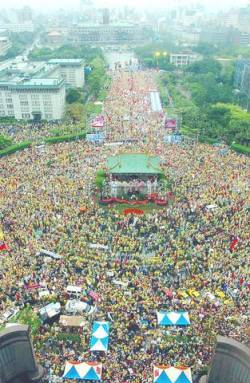
Tens of thousands of protestors flood Ketagalan Boulevard in front of the Presidential Office, creating a roaring sea of humanity and national flags yesterday.
-----------------------------------------
On March 28, 2004 ……
China condemns US for congratulations to Chen
DISPLEASED: A spokesman for China's foreign ministry said the White House's congratulatory message constitutes interference in the PRC's internal affairs
By Melody Chen, STAFF REPORTER
Beijing yesterday expressed displeasure at the US' congratulations to President Chen Shui-bian on his re-election after issuing a strong warning on Friday night that it would intervene if Taiwan's post-election turmoil should spin out of control.
"Taiwan's Central Election Commission (CEC) on March 26 officially proclaimed that Mr. Chen Shui-bian has won re-election, and we congratulate Mr. Chen on his victory," White House press secretary Scott McClellan said on Friday.
Chinese foreign ministry spokes-man Kong Quan yesterday said that China firmly opposed the US sending congratulations to Chen after the CEC announcement.
Kong said the congratulations are a violation of the three joint China-US communique's, and constitute interference in China's internal affairs.
He urged the US to adhere to the "one China" policy.
A spokesman for the Taiwan Affairs Office of China's State Council said on Friday night that Beijing would not look on with indifference if the current situation in Taiwan were to worsen and spiral out of control.
The American Institute in Taiwan, on the other hand, issued a statement yesterday afternoon noting, "the US strongly condemns all acts of violence intended to disrupt the democratic process."
The US "supports the use of the established legal mechanisms for the peaceful resolution of any doubts about the outcome of the election," the statement read.
The Mainland Affairs Council expressed "strong displeasure" late Friday night in response to China's strongest comment to date about the results of Taiwan's disputed presidential election.
The Taiwan Affairs Office's remarks are "senseless criticism," the council said.
"The Republic of China is a
law-abiding country. Election agencies do everything in accordance with the
law. The police and justice units will handle the minority's demonstrations in
accordance with the law," the Mainland Affairs Council said.
"Both sides share the responsibility of maintaining peace and stability across the Taiwan Strait. On our side, we have been committed to maintaining stability and have never intervened in the internal affairs of the People's Republic of China," the council said.
Condemning Beijing's criticism as "rude interference" in Taiwan's internal affairs, the council said that China's attempts to look for excuses to trigger cross-strait conflicts will end in vain.
China's behavior would only strengthen the Taiwanese people's solidarity, while casting the PRC in a contemptible light, the council said.
Su Chi, former Mainland Affairs Council chairman and senior policy advisor to the Chinese Nationalist Party (KMT), said yesterday the Taiwan Affairs Office's statement was "surprising" and urged Beijing to keep its hands off Taiwan's election.
"Taiwan's election is an internal matter. We hope China can maintain its pre-election attitude towards Taiwan," Su said.
The KMT-People First Party (PFP) alliance would not like to see China or the US interfering in Taiwan's internal affairs, Su said.
Asked whether the blue camp should ask its supporters to rein in their demonstrations after China's warning to intervene, Su noted the demonstrations were all legal.
According to Chang Wu-yen, a professor at the Institute of China Studies at Tamkang University, the Taiwan Affairs Office's statement on Friday was an initial sign that Beijing had adjusted its Taiwan policy from silence before the election to a willingness to intervene.
The Taiwan Affairs Office's statement showed that Beijing held a negative attitude towards Taiwan's democratic development, Chang said.
The demonstrations following the election have revealed internal conflicts in Taiwan, and Beijing apparently wants to use this opportunity to exert its influence over Taiwan, he said.
In order to suppress growing appeals for democracy in Hong Kong, as well as in China itself, the Beijing authorities have ordered state media institutions to extensively report on Taiwan's post-election turmoil, Chang said.
-----------------------------------------
On March 28, 2004 ……
PFP lawmakers in legal trouble after violent rampage
By Debby Wu, STAFF REPORTER
The Executive Yuan yesterday said than a criminal investigation had been launched into a group of pan-blue lawmakers who led supporters on a violent rampage outside the Central Election Commission (CEC) on Friday night.
People First Party (PFP) legislators, including Lee Ching-hua, Chiu Yi and Shen Chih-hwei, led about 200 pan-blue protesters into the Central Election Commission (CEC) yesterday to prevent the CEC from officially announcing the election result.
The protesters shouted, "Truth unclear, suspend declaration; down with the commission," and smashed windows at the entrance before forcing their way inside. They also threw rocks and eggs and scuffled with police.
PFP Legislator Fu Kun-chi threw chairs inside the CEC in a display of anger.
"The lawmakers who led the crowd to break into the CEC yesterday to attempt to stop the official announcement of the winners of the election have broken the Assembly and Parade Law and the Criminal Code. The judiciary has finished gathering evidence and has started to investigate the case," Cabinet Spokesman Lin Chia-lung said.
Lin said that Premier Yu Shyi-kun had instructed the judiciary to investigate the incident yesterday.
Lin said that the damage to CEC property and threat to civil servants who were carrying out their duties yesterday was a violation of the Criminal Code, and that lawbreakers could be sentenced up to three years.
"Some pan-blue legislators broke the law intentionally and gathered a crowd to cause a riot. This is a wrong example for democracy and everything will be investigated according to the law," Lin said.
Meanwhile, the Cabinet also set up a special task force, headed by the premier, to deal with the pan-blue's mass demonstration yesterday.
Yu said that the administration should monitor the demonstration closely, and that there was no space for China's intervention in Taiwan's domestic affairs.
He also instructed the Ministry of Foreign Affairs to keep in close contact with the US and Japan, and to hold international press conferences whenever necessary.
-----------------------------------------
On March 28, 2004 ……
We must rely on legal mechanisms
It was good to see most participants involved in the protest in front of the Presidential Office leave for the Chiang Kai-shek Memorial Hall, where, although the protest will continue, at least it will no longer occupy a major intersection and won't create as great a traffic obstruction for Taipei residents.
The Chinese Nationalist Party (KMT)-People First Party (PFP) alliance faced enormous internal and external pressure to peacefully end the rally in front of the Presidential Office. The greatest pressure resulted from the violent confrontation that took place Friday night in front of the Central Election Commission (CEC) between Taipei police and hundreds of pan-blue supporters led by PFP lawmakers. Protesters were trying to keep the CEC from posting an announcement of the presidential election result. In addition to incurring uniform condemnation from both the public and the news media, the violent episode stirred increasing skepticism about the KMT-PFP alliance's ability to keep their supporters under control and prevent further violence.
Then there was the statement issued by Beijing's Taiwan Affairs Office on Friday, declaring that "if the situation gets out of control in Taiwan ... we will not sit idly by." Over the past week, some people have expressed concern that if the demonstrations escalated into civil unrest, China would be presented with a golden opportunity to use force. While the pan-blue camp ignored such warnings, it could not do the same when it came to Beijing's statement. This naturally increased pressure on the pan-blue side.
In addition, there was the statement from the White House early Saturday morning that not only congratulated President Chen Shui-bian on his re-election but also condemned the use of violence and called for the resolution of challenges to the election result through "existing legal mechanisms." The truth of the matter -- as can be seen in comments by US State Department Spokesperson Richard Boucher on Monday and in statements issued by the White House over the weekend of the election -- is that the US repeatedly emphasized the resolution of disputes through existing legal mechanisms. Until Friday, the pan-blue camp had simply decided to ignore that message.
The right of the pan-blue supporters to assemble and express their views should be respected. However, such demands can be dealt with through existing legal mechanisms. The law provides for a judicial recount of the votes. The police are investigating the shooting of Chen and Vice President Annette Lu. The problem is that the pan-blue camp doesn't want to wait for the judicial recount and doesn't even seem to trust the police investigation. But then, considering that Chen has agreed to amend the law to allow for an immediate recount and has agreed to the establishment of an independent task force to investigate the shooting, one fails to see what legitimacy remains in the pan-blue camp's protests.
Many pan-blue politicians are comparing the protest with the Kaohsiung Incident and are exalting protests by political dissidents -- many of whom later became important members of the Democratic Progressive Party -- as an important milestone leading to the democratization of the nation. But this is comparing apples and oranges. At the time of the Kaohsiung Incident, Taiwan was still under martial law and the KMT's one-party totalitarianism. People's demands for democracy and freedom had no way of being met through the legal system that then existed.
Yet today, after more than a decade of democratization and reform, with an opposition legislative majority, open and transparent elections and vibrant press freedoms in Taiwan, there is no legitimacy in seeking a resolution of differences outside existing legal mechanisms.
It is hoped that the protesters will listen to Taipei Mayor Ma Ying-jeou's plea yesterday -- to respect law and order and the result of the recount.
-----------------------------------------
-----------------------------------------