20040329
=======
Riot on March 29, 2004 ……
Riot police clean up Ketagalan Blvd
FINAL PUSH: After a week of non-stop protesting against President Chen Shiu-bian's re-election, the remants of a massive crowd were removed by special police squads
By Jewel Huang, STAFF REPORTER
The crowd that continued protesting in Ketagalan Boulevard after the end of Saturday's massive rally was finally dispersed by the Taipei Police Bureau at 5:25am yesterday morning.
Taipei Mayor Ma Ying-jeou, who ordered the police to act, said the exercise was successful as there had been no violence and nobody was injured in the process.
"I ordered the police to by no means use batons to beat the people who gathered in front of the presidential office building," Ma said.
He stressed that it was he who had ordered the police to disperse the crowd.
"I never balked from dealing with the protesters. I just waited for the most opportune moment to disperse them," Ma said.
Only a few people suffered slight abrasions in the process and many of them left the scene voluntarily, Ma said.
After President Chen Shui-bian on Saturday night demanded that Ma shoulder his responsibility as mayor of the capital and to disperse the crowd "without using double standards," the Taipei Police Bureau deployed about 800 riot police.
The first deployment began at around 3am yesterday morning. The police, including female officers, squatted or bent down in the rain in front of the crowd in an effort to persuade the people to go home of their own accord.
Many people yelling slogans and singing the national anthem refused to leave and a few skirmished with police.
A second unsuccessful effort was made at about 4am when around 300 people were still lingering in front of the Presidential Office. This was followed by the full contingent of near 800 riot-control police wearing helmets and shields mopping up the remnants of the crowd at 5:25am.
After Bureau Director of Police Wang Cho-chun issued the command, the police first tried to persuade the crowd to leave of their own accord. They then carried away, one by one, protesters who refused to leave.
While the police were carrying out orders, the call to remain calm and rational was repeated over a powerful loudspeaker.
At about 7am yesterday morning, Ketagalan Boulevard was completely cleared, with only about 200 people remaining at the Chiang Kai-shek Memorial Hall to continue the protest.
"I can't go on anymore. I have to go home today. I am just too tired," said a woman only identified by her surname, Liao, sitting on the stairs of the National Concert Hall.
She said that she would not adhere to a call by lawmakers of the Chinese Nationalist Party (KMT) to keep up the protest for the next few weeks.
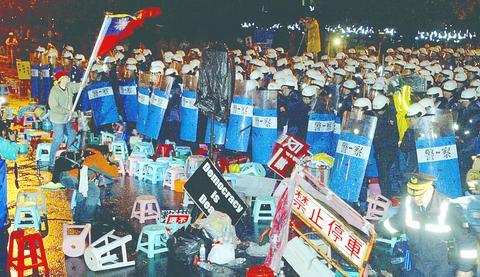
The police forms a cordon with shields and batons to disperse the protestors on Ketagalan Boulevard in the early hours of yesterday morning.
-----------------------------------------
On March 29, 2004 ……
Pan-blue camp plans to refile election suits
VOTE CONTROVERSY: A quick recount depends on Chen agreeing not to contest the new suits and the pan-blue camp not being forced to bring evidence of election fraud
By Jimmy Chuang, STAFF REPORTER
A lawyer representing the Chinese Nationalist Party (KMT)-People First Party (PFP) alliance said the pan-blue camp would refile two suits contesting the March 20 presidential election with the Taiwan High Court this morning, opening the way for a recount to start on Wednesday.
"We have all the necessary documents ready," said the lawyer, PFP Taipei City Councilwoman Huang Shan-shan. "We will return to the high court and refile the suits first thing in the morning."
Huang's remarks came in response to President Chen Shui-bian's promise on Saturday night to sign an agreement to begin the recount once the pan-blue camp refiles its suits.
Chen, Vice President Annette Lu, the Central Election Commission (CEC) and the CEC's local branch offices in every county will be listed as defendants in the suits, according to Huang. As a result, to begin the recount, the pan-blue camp also needs agreement from Lu, the CEC and its branch offices.
The Taiwan High Court said that the recount could begin on Wednesday if Chen, as he has promised, does not contest the suit, meaning the pan-blue camp does not have to provide evidence of election fraud.
The court will ask local district courts to carry out the recount, overseen by judges, prosecutors and officials from the pan-blue and pan-green camps.
The pan-blue camp filed two suits last Monday, one to suspend Chen and Lu's re-election on the grounds of fraud and the other to request that the court nullify the election.
However, the Taiwan High Court rejected the suits on Wednesday because, according to the Presidential Election and Recall Law, such suits cannot be filed before the CEC announces the winner of the election, which it did on Friday.
Even with everyone's agreement, judges could still turn down the request to recount the ballots, or agree to recount only some of them.
In this case, Huang said, the pan-blue camp may accept a proposal to recount the invalid ballots first. The pan-blue camp has pointed to the more than 330,000 invalid ballots as a sign of election-rigging.
"Although the law stipulates that the first instance of such a case must be completed within six months," Huang said, referring to the time provided by law for the Taiwan High Court to consider the case, an appeal "may take more than a year."
"As a result, we hope to begin the recount as soon as possible, even if it's just a partial recount," she said.
Taiwan High Court Spokesman Wen Yao-yuan said that as long as both parties agree on the recount, judges would recount all the ballots.
-----------------------------------------
On March 29, 2004 ……
Church slams Lien, Soong
By Caroline Hong, STAFF REPORTER
The General Assembly of the Presbyterian Church in Taiwan and Society Committee held a public prayer meeting in Taipei yesterday, praying for peace while strongly condemning the actions and motivations of Chinese Nationalist Party (KMT) Chairman Lien Chan and People First Party Chairman James Soong in the aftermath of the March 20 presidential election.
The assembly asked the leaders of the pan-blue camp to calm their supporters down and wait for justice through legal channels.
"Lien has stirred up trouble because of hatred. If he has doubts about the election, he should make complaints through the law, not use crowds to put pressure on our democracy," said Reverend William Lo, the assembly's general-secretary.
A written statement by Reverend Lu Chen-fa, passed out to the meeting's attendees, expressed the assembly's wish for conflict resolution: "People win and they lose. We each have our time and each must face the time when we bow out ... For the Taiwanese people's reputation and future, for your own legislative elections at the end of the year, or for the 2008 presidential election, cool down and recoup while waiting for the law to reveal the truth."
Holding hands, ministers led audience members in prayer, asking God to grant President Chen Shui-bian and Vice President Annette Lu a successful transition into their next term. The prayer also wished Chen and Lu health and wisdom, so that they can effectively govern the country in the coming years, and asked for mutual respect among all citizens and political parties.
"Political parties should respect each other and their country's leader. Political figures should not twist facts and defame their president," Lo said, the assembly’s general-secretary, during a sermon at the meeting.
The assembly also urged people to stand up for their rights.
"For so long, Taiwan has been ruled by foreigners, including mainlanders who came over with the KMT in 1949," Lo said.
"Many of these people, who support the pan-blue camp, have held control over the government for so long; it is time for the Taiwanese people to stand up and claim equality," the reverend said.
Church members handed out yellow ribbons and red roses, meant to symbolize a wish for peace and love, to people attending the meeting.
The assembly, along with other social groups, recently took out ads in major newspapers around the country, calling on the public to wear ribbons in support of a "soft," or non-confrontational, approach to post-election conflict.
-----------------------------------------
On March 29, 2004 ……
Under pressure at home, China plays patriotism card
REUTERS , TAIPEI
Asserting authority over islands is becoming a headache for China's powerful communist leaders and their frustrations are mounting as they watch Taiwan inch toward independence and Hong Kong's desire for more democracy.
Beijing vented ire against Taiwan on Friday, vowing to do more than just stand idly by if political chaos in the country persists over the hotly disputed presidential election.
China also showed every sign of breaking a promise not to interfere in Hong Kong by saying it was time to end confusion over how the island city will choose its leader and legislature.
"China wants some measure of stability and predictability. Things must not get out of control," said Hong Kong political commentator Andy Ho.
One solution to calm things down in Hong Kong and Taiwan could be to play the patriotism card to unite Chinese. That chance came when seven activists were arrested by Japanese authorities after they landed last week on a chain of disputed and uninhabited rocky islands, claimed by China and Taiwan as the Diaoyus and by Japan as the Senkakus.
"The Diaoyu islands are the single issue of a common interest and concern to the mainland, Hong Kong and Taiwan," said one political analyst who asked not to be identified.
"It is to remind everyone that we have something in common," he said. "Even if the mainland isn't good, it's better than Japan. Anti-Japanese sentiment is a card the mainland can play at any time."
Chinese newspapers and television broadcasts have been filled with reports berating Japan and bemoaning the fate of the seven, deported to Shanghai on Friday. Beijing even allowed protesters to gather at the Japanese embassy and burn the Japanese flag.
"This is to deflect the attention of mainlanders from the Taiwan elections," said another analyst.
"This is also to stir up patriotism among Hong Kong residents," the analysts said.
China's 1.3 billion people have heard scarcely a word about Taiwan's third, and most closely fought, presidential elections on March 20. Only on Friday did the Taiwan Affairs office issued a harshly worded statement, saying it would not tolerate turmoil in the country.
Even that angry statement was more restrained than usual: a signal of China's dilemma, caught between hotheads eager to spit fire at the island as it edges toward declaring sovereignty and cooler brains urging restraint to prevent an anti-China backlash.
Neither camp can point to great success.
"You can say it's either bluster or it's a serious warning," Susan Shirk, professor at the University of California at San Diego and deputy assistant secretary of state under US president Bill Clinton, said of the latest warning.
"I don't think we should discount the fact that it might be a serious warning because right now Beijing has been so quiet and accommodating before the election that they probably feel that they need to establish the threat to use force credibly again," she said.
China retains the right to use force to recover Taiwan. Recent weeks have seen few such threats.
"I do have some concern that this might be more than just bluster. Right now they have a need to restore the credibility of their threat to use force because they have been so quiet before the election," Shirk said.
That is when the disputed rocks in the East China Sea become useful. China may have 500 missiles arrayed against Taiwan but it can hardly use them without triggering a US response.
Playing to the patriotic gallery is one of the few arrows in China's quiver which it can use far more easily, since it focuses on the resentment against Japan that dates back to World War II.
"There is a limit on what China can do about Taiwan. If it aims more missiles at the island, it will only give [President] Chen Shui-bian more ammunition," said Ma Ngok, social science professor at the Hong Kong University of Science and Technology.
"It can't do much to win hearts in Taiwan," he said.
And while Beijing is no doubt deeply concerned about the re-election of Chen, it must be relieved that his 0.2 percent margin of victory over Chinese Nationalist Party (KMT) Chairman Lien Chan, could restrain his second four-year mandate.
Nervous that calls for more democracy in Hong Kong will not only seep into the mainland, China can cite Taiwan's electoral confusion to back moves unveiled on Friday to bring Hong Kong back into line.
"The chaotic situation gives China a perfect excuse to tell Hong Kong not to pursue democracy," said Lo Chih-cheng, executive director of the Institute for National Policy Research, a private think-tank in Taipei.
-----------------------------------------
On March 29, 2004 ……
Emotion must not override reason
By Xiang Yang
President Chen Shui-bian's re-election closed the curtain on the March 20 election. The razor-thin margin by which the pan-blue ticket lost, however, has stirred up considerable discontent within the pan-blue camp.
On the night of the election, Chinese Nationalist Party (KMT) Chairman Lien Chan did not concede defeat as expected but instead refused to accept the results. He called for the election to be annulled and demanded that the Central Election Commission recount the vote at once.
Lien's astonishing remarks raised the curtain once again. Since the night of March 20, pan-blue supporters have massed in front of the Presidential Office, demanding a recount and the truth behind the shooting incident.
Remembering that supporters of People First Party Chairman James Soong besieged the KMT headquarters four years ago, the drama of the last few days seems like deja vu. While four years ago the pan-blue supporters directed their unhappiness at former KMT chairman Lee Teng-hui, who adopted "dump Lien to save Chen" tactics, this time the protesters have questioned both the justice of the election and the president's character.
Lien's demand for a recount is not unreasonable, given that according to the official tally he lost by so few votes. And because Lien's call for a recount stands on the solid ground of law, the Taiwan High Court has ordered that all ballot boxes be sealed nationwide. But now that Lien's lawsuits are being processed, there is little else to do but wait for the machinery of the legal process to settle the election dispute.
If, on the other hand, we let emotion override reason, the problem will remain unresolved.
A tiny margin is, after all, an undeniable difference. The rules of democratic politics are not set by a single party alone. For example, the Presidential and Vice Presidential Election and Recall Law was ratified by a Legislative Yuan comprised of many parties. And since the legislature has recently set more stringent laws regarding what constitutes an invalid ballot, the number of invalid votes has naturally increased. It is unwise to accuse one's opponents of vote-rigging on the basis of there being a substantial number of invalid ballots.
Each party within a democracy is obliged to accept election results. One cannot refuse to accept the outcome just because one believes that the election was unfair.
In light of this, the fact that Lien and Soong have led supporters to march to the Presidential Office, called for their supporters to congregate and protest in violation of the Assembly and Parade Law -- which was enacted by the pan-blue-dominated legislature -- and have shown no regard for Taipei Mayor Ma Ying-jeou's repeated appeals for the crowds to disperse, makes one feel that they are letting their emotions get the better of them.
I am afraid that the majority of voters in Taiwan will not find this acceptable.
The pan-blue camp is willing to resort to legal means, demanding a recount and the sealing of ballot boxes and vowing to file a lawsuit to have the election annulled -- so why are they incapable of obeying the Assembly and Parade Law? If Lien and Soong abide by the law only insofar as it suits them, how can we expect them to rule this nation by law? How can they justify their demands?
The gravity of the problem goes way beyond this. The political gatherings over the past few days have come dangerously close to rupturing ethnic harmony.
Chen's re-election bid was endorsed by at least half of the electorate. A handful of politicians can refuse to recognize his victory but they must not brand him a liar or demand that he step down. Is doing so conducive to social stability?
The election result reveals overwhelming support for the pan-blue camp in northern Taiwan and support for the pan-green camp in the south. This phenomenon only reflects the differences in politics and culture between the north and south. But a handful of politicians have openly suggested that the north and south separate and build their own nations. Is this conducive to ethnic harmony?
Even before all the facts about the assassination attempt on Chen could be determined, they boldly asserted that it was a staged drama in a dirty election. Is this rational?
Despite demanding that their supporters remain rational and peaceful, they are stirring up people's emotions, wanting them to carry out a long-term fight amid wind and rain. Is this how responsible political leaders should behave?
Lien's not delivering a concession speech was understandable, even though it demonstrated a lack of democratic spirit.
Destroying partisan relations is also understandable because politics necessarily involves power struggle.
But if the pan-blue side incites people to take to the streets just because of the miniscule margin by which Chen won and lets a handful of politicians play up irresponsible issues to undermine ethnic relations, then this is unforgivable.
Some religious leaders have called for reason and mutual respect -- in direct contrast to some politicians' wild appeals and the gestures of hatred and the bloodshot eyes that we have seen on TV.
Those who love this nation and society watch with bleeding hearts.
Xiang Yang is an associate professor of indigenous languages at
National Dong Hwa University.
-----------------------------------------
On March 29, 2004 ……
Social programs can heal wounds
By Chang Shr-syung
As Secretary-General of the Presidential Office Chiu Yi-ren firmly predicted, the election was a cutthroat fight. A tiny margin of 29,518 votes (0.22 percent of the turnout) determined the winner. But as many people have noticed, with alarm, the small difference and the two unratified referendum questions signal that ethnic hatred is escalating and public confidence has weakened. While the wound on President Chen Shui-bian's abdomen can be sutured easily with surgical finesse, the psychological scar seared upon the heart of the people cannot easily be healed. The bullet that grazed Chen's abdomen was laden with animosity and rancor.
The damage is more than it appears. Apart from mistrust in the authorities, relations between groups in society have also been dramatically twisted and undermined. All kinds of pathological behavior and conflicts of value and interest emerged at the end of the election campaign, such as the breakdown of family relationships or covert threats to colleagues, doctors, patients and employees. All these have turned the trust relationships in our daily lives into a matter of psychological terrorism.
All of a sudden, our workplace and community are transformed into a battleground where the hesitation of undecided voters has been eliminated. Every day, hyped-up propaganda bombards our consciousness and besieges our normal lives. The nationwide action to take sides has removed reality to a simulacrum, where people fight a war of us against them, north (blue) against south (green) in a tribalized world.
Not only has this taking of sides failed to build the most fundamental consensus required by democracy, but it also leaves little space for the freedom to speak one's mind and little time for a public discussion of deliberative democracy. The price we paid for the "democratic miracle" turns out to be a split society.
Repeatedly, abstract collective identification and narcissism is used to incite mass rituals of collective worship. This thought-numbing strategy of common hatred of an enemy ultimately suppresses basic individual freedoms and rights. Years after martial law was lifted, the culture-political project to eliminate authoritarianism has suddenly collapsed overnight as if shaken by another 921 earthquake.
Some people insist that this price is necessary, if not reasonable. In order to achieve Taiwan's self-awareness, they claim to have no choice but to go to such extremes. These destructive means, however, supplant our objective of social integration (democracy) and individual rights (freedom). Once the means override the end, the means will become an uncontrollable monster and an addictive stimulant for frustrated politicians.
For instance, all social, educational, cultural, economic and welfare constructions are deliberately branded with an eye-catching ethnicity logo. But how can a country lacking a basic consensus and mutual respect and trust talk about a diversified country and society in anything but vague terms of respect and materialistic integration?
Let us look back on the reformative politics of the New Middle Way and the citizen-oriented politics focusing on economic welfare and how it came to die in its infancy.
First, social welfare, labor insurance and environmental protection were given up one by one in order to maintain capital-absorbing economic growth. It then became unavoidable to adopt the deeply sick economic strategy of building a partnership with capitalists, directing all efforts toward the demarcation of ethnic identification, which led to the suffocation of reformative and citizen-oriented politics.
At the same time, a sense of insecurity spread throughout society and unemployment and poverty soared. Frustration then led to suicides and violent money-related crime became rampant. The authorities' impotence and loss of credibility forced the government to tear society apart and adopt risky measures.
The task we face now is how to rebuild public confidence and heal the wounds. Among many urgent issues, a social security network protecting citizen's basic livelihoods is the most fundamental. It cannot be denied that National Health Insurance (NHI), despite conflicts over resource distribution, has guaranteed equal health security for a majority of the people. The insurance program has now become a new cornerstone of our society. Compared to the NHI, the pension system, delayed and debated for a decade, appears more pressing. Nonetheless, if we expect the pension system to produce and accumulate public confidence, we should exclude two disturbing factors -- capitalist logic and ethnic identification. After all, economic growth and ethnic outlook cannot replace the relevance of social trust, improvement of individual wealth and the protection of a free and democratic political system.
Chang Shr-syung is the dean and professor at the department of social
welfare in National Chung Cheng University.
-----------------------------------------
On March 29, 2004 ……
Do we need a recount or a shrink?
President Chen Shui-bian's speech on Saturday night was one of the best he has ever made, combining exactly the right tone of reason with toughness, gently mocking the more absurd claims of the pan-blue camp and showing an iron determination to stick to the letter of the law and not give in to the mob rule that the pan-blues have tried to whip up in the past week, which culminated in the storming of the Central Election Commission building on Friday night to prevent the election commissioners from fulfilling their legal duty.
It was interesting that the major criticism of Chinese Nationalist Party (KMT) spokesman Alex Tsai after the speech was that it was late in coming. Actually, Chen said nothing Saturday night that the presidential office had not already offered before. A recount, international participation in the shooting investigation: these had been on the table as of midweek, but KMT Chairman Lien Chan would not call off the demonstration planned for Saturday because his power in his party depended on the projection of leadership that this would allow.
That Lien and People First Party Chairman James Soong still haven't, at the time this was written, said they would accept the result of a recount is worrying. It shows a level of irresponsible brinkmanship that makes us question their suitability, under any circumstances, to govern.
But this week has shown something far more upsetting to anyone who cares not just about democratic processes and the rule of law, but also about simple common sense. Everyone involved in this dispute knows how the balloting process in Taiwan is carried out. Everybody should therefore know quite well that it is a model of openness that other democracies would do well to imitate.
You cannot stuff ballot boxes in Taiwan. The bookkeeping about how many ballot papers are delivered to polling stations, how many are used and how many must be returned is simply too strict. You cannot fraudulently count the vote, since it is carried out in too open a style, and the registration of each ballot is liable to objection from party representatives if there is a hint of partisanship or skullduggery.
All parties involved in the election know this. All of the pan-greens, all of the pan-blues, everyone. You cannot rig a vote in Taiwan under the present system.
There is another thing that people should already know, unless their minds have been rotted by too many bad action films. You cannot "shoot to wound" a man in the stomach standing on a moving vehicle. And yet people believe these things.
Both these events have obvious explanations.
As to the election, Chen and the Democratic Progressive Party won it by a small number of votes. This happens: that is the way the system works.
And as to the shooting, some wacko, his mind turned crazy by the endless diet of pan-blue hate propaganda against Chen in the last few weeks -- the analogies with Hitler, bin Laden, Saddam and the like -- decided that Chen simply couldn't be allowed to win, and tried to kill him to prevent it.
This makes absolute perfect sense. It is a model of events that we can all understand. That does not mean that it is exactly what happened, but it is the most likely chain of events and should do as a working hypothesis for most people, until other evidence comes along. But not for the pan-blues.
What is disturbing about this is not that an election can be challenged: that is a legal right. Nor that losing an election is frustrating: that is human nature.
What is truly disturbing is the way
that common sense has simply been thrown aside. Sane and rational people have
been willing to overlook the obvious and believe the most preposterous things,
rather than face the truth. A large number of people in this country are in the
grip of hysterical self-delusion.
Perhaps Taiwan needs psychiatric
help.
-----------------------------------------
-----------------------------------------