20040330
=======
Defend democracy on March 30, 2004 ……
US must defend democracy
By Mark Du, United States
History has shown that democracy functions best when instituted from within. Our contemporary affairs on the international arena further emphasize this point.
Iraq struggles on a day-to-day basis, failing to secure the delicate balance between freedom, order and equality. In Afghanistan, democratically elected President Hamid Karzai's electoral legitimacy hardly reaches beyond the borders of Kabul, and due to security, his presence merely extends to the fringes of the presidential compound.
I applaud the efforts of the US government to expand the democratic principles we enjoy as American citizens, but if we are the leader of the free world, democracy construction projects should not be limited to countries that have yet to take the first step toward self-governance.
Though not exactly struggling between freedom and oppression, Taiwan is arrested midway in its democratic development.
The truth is that, as US administrator Paul Bremer stated, that there can be no freedom without security. Security assurance is necessary to assist states in transition. This is especially true for Taiwan, which is in a class of its own, and could use that benefit to attain true democracy.
Taiwan deserves the US' help in defending a true democracy. Unlike Palestine, friction between ethnic groups does not inspire violence or terrorism, but instead encourages representatives to settle matters in a legislature. Unlike Chechnya, the people of Taiwan have not resorted to violence to communicate their cause, but believe self-governing principles of the citizens' consent authorize sovereignty. Unlike Kurdish areas in Iraq, Taiwanese society has developed an economic infrastructure that yielded a 2.9-percent GDP growth last year, whereas the US grew at 2.3 percent.
Ironically, the only issue some might be uneasy with is Taiwan's over-emulation of the US' government and political process. The constitutions of both countries are fundamentally identical: A bill of rights protects the citizens and branches of government separate powers to check and balance each other. Some may even find it amusing that the free press in Taiwan, like in the US, provides political candidates with an effective venue to sling mud and hurl negative ads. Campaigns are also about horserace politics and trivially focus on scandals rather than the issues, a feature Americans are familiar with. Finally, here's the kicker -- the last election, just a week ago, featured disputed ballots where voter intentions were unclear, followed by the losing candidate suing for a recount.
If Taiwan is politically and socially a Massachusetts-sized version of the US with a population of 23 million, what more does the nation need for sovereign affirmation? Answer: security.
Around 500 missiles from the world's largest country are an effective way to inspire voter apathy or constitute a persuasive retort to foreign policy negotiations.
How can election results be legitimate if people vote in fear for their lives rather than for the general welfare of society? Needless to say, until Taiwan's electorate is free to vote its conscience, it will never really taste self-government.
Unlike the Taiwanese government, the US controls the largest military budget in the world and an unparalleled military ready take on any state or non-state organization wishing to scare voters headed for the polls.
If the US government is indeed an advocate of freedom, then our leaders shall not only plant seeds of democracy in the Middle East and central Asia but should also cultivate democracy in Taiwan. Taiwan needs the umbrella of security against Chinese missiles in order to function as a free and open society. There is no need to draft a constitution, rebuild the nation or deal with anti-US sentiment -- just a foreign policy consistent with US values.
History will judge the US harshly if it stands idle while a communist country with the world's largest standing army invades a full-fledged democracy without a realistic chance of defending itself.
Whoever the leader of the US is at the time of such a crisis should look at the situation and see a struggle between freedom and oppression. He or she should not look at China and see only the lucrative opportunities of the world's largest market and a chance to appease investors who contribute to political campaigns.
The US' interests will conflict with China's sooner or later, and it will only be a matter of time before the US$124 billion trade deficit spirals out of control. China's military budget will eventually surpass that of the US -- its moon program was funded entirely by the military.
Presently, the issue of democracy in Taiwan is swept under the rug while business and politicians rush to carve and develop China's markets. Procrastinate as US leaders might, ultimately the US will have to choose between fleeting financial gains for the political present or forgoing trade and promoting US values of democracy.
Regardless of what happens, future generations will hold decision-makers of today accountable for freedom and rights, and for this reason I urge US leaders to uphold the ideals that the US is founded upon.
-----------------------------------------
On March 30, 2004 ……
Scars are a sign of healing
Since the conclusion of the presidential election, dissatisfaction and the potential for confrontation have simmered. While some pan-blue supporters feel disillusioned and outraged at the result, the pan-greens feel they have been deprived of the joy to celebrate President Chen Shui-bian's re-election. And although Saturday's pan-blue demonstration ended peacefully, the ruling and opposition parties still need to work hard to reduce tensions.
The reason why the election resulted in such a serious split is that voters have been encouraged to vote according to their ethnic backgrounds. This has affected every part of society, with dichotomies such as "Taiwanese president versus foreign control," "Taiwanese versus Chinese," "pro-referendum versus anti-referendum" and "pro-democracy versus anti-democracy" proving most effective.
This campaign method is capable of generating antagonism with very little effort. And the distinction between these would-be poles has been devised to place barriers between friends and foes and conjure up maximum political momentum.
However, such a discourse -- "the enemy versus us" -- implies a dichotomy in which mutual trust has no place. That is why the collective anxiety and frustration of those who do not identify with the winner erupted following the election.
How can this crisis be resolved? The priority for the president is to smooth over the confrontation caused by this deliberate act of social cleavage. He must both observe his constitutional obligations and at the same time remind everyone of the thing that unites the country -- love for Taiwan. If the ruling and opposition parties refuse to recognize this foundation for future stability, further and more damaging confrontation could result.
Regardless of the result of the recount and the investigation into the shooting of Chen and Vice President Annette Lu, the president must embark on a project of reconciliation with humility and an open mind. One way to start this would be to listen compassionately and patiently to all those who have ideas to share. Although generations of immigrants of varying backgrounds have converged here, Taiwanese people still share the same living space and general life experiences. This sense of identification with a gemeinschaft is the cornerstone of any post-election reconciliation campaign.
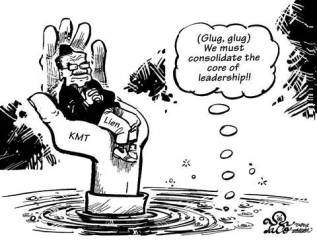
Now that Chen has won a clear mandate by majority vote, the KMT, the PFP, and the New Party have sensed the need for greater unity among themselves. They have realized that, be it through cooperation or even a merger, unity is imperative. If these three parties merge into a sufficiently powerful force to balance the Chen administration, the nation's fractured political landscape will become simpler -- a scenario conducive to sustained social and political stability.
The dust from disputes over the election has yet to settle, and the caucuses of both ruling and opposition parties should cool down and continue to discuss legislative reform and constitutional amendments relating to the halving of seats in the legislature and the single-member district and two-vote system.
With these matters dealt with, candidates for December's legislative elections can focus more closely on the demands of most voters and strengthen the economy. The scars from this election will then be able to be interpreted as a symbol of national healing.
-----------------------------------------
-----------------------------------------