20040331
=======
Recount’s problems on March 31, 2004 ……
Chen and Lu pave way for recount
ELECTION UPROAR: With the president and vice president giving their go-ahead, only the consent of the Central Election Commission is needed for a recount to proceed
By Jimmy Chuang, STAFF REPORTER
President Chen Shui-bian and Vice President Annette Lu signed and submitted a letter of consent to the Taiwan High Court yesterday allowing for a recount of the March 20 election.
According to Democratic Progressive Party (DPP) Secretary-General Chang Chun-hsiung, Chen and Lu submitted the letter after the court confirmed it had received at 11pm on Monday the pan-blue camp's suit seeking to suspend the result of the election.
A computer chose at random the judges who will hear the case, said Taiwan High Court spokesman Wen Yau-yuan.
"The case was assigned to our No. 10 election court, which will be hosted by Presiding Judge Wu Ching-yuan," Wen said.
As of press time last night, Wu and the other judges who will hear the case -- Cheng Chun-hui and Teng Yun-chieh -- were in a meeting to discuss how to hear the case.
According to the Presidential and Vice Presidential Election and Recall Law, in addition to the agreement from the president and the vice president, the High Court requires agreement from the Central Election Commission (CEC) and its local branch offices to begin to recount since Chen, Lu, the CEC and its branch offices were listed as defendants.
Once all the agreements have been collected, judges can skip hearings and begin a recount.
Meanwhile, Chinese Nationalist Party (KMT) spokesman Justin Chou said the pan-blue camp's second suit, which seeks to have the presidential election ruled a fraud and call for a new vote, will be refiled "soon."
The blue camp had not refiled the second suit as of press time yesterday.
Chang said the pan-blue camp would have to pay the legal costs for the suit since KMT Chairman Lien Chan and People First Party Chairman James Soong are the plaintiffs.
Wen said that judges will decide who will pay, but the KMT-PFP alliance said the Taiwan High Court should foot the bill.
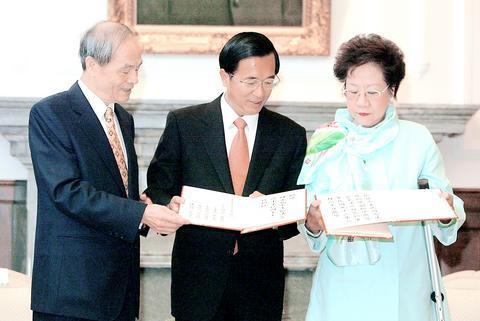
President Chen Shui-bian and Vice President Annette Lu receive their certificates of election at the Presidential Office from Central Election Commission Chairman Huang Shih-cheng yesterday. Chen and Lu submitted a letter of consent to the Taiwan High Court yesterday allowing for a recount of ballots in the presidential election.
-----------------------------------------
On March 31, 2004 ……
Chen wound caused by gunshot
SLEUTHS: Three US forensic experts agreed yesterday that the wound on President Chen's stomach was made by a gun, but stressed that their results were not final
By Jimmy Chuang, STAFF REPORTER
Three US forensic scientists yesterday said that President Chen Shui-bian's stomach wound was caused by a gunshot.
"All three of us agree that the president sustained a gunshot wound," Cyril Wecht, a respected forensic scientist, told reporters.
Flanked by trajectory analyst Michael Haag and crime-scene-identification analyst Timothy Palmbach, Wecht said that the trio had 1visited Chen at the Presidential Office yesterday morning and carried out a careful examination of the president's wound.
"We are forensic scientists and we make sure what and how the suspect caused the damage or injury," Wecht said. "But we are not here to decide who committed the crime. In addition, we are not law enforcement officers in Taiwan. We are independent forensic scientists and we are here to assist local law enforcement officers with their investigations."
Chen and his vice president were wounded by what police suspect to be two bullets fired during a street rally in Tainan the day before the presidential election.
Palmbach endorsed a preliminary investigation by the National Police Administration's Criminal Investigation Bureau, which said that it would be difficult to identify the pistol that fired the shots because of the poor quality of the homemade bullets.
Since arriving in Taiwan on Monday, the scientists have been accompanied by cable channel ETTV executive director Joanna Lei, whose company organized a press conference for the visiting experts yesterday.
Democratic Progressive Party politicians, however, have questioned Lei's role in the investigation because of her political background.
Lei unsuccessfully ran in the 2001 legislative election for the New Party.
"I did not join in any discussion about the case while they were talking to officers or prosecutors," Lei said. "I simply helped them translate when necessary."
Wecht told reporters: "You guys have been working hard with us wherever we were so there are no secrets about who we met or what we did during our stay here in Taiwan."
Wecht, who has disputed the official Warren Commission report on the assassination of President John F. Kennedy, said that it would take two weeks for the scientists to complete their work and that they would hand the results to Dr. Henry before he comes to Taipei sometime around April 13.
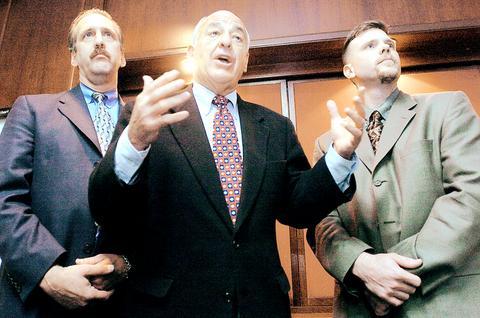
Forensic scientists, Timothy Palmbach, left, Cyril Wecht, center, and Michael Haag disclose their findings on President Chen Shui-bian's gunshot wound at a press conference at Howard Plaza Hotel yesterday.
-----------------------------------------
On March 31, 2004 ……
Referendum was no flop, President Chen says
CNA , TAIPEI
President Chen Shui-bian said in an interview with the Washington Post on Monday that Taiwan's first referendum, held alongside the March 20 presidential election, was not a flop, even though it failed to pass the 50-percent threshold required to make it valid.
Chen said more than 7.4 million eligible voters cast ballots in the referendum on two questions -- whether Taiwan should buy more anti-missile systems in the face of China's mounting missile threat, and whether Taiwan should negotiate a "peace and stability" mechanism for interaction with China.
"The number of referendum
ballots far exceeded the number of votes I received in the presidential
election," said Chen, who garnered 6.47 million ballots to secure a second
four-year term.
From this perspective, Chen said, the
referendum received a warm response and support from the general public.
Chen attributed the failure of the referendum mainly to the high threshold set by the Referendum Law. According to the law, a referendum will be considered valid only when at least half of the electorate casts a ballot. Under this rule, at least 8.2 million would have had to take part to make the referendum valid.
"If the formula used in the presidential election were to have been applied to the referendum, it would have been counted as valid," Chen said.
In the presidential election, the percentage was calculated on the basis of ballots that were actually cast, not on the basis of the number of eligible voters.
Chen said an opposition boycott of the referendum, coupled with China's intimidation, had adversely affected the participation rate.
"One other unfavorable factor was the layout of the referendum voting. I believe that many voters simply forgot to pick up and cast referendum ballots after they cast their presidential election ballots," Chen said.
In any event, Chen said he was glad to see the referendum proceed smoothly without any glitches.
"With this experience, we have taken a step forward in deepening our democratic system," he said.
The one-hour interview was conducted by David Hoffman, the Washington Post's diplomacy news editor, and Philip Pan, the paper's Beijing correspondent, at the Presidential Office. The interview was published in the paper's March 29 issue.
-----------------------------------------
On March 31, 2004 ……
Presidential Office blasts `Washington Post' for distortion
STAFF WRITER
Presidential Office Spokesman James Huang yesterday rebuked the Washington Post for distorting President Chen Shui-bian's words in a report published yesterday, the local media reported yesterday.
In the very first paragraph of the online version of the newspaper's interview with Chen -- headlined "Taiwan's President maintains hard line: Chen rebukes China in interview" -- reporters Philip Pan and David Hoffman wrote that "President Chen Shui-bian declared Monday that his narrow re-election victory was a mandate from voters to press ahead with an aggressive agenda to develop Taiwan as an `independent, sovereign country' despite the risk of war with China."
Huang said: "The content of the interview is correct. But the preamble of the report based on the two reporters' personal interpretation is not."
The newspaper reported: "Chen's defiant remarks signaled an intent to carry his campaign's tough line toward China into a second term despite the deep divide his approach has created in Taiwanese society."
-----------------------------------------
On March 31, 2004 ……
Military police says it didn't arm soldiers against rally participants
SECURITY MEASURES: The March 27 rally saw many people converge on downtown Taipei, but military police were not given live ammunition
By Brian Hsu,STAFF REPORTER
The military police command yesterday acknowledged that it sent a battalion of troops armed with live ammunition to reinforce security in the area around the Presidential Office during the March 27 rally organized by the pan-blue camp.
However, the command refuted charges by People First Party (PFP) lawmakers that the soldiers were to be used against the demonstrators. The command issued a press release yesterday afternoon in response to the legislators' allegations.
In the press release, the command said that throughout the rally, the troops remained at a nearby camp which houses the offices of the minister of national defense and chief of the general staff.
"These troops were sent to enhance the security of the offices of the defense minister and chief of the general staff. There were already military police guarding the Presidential Office and the president's residence which sits not far away," the command said.
"Among the reinforcements, only one platoon was armed with rifles and live ammunition. It was quite natural for armed forces to carry weapons to execute security missions," it said.
In a press conference at the Legislative Yuan, PFP Legislator Liu Wen-hsiung cited a copy of an order which he claimed was issued by the Ministry of National Defense's general affairs office on March 26.
Liu said the order came from Major General Wang Han-chi, deputy director of the general affairs office. The office handles mainly matters related to the defense minister's work.
Liu said the order asked the military police command to send a battalion of troops to the Poai special district, which covers the Presidential Office and the ministry's office on March 26.
The general affairs office declined to respond to the lawmakers' charges yesterday, leaving the rebuttal to the ministry's spokesman's office.
Spokesman Major General Huang Suei-sheng said that it is the responsibility of the police, not the military, to handle a situation such as the March 27 rally.
"Under no circumstances will the military use weapons against civilians," Huang said.
He made the remarks yesterday morning at the ministry's regular weekly press conference.
-----------------------------------------
On March 31, 2004 ……
Taiwan is in need of discerning media
By Peng Yun
In recent years, my study sponsored by the National Science Council has focused on the media, social capital and political trust. The basis of my hypothesis is that since the opening up of television stations in Taiwan, the plethora of TV talk shows that ensued have provided people who formerly had no way of making their opinions heard with a chance to participate in debates on public affairs, promoting the development of civil society.
However, over the last few years, we have seen talk show upon talk show appear on our TV screens, creating large numbers of celebrity hosts and guests, and this was even more apparent during the election period. But how much does this actually contribute to social capital? And has it improved political trust?
Western countries attached great importance to social capital at the end of the 20th century, with the belief that social divisions need not be resolved through violent confrontation. Instead, a democratic society should be based on the mutual trust and cooperation of everyone within the community. The media has the role of being a catalyst in this process, providing information to everyone in civil society. Therefore, even if differences do exist, conflict can be resolved by mutual trust through peaceful means, highlighting the essence of democracy.
Taiwanese cable TV news stations have gained fame and profit over the last few years, with relatively low running costs. All they need are a few SNG vans manned with low-paid youngsters right out of school, scouting the streets for anything newsworthy enough to push up their viewer ratings.
Chat shows will never be short of guests who know that sufficient exposure assures them celebrity status: you can see them every night, talking about everything and anything, desperate to come up with a fresh take on their subject.
During the election period the news channels stood to gain much from covering election rallies, but the damage this has done to social capital exceeds the benefits. The crowds that gathered outside the Presidential Office after the election added to a general feeling of foreboding and dissipated the trust that people had in certain institutions and individuals. Given this, what kind of social capital are the people of Taiwan to rely on in their quest for a civil society? And how are they to continue to put their trust in Taiwan's political institutions?
Of course, political leanings toward a particular political party or candidate are also common in the media of democratic countries in the West, but the news media should never lose sight of the principles of justice and objectivity.
Hate speech resulting from the Oklahoma blasts led to criticism and reflections within the academic world and the news media, and despite the fact that there are still echoes of it within the minority media and on the Internet, it is currently frowned upon within the mainstream media.
And the media in this country? How many political stances and demonstrations of emotion are we going to find within the newspapers? The superficiality and narrowness of the TV news, the subject matter of talk shows, together with comments by the hosts and countless guests, are all a far cry from what we should expect from the media in a civil society.
Taiwan is now at a turning point. The media have a responsibility to prevent Taiwanese society from sinking any further and put an emphasis on love and compassion. The media are, after all, a tool of society, and should publish and report more things beneficial to social capital, and restrict the reportage of any matters that could damage it.
Peng Yun is a professor in the department of journalism at the National
Chengchi University.
-----------------------------------------
On March 31, 2004 ……
The truth shall set you free
As the agitation following in the wake of the presidential election is subsiding, the pan-blue camp, which still hasn't conceded defeat, has demanded a full recount of the vote, the establishment of an independent committee to investigate the assassination attempt on President Chen Shui-bian and Vice President Annette Lu, and an investigation of the effects, if any, the activation of the national security mechanism had on the election. They have also filed a lawsuit to have the election declared invalid.
Dr. Henry Lee has agreed to assist in the investigation of the assassination attempt, and three of his assistants began a two-day investigation on Monday. Although Lee always has been a supporter of the pan-blue camp, Chen has welcomed Lee's participation in the investigation. We believe that Lee's international reputation and love for the truth will weigh heavier than his pan-blue proclivities, and that his team will proceed with professionalism and conscientiousness and set an example for scientific criminal investigations in Taiwan.
It's widely believed that the outcome of a recount may be disadvantageous to the pan-blue camp and they appear to be aware of this. As a result, before Chen announced last Saturday that he agreed to a recount as soon as possible, the pan-blue camp had already changed its demand for an instant recount. It had first demanded a re-election. But after the public responded negatively to the idea, the pan-blues switched their stance by saying that a re-election was not their true intention. They said that the results of a recount would be insufficient for them to admit defeat.
The pan-blues' methods are hardly a show of their sincerity about resolving the election dispute. No wonder their credibility is being increasingly questioned by the outside world, even as they convey the impression that Taiwan is mired in disorder.
As for the questions about the national security mechanism, these are a red herring. Discussion of the matter will be meaningless if experts can prove that the shooting was not planned by Chen himself.
The reason for this is that it is only appropriate to trigger the mechanism when a president and/or a vice president have been injured. National security is paramount. In this light, whether the military and police personnel are allowed to vote should not be the question at all.
If the assassination attempt turns out to have been a fake, however, then the discussion on this matter is even more irrelevant. If this were the case, Chen and Lu would have to step down and apologize.
However, a greater worry is that both
the pan-blue and the pan-green camps, knowing that the result is unlikely to be
overturned, might resort to manufacturing confusing questions to mislead the
public and creating social conflict in a nod to the December legislative
elections. The goal would be to court middle-of-the-road voters supporting the
pan-blue camp and to pave the road to power for some politicians. If partisan
interests blind people's judgment, then the nation's democratic development is
heading toward a cul-de-sac. The truth behind the assassination attempt, rather
than an extension of political confrontation, is what the people want.
-----------------------------------------
-----------------------------------------