20040402
=======
Chinese threat on April 2, 2004 ……
Congress hears US forces ready for Chinese threat
"To date, we've seen no
indication of an imminent military crisis." --- Admiral
Thomas Fargo, US Navy Commander of the US Pacific Command
By Charles Snyder, STAFF REPORTER IN WASHINGTON
The top US naval commander in the Pacific has told Congress that US forces are well-positioned to deal with any Chinese military activity aimed at Taiwan, but says that the US has not seen any indication of an immediate military threat in the period surrounding Taiwan's presidential election.
Admiral Thomas Fargo, the Navy Commander of the US Pacific Command, made his comments in testimony on Wednesday before a House Armed Services Committee hearing on defense budget issues and US security concerns in the Pacific region.
Asked about US forces' ability to deal with a miscalculation that could be "catastrophic" for Taiwan, Fargo said, "I'm pretty confident of our deterrent capability. Certainly, we're well-postured right now. We understand the problem. Our forces are well-trained. So our ability to dissuade and deter China, I think, is really very good."
He also noted that "we maintain a force posture and readiness and an ability to respond to contingencies that will ensure that should the president ask us, we can meet those responsibilities under the [Taiwan Relations Act]."
This act, enacted 25 years ago today, commits the US among other things to "maintain the capacity ... to resist any resort to force of other forms of coercion that would jeopardize the security ... of the people of Taiwan."
Fargo said that the Taiwan Strait is "a place where miscalculation could result in terrible destruction and poses a possibility of expanding into a wider regional confrontation," calling cross-strait issues "the largest friction point in the relationship between China and the United States."
He said his forces continue to watch closely the developments associated with the March 20 election.
"To date, we've seen no indication of an imminent military crisis," he said.
Fargo was asked whether Taiwan's desire for "increased autonomy and eventual independence" could spark a military confrontation between Washington and Beijing.
He refused to speculate on Taiwan's actions, but said "the most important thing is that we have to meet our responsibilities with respect to the Taiwan Relations Act as well as provide good advice to Taiwan as to how they improve their capability to defend themselves. And we're certainly doing that."
Committee chairman Duncan Hunter, a Republican, made Taiwan a central issue in the hearing, with an opening statement pointing to the March 20 election.
"The situation across the Taiwan Strait deserves our special attention because it's long been recognized as an international flashpoint," he said.
"The balance of power is changing across the Taiwan Strait" with China's continued military modernization, he said.
"Taiwan, on the other hand, continued cutting its defense budget," he said.
"These diverging military trends highlight a political problem in which China constantly seeks to strangle more assertive demonstrations of Taiwanese democracy lest the people of Taiwan decide that they don't want to surrender their rights in order to become part of greater China.
"Those trends are accelerating, undermining the fragile standoff that has secured peace across the Strait for most of the last 50 years," he said.
-----------------------------------------
On April 2, 2004 ……
Chen wants US to facilitate cross-strait talks
By Lin Chieh-yu, STAFF REPORTER
President Chen Shui-bian yesterday continued to clarify his stance on his campaign promise of writing a new constitution before the end of 2006, vowing that the constitutional reform has nothing to do with independence or changing the status quo.
Chen also expressed goodwill toward Beijing and said he would pursue "peaceful cross-strait relations," urging the US to play a more prominent role in facilitating the reopening of cross-strait dialogue.
The Presidential Office has granted a number of requests from foreign media to interview Chen during the past week, and it expects the international community would now better understand the government's policies and avoid making incorrect judgments.
In an interview published by the Asian Wall Street Journal yesterday, Chen again denied that his intention to create a new constitution is a step toward independence for Taiwan.
"My most important goal in my second term would be to foster peaceful cross-strait relations and stability and safety in the Asia- Pacific region," Chen said.
The newspaper said that Chen stressed that he would continue to abide by the pledge he made at the beginning of his first term to not declare independence.
"And of course we will not draw any country, especially the US, into a conflict in the Taiwan Strait," Chen said.
To break the deadlock in cross-strait relations, Chen said in no uncertain terms that the US should serve a "more active, constructive" role in bringing about dialogue across the Strait.
"The US government could be a `peace bridge,' helping facilitate cross-strait contact and dialogue and acting as consultant. It could be a peace angel," Chen said.
Almost all foreign media were concerned that a new constitution would be the last step on the way to Taiwanese independence, which may anger Beijing and lead to a war.
Chen said that the aim is to create a new constitution for fulfilling the country's "reality" and satisfying the public's expectations.
Neither the reunification nor the independence arguments would be touched on, he said.
As to the question whether the Democratic Progressive Party (DPP) would realize the majority of people's wish to change the name, flag and territory of the nation, Chen reaffirmed his resolution of maintaining the status quo.
Secretary general to the president, Chiou I-jen, has said many times in the media that he believes, "the Taiwanese people are wise enough to restrain themselves from taking the nation onto a dangerous road."
"In the past decades, every time the country needed to accomplish democratic reform, the people always performed rationally -- they know the bottom line," Chiou said.
"Therefore, we are confident that the Taiwanese people will demonstrate their wisdom during the process of creating a new constitution," he said.
-----------------------------------------
On April 2, 2004 ……
Tibet's `nowhere people' want their country freed
UNEASY EXILE: Thousands of Tibetan refugees pour into India every year, fleeing an oppressive Chinese regime at home and determined to free their country
REUTERS , MCLEODGANJ, INDIA
Jampa Norgay is 10 years old, an age at which he should be in school.
But the curly-haired boy has just spent a month trekking through treacherous snowy mountains and thick forests to escape from Tibet. He is now in a refugee center in northern India wondering where he goes next.
"My mother cried a lot when I left," said Norgay softly, tears welling in his eyes, as he sat on a grubby mattress in a small room surrounded by many tired Tibetan refugees just arrived after a long gruelling journey through the Himalayas.
"I miss my mother a lot."
Norgay joins about 80,000 Tibetans refugees living in India since their spiritual leader, the Dalai Lama, sneaked out of Lhasa in disguise 45 years ago after a failed uprising against Chinese rule.
Many live in the northern hill town of McLeodganj, a bustling little settlement where wizened monks with prayer wheels in their hands jostle for space with European and American backpackers clutching Lonely Planet guides.
Activists say some 2,500 refugees have been pouring into India from Tibet every year. From McLeodganj, they are sent to Tibetan schools, monasteries and settlements all over the country.
"Since most of them escape in winter, many of them suffer from frostbite when we receive them first in Kathmandu," said Mingyur Youdon, who manages the McLeodganj center. "They're also mentally devastated."
The refugees say they were forced to leave because of Chinese disregard of fundamental human rights, religious intolerance and cultural discrimination.
The walls of McLeodganj -- called "Little Lhasa" -- are plastered with posters that say "China: Get Out of Tibet" or "China's record in Tibet: More than a million killed, More than 6,000 monasteries destroyed, Thousands in prison, Hundreds missing."
"We're forced to flee because we have no Tibetan education in schools there, we're not allowed to follow our religion," said an angry shopkeeper, standing behind a pile of T-shirts with "Free Tibet" emblazoned on them.
"Our lives are tragic. It's the same story for thousands."
But living in exile isn't easy either.
Many Tibetans in McLeod-ganj, where Hollywood stars Richard Gere and Goldie Hawn are regular visitors, say they are running out of patience living as nowhere people in a nowhere land.
They have few jobs and can only make a living working for the government-in-exile or running handicraft shops and hotels.
"How long can we live like
this?" asked Shereb, a second-generation refugee whose father fled Tibet
decades ago but who has never been there himself.
"We want the problem resolved so
we can return to Tibet or move to the US where we're treated with more sympathy
and also have more job opportunities."
Many are also critical of the Dalai Lama's "Middle Way" approach seeking greater autonomy for Tibet instead of complete independence, and they call it a climbdown from the original aim of their movement.
Although a 46-member Tibetan parliament in exile this month endorsed the god-king's plans to seek a dialogue with China, many activists say they won't settle for anything but independence.
"We want to fight for complete independence," said Acharya Yeshi Phuntsok, the president of the National Democratic party of Tibet, the only Tibetan political party, though it has still to be recognized by the Tibetan government in exile.
"The Dalai Lama has changed his strategy because of circumstances."
The Dalai Lama says he is willing to negotiate with China but the Chinese still remain deeply suspicious.
"My side is always welcome ... I am always ready to meet them. What's their suspicion? Let me know," the Nobel Peace laureate told reporters at his heavily guarded home in McLeodganj, a near spiritual supermarket where you can learn everything from Tibetan cooking to yoga and meditation.
"There should not be any disagreement. But the Chinese accuse me of seeking independence. There's too much suspicion in them. The best way to eliminate suspicion is to meet face to face."
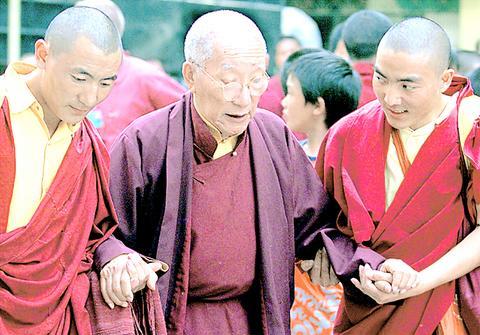
An elderly Tibetan monk, center, is helped by two monks to cross a road in Dharamshala on March 16. Activists say some 2,500 refugees a year have been pouring into India from Tibet.
-----------------------------------------
On April 2, 2004 ……
Taiwanese with ties to China must look within
By Wong Ping-yun
I am very disappointed, as a second-generation Mainlander in Taiwan, at the recent comments by the Coalition for Equal Opportunity. I think the coalition's opinion on Taiwan's ethnicity problem only spotlights superficial harmony and lacks a deep reflection on history. From their perspective, it seems that anyone who proposes to examine ethnic inequality in Taiwan's history is guilty of accumulating ethnic hatred and escalating antagonism. I strongly oppose such thinking.
I think the key to easing ethnic tension lies in the Mainlanders' attitude. Politically and economically privileged in the past, Mainlanders should engage in public and continuous reflection and discussion of the inequalities of their past rule over other ethnic groups like Hoklo (more commonly known as Taiwanese), Hakka and Aboriginals. Also, politicians of Mainlander ancestry should educate and guide their Mainlander supporters to reflect on the privileged status they have enjoyed for a long time and not haggle over whether they are treated equally or misunderstood by other ethnic groups.
As my age and learning increase, I gradually realize how my status as a child of a serviceman led to my being treated better by the government than other ethnic groups because the government did not fairly distribute social welfare resources. At the same time, I have also recognized that, under the hegemonic Chinese culture at the center of which is the Mainlander group, Mainlanders often involuntarily reveal a superiority complex while Hoklo, Hakka and indigenous cultures are distorted and marginalized.
Admittedly, not all Mainlanders have enjoyed vested interests and a privileged status. There are also quite a few Mainlanders opposing "cultural hegemonism." However, to wash off the historical sediment of past ethnic injustice requires more energy and effort from the Mainlanders. Which politician of Mainlander ancestry is willing to stand up to oppose the preferential interest rate, a policy that distorts an equal distribution of social welfare, and the proposal to rebuild the veterans' communities?
What disheartens me more is that quite a few Mainlanders (and among them are many of my father's friends) still misunderstand and hold a grudge against Taiwan's democratic movement.
More than 10 years ago, I participated in a student demonstration and my kind father was suddenly beleaguered with blame from his friends. They claimed my father had not fulfilled his duty to educate his son and urged my father to repent for this piece of negligence. Amid this storm of criticism, my father, with tears running down his cheeks, warned me not to support the Democratic Progressive Party (DPP) anymore, saying that someday the DPP would kick him and his friends back to China.
Surely, we Mainlanders did not choose to put ourselves in such an embarrassing position in history. We did not ask for privileges or deliberately antagonize others. Instead, we were made flag-waving and slogan-chanting puppets of the former authoritarian regime. This is a tragedy.
However, if Mainlanders can look closely at their situation, willingly shoulder the burden of historical mistakes and redress collective ethnic injustice, we will be able to transcend the destiny wrought by history and blood-ties. Then, we will taste the sweet fruit of true freedom.
Only by opening the scar and
re-cleansing the wound can the festering sore be healed. Inward-looking
reflection, I believe, is a better way to promote ethnic equality than the
"alliance through blood donation" praised by the Coalition for Equal
Opportunity.
Wong Ping-yun is a lawyer.
-----------------------------------------
On April 2, 2004 ……
Pentagon okays sale of long-range radar system
KEY DEFENSE: The new early-warning equipment could prove invaluable in case a sudden military attack is launched against Taiwan from any country
AGENCIES , TAIPEI
The US Defense Security Cooperation Agency has approved the sale of long-range radar systems to Taiwan -- equipment that could be key in defending the country against a missile attack from China.
The proposed sale of the early- warning systems, approved this week, comes as China is pressuring Washington to minimize its ties with Taiwan. Beijing has reacted angrily to such deals in the past.
The radar package, priced at NT$58.55 billion (US$1.77 billion), would help Taiwan "identify and detect ballistic missiles, cruise missiles and [other] threats," the agency said in a notice posted on its Web site.
The agency -- part of the US Department of Defense -- evaluates foreign requests for weapons sales and advises whether they'd be consistent with US law and policy.
The two largest companies expected to bid on the deal were Raytheon Co of Tewksbury, Massachusetts, and Lockheed Martin Corp of Syracuse, New York, the agency said.
The Ministry of National Defense traditionally doesn't discuss weapons deals that aren't final, and officials declined to comment on the proposed radar sale.
The full radar package would also include missile warning centers, facilities to house and maintain the radar and training programs, the agency's statement said.
The sale of the equipment "will not affect the basic military balance in the region," the statement said.
The radar "will contribute to the foreign policy and national security of the United States by helping to improve the security and defensive capability of the recipient, which has been and continues to be an important force for economic progress in the Far East," the agency said.
In response to the arms-sale report, China has urged the US to avoid any official contact with Taiwan and stick to a "one China" policy, Xinhua news agency said yesterday.
Chinese Foreign Minister Li Zhaoxing made the comments when he met US Secretary of State Colin Powell in Berlin, Xinhua said, apparently before the Pentagon announced the sale.
"Describing the Taiwan issue as the most sensitive and important question in Sino-US relations, Li said the United States should adhere to the one China policy ... and oppose Taiwan independence," Xinhua said.
"The Chinese foreign minister urged the United States to refrain from any official contact with the Taiwan authorities," Xinhua said.
"Powell said the United States values its relations with China and is willing to make joint efforts with China for the continued development of bilateral relations," Xinhua said.
US Vice President Dick Cheney is scheduled to visit China this month while Chinese Vice Premier Wu Yi will visit the US.
Powell said the US would "continuously uphold the one China policy," Xinhua reported.
-----------------------------------------
-----------------------------------------