20040404
=======
Pan Blue rallies on April 4, 2004……
KMT calls an end to pan-blue rallies
NO MORE: On the day a large crowd of
pan-blue supporters descended on CKS Memorial Hall to protest the election, KMT
officials said protesters will stay at home after April 10.
By Cody Yiu, STAFF REPORTER
One day after Taipei Mayor Ma Ying-jeou spoke out against the pan-blue camp's threat to hold mass demonstrations every week until inauguration day, Ting Shou-chung, director of the KMT's Organization and Development Affairs Committee, yesterday said an April 10 rally on Ketagalan Boulevard would be the pan-blue's last.
"Holding protests day in and day out is not the way to go," Ting said. "There are many other ways to fight, such as holding press conferences, public hearings and through the legislative and the judicial system. I am not saying that April 10 will mark an end to all rallies, but it is impossible for the pan-blue camp to a hold a rally on a weekly basis."
The presidential inauguration is scheduled for May 20.
On Friday Ma said he supported Taipei police's decision to decline a pan-blue application for rallies in front of the Presidential Office after April 10.
"According to a poll, the public doesn't support non-weekend rallies," Ma said. "But whether the proposed weekend rallies will be supported by the public depends on the rallies' appeal."
According to media reports, Ma has been against pan-blue street demonstrations urging President Chen Shui-bian to agree to a ballot recount and the establishment of an independent task force to investigate an assassination attempt on the president in Tainan the day before the election.
Yesterday afternoon the pan-blue camp held its second post-election rally at CKS Memorial Hall, drawing a large crowd thanks to some better weather.
Police said 40,000 attended the rally, according to AFP, however AP estimated the figure to be much lower.
Chinese Nationalist Party (KMT) Chairman Lien Chan again urged Chen to form a task force to investigate the shooting which injured both the president and Vice President Annette Lu (呂秀蓮).
"The truth behind this ambiguous shooting incident needs to be revealed, and we urge President Chen to form a task force to investigate the shooting as soon as possible," Lien told supporters.
People First Party (PFP) James Soong and Ma also delivered speeches. However, KMT Legislative Speaker Wang Jin-pyng, who is also the director-general of the pan-blue national campaign headquarters, was not able to attend the rally as he was in Kaohsiung to discuss December's legislative election.
"The rally at CKS Memorial Hall was scheduled only four or five days ago, but this trip to Kaohsiung was slated a long time ago," Wang told reporters earlier.
A group of eight university students have been on hunger strike at the memorial hall since Friday in a silent protest against corrupt politicians.
"We are neither pro-green nor pro-blue; we are protesting against politicians who push for the idea of an ethnically divided country, as well as those who use dirty tricks," said a statement released by the students.
Exiled Chinese dissident Wuer Kaixi paid a visit to the students yesterday, offering them his support.
"On behalf of the students who once sat in Tiananmen Square, I want to say that what you are doing for social justice is very admirable, " Wuer said.
When the rally officially ended at 6pm, a group of protesters, led by former Taipei city councillor Chung Hsiao-ping, headed for Ketagalan Boulevard to continue the protest.
The group trampled over security fences put in place to keep the rally away from the Presidential Office, however, as of press time, no other incidents had been reported.
-----------------------------------------
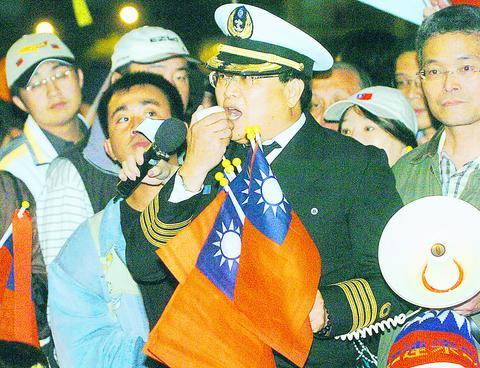
A man surnamed Liao speaks to protesters on Ketagalan Boulevard last night. He claimed he had been deprived of his right to vote in the March 20 presidential election and encouraged servicemen to leave their bases to protest the ``unfair election.'' The Navy later announced that he was a retired captain.
-----------------------------------------
On April 4, 2004 ……
KMT's finances in dire straits, newspaper claims
Speculation over a financial crisis inside the Chinese Nationalist Party grew after the party told employees that this month's salaries would not be paid on time, Chinese-language media reported yesterday.
A Chinese-language evening newspaper said that the KMT was seeking to raise funds from party members to see itself through a lean period.
Kao Chin-yen, chief executive officer of Uni-President Enterprise Group and a member of the KMT's Central Standing Committee, was quoted by the newspaper as saying he was willing to offer a loan to the party.
It is customary for the KMT to pay its employees on the first day of the month, but the April salary was delayed. It's the second time the KMT has delayed salaries since it lost power in 2000.
"This is because we spent a lot of money on election campaigning in March and that has affected the management of the party's funds," KMT Administration and Management Committee Director-General Chang Che-shen was quoted as saying.
He added that the party was planning to urge its supporters to provide donations.
"On average the KMT has to pay NT$150 million to its employees a month, and if we also count in the retirement pension for the retired employees, then we need at least NT$200 million a month to straighten out everything," Chang was quoted as saying.
Chang said that KMT's main income was from its membership fee, which is NT$500 a person per year. Chang said, however, that the party never gathered the fee in full.
"Income generated from donations is not much due to the impression that the KMT is rich," Chang was quoted as saying.
KMT officials said that the employees will be paid their salary in full tomorrow.
According to the evening paper, the KMT only managed to raise between NT$300 million to NT$400 million for the presidential election, with the party covering its costs by selling shares and party assets.
The KMT is now facing huge debts in the wake of the election, the evening paper said.
"To deal with the financial crisis, we have to investigate the feasibility of layoffs again, and find new sources for income at the same time," Chang was quoted as saying.
In 2000, financial magazine Wealth Monthly estimated the KMT's assets as standing at US$17 billion.
-----------------------------------------
On April 4, 20004 ……
Pan-blues' ineptness on shooting is pathetic
By Dave Lindorff
The pan-blue post-election effort to reverse the voters' decision has stumbled badly over the issue of the attack on President Chen Shui-bian and Vice-President Annette Lu, but much of the Taiwanese media has missed it.
Chinese Nationalist Party (KMT) Chairman Lien Chan and People First Party (PFP) Chairman James Soong tried to raise doubts in the public's mind about the integrity of the investigation into the March 19 shootings in Tainan by demanding that outside experts examine the evidence and monitor the investigation itself. They recommended the well-respected criminologist Henry Lee of the Connecticut State Police crime lab.
Lee dispatched three experts to visit the crime scene, review the evidence, interview witnesses and check out the Criminal Investigations Bureau and Tainan prosecutors' investigative efforts.
The team did all that and more, even obtaining permission to examine Chen's wound.
Their conclusion: Chen and Lu indeed appear to have been shot on March 19, and at the time that cameras and witnesses suggest they were shot. One of the experts, Allegheny County, Pennsylvania, Coroner Cyril Wecht -- who was highly critical of the controversial Warren Commission investigation of the 1963 assassination of former US president John Kennedy -- said: "Everything is completely consistent -- no discrepancies, nothing strange." He said that the president's wound "is completely consistent with a gunshot wound," and added that the investigation of the incident was being conducted in a "completely open way -- not the way it was done in 1963 in America."
If that is the case, and given who invited Wecht and his colleagues into this investigation in the first place (a point not mentioned in most media reports), one has to wonder at Lien and Soong's further demands. Why the need for another "independent" investigation of the shootings if the current investigation is being done openly and handled well according to their own experts?
Meanwhile, if the investigation so far suggests that the shooting was a genuine attack on the president and vice president, how on earth can the pan-blue team claim, as they are now doing, that the decision to put the military and police around the country on alert was simply a political scheme to keep soldiers and cops from voting? I would argue that had the government not put the military and police on some kind of higher alert status following the attack, it would have been at best derelict, and at worst, open to the suspicion that somebody knew the shootings were bogus.
I can state with some confidence that if the president and vice president of the US were shot and wounded at the same time, and if the perpetrators were not immediately caught, the US would be on a high state of alert. (Why do people think US Vice President Dick Cheney has spent most of his time since Sept. 11 in hiding?)
Certainly there are questions that should be answered: Who came up with the foolish idea of having Chen and Lu repeatedly appear in public together? And who could have come up with the equally foolish idea of having them ride down crowded streets in an open jeep?
But at this point, continuing to charge that the shootings may have been staged, as the pan-blue leaders are doing, is nothing but dangerous demagoguery.
A recount in such a close election, carefully monitored and openly done under court supervision, makes absolute sense.
As for the rest of the pan-blue demands, charges and insinuations, they should be seen clearly for what they are -- the desperate ploy of people who have lost but won't admit it.
Dave Lindorff is a Fulbright Senior Scholar in residence at National
Sun Yat-sen University.
-----------------------------------------
On April 4, 20004 ……
Out of crisis comes opportunity
`The ridiculous thing is this -- politicians from the pan-blue camp are apparently unable to stop themselves from threatening protests.'
After the presidential election, the three major demands of the Chinese Nationalist Party (KMT)-People First Party (PFP) alliance -- a recount of the votes, an investigation into the so-called "truth" behind the shooting of the president and the vice president and an explanation of the so-called "national security mechanism" that was triggered by the shooting -- were all agreed to by President Chen Shui-bian.
All these matters have now come under judicial investigation.
The secretaries-general of the two major camps began an official dialogue this week.
It is generally believed that the truth is about to come out. But in times like these, both the ruling and the opposition camps should patiently wait for the final results of the judicial proceedings.
They have an even greater responsibility to address the ethnic rivalries that the election triggered and return society to peace and harmony.
However, on Wednesday, KMT Secretary-General Lin Fong-cheng demanded that the Presidential Office provide a quick response to his camp's demands, saying the government "should not underestimate the power of the people."
Ting Shou-chung, director of the KMT's Organization and Development Affairs Committee, said in a harsh tone that if the administration did not immediately meet the pan-blue camp's demands, many people wouldn't be able to wait until May 20 and that the KMT-PFP alliance would mount another massive rally in front of the Presidential Office.
By then, he said, "the situation may not be as sensible as last time."
Such stern and hawkish talk by the KMT-PFP alliance added a level of uncertainty to the somewhat eased political tensions, casting a shadow in the minds of people.
After the election, the KMT-PFP alliance alleged that the election had been unfair and mobilized mass rallies in protest. The emotional crowds not only took over the square in front of the Presidential Office but stormed various government buildings in Kaohsiung, Taichung and Taipei.
Some radical lawmakers even stated that "the trumpet of the revolution has been heard." China's Taiwan Affairs Office said that China will "not sit idly by" in the event the situation in Taiwan gets out of control. All these things together produced a sense of disquiet on the eve of the KMT-PFP rally on March 27.
This disquiet created serious division and polarization. Among friends, co-workers, neighbors and even within families, people fought with and distrusted each other as a result of their different political stances. Society faced a grave risk of serious damage.
The protests in the old days were made to challenge the totalitarian government and fight for democracy. Now, the protests inflamed by politicians are causing people to break up into two camps.
With such hatred and grudges among people, once conflicts ignite, fighting could bring everyone to a destructive end. Except for China, which will be able to benefit from this, no one in Taiwan can escape a tragic destiny if such divisions truly erupt. Therefore, with the March 27 rally having come to a peaceful end, and the crowds in front of the Presidential Office having located elsewhere, allowing order to be restored, we believe that every politician who genuinely loves Taiwan will listen to the voices of the majority of the people with a humble heart and avoid taking the country down the path of destruction.
The ridiculous thing is this -- politicians from the pan-blue camp are apparently unable to stop themselves from threatening protests. They are getting ready to launch more protests at a time when their supporters are calming down, threatening that "the situation may not be as sensible as last time." This seems to suggest that they couldn't care less whether confrontations result -- as long as the demands of the pan-blue camp are met.
We understand that some hawkish members of the pan-blue camp think that maintaining social order is the responsibility of the ruling party, and that the pan-blue camp -- as the opposition, no longer in a suit and tie -- should not care about the underlying social costs of their protests. This kind of logic reveals that the opposition gives priority to party interests over the interests of the country.
Though the opposition can cast aside concerns about social costs, it will pay a hefty price as well: legal liability for one thing and political responsibility for another. If the mass protests result in bloodshed, those who led the protests will have to face the legal consequences. They will not be entitled to "legal immunity" merely because of their belief that "the truth is with us."
Politically, most people find it hard to accept the costs created by disorderly protests -- such as social unrest, violations of the law, withdrawal of foreign capital, a decline in consumption and in the stock market, depreciation of the NT dollar, injuries to the nation's image in the international community and a decrease in overseas tourists -- regardless of whether the protests have any legitimacy.
By forcing people to pay these costs, the opposition may remain in the opposition indefinitely, becoming despised or even vanishing altogether.
Therefore, if the opposition is truly thinking about a comeback, it must remain socially responsible. The word "opposition" is no excuse for acting irresponsibly.
People can understand how the pan-blue camp must feel about suffering a defeat by such a narrow margin. However, frankly speaking, all the allegations by the pan-camp about the election being unfair, thus far, are made purely out of emotion and are based on unverifiable rumors. The pan-blue camp has failed to submit any concrete evidence to prove illegality in the election.
Elections in Taiwan are not only administered in a transparent and open manner, but all parties are entitled to send people to monitor and supervise the process. The more than 200,000 front-line election administrators are all civil servants and teachers. Under the circumstances, the impartiality in the administration of the election is beyond question. To say otherwise is a personal insult to these election administrators. While some may have made careless mistakes in the performance of their duties, allegations of their tampering with the ballots are pure nonsense.
As for the shooting of the president, while the motives of the shooter or shooters may be unclear, the investigation by the police and the information provided by the hospital where Chen was treated should have been sufficient to dispel any allegations that Chen fabricated the shooting. The suspicions of the KMT-PFP alliance are not reasonable suspicions at all but instead are derived from hatred and dissatisfaction with certain individuals.
Despite the fact that the legitimacy of the pan-blue camp's protests is so shaky, a majority of the people nevertheless has been tolerant toward the mass rallies. As for the pan-blue camp's three major demands and its shifting and escalating requests, Chen could have ignored them but he willingly cooperated with them. This is because most people have swallowed their anger, decided to be forgiving and to remain silent in hopes of facilitating social harmony for the good of the country.
Now that the judicial process has begun and all the disputed issues are expected to be resolved, the KMT-PFP alliance should be more appreciative of the patience and tolerance of the great majority of the people and rely on peaceful and rational means to advance their cause.
Relying on legal mechanisms to resolve disputes, rather than inflaming the emotions of crowds and inciting them to take to the streets yet again, is the way to facilitate truth, fairness and righteousness.
Turn a crisis into an opportunity, so that the people of Taiwan can enjoy peaceful and stable lives.
-----------------------------------------
On April 4, 20004 ……
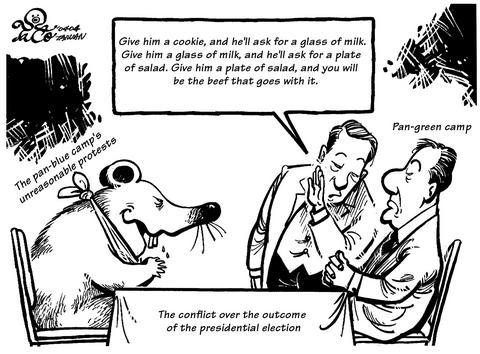
Stop braying and start paying
The first court hearing in the suit filed by Chinese Nationalist Party (KMT) Chairman Lien Chan and People First Party (PFP) Chairman James Soong to declare the result of the presidential election null and void took place on Friday. However, it only revealed that a speedy resolution of the dispute is just not going to happen.
Apparently the KMT-PFP alliance has again changed its mind -- now, instead of a total recount of the votes, it wants a partial recount of only those votes cast for President Chen Shui-bian and Vice President Annette Lu.
This news came as a surprise even to the alliance's most loyal supporters -- those who have been chanting "immediate and total recount" for two weeks at rallies that have been taking place at the Chiang Kai-shek Memorial Hall or in front of the KMT headquarters. Reportedly, some of them couldn't help but ask, "Isn't it more fair to have a total recount?"
Indeed, leaving aside the sense of frustration that the KMT-PFP alliance's indecisiveness has produced, the popular consensus built since the election has been for a total recount, not a partial recount. It was due to this overwhelming public expectation that Chen and Lu waived their legal rights and agreed to a total recount. Otherwise, according to the Presidential Election and Recall Law, Lien and Soong would only be entitled to a partial recount of the votes cast at individual voting stations, and only if they could submit evidence to prove the votes had been tampered with.
Moreover, no one who genuinely wishes to resolve all disputes regarding the votes once and for all can be satisfied with a partial recount, which would forever leave the country under a cloud of skepticism about the election result. A partial recount could only be bad for the stability of the country.
Besides, during the hearing on Friday, Lien and Soong's attorneys charged that the numbers of votes cast for the two camps had been erroneously reversed in some cases. In order to verify whether that accusation is correct, the votes cast for both camps would of course have to be recounted. Otherwise, the recount would be meaningless.
The main reason that the KMT-PFP alliance is asking for a partial recount is that it is unwilling to fork out money for the enormous expenses that would be entailed in a complete recount. According to KMT Secretary-General Lin Fong-cheng, if the Democratic Progressive Party (DPP) wants a recount of the votes cast for Lien and Soong, the pan-blue camp will give its consent -- meaning that the DPP will have to pay for it.
Since Chen and Lu are the defendants being dragged into this lawsuit and are cooperating out of good faith, the pan-blue camp just doesn't seem to be playing fair. This is not to mention that since, according to current law, the party losing the lawsuit will have to pay for a recount when all is said and done, all these calculations and conniving about who should pick up the bill just seem like a waste of time.
Moreover, it isn't as if the KMT-PFP alliance does not have the money to pay for a recount. Leaving aside its own great wealth, it is receiving around NT$200 million (US$6.06 million) from the government -- NT$30 for each vote garnered -- as a campaign subsidy.
Finally, since the alliance can afford to run whole-page ads in major newspapers on a daily basis to make wild allegations against the government and the president, it is hard to believe that it cannot pay for a recount.
-----------------------------------------
-----------------------------------------