20040405
=======
Ma’s statement on April 5, 2004 ……
Ma equivocates on upcoming protest
"Since it was the Taipei Police
Bureau which approved the rally, I think it is also up to the bureau whether to
cancel the rally." --- Ma Ying-jeou, Taipei mayor
MOB JUSTICE: The Taipei mayor said violence at a rally Saturday night was unfortunate, but did not say whether he would put a stop to a similar protest planned for next weekend.
By Jewel Huang, STAFF REPORTER
Taipei Mayor Ma Ying-jeou equivocated yesterday on whether he would revoke a permit for a pan-blue rally next Saturday.
Despite violence at last Saturday's rally, Ma said the decision was up to the Taipei Police Bureau.
The bureau is an arm of the city government, which is run by Ma.
"The Constitution endows people with the freedom to hold rallies and parades. Since it was the Taipei Police Bureau which approved the rally, I think it is also up to the bureau whether to cancel the rally," Ma said at a news conference yesterday.
Ma also said the Cabinet interfered with the city government's efforts to disperse the crowd Saturday night and accused it of abusing its authority.
"The Cabinet's requests to disperse the crowd only caused more conflicts," Ma said.
Police began to break up the crowd of about 1,200 at about 1:30 am yesterday. The move came after the crowd was warned five times to leave and protesters trampled security fences outside the Presidential Office.
After Chungcheng First Precinct Chief Wu Su-lu gave the order, nearly 1,500 police officers equipped with helmets and shields pushed forward, clashing with the crowd, which threw bottles, flagpoles and traffic signs at police.
The police carried or dragged away people who refused to leave the scene. About 15 people and three police officers suffered injuries and about 150 people were arrested.
Some of those who fled to the Chinese Nationalist Party's (KMT) headquarters were also arrested. Most of them were released after interrogation.
Unlike when police dispersed a crowd on March 28, police appeared to be running out of patience with the protesters yesterday morning and shouted back at those trying to provoke them.
Ma said he felt sorry to see protesters and police injured. He said the bloodshed was the result of protesters who were not organized, adding the situation was more complicated than at the rally the week before.
"We are still unclear about who caused the turmoil. But it was fortunate that only a few people were hurt and their injuries were not serious," he said.
Ma said he asked police to use shields and batons to disperse the crowd rather than water cannons, because water cannons would have led to a more severe outcome.
He said the Taipei Police Bureau's work went according to plan and denied accusations by the Ministry of Interior that the enforcement order was delayed.
"I don't understand why the Cabinet has such different interpretations of the city government's dispersions yesterday and last week since the Taipei Police Bureau took the same measures on both occasions," Ma said.
When asked whether the KMT-People First Party alliance should take responsibility for the turmoil, Ma said he felt some political figures could not avoid shouldering political responsibility but refused mention anyone by name.
Minister of the Interior Yu Cheng-hsien said he wanted to remind Ma not to delay breaking up the protest since the rally was illegal, adding that, as minister, he is responsible for public security.
-----------------------------------------
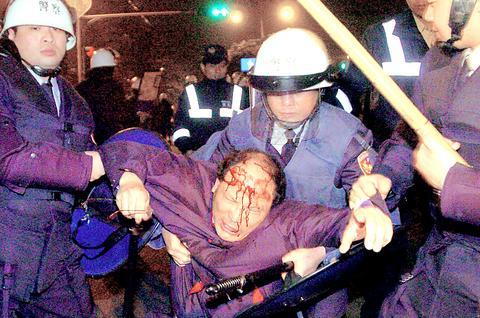
Police drag away a protester as blood trickles down his head during a riot on Ketagalan Boulevard yesterday. Police took action to disperse the crowd, which was protesting illegally, early yesterday morning.
-----------------------------------------
On April 5, 2004 ……
Cabinet calls on city to revoke demonstration permit
By Ko Shu-ling, STAFF REPORTER
The Cabinet plans to ask the Taipei City Government to revoke the permit for a demonstration by the pan-blue camp next Saturday, arguing the rally might get out of control.
"We'll issue a letter to the city [today] requesting that it invalidate the application already approved by the city's police headquarters," Cabinet Secretary-General Liu Shih-fang said.
The blue camp held a demonstration last Saturday that ended in violence.
The alliance says next Saturday's rally on Ketagalan Boulevard will be its last.
Liu said she phoned Taipei Mayor Ma Ying-jeou at around 9pm Saturday to express the Cabinet's wish that the city "handle the illegal mass demonstration outside the Presidential Office in accordance with the law."
She said that she told Ma the city should consider revoking the pan-blue alliance's permit for next Saturday's rally given that there were problems with last Saturday's protest.
"Mayor Ma repeatedly told me not to worry about it," she said. "I told [him] the premier was very unhappy about how the city had handled the matter when I called him again at around 1:45 [yesterday morning], a few minutes after city police started to scatter the crowd by force."
The crowd was supposed to disperse from the Chiang Kai-shek Memorial Hall by midnight but instead proceeded illegally to the Presidential Office and clashed with police.
After failing to persuade the crowd to disperse, municipal law enforcement officers resorted to force at around 1:30am. The crowd then proceeded to the nearby headquarters of the Chinese Nationalist Party at around 5am.
Minister of the Interior Yu Cheng-hsien, who is responsible for the National Police Administration, faxed a personal letter to the city government requesting that municipal police disperse the crowd before 1am or move aside to let national police do the job.
The city and the minister's office held three press conferences within an hour early yesterday morning to criticize each other.
The city argued that the ministry did not have the right to give orders to the special municipality, whose administrative status is on a par with the that of the ministry. The ministry, however, said the central government was merely trying to help.
Liu also confirmed yesterday that Yu Cheng-hsien had tendered his resignation to Premier Yu Shyi-kun in person at noon yesterday but may agree to stay on until next month, when the premier will lead Cabinet officials to resign en masse in accordance with the Constitution.
"The premier is considering the minister's resignation and the overall Cabinet line-up," Liu said.
According to Liu, Yu Cheng-hsien offered his resignation verbally on March 19, the day of the attempted assassination of President Chen Shui-bian.
Yu Shyi-kun, however, had persuaded Yu Cheng-hsien to stay on because of the upcoming presidential election.
Yu Chen-hsien is scheduled to hold a press conference today at which he is expected to express his determination to leave.
-----------------------------------------
On April 5, 2004 ……
The referendum and democracy
By Ku Er-teh
The referendum, at first considered an attempt by President Chen Shui-bian to attract voter support, failed in the end because less than 50 percent of voters chose to participate in the vote.
Although the Taiwanese people have long dreamed about holding a referendum, the first national referendum failed, before the eyes of the whole world. The reasons for this failure were that some people suspected a link between the referendum, independence and self-determination; that the dispute over the legality of the referendum created public opposition to it and that the referendum questions really weren't very exciting.
Chen's announcement immediately after the legislature passed the Referendum Law last November that he would hold a defensive referendum together with the presidential election became a constant source of conflict. Apart from the confusion and conflict in the months leading up to the referendum, what other effects has the referendum had on society? Has it really promoted a deepening of democracy?
The best way to answer these questions is to look at the different positive and negative opinions and the further debate incited by these opinions.
There are several different opinions in support of the referendum. First, from the Democratic Progressive Party's (DPP) perspective, it helps political mobilization. Second, it helps consolidate a collective public awareness. Third, it can be used to demonstrate the power of Taiwan as a whole to the international community and as a means to firmly establish Taiwan's international position and guarantee its national security. Fourth, it helps create space for public participation in the debate on public issues, thereby creating a bottom-up democratic and participatory decisionmaking process as well as a true deepening of democracy.
The doubts concerning the referendum can be roughly divided into several different aspects. First, the short-term motive for the referendum was to attract voter support, thereby diminishing the highest of democratic rights into an appendix to a presidential election. Second, the long-term motive was to pave the way for a referendum on independence, which would attract pressure from China and the international community and create confrontation over national identification and ethnicity domestically. Third, issues concerning the legality of the referendum. Fourth and most crucial, are the doubts arising out of considerations regarding the relationship between political power and society in a sovereign nation, ie, the social democracy could have been controlled by the state to influence referendum performance.
It is not difficult to see how the referendum involves a wide range of aspects, from the most realistic political mobilization, international relations, constitutional and legal issues, the fundamental character of democratic constitutional politics and consolidating social-emotional awareness, to the possibility of implementing social democracy. All these complex issues have appeared amid the conflict over the referendum.
The first setback for Chen in his push for a March 20 referendum was having to face international political pressure. The US and Japan, two countries important to Taiwan's national security, have aired doubts concerning the referendum, thus putting pressure on Taiwan. This is why the two questions finally presented by Chen were so neutral in character.
The referendum succeeded in consolidating a certain level of social-emotional awareness. One good example of this was the 228 Hand-in-Hand Rally, when over 2 million people joined hands to say "No" to China and "Yes" to Taiwan. But then the 313 rally also gathered almost 2 million people to say "No" to Chen, which is evidence that the use of national security and international status to consolidate the emotions of the people is not acceptable to everyone.
The issue that has engendered the most lively discussion has been the question of the legality of the referendum. Almost every aspect of the law has been discussed, but the debate has been restricted because neither law nor formal logic touches upon the more fundamental issues. Further exploration appears impossible since both the government and the opposition are unwilling to ask for a constitutional interpretation of the issue. However, this situation is bringing two positive results:
First, the public debate allows the public to gain a deeper understanding of the law. Second, Chinese Nationalist Party (KMT) legislators have proposed an amendment to the Referendum Law aimed at restricting the president's right to initiate a referendum. Whether or not this is reasonable is a problematic issue, which at the very least will lead to further discussion.
The theory that the referendum deepens democracy is the referendum proponents' most forceful argument. Has the referendum process had this effect? An attempt at finding the answer in the televised debates between various well-known orators will end in disappointment. However, the public debate in the media regarding the legality of the referendum was one of the positive effects the issue has had. In addition, the first referendum question about strengthening national defense has indeed led to reflection on the arms race terror balance, as well as the question of whether anti-missile equipment is effective.
The dispute has also led to deeper reflection on whether the referendum will bring about a bottom-up process for public participation in decisionmaking, or, as sociologist Wu Jieh-min said, whether the referendum will become a social movement of sorts and be transformed into a force for public participation in reform.
On the other hand, Chien Yung-xiang, a scholar at the Academia Sinica, has asked: "In which modern country would social movements be allowed to set the political agenda?"
The failure of the referendum is evidence that an attempt to win public recognition using a top-down referendum model requires more cautious deliberation. But are bottom-up referendums a possibility in Taiwan? At least, public debate has entered a stage of deeper deliberation and debate. What now remains is a practical test.
Ku Er-teh is a freelance writer.
-----------------------------------------
On April 5, 2004 ……
KMT says it did not control protesters
IN DENIAL: The pan-blue camp tried to
distance itself from the clash between demonstrators and riot police yesterday
as supporters complained of a lack of support.
By Huang Tai-lin, STAFF REPORTER
In the wake of the violent clash between Taipei police and pan-blue supporters on Ketagalan Boulevard early yesterday morning, Chinese Nationalist Party (KMT) Secretary-General Lin Fong-cheng said the opposition camp had no control over people who had not been personally mobilized by the alliance.
"The alliance, along with its political ally, the New Party, did its best to mediate by advising people against illegally gathering in front of the Presidential Office," Lin said. "However, we had no control over people who were not mobilized by the alliance."
A number of pan-blue supporters yesterday complained that the leaders of the KMT-People First Party (PFP) alliance had offered them no support or even words of comfort after their clash with the riot police.
Looking weary after a night of scuffles with the police, protesters seeking a moment of rest at the KMT national headquarters, which is situated across the boulevard from the Presidential Office, yesterday voiced their dissatisfaction with the attitude of the KMT-PFP alliance.
"It [the alliance] wanted us to come, we didn't come here on our own," a 40-something pan-blue supporter said at the KMT national headquarters.
"We rely on [the alliance] to support us, how can they just leave us like that?" he said.
Other protesters at the KMT headquarters complained that they had lost personal items such as eyeglasses, mobile phones or shoes in the scuffle.
Many supporters said they thought they were carrying out the alliance's wishes and furthering its cause by gathering in front of the Presidential Office. Some said the absence of any alliance representatives after their clash with the riot police filled them with anger and annoyance.
"We are here fighting for you [the alliance,]" an army veteran surnamed Wang said.
"[KMT Chairman] Lien Chan and [PFP Chairman] James Soong should brace themselves and step forward. They should not cast away ties with us," Wang said.
The alliance should not simply claim that the whole brawl on Ketagalan Boulevard had been a spontaneous act by supporters and that the pan-blue-leadership had nothing to do with it, he said.
Although a number of KMT legislators have questioned the wisdom of holding further street demonstrations to increase pressure on President Chen Shui-bian, Lin said the alliance has received approval from the Taipei City Police Headquarters to hold another mass demonstration in front of the Presidential Office next Saturday.
-----------------------------------------
On April 5, 2004 ……
Many were tarnished by their own words
By Parris Chang
The presidential election and referendum have finished, and the Central Election Commission has proclaimed President Chen Shui-bian and Vice President Annette Lu as the winners. Unfortunately, the referendum did not succeed since the two questions failed to achieve the 50 percent vote required. The tiny margin by which the election was won prompted Chinese Nationalist Party (KMT) Chair-man Lien Chan and People First Party (PFP) Chairman James Soong to refuse to concede, calling for an immediate recount and the annulment of the election.
Governments around the world have already offered their congratulations, and this is to be seen as a victory for democracy. However, because a number of losers are refusing to play by the rules, a blow has been struck against Taiwanese democracy. These politicians have continued to protest, inciting social unrest and causing the stock market to fall. One wonders what the pan-blue supporters in the business world are thinking, having witnessed this turn of events.
With an eye on the year-end legislative elections, some pan-blue legislators have not only failed to encourage their supporters to be reasonable, but they have actively encouraged them to do decidedly unreasonable acts.
The road to democracy has not been an easy one, and through the actions of a few individuals over the last few days Taiwan's good name in the international community has been compromised. The legal authorities have already had the ballot boxes sealed and promised to promptly deal with Lien's and Soong's demands. Now that the furore surrounding the election is being dealt with through legal channels, the pan-blue politicians should desist from their current course, call off the protests and allow society to get back to normal.
The media has also come out of this election tarnished. We have seen huge disparities between the pre-election surveys and the exit polls conducted by a number of newspapers and TV stations and the actual outcome. These media have now lost all credibility. Furthermore, many commentators and media personalities overlooked the fact that a great number of people refused to participate in pre-election polls. In the end there appeared to be little relationship between the results of these polls and the final count. Why did so many people refuse to participate? Was it perhaps that the readers and viewers saw the surveys as fundamentally biased towards certain political parties, and therefore refused to take part in them?
The aftermath of the election will see a change in the political landscape. Lien will have to step down as KMT chairman to make way for new blood. If the KMT wishes to be a viable force four years from now, its leaders will have to cease turning their back on mainstream public opinion and recognize Taiwan. Failure to do so will result in a split between the various factions within the party. It is unlikely that the KMT and the PFP will join forces in the year-end legislative elections: their competitive spirit will surely smother their desire to co-operate.
Beijing may well have been disappointed by the news of another term for Chen, but the situation should nevertheless have a stabilizing and positive influence on Sino-Taiwanese relations. They will be reluctant to wait another four years for a possible handover of power, opting instead for dialogue with the powers-that-be, and no longer expect the president to accept the "one China" principle. It is hoped that the international community will take the mainstream will of the Taiwanese people seriously, recognize the fact that 60 percent of the people identify themselves as Taiwanese and want to be the masters of Taiwan, and amend their current "one China" policy.
Parris Chang is a Democratic Progressive Party legislator.
-----------------------------------------
On April 5, 2004 ……
Lien should seek US role model
By Wang Chien-chuang
The late US president Richard Nixon had to swallow two bitter pills in his life: the Watergate scandal that drove him out of the presidency and the 1960 presidential election that was stolen from him.
In the hotly contested 1960 election, John Kennedy claimed 22 states while Nixon won 26, with the rest gained by the third candidate Harry Byrd. However, in terms of the popular vote, Kennedy's 34.2 million ballots beat Nixon's 34.1 million by a narrow margin of around 115,000 votes. Despite losing the election by a tiny 0.17 percent margin -- a margin even less than the 0.22 percent between President Chen Shui-bian and Chinese Nationalist Party Chairman Lien Chan -- Nixon still phoned Kennedy to congratulate him, conceding defeat. Nixon also refused appeals to challenge the result, adding that "a recount will trigger a constitutional crisis."
In fact, the 1960 election was plagued with fraud and foul play. Before the day of the election, rumors that Kennedy's father Joseph had been buying votes for his son clouded the proceedings. Especially in Mafia-plagued Chicago, vote-rigging was widely speculated about and reported on. Nixon later jeered, "even a tombstone in Cook County can go to vote."
Although Nixon is usually ridiculed as "Tricky Dick," his refusal to call for a recount and his prioritization of national interests over personal gain earned him another nickname, "Noble Dick." How-ever, watching Kennedy snip off the fruit of victory right in front of their eyes, Nixon's outraged supporters launched bids for recounts and investigations in 11 states. Despite the fact that Nixon distanced himself from all these suits, everyone knew "Tricky Dick" was pulling the strings behind the curtains.
Yet it is a story rich in irony. The recount showed the original figures to be overgenerous in favor of Nixon, even in the hotly disputed Cook County. For lack of any hard evidence, neither the state nor federal courts saw a reason to overturn the results, despite the trivial, occasional negligence in the counting of votes. Despite the rumors of vote-rigging, Nixon's supporters had no choice but to swallow their bitter defeat.
Forty years on, speculation on whether Kennedy stole the 1960 election keeps coming. In his book The Dark Side of Camelot, published last year, the prominent investigative journalist Seymour Hersh pinpoints several suspicions. Using FBI wiretaps, Hersh claimed that the votes for Nixon in Chicago were rigged. Hersh also wrote that the director of the FBI, J. Edgar Hoover, believed Nixon actually won the presidency. But in deciding to follow administrative procedures and referring the FBI findings to the Attorney General, Robert Kennedy, Kennedy's younger brother, Hoover had actually buried the case. The truth is still shrouded in fog.
Until the day he died, Nixon firmly believed that Kennedy had stolen the election. Nevertheless, when his secretary Monica Crowley asked him in his later years if he still believed a recount would have torn the country apart and sunk America into chaos, Nixon still gave an emphatic "Yes."
There are four "stolen elections" in American history, including the one in 1960. The disputes over the 1824 election, when John Quincy Adams challenged Andrew Jackson, and the 1876 one, when Samuel Tilton confronted Rutherford Hayes, were taken to the House of Representatives. In another case, the 2000 election contested by then-vice president Al Gore and George W. Bush was finally heard by the US Supreme Court.
Despite various means of settlement, the four losers share one thing in common -- they all called on their supporters to remain calm and wait for the results, in line with the Constitution. No one ever incited supporters. Although Tilton's supporters once threatened to recapture "the stolen power" by violence, Tilton sternly rejected such attempts. If these four losers had not relied upon constitutional procedures, the history of American democracy could have been rewritten four times.
Given his doctorate in political science, Lien should know the history of the four "stolen elections" in the US. No matter whom Lien chooses as his role model among these four, he can easily find a rule to guide him. But if he looks for models in the Philippines or in other underdeveloped countries, then he is wrong for degrading himself and underestimating Taiwan.
Wang Chien-chuang is the president of The Journalist magazine.
-----------------------------------------
On April 5, 2004 ……
Overlooking the obvious
Nobody has yet suggested that the shooting of President Chen Shui-bian on March 19 was motivated by someone with a perverse crush on American actress Jody Foster. Why not? This is far from being the least convincing of all the lunatic theories we have heard.
Dr. Henry Lee managed to queer the pitch nicely last week when he told a local cable TV station that, while he doubted theories according to which Chen had staged his own shooting, he also did not believe the shooting was really an assassination attempt, "because an assassin would have aimed at the chest, heart or used a more powerful gun."
In an interview with the Taipei Times published today Lee makes a similar claim: "In my experience, if it was a political assassination, a high-powered rifle would been used. Even if the assassin opted for a handgun, it would be a high-powered one. If the aim was to kill, why not take it to the extreme?"
It all depends, we suppose, on what is meant by "assassin." If it is a professional hit man, the Edward Fox character in Day of the Jackal for example, then this sort of killer would have used neither the weapon, the ammunition nor the location that was actually used. He would be on a rooftop somewhere with a sniper rifle. On the other hand, if we are talking about a lone nut case, Travis Bickle from Taxi Driver say, such a person has to use what he can get, when he has an opportunity to use it. The fact that he is not a professional killer does not make him any the less a would-be assassin.
Lee might be trying to tell us only that the shooter was not a professional marksman. But his words have been taken in this country to mean that he thinks that the shooter was not trying to kill Chen. If he was trying to kill him, he would have done it differently.
Balderdash! The overwhelming likelihood is that he simply couldn't attempt the shooting any other way. The shooter couldn't use a more high powered gun because he couldn't get one. And as for aiming at the head, it is pointed out to US Marines in basic training that only one person in 10 can hit a moving target without proper training. If we assume that the gun he used was small -- after all nobody saw it -- and given that the bullets were homemade, therefore pretty unpredictable in their behavior, and also that the shot was pulled off in a crowd amid smoke from firecrackers, thus both precluding careful aim and obscuring the target, the fact that the gunman hit Chen at all, anywhere, is something of a surprise. The idea that he could aim, with a reasonable expectation of hitting, either head, the heart or the stomach is sheer foolishness.
There is a logical principle known as Occam's Razor according to which of two competing theories, the simplest explanation is to be preferred. Discussion of the shooting shows massive ignorance of this principle. Hearing pan-greens speculate that Chen was shot by bookmakers who wanted to clean up on a win by the outsider in the race is no different a failure of common sense than Chinese Nationalist Party (KMT) Chairman Lien Chan's idea that the Democratic Progressive Party had Chen shot to win the election.
The simplest story is always the most persuasive and the simplest story here is that a lone pan-blue supporter, possibly ex-military so with a working knowledge of firearms, driven to a frenzy by the pro-Chen hoopla in Tainan and the amazing level of hate propaganda in the pan-blue campaign -- Chen as Hitler, Osama bin Laden, former Iraqi president Saddam Hussein, etc -- decided to take matters into his own hands.
And yet of all possible explanations this is the one that is least discussed.
-----------------------------------------
-----------------------------------------