20040407
=======
Mind your own business on April 7, 2004 ……
Mind your own business: Ma
POWER PLAY: Taipei Mayor Ma Ying-jeou
said the Constitution would be breached if the Cabinet moved to block the
pan-blue camp's next rally, scheduled for Saturday.
By Jewel Huang, STAFF REPORTER
Taipei City Government officials yesterday said the Constitution would be violated if the Cabinet blocked a pan-blue camp rally on April 10, saying the decision to revoke the permit belonged to the Taipei City Police Bureau.
Taipei City Government spokesman Wu Yu-sheng, relaying a statement by Taipei Mayor Ma Ying-jeou, said the Cabinet had no right to interfere in the affairs of local government, let alone revoke the permit of a rally on behalf of the city government.
"The central government may only function in an acting capacity for the Taipei City Government if the city government does not execute its responsibilities," Wu said. "But this is not the case now."
Wu said that Ma had urged people to refrain from exerting political influence on the police bureau, which had the authority to revoke the permit and which, he said, should be allowed room to make a decision according to its professional judgment.
Wu said that a letter from the Cabinet to the city government suggesting it block the rally had violated the Constitution.
The city's Law and Regulation Commission director, Chen Ching-hsiu, said that "only when apparent and immediate danger occurs can a rally be canceled," otherwise the Constitution, which guarantees the right to hold rallies, would be violated.
Wu also cited the Assembly and Parade Law, stressing that it was the organizers of the April 10 rally, and not the city government, that would take responsibility if any accidents or turmoil occurred.
"The city government has asked the Chinese Nationalist Party [KMT] and People First Party [PFP] alliance to come up with a comprehensive plan to cope with any incidents on April 10," Wu said, adding that the alliance promised to dispatch a team to monitor public order on Saturday.
On Monday night, when PFP Chairman James Soong visited students on a "hunger strike" at the Chiang Kai-shek Memorial Hall, he threatened to lead students to march on the Presidential Office during the rally if Chen did not respond to the pan-blue camp's appeals.
Asked if Soong's words amounted to "apparent and immediate danger," Wu said they were simply Soong's personal opinion and the city government believed that Soong would "adjust his words and actions."
He said the city government would improve communication with the pan-blue camp to avoid such a situation.
Democratic Progressive Party Taipei City Councilors Wang Shih-chien, Hsu Kuo-yung and Lu Ying-ying yesterday held a news conference to urge Ma to revoke the permit for the April 10 rally.
Otherwise, the trio said, they would launch a recall campaign against Ma based on the volume of complaints they had received from Taipei City residents.
"Ma has neglected the voices and feelings of a large number of residents and continued to allow illegal rallies and riots to break out in Taipei City, which has seriously impacted on people's lives and stained Taipei's reputation," Wang said.
Wang added that the recall campaign would sound a warning to Ma for neglecting his duties as mayor.
As of press time last night, neither Ma nor the Taipei City Police Bureau had announced whether permission for the April 10 rally would be revoked.
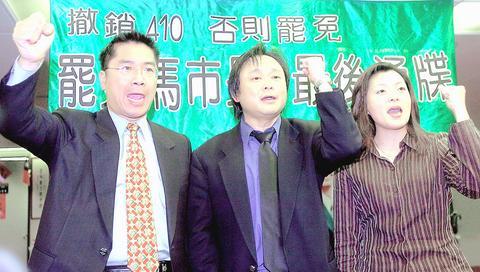
Taipei City councilors Hsu Kuo-yung, left, Wang Shi-chien, center, and Lu Ying-ying, right, of the Democratic Progressive Party raise their fists as they call upon Taipei Mayor Ma Ying-jeou to retract permission for a pan-blue rally on Saturday. They told a press conference yesterday that they will initiate a recall if Ma fails to act.
-----------------------------------------
On April 7, 2004 ……
`Hunger-strikers' linked to parties
SIT-IN: Two of the group made brief
visits to doctors as claims surfaced that the 'neutral' protesters actually had
party connections.
By Jewel Huang, STAFF REPORTER
The student protesters staging a "hunger strike" at the Chiang Kai-shek Memorial Hall yesterday were alleged by fellow students to have worked with the pan-blue camp even as they claimed to be politically neutral.
The university students, numbering no more than 15 at a time, have been staging a sit-in and "hunger strike" since last Friday in an appeal to the government to establish a "truth task force" to investigate the shooting of President Chen Shui-bian and Vice President Annette Lu.
Students are taking turns going without food for 12 hours, labeling the action a "hunger strike."
Tien Wei-li, a student at Feng Chia University in Taichung, fainted yesterday morning after claiming to have been on a 88-hour fast.
He was taken to the National Taiwan University Hospital for treatment before being released.
"I hope President Chen can come to talk to us," a teary Tien said at the hospital, adding that he did not regret joining the sit-in.
Another hunger-striking student surnamed Chu took himself to the hospital by taxi after he began to feel dizzy.
Doctors at the hospital said the condition of both students was stable and that they could be immediately discharged.
Tien and Chu then returned to the scene of the protest yesterday afternoon and continued their "hunger strike."
Chen Cheng-feng, one of eight organizers of the student movement and a history major at National Taiwan University (NTU), urged the president to show up and talk sincerely with the group of students.
"The students can't go on forever. I hope President Chen can show up promptly and respond to our appeal," he said.
Meanwhile, a Chinese major at NTU, Lin Yu-lun, and several other students produced photographs and other materials collected from the Internet yesterday, alleging that leaders of the "hunger strike" had political connections and that some of them worked on the Chinese Nationalist Party (KMT)-People First Party (PFP) alliance's campaign.
Lin displayed photographs showing what he said were some of the hunger-striking students standing with KMT Chairman Lien Chan at a KMT awards ceremony and with PFP Chairman James Soong at a celebration of his party's anniversary.
"Chen [Cheng-feng] in fact had close connections to the KMT but kept saying he did not belong to any party," Lin said.
"These students are not as neutral as they claimed. I urge them to stop saying they represent the voice of university students and urge them not to be the tools of political parties," he said.
"We oppose political interference with student movements and using the image of students in furthering political goals," Lin said. "We cannot accept it."
Lin said he agreed that everyone had the right to express an opinion, but he questioned why this group of students had covered up their political connections, claiming instead that they were all neutral.
"We hope the controversy [over the election result] can be solved through legal channels rather than irrational protests," he added.
Late in the day, Presidential Office spokesman James Huang said the president would respond to the students' requests at the appropriate time.
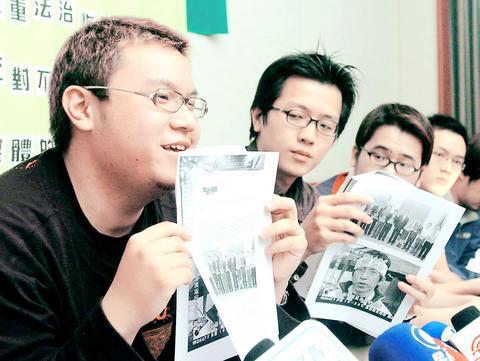
University students hold up pictures of students taking part in a sit-in at the Chiang Kai-shek Memorial to show the protesters' political affiliation. The students were taking part in a press conference at the Legislative Yuan yesterday.
-----------------------------------------
On April 7, 2004 ……
Media now a catalyst for unrest
By Xiang Yang
With the pan-blue camp's April 3 demonstration having ended and the protesters in front of the Presidential Office having been dispersed by the police, we have earned a temporary calm after more than two weeks of political unrest. The weather in Taipei was fine on Monday, and the stock market rose sharply, providing concrete evidence that what our society needs is reason and peace.
The calls from religious leaders, women's organizations and business and student associations for the government and opposition to maintain their cool and heal the wounds of the election with care and tolerance is further evidence of the existence of a middle-of-the-road force. This force often remains silent, but it makes up the mainstream of society and is invaluable at crucial moments.
The media originally belonged to this middle-of-the-road force. They are society's conscience and the protectors of the public. Regrettably, the media's reporting during and after the presidential election has added to the political conflict and unrest, without regard for the media's function as a fourth estate independent of executive, legislative and judicial authority.
The media have instead deteriorated into a center for instigating unrest, expanding the confrontation between government and opposition, and misleading readers and viewers. They have even intervened in the political conflict, willing to become the mouthpieces of political parties and lead society into a state of chaos, anxiety, doubt and worry, which in turn has led to social and ethnic division. These are serious issues that media professionals must face at this crucial moment.
There are political and legal mechanisms to decide who is right and who is wrong in a political conflict. The media must do all it can to verify that there are no mistakes in their reporting and that it is not prejudiced. They also have a responsibility to eliminate the use of emotional or biased language, wording and images. This is the only way to do right by readers and viewers belonging to neither the pan-blue nor the pan-green camp.
A reality check, however, shows that from before the election to this day, our media -- the electronic media in particular -- still include avoidable bias. This has led to hostility between the pan-blue and pan-green camps, an increasing blurring of the truth and a nervousness among the public who no longer feel at ease going about their daily lives.
Although the political unrest was not created by the media, their excessive participation has become a catalyst for unrest, and they can therefore not escape responsibility.
I'll give a few examples. On election day, the electronic media had promised to promptly report on the vote-counting process. But apart from a minority of media that reported the Central Election Commission's data, the specialized news stations differed greatly in their reporting of the number of votes won by the two tickets. Preposterously, some reports even differed by hundreds of thousands of votes.
Such obvious manipulation of the vote-counting process to influence the mood of readers and viewers not only violates the ethical and professional demands on news reporting and tramples on the rights and interests of readers and viewers, but also misled voters from both camps. Pan-blue supporters went mad with joy as they saw the inflated numbers, which led to disappointment when Chinese Nationalist Party (KMT) Chairman Lien Chan lost by a minuscule margin.
Should the media escape responsibility for these great mood swings? Is there no relationship between the dissemination of this misinformation and Lien and People First Party (PFP) Chairman James Soong's refusal to concede the election that evening? Has any of the electronic media owned up to their mistakes and offered an apology?
I'll give one more example. The pan-blue protests in front of the Presidential Office continued for seven days. The electronic media offered around-the-clock reporting of the event, and there is nothing wrong with that. However, during these seven days, there was no shortage of reporters relaying various statements in a hysterical tone of voice and with a hysterical expression, without questioning the veracity and accuracy of those statements. Should the media really engage in this sort of preposterous, unscrupulous and unverified rumor mongering?
In addition, a majority of the electronic media focused on the state of collective agitation among protesters, ridiculous statements by politicians and even on images of people being surrounded and beaten by the crowd.
Not only was such reporting a misrepresentation of the protesters' main demands, it also enlarged ethnic differences and hatred between the blue and green camps. Could it be that these scenes displayed a wider truth about society that transcends the protesters themselves?
Then there were news anchors, who had not been present at the protest, offering conclusions based on images or fragmentary information, saying things like "the Taiwanese people's call for truth is moving" or "what we see here is the hope for Taiwanese democracy." There were also broadcast producers alternating between images from the March 27 demonstration and the protesters in front of the Presidential Office -- when there were a lot of people, they used bird's-eye views, and when there were fewer people, they used close-ups. Is such treatment of images likely to provide people with the truth?
The media must not lack substance or reason. Nor must it veer far from the middle and use biased and distorted reporting to instigate public agitation and confrontation. Media professionals must take a careful look at what they are doing to avoid letting a lack of substance lead to public contempt for the media.
Xiang Yang is an associate professor of indigenous languages at National Dong Hwa University.
-----------------------------------------
-----------------------------------------