20040408
=======
The gap between Taiwan and China on April 8, 2004 ……
China licks its wounds as Taiwan holds firm
By Wang Dan
The clearest signal sent by the presidential election is that mainstream opinion in Taiwan has changed. The pan-green camp's vote has jumped from 40 percent in 2000 to 50 percent this year, showing that a feeling of Taiwanese identity has expanded.
The Chinese Communist Party had always placed its hope in the people of Taiwan, but this election has shown that the Taiwanese people are neither interested in nor willing to accept Beijing's policy of "one country, two systems." Mainstream opinion here is now heading in the opposite direction, away from unification. In other words, China's hopes for support from the Taiwanese have been dashed.
If Beijing and Washington were not convinced about this trend four years ago, then they should be now. They must deal with the reality of Taiwan. No matter how Beijing adjusts its policy, it is no longer possible to make "one country, two systems" the core of that policy.
The Taiwanese people should receive
congratulations for this election, because their democracy is now able to stand
up to the test of post-election conflict between political parties. When the
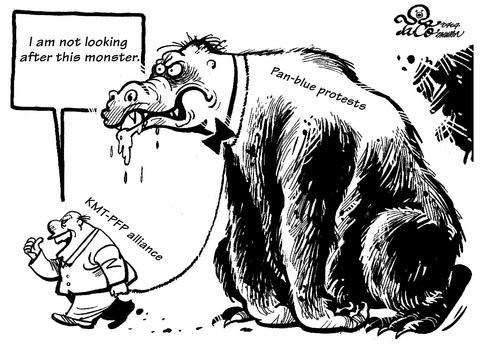
Chinese Nationalist Party (KMT)-People First Party (PFP) alliance refused to
admit defeat, attempting to launch a mass movement, the whole world was
watching to see if Taiwan's democracy would remain stable.
The fact is, despite the confrontation we see at the moment, the two camps have agreed to accept the results of a recount and resolve the conflict by legal means. With this, a political struggle has, in the end, returned to the constitutional framework. This is a victory for Taiwan's democracy, and a vindication of its democratic ideology.
Compared to the notorious 1989 Tiananmen Square demonstrations in Beijing, during which the Chinese Communist Party shot its own civilians and students, the relatively peaceful protests of the Taiwanese people have highlighted the democratic system's function of stabilizing society. This is a source of inspiration and encouragement to the Chinese people who thirst for democracy. Massive, violent conflict is unlikely to occur in a real democratic society, and Taiwan is the best example of this.
China has misread Taiwan's situation for a long time in two ways. First, Beijing misjudged mainstream public opinion, believing that the people's resistance to unification had merely been aroused by a minor pro-independence element, rather than an appeal from within the greater body of the people. Second, Beijing miscalculated by thinking it was able to stop a tectonic shift in mainstream opinion by issuing threats.
China is also placing hope in the US, but this strategy faces enormous obstacles. US diplomatic policy prioritizes the national interest, and this is why Beijing has been able to gain concessions from Washington over North Korea and other issues. But the promotion of US-style democracy is also a basis of US diplomacy. Thus, the US government is unlikely to sacrifice too much democracy for the sake of national interest.
Although the US strongly opposed Taiwan holding a referendum at first, it remained ambiguous in its stance, exhibiting a kind of dualism in its diplomacy. If Beijing puts excessive faith in Washington, then their unrealistic hopes will also be dashed.
China should hold more hope for itself. Confrontation and estrangement between China and Taiwan is the result of the gap between political systems. It will only be possible for the two sides to seek a certain kind of unification when China brings about democratization and erases this gap. China will only push Taiwan further away if it continues to maintain a dictatorship while persisting with military threats.
Wang Dan was a student leader during the 1989 Tiananmen Square protests
in Beijing.
-----------------------------------------
On April 8, 2004 ……
Election dashed Beijing's dream: UCLA professor
CNA , SAN FRANCISCO
The result of the March 20 presidential election has dashed -- perhaps forever -- Beijing's "one China" dream, a Los Angeles-based academic and China hand has said.
Following the election, Beijing can no longer assume that most of the people of Taiwan wish to unite with China, and Beijing must now decide how far to bend, said University of California, Los Angeles (UCLA) political science professor Richard Baum in his latest essay entitled "The Chinese Puzzle," which was carried in the San Jose-based daily Mercury News last Sunday.
For the first time, an absolute majority of Taiwanese voters cast their ballots for an avowedly pro-independence candidate, Baum noted.
As a result, relations between Taiwan and China have entered a period of heightened uncertainty, fraught with potential danger, said Baum, the director of the UCLA Center for Chinese Studies.
Baum, author of Burying Mao: Chinese Politics in the Age of Deng Xiaoping, said that although President Chen Shui-bian's victory was by the narrowest of margins -- 29,518 votes -- his 50.1 percent share of the vote represented a dramatic increase over the 39.3 percent he garnered four years ago.
As one of more than 50 Western observers invited to monitor the election, Baum said, "I was impressed by the fairness and transparency of the process. Even the post-election demonstrations, for all their extraordinary size and emotional intensity, were mostly peaceful and orderly, with people eventually dispersing voluntarily."
-----------------------------------------
On April 8, 2004 ……
DPP condemns Soong's actions
OUTRAGEOUS REMARKS: Not only did PFP
Chairman James Soong say he would lead a break-in at the Presidential Office,
he also insulted Vice President Annette Lu.
By Debby Wu, STAFF REPORTER
The Democratic Progressive Party (DPP) yesterday condemned People First Party (PFP) Chairman James Soong's public declaration that he would lead the crowd to break into the Presidential Office during a planned blue-camp rally on Apr. 10. His sexually unsavory comments about Vice President Annette Lu's statement on the election-eve shooting incident was also slammed.
When Soong visited students on a hunger strike on Monday evening, he said that people should give up their lives for what they believe in and that he would accompany the crowd to break into the Presidential Office on April 10.
DPP Legislator Hsiao Bi-khim yesterday said that it was surprising that Soong would encourage students to break the law.
"This statement will do no good to the election controversy and it also ignores the students' security. A person who wants to lead the country should care more about the health and security of his supporters," Hsiao said.
"The DPP does not want to handle the controversy according to anything other than the law, and President Chen [Shiu-bian] has already responded with kindness to the opposition leaders. But his kindness has not yet been responded to, and if James Soong really cares about the students, he should solve any problems according to the law," Hsiao said.
Soong's statement was also not appreciated by the pan-blue camp earlier on and put the Taipei City Government in a difficult situation.
While Taipei Mayor Ma Ying-jeou would not respond to Soong's statement, city government spokesman Wu Yu-sheng said that Soong should have known better when the students present at the protest shot down his proposal.
The city government's Law and Regulation Commission Director Chen Ching-hsiu was even more direct about Soong's proposal.
"PFP Chairman James Soong's declaration has imposed danger on the social order and it was indeed improper," Chen said.
Besides trying to provoke the crowd to break into the Presidential Office, Soong recently also made controversial remarks regarding Lu's statement released on April 4 on the shooting incident.
Lu said in the statement that when she noticed she had been shot, "my arm touched the lower rim of the jacket worn by the president, who was on my right. I felt his jacket was a bit sticky and wet, so I asked him, Mr. President, you too?'"
Soong later questioned Lu's statement by saying, "which lady would publicly touch a man's body on the spot which is about two or three inches below his stomach? How did Annette Lu manage to touch such a sensitive spot?"
DPP Legislator Chou Ya-shu yesterday slammed Soong for the sexual innuendo.
"Mr. Soong has turned the care a wounded person gave to another wounded person into an insult of women. He is probably the only one who could still think about sex when somebody's life is in danger," Chou said.
"We do have doubts about Mr. Soong's mental condition. He might actually be ill mentally, and we request him to go to the nearest hospital for a checkup and prove that he is mentally sound within two days.
"We would then check with the Central Election Commission to see whether Soong should have qualified as a vice presidential candidate, since the mentally ill do not enjoy the rights a normal citizen is entitled to," Chou said.
-----------------------------------------
On April 8, 2004 ……
HK activists tell China to back off
POINT MAN: The deputy secretary-general
of the Standing Committee flew down to Hong Kong to explain a recent ruling
that shackled election reform.
AP, HONG KONG
Pro-democracy figures yesterday charged that China had violated constitutional law by asserting control over Hong Kong's political reforms, and some predicted the move could stir unrest in the territory.
China issued a ruling on Tuesday that Hong Kong must get Beijing's blessing before trying to change the way it selects its leader and lawmakers -- giving the central government more control over such matters than is spelled out in the Basic Law, Hong Kong's mini-constitution.
The Standing Committee of China's National People's Congress put forth the ruling in an interpretation of the territory's constitution -- a move many here viewed as an attempt to quash growing calls for full democracy.
"It has been calculated to add new obstacles to Hong Kong's already bumpy road to full democracy," said Law Yuk-kai, director of the Hong Kong Human Rights Monitor.
The Basic Law holds out democracy as a goal for Hong Kong but sets no timetable, and Beijing insists it's only explaining the way forward.
The deputy secretary-general of the Standing Committee, Qiao Xiaoyang, flew to Hong Kong on Wednesday to explain the ruling to academics, lawmakers and others. Qiao told reporters he would listen to a cross-section of the community to seek "honest exchange and common ground," but he didn't elaborate.
Law said China's top legislative committee had changed the constitution with "no due process" but rather through "a political body operating in a black box without any fair hearing."
The Hong Kong Bar Association agreed, saying Beijing was making law, not interpreting it.
"This is adding to the law," bar chairman Edward Chan told reporters Tuesday night. "Hong Kong cannot accept this."
Meanwhile, the US reiterated its support for democracy in Hong Kong -- a stance Beijing has condemned previously as improper meddling in Chinese affairs.
US Consulate General spokeswoman Susan Stevenson said yesterday that Washington is urging Hong Kong "to do everything possible to respond to the expressed aspirations of the Hong Kong people for electoral reform and universal suffrage."
Activists said they planned to march in protest Sunday to China's representative office in Hong Kong.
China guaranteed Hong Kong civil
liberties and a great deal of autonomy -- unheard of in the mainland -- when
the former British colony returned to its rule in 1997. But The Standard
newspaper likened Beijing's latest action to "infecting the territory with
a deadly plague."
"It is bad for Hong Kong, but it is bad for China, too, because it will not allow Beijing to benefit from the lessons of a smooth transition to democracy," The Standard wrote in an editorial.
Others, however, were more optimistic, noting that Beijing has not ruled out political reforms and that it has even left open the possibility for changes in the way Hong Kong's next leader is chosen when Chief Executive Tung Chee-hwa's second and final term ends in 2007.
Tung was chosen by an 800-member committee loyal to Beijing and has been enormously unpopular with locals who see him as the mainland's puppet who looks out for tycoons but not ordinary Hong Kong citizens.
Many people in Hong Kong want direct elections of their next leader as well as all lawmakers in 2008.
-----------------------------------------
On April 8, 2004 ……
Pity for Hong Kong's downtrodden
On Tuesday, the Standing Committee of China's National People's Congress ruled -- in an interpretation of Hong Kong's Basic Law -- that Beijing has final say over amendments the territory's government makes to its laws governing the election of its chief executive and the Legislative Council. The interpretation crushes hopes in Hong Kong for universal suffrage in 2007. It is also a disappointing retraction of promises concerning the territory's autonomy and a new interpretation of Beijing's "one country, two systems" policy.
Pro-democracy groups are reportedly organizing a demonstration for Sunday to protest the ruling. They have also started an action asking each resident to send a protest letter to Beijing's liaison office in Hong Kong. The angry reaction from Hong Kong's democrats is not difficult to understand, nor was Beijing's ruling unexpected. The inability of the people of Hong Kong to come to grips with this decision is a reflection of their unrealistic expectations of the Zhongnanhai leadership and the "one country, two systems" policy.
The people of Taiwan, however, firmly
set on consolidating democracy, should condemn Beijing's ruling and support the
determination of the people of Hong Kong to pursue autonomy.
Democracy is a universal value. China should not postpone democracy in the name of cultural or national conditions. It doesn't enhance China's international image and is detrimental to future cross-strait developments. China's tightening of its grip on Hong Kong dampens the willingness of the people of Taiwan to improve cross-strait relations. The political credibility of Beijing, slim to begin with, will evaporate.
When the late Chinese leader Deng Xiaoping first proposed the "one country, two systems" policy, he said the people in Hong Kong could go on dancing and racing horses, and that the territory would remain unchanged for the next 50 years. However, within a decade of the handover, Beijing's leaders have backtracked on promise after promise. On July 1 last year, 500,000 people took to the streets of Hong Kong to protest a proposed anti-subversion bill. Beijing intended to use the bill to gag freedom of speech and curb political activity. That ambition was temporarily thwarted by the unprecedentedly large rally.
But Beijing has not given up and has now placed severe restrictions on direct elections for the territory's leadership. Will the people of Hong Kong have to take to the streets whenever China launches a bill to restrict democracy? If this is the case, where is Hong Kong's better tomorrow?
Friendly observers must also note that one of the biggest blind spots among Hong Kong's pro-democracy activists is their acceptance of Chinese nationalism. Due to their full identification with and belief in China, they have been repeatedly trapped by their own "nationalist complex" in their pursuit of autonomy. For example, in testimony on Capitol Hill early last month, Democratic Party founder Martin Lee said he did not support President Chen Shui-bian's referendum. His opposition surprised people in both Taiwan and Hong Kong. In light of his pursuit of freedom for his Hong Kong compatriots, his stance on the referendum was confusing.
Lee's blind spot is shared by the Chinese Nationalist Party (KMT)-People First Party (PFP) alliance, which also subscribes to with Chinese nationalism. The alliance faces the same problem as Lee in its pursuit of a mature democracy. It upholds certain democratic values, but is bound by Chinese nationalism. As a result, the alliance is completely trapped in a nationalist-style reaction when facing crucial democratic problems, such as Chinese interference.
This story has been viewed 824 times.
-----------------------------------------
On April 8, 2004 ……
Learning to abide by the rule of law
By Howard Shyr
The sensational accusations that received much attention since the election have come to an end, as the pan-blue camp once again turns to the judicial system for relief. From the recovery in the stock market and the vitality of other businesses, it does seem that the divisions rent in society by the election have healed to a certain extent. However, underneath this apparent harmony looms the recent controversy and the dissatisfaction that it has bred.
The bickering has been taken beyond the courts, moving the election battle into overtime. When the combatants finally get the verdict from the courts, I suspect that this will merely resolve the matter in legal terms: the likelihood is that these actions will not bring an end to the political controversy.
The crux of the matter lies in what can actually be achieved within the framework of the law.
This election was held according to the Presidential and Vice Presidential Election and Recall Law, amended last October. Any issues regarding the fairness of the election and the procedures to be followed in dealing with any subsequent controversy should follow these "game rules" that were agreed upon prior to the event.
Whether or not the election is annulled, or whether the winner should continue as president, fall within the jurisdiction of the Taiwan High Court, which should proceed according to the stipulations of the above mentioned law. The court need only consider Article 102 and Article 104 of the law. The former concerns only whether it can be proven that the law was broken by an election commission of any level, and whether this was sufficient to have influenced the election results. The scope of the latter is limited to questions over the counting of the ballots, or surrounding any cheating or rigging and buying of votes that may affect the final results.
Now, the lawyers of the pan-blues have announced that they will claim that a miscount, the linking of voting for the election and the referendum, the assassination attempt and the subsequent activation of a national-security mechanism all influenced the vote.
First the pan-blue camp has to get
over the hurdle of whether there is sufficient evidence to back up their
claims. Even if they succeed, there is still the matter of trying to equate, in
legal terms, the referendum, the shooting and the national-security mechanism
with vote rigging, corruption or vote buying as a basis for the annulment of
the election.
Despite the fact that Article 112 allows for the use of the Code of Civil Procedure in the litigation process, it does not permit the free interpretation, or simplification, of procedures on the part of the individuals involved in the suit. The ideas that the two parties agree to an immediate recount, or even an annulment and subsequent re-election, do not conform to the original rules that both sides acknowledged prior to the election.
Strictly speaking, these can only be viewed as "new rules added after the event," hasty amendments that, given the legal principle that no changes can be applied retroactively, should only take effect as of the next election. Naturally, in judging the necessity of a complete recount, the court should make an independent decision based on the evidence, and not be constrained by the desires of the plaintiffs and defendants.
In fact, the issue of the pedantic interpretation of the law had already appeared when the court overruled the pan-blues' original case. Should the court, after all, have ignored due process and accepted the premature filing of the suit simply to speed the case up? In the end the court opted to follow a strict interpretation of the law regardless of the political importance of the case.
Nevertheless, isn't this precisely part of the built-in safety mechanism designed to level the political playing field? If due process were abandoned simply because of the political importance of this situation, it would open up a Pandora's Box, with every future political controversy having to be dealt with as a special case beyond the law.
In terms of the so-called "Shooting Investigation Team" of foreign forensics experts, it will have, at best, an equal amount of clout as those of forensic scientists appointed by the two parties and the court. It is the constitutional responsibility of the judge of the full court to make an objective assessment based on the law, concerning whether the results of the forensic tests prove that any cheating took place, and whether this constitutes a legal basis for an annulment. He need not, and indeed should not, bend the law in view of the potential political implications of his ruling.
The fundamental spirit behind the rule of law is that any ruling should be based on clearly defined laws established prior to the event in question, regardless of the identity or political status of the individuals involved.
In deciding who is right, and who is wrong, in the election controversy, the law has to work with a limited amount of factors to preserve the rules of the game and maintain the basic amount of trust needed between the candidates, elected individuals and the electoral institutions.
If this were not the case future confrontations would lack an objective measure with which to judge them by. In addition, the ability to quell political arguments surrounding the suspicions of the shooting incident, the libel and slander suits arising from gossipmongering, and the damage done to government agencies, fall beyond the scope of the law. Because of this, we cannot rely only on the specific application of the law within this election case to cure the ills of society precipitated by the controversy.
For that, we also need the politicians in both camps to respect the law, think of a way to create a win-win situation and not focus solely on their own interests.
Howard Shyr is the director of the Institute of Financial and Economic
Law at National Dong Hwa University.
-----------------------------------------
-----------------------------------------