20040409
=======
Arms ban to China on April 9, 2004 ……
President asks Germans not to repeal arms ban
`The president is also concerned
about Germany's intention to sell a plutonium factory to China.'
ARMS BLOCK: President Chen Shui-bian
told a German legislator that China's poor human rights record disqualified it
from resuming arms purchases.
CNA , TAIPEI
President Chen Shui-bian expressed the hope yesterday that Germany will not support an easing or lifting of a EU ban to sell arms to China that was imposed in the wake of the Tiananmen Massacre in Beijing in 1989.
President Chen made the remarks when he met Klaus Rose, head of a Germany-Taiwan friendship group from the German parliament, at the Presidential Office. Rose arrived in Taipei on Sunday for a six-day visit.
The president took the chance to thank Rose first for the hospitality extended to Chen's wife, Wu Shu-chen, when she visited Germany in July last year to help open a National Palace Museum exhibition there.
Chen noted that the Germany-Taiwan friendship group is one of the largest interest groups in the German parliament, with 59 members.
He expressed his appreciation for the group's support and assistance to Taiwan under Rose's leadership, especially in cultural exchange and cooperation on trade.
Noting that the exhibition of National Palace Museum artifacts was successfully received, the president said that a Prussian cultural heritage foundation from Germany will have an exhibition in Taiwan after next month.
In terms of trade exchanges, the president said that Taiwan is the third-largest trading partner of Germany in Asia, while Germany is the largest trading partner of Taiwan in Europe, with bilateral trade hitting US$10 billion last year.
Taiwanese manufacturers have been active in taking part in trade fairs in Germany, with the number of manufacturers taking part in the prestigious Cebit exhibition in Hanover exceeding those from other countries for the sixth consecutive year.
The president also said that he was concerned that some countries in the EU are trying to lift or east the arms sales ban on China.
He said that the ban was imposed because of the poor human rights record in China.
So far, Beijing has not improved its human rights record to warrant lifting the ban, he claimed.
He expressed the hope that Rose would use his influence in the parliament by urging his country not to ease or lift the ban.
The president is also concerned about Germany's intention to sell a plutonium factory to China, saying that Beijing could use it to produce nuclear weapons, thereby jeopardizing world peace.
-----------------------------------------
On April 9, 2004 ……
Tiananmen leader is a shadow of former self
`People like Wu'er Kaixi [are] lucky to have been able to move from a dictatorial system in China to a free Taiwan.'
By Cao Chang-ching
A number of students have been taking part in a hunger strike as part of demonstrations organized by the pan-blues at the Chiang Kai-shek Memorial Hall. The Chinese-language media in the US have since printed sensationalist stories of how Wu'er Kaixi and Shen Tong, both prominent members of the 1989 pro-democracy protests in China which ended with the Tiananmen massacre, participated in the hunger strike. The pair said that when they visited the scene, they felt something akin to the atmosphere that day in Tiananmen Square. According to Wu'er, the media and the law in Taiwan were being controlled by the government, and he wanted to give his support to the people.
I cannot help but pity Wu'er. The Tiananmen massacre happened 15 years ago, and he is now almost 40 years old. It seems that with the passage of time he has lost the ability to differentiate between dictatorship and democracy. He seems to think Taipei is Beijing, and muddles the Democratic Progressive Party (DPP) with the Chinese Communist Party. His values are utterly confused. After more than a decade living in the free world, Wu'er doesn't seem to have learned anything.
The students who gathered in Tiananmen on that day in June were protesting against a dictatorial government that had deprived more than a billion Chinese of the freedom of choice. Taiwan, on the other hand, has already had three elections in which its president was directly elected, in addition to countless democratic local and legislative elections. How is it possible to equate democratic Taiwan, in which the government is elected by the people, with China?
The students taking part in the Tiananmen protests resorted to hunger strikes because this was the only way to make themselves heard. The media and legal processes were completely controlled by the Communist Party. Taiwan, by contrast, is already well along the road toward a healthy democracy and enjoys freedom of the press. Sure, the government has its problems, but it owes its existence to democratic elections. Sure, there is room for improvement in the media and the legal system, but at least they are free and independent.
How can Wu'er justify saying that these mechanisms are being controlled by the DPP? It is common knowledge that a large part of the media is actually biased in favor of the Chinese Nationalist Party (KMT) and the People First Party.
The US has also seen its share of chaotic elections, but the losers never provoked demonstrations, nor did students amass in front of government buildings and start hunger strikes. Everything was done through legal channels. In a society governed by the rule of law, people should act like citizens, not form mobs.
People like Wu'er Kaixi ought to count themselves lucky to have been able to move from a dictatorial system in China to a free Taiwan. Fifteen years later, Wu'er and others don't seem to understand the value of freedom.
It leaves me wondering: What exactly was it that they were fighting for in Tiananmen Square?
Cao Changching is a writer based in the US.
-----------------------------------------
On April 9, 2004 ……
EU will not always say `yes, Beijing'
Last December, German Chancellor
Gerhard Schroeder told Chinese Premier Wen Jiabao he would ``work toward''
lifting the EU ban on arms sales to China. Yesterday, President Chen Shui-bian
told Klaus Rose, chairman of the German parliament's Berlin-Taipei friendship
group, that he hoped Germany would not support the lifting of the arms ban.
`Taipei Times' reporter Melody Chen talked to Rose about the EU embargo,
Taiwan's bid to join the World Health Organization (WHO) and democracy in Hong
Kong
Taipei Times: President Chen Shui-bian said he hoped the EU would not lift the arms embargo against China. Analysts have expressed concern that if the EU sells weapons to China, it may trigger an arms race, with the EU and the US becoming arms suppliers to China and Taiwan, respectively. What do you think will happen?
Klaus Rose: Referring to the statement by the German chancellor that he would like to abandon the arms embargo, I would like to emphasize that there is no exact political position in Germany to really give it up.
It was one political sentence. Perhaps it was made in connection with France. Now we have a political debate [on the embargo] in Germany and even in the EU. Perhaps it would not be the best way to lift the embargo. Of course, it would not be good to have a new arms race.
As you can imagine, there are some arms enterprises or firms that would like to sell something and help anybody. It could be better to have no embargo. It is good for trade and for bargains and so on, but if you look at the national consequences, it is a different question. First, you have ... to speak about business, and then you have [to address] the political consequences.
We are now in the phase of discussing political consequences. This seems to me to be very different from what happened before. We are not coming to an end to really lift the embargo.
The only support for arms sales here comes from the US. No European [support exists], despite some exceptions some time ago. There would be no arms race between the US and Europe in order to sell weapons to Taiwan. This is not [being considered by] German or European politicians.
TT: You
met our legislative WHO lobby group that went to Europe to talk about Taiwan's
application to join the health body. Do you think Taiwan has a better chance of
entering the WHO this year? What are Germany and other European countries'
attitudes toward Taiwan's bid?
Rose: We had a long discussion to help Taiwan become an observing member of the WHO. Whenever you talk to German politicians, even [those] very high up in the government, they say it is a good idea. You cannot exclude the population anywhere in the world from the big question of health.
There are always so-called "details" coming from Beijing. Perhaps we are in the position to disobey or not listen to the veto just for health reasons.
TT: We often hear about China putting pressure on other countries to block Taiwan's entry to the WHO. How is this pressure applied? And are you aware of instances where China put pressure on Germany to prevent Taiwan's participation?
Rose: Whenever there is an idea to help Taiwan in any way, there is somebody coming from the People's Republic of China's (PRC) embassies in Berlin or Paris saying this is not the best way of doing things.
Whatever happens in politics, you have to decide despite pressure from the other side. You have to decide which is more important. Of course, the PRC is a very important partner for trade and many other reasons. But if we speak of the health of the whole world's population, it should be different. I am quite sure that in Germany and the EU we will change our position of always saying, "Yes, Beijing, you are right." In this field, Beijing is not right.
TT: The current events in Hong Kong have caused concern in the US and other countries. It is now almost impossible to directly elect Hong Kong's chief executive after Beijing's interpretation of the Basic Law. Do you regard this as an initial sign that the "one country, two systems" formula does not work?
Rose: The signal we get from the Hong Kong issue is, in my opinion, very clear: It would not work to have the "one country, two systems." Beijing obviously does not allow Hong Kong to have its democratic way in deciding anything. People around the world will look very closely at what happens now.
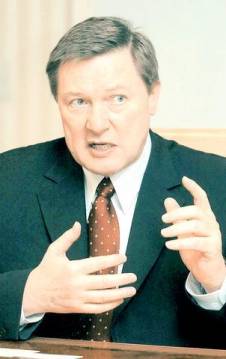
Klaus Rose, chairman of the German parliament's Berlin-Taipei
friendship group.
-----------------------------------------
On April 9, 2004 ……
Taiwanese determine China's fate
By Ku Lai
History takes place when we are not watching. For the whole world to see, four consecutive Saturdays -- the 228 Hand-in-hand Rally on Feb. 28, the 313 Rally on March 13, the presidential election on March 20 and the big pan-blue demonstration on March 27 -- have thoroughly changed the fate of Taiwan and the future of all Chinese.
For pan-blue and pan-green supporters, this has been a peaceful revolution, a revolution where the people of Taiwan have decided their own future. "Fear" was what set off this profoundly moving revolution. One side feared "independence" and the other "unification." Then, due to the dramatic result, 23 million Taiwanese were instantly swept away in a frenzy of rallies.
Although many people are still anxious, worrying over whether the nation will become divided, blue and green supporters in fact need worry no more after this total mobilization of the public.
This has been an excellent example of public mobilization. The people have learned how to express their wishes through peaceful gatherings, and how to use the international media to make their voice heard throughout the world. It has been an unprecedented exercise and, without knowing it, the people have relied on their own intelligence and peaceful demeanor to achieve a revolution.
From another perspective, after watching the presidential election, the Beijing government must understand that an anti-democratic, violent "liberation" of Taiwan by military force will run into the concerted opposition of 23 million Taiwanese, despite China's strong military and almost 500 ballistic missiles aimed at Taiwan. The possibility of China "liberating" Taiwan by military force is now non-existent.
The rallies have also done away with the possibility of the "one country, two systems" policy being accepted here, the many shortcomings of which were revealed long ago.
Very few Taiwanese know that the "one country, two systems" policy celebrates its 20th anniversary this year. On June 22, 1984, when then Chinese paramount leader Deng Xiaoping met with an industrial and commercial delegation from Hong Kong in Beijing, he proposed the policy. He said that "Hong Kong's current social and economic systems will remain unchanged, its legal system will remain basically unchanged, its way of life ... will remain unchanged," and that "[our policies with regard to Hong Kong will remain] unchanged for 50 years." "One country, two systems" also became the policy for peaceful unification with Taiwan.
However, less than seven years have passed since Hong Kong's return to China, and not only has the "one country, two systems" policy failed to induce a Taiwanese capitulation, it is also being seriously challenged in Hong Kong. On June 1 last year, an unprecedented 500,000 people took to the streets of Hong Kong, demanding the replacement of Chief Executive Tung Chee-hwa, a high degree of democracy and general elections for the chief executive and the Legislative Council by 2007 or 2008.
During the fervor surrounding Taiwan's presidential election, a meeting of the standing committee of China's National People's Congress decided to interpret articles in Hong Kong's Basic Law dealing with the change of chief executive and the creation of the Legislative Council. The aim was to silence Hong Kong calls for chief executive and Legislative Council general elections, and to warn the people of the territory that they cannot walk down the road of Taiwanese-style democracy.
This action clearly reveals that a "Hong Kong ruled by Hong Kong people" is a birdcage autonomy restricted to mundane matters of daily life.
It is not unexpected that the "one country, two systems" policy has reached a dead end after 20 years. Deng indeed had a vision 20 years ago. Regarding the two incompatible systems -- socialism and capitalism -- Deng said that "this means that within the People's Republic of China, the mainland with its 1 billion people will maintain the socialist system, while Hong Kong and Taiwan continue under the capitalist system."
The differences between Taiwan, Hong Kong and China have long been transferred to the two "new systems," "democracy" and "centralized authoritarianism."
Faced with Taiwan's latest presidential election and seeing the democratic force of the collectively mobilized Taiwanese public, former Chinese president Jiang Zemin and President Hu Jintao will have to display more wisdom if they want to complete their unification mission. They will have to give up the 50-year-old idea of liberation by military force and the 20-year-old "one country, two systems" policy. Instead they will have to adopt a visionary approach in order to find a new way to resolve the contradictions between democracy and centralized authoritarianism.
The people of Taiwan have written democratic history. The March election involving almost 13 million people may change the future of 1.3 billion Chinese.
Ku Lai is a political commentator.
-----------------------------------------
On April 9, 2004 ……
Pan-blues need a new discourse
After the March 20 election, Ketagalan Boulevard suddenly became a political stage for the pan-blue camp's razzmatazz. Despite some media euphemizing the protests as the "middle class" taking to the street, the reality is that this is a just topsy-turvy political stunt.
In live broadcasts, we saw People First Party (PFP) Legislator Liu Wen-hsiung lead the demonstrators in chanting the martial song Await Not. We also heard the song of the New Party, Man Should Improve Himself. The protestors who attacked the Central Election Commission sang the tune Peach Blossom, which is spiced with strong Chinese ideology. It may seem natural that such songs should serve as the soundtrack for the pan-blue camp's political show. However, when Cheng Li-wen started singing the green camp favorite Formosa Song, solemnly evoking sympathy for Hsu Hsin-liang's hunger strike, the atmosphere brought many of us back to the times of the green camp's campaigns.
The same group of people displayed entirely different symbols of nationality and ethnicity. How should we interpret such variation?
If the blue camp tries to represent "ethnic integration" -- since a variety of symbols and voices are included -- then it is merely putting on a charade. In fact, since the blue camp has become the opposition party, it has never studied its script for playing the role of an opposition party. The whole presidential campaign and the protests are yet another show of its laziness. Given its earlier boycotts of legislative meetings and the current demonstrations, the pan-blue camp has only succeeded in learning the form of opposition party but not its inner meaning.
What the blue camp lacks is a distinctive political discourse open for debate. The issues to be discussed in the discourse include how to maintain Taiwan's sovereignty, how to tackle China's military threat, how to achieve internal unity under pressure from China, how to distinguish the structural features of Taiwan's eco-political institutions, how to deepen Taiwan's democracy, and how to accommodate Taiwan's industries to the tide of globalization.
Unable to answer these questions, a blue-camp-style "pluralism" appears in the void. The candidates and campaign workers hold different views on important issues. The question of whether to take part in the referendum serves as a good example. Maybe the blue camp presumed it could take this question lightly, since it has a 60 percent to 40 percent advantage. In fact, this estimation overlooked the influence of former president Lee Teng-hui. More significantly, this election shows a huge increase in local awareness. Any blurring of the Taiwan sovereignty issue will be blocked by the electorate.
We must not forget the fact that the green camp had waited long for its ruling day. The key factor of why the green camp won elections in recent years is not their "proficiency in electioneering," as the blue camp alleges. Rather, the green camp won elections on the basis of its accumulated discourses and its experience in political reality. From the perspective of the Taiwanese discourse of identity construction, the green camp's discourses -- from the gemeinschaft concept Kaohsiung Mayor Frank Hsieh cited, the constitutional movement discussion of the ethnic issue, to the "four major ethnic groups" the Democratic Progressive Party (DPP) advocates -- all contribute to elevate the independence of Taiwan from a level of political reality to a higher level of identification and a deepening of culture.
Take the DPP's anti-"black gold" stance for example. Black gold is not only felt by the people. The conundrum of administraion/business syndicates/local factions also needs to be unraveled. What concerns us more is the long-standing media bias. Despite being disliked by the media, some phrases and words the green camp coined began to appear in the media. Such is the power of discourse.
Although the pan-blue camp does not study hard, it is not stupid. On the contrary, it is quite smart. It need not exercise its wit to compose discourses, but simply manipulate the sensationalist media to spread alarmist talk. When many senior journalists or political commentators leak information under the rubric of "as far as I know" and irresponsibly speak up without any evidence to back their claims in talk-shows, or when they criticize President Chen Shui-bian in words sounding mysteriously authoritarian, it is hard to say their baseless allegations have little effect. But the question is, does this do any good for our democracy?
The pan-blue camp's sluggish and opportunistic strategy has led it into a dilemma -- devoid of any substantial discourse, the blue camp can only recruit some senior journalists and political commentators as its mouthpiece. Their mission is to slander any national leader from the green camp, from Lee to Chen. As long as the green camp is in power, such character assassination will continue.
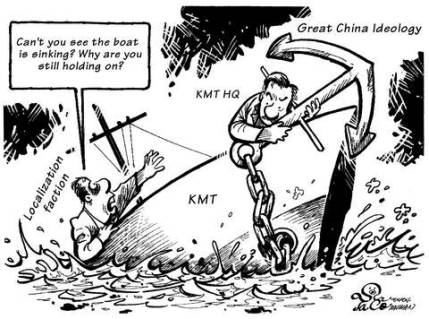
After the March 27 parade, a localization faction legislator from the blue camp said that the blue camp had been too docile, and thereby bullied by the green camp. Now, he said, the blue camp should emulate the green to drum up populism. This legislator is probably mistaken. The blue camp's ability to mobilize is not less than the green camp's.
The point is that without any vision and discourse, the pan-blue camp will be nothing but an anti-Chen rally.
Hsu Tung-ming is a freelance writer based in Beijing.
-----------------------------------------
-----------------------------------------