20040411
=======
Relationship on April 11, 2004 ……
Rallies turn violent: Ma takes action
CROWD CONTROL: What had been a large,
peaceful protest turned into a angry demonstration as pan-blue supporters
attacked the barricade on Ketagalan Blvd.
By Huang Tai-lin and Joy Su, STAFF REPORTERS
Pan-blue rallies yesterday again turned violent as protesters attempted to destroy the barricade seperating them from the Presidential Office.
Supporters of the opposition Chinese Nationalist Party (KMT)-People First Party (PFP) gathered on Ketagalan Boulevard for another demonstration, demanding a special task force be assembled to probe the election-eve assassination attempt on President Chen Shui-bian.
As the pan-blue's rally turned towards violence yesterday evening, KMT Secretary General accused the pan-green camp of purposely inciting confrontation while DPP Deputy Secretary-General Lee Ying-yuan said a lawsuit would be in order if the accusation were not retracted.
Taipei City Mayor Ma Ying-Jeou officially ordered the protest to disperse at 10:30pm. As of press time however, violence had continued to escalate.
While protestors had peacefully assembled in front of the Presidential Office yesterday afternoon, a confrontation between police and protestors broke out when protestors tore down the barricade blocking the protest at 6:07pm, and began knocking down scaffolding at 6:30pm.
Police began using water cannon against the crowds to put a halt to the violence at 7:05pm, and by 7:55pm, Ma ordered the police to step up their actions to deter illegal acts.
"The DPP has consistently worked to make improvements, and still, the pan-blue camp dares to make untrue accusations. If they do not take it back, the DPP will sue the KMT tomorrow," Lee saidin response to Lin's accusation.
While Lin and People First Party (PFP) Secretary General Tsai Chung-hsiung arrived at the scene of the rally shortly after violence broke out to calm pan-blue supporters, Lin said that KMT Chairman Lien Chan and his running mate PFP Chairman James Soong were unable to be present.
However, shortly after Lin and Tsai's departure, a second wave of violence commenced, with protestors picking up fallen stage scaffolding and attempting to charge at the police. Other demonstrators used wooden planks to set up a barricade against police lined up in front of the Presidential Office.
At 10:30pm, as the crowds grew more aggressive, police began fighting off protestors with shields and batons as the agitated protestors threw at least two Molotov cocktails at police and engaged in violent physical clashes.
The latest reports indicated that at least seven people had registered at National Taiwan University Hospital with protest-related injuries.
Yesterday's protest was the latest in the series of weekly demonstrations staged by the pan-blue camp since the alliance's presidential candidate, Lien and Soong lost to Chen during the March 20 election with a margin of less than 30,000 votes.
Although he has not been able to produce proof, Lien made claims about voting irregularities, calling the election unfair and refusing to concede defeat. Raising question about the attack on Chen on March 19 -- which the alliance claimed was an attempt to win sympathy votes -- Lien urged Chen to form an independent task force to investigate the shooting, in which bullets grazed Chen's stomach and Vice President Annette Lu's knee.
At the protest yesterday, Lien stressed that his appeals were not self-serving, but were out of his heartfelt concern over the nation's democratization.
"We are not here to push this cause out of personal interest ... but to be the guardian angels of Taiwan's democracy," Lien told the crowd.
"The Republic of China does not need to cultivate a new dictator," Lien said.
Saying Chen was oblivious to the appeals of the people, Lien in his speech proposed holding a referendum to form an independent task force.
"Until the truth is known, Chen should not take part in the presidential inauguration on May 20," said Soong, who spoke after Lien. Soong called on the crowd to come back and gather at the square in front of the Presidential Office on May 19 if Chen insisted on holding the presidential inauguration -- as required by law -- before "the truth is revealed."
"No truth, no president!" Soong shouted, leading the crowd in chanting the slogan.
The alliance claimed the demonstration had drawn over 200,000 people, but wire agencies reported the police as saying 80,000 people attended the rally.
-----------------------------------------
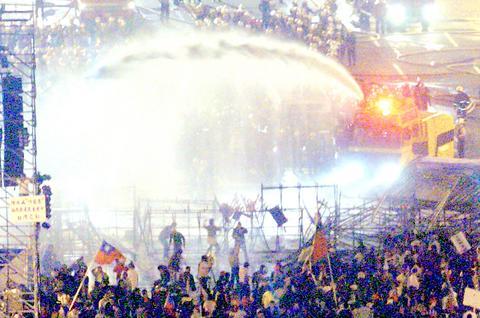
Police use water cannons to disperse protesters after they clashed with police forces during the pan-blue alliance's demonstration on Ketagalan Boulevard yesterday.
-----------------------------------------
On April 11, 2004 ……
Relationship with US ripe for change
Yesterday was the twenty-fifth anniversary of the Taiwan Relations Act, which has been a pillar of the US' Taiwan policy along with the Three Communiques. Coincidentally, the US-Taiwan relationship is currently at an all-important crossroads. This is spurring discussion and providing opportunities for pragmatic adjustments to the relationship.
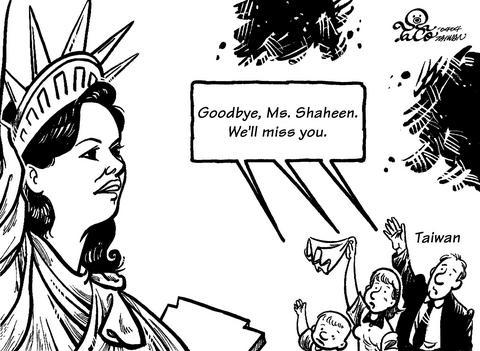
One factor that might help to create change is a series of personnel changes that have recently or might soon take place. Not only are American Institute in Taiwan Chairwoman Therese Shaheen and Minister of Foreign Affairs Eugene Chien stepping down, but the two-year term of institute Director Douglas Paal is about to end as well. With at least two prior attempts at resignation by Chen Chien-jen, Taiwan's top representative to the US , a new game is about to be afoot, with a very different cast of front-line players.
In making personnel decisions, both the American and Taiwanese governments should give top priority to maintaining instantaneous, direct and unhindered channels of communication. In particular, considering the divisions that exist between the pan-blue and pan-green camps, it is imperative for the US that its information about and analyses of the situation in Taiwan come from both camps, so that the US can maintain a balanced perspective.
This need is plainly evident in the confusion and miscommunication that have occurred over a series of issues in recent years -- such as the defensive referendum, the rewriting of the nation's Constitution and the controversy surrounding the presidential election. In particular, with respect to the election, opportunities were left open for wild speculation that the US intended to intervene and pressure the government of President Chen Shui-bian. Such rumors inflamed radical supporters of the pan-blue camp to the point that they nearly got out of control, as evidenced by the violent confrontation in front of the Central Election Commission on March 26.
Even more important is the issue of substantive adjustments to the US' Taiwan policy now that the presidential election is over. To the dismay of Beijing, Chen's re-election unequivocally indicates the mainstream emergence of Taiwanese consciousness and a Taiwan-centered national identity. Having received more than 1 million more votes in this year's election than he did in 2000, Chen is no longer a minority president, but rather a president carrying out the mandate of the majority, who embraced policy ideas such as holding a defensive referendum on the cross-strait relationship and rewriting the Constitution.
Under the circumstances, perhaps amendments to the act and the abandonment of the Three Communiques are not practicable, but at least in terms of substantive policy implementation and enforcement, an effort should be made to satisfy the more pragmatic demands of the changing popular will in Taiwan.
For one thing, the US should try to serve as a mediator by trying to persuade Beijing to demonstrate more flexibility on pragmatic issues such as cross-strait links and dialogue with Taiwan.
The US, on top of de-emphasizing the ambiguous Three Communiques and emphasizing instead the more pragmatic Taiwan Relations Act, should seek to assist Taiwan in entering international organizations -- at the very least, non-political organizations such as the WHO.
This is because both Washington and Beijing need to come to grips with the fact that in this increasingly globalized world, where people give high priority to fundamental values such as human rights, democracy and freedom, the people of Taiwan are no longer happy with undignified isolation and demeaning treatment from the international community -- particularly from China. It is isolation and poor treatment that have stimulated the growth of Taiwanese national pride and Taiwanese identity.
-----------------------------------------
On April 11, 2004 ……
Hong Kong formula a dead letter
`China can see that the democratization campaign in Hong Kong is gaining momentum, and also is beginning to understand that "one country, two systems" has lost what little allure it ever had for the people of Taiwan. China had to choose between securing its authority in Hong Kong or maintaining a fiction that no longer could dupe its intended victims, the Taiwanese.'
By the Liberty Times editorial
Two decades ago China and Britain reached an agreement to hand over Hong Kong to China and then implement "one country, two systems" there. After the recent issuance by the standing committee of China's National People's Congress of an interpretation of the Basic Law of the Hong Kong Special Administrative Region (SAR), that agreement has been officially broken. According to this ruling, while the manner of selecting the SAR chief executive in 2007 and members of the Legislative Council (Legco) in 2008 may be amended, the central government holds the ultimate power to decide on this amendment. The move means that the demand of the Hong Kong people for popular election of the chief executive and Legco has been rejected by China.
This not only cuts off Hong Kong's path toward democracy, but also means that China has destroyed autonomy in Hong Kong through this ruling. The balance is gradually shifting toward the "one country" and away from "two systems." Basically the illusion of "one country, two systems" has been dispelled. The Chinese dictators gave barely a second thought to junking the system in an attempt to destroy the flames of democracy and autonomy in Hong Kong.
"One country, two systems" was the brainchild of the late Chinese leader Deng Xiaoping. The central idea, as applied to Hong Kong, was to allow the colony to maintain its existing political and economic systems after it was handed back to China. In other words, Hong Kong was to continue implementation of its free market economy, growing democracy and its free way of life, sugar-coasted with flowery slogans such as "no change for 50 years," "high level of autonomy," and "having Hong Kong people rule Hong Kong."
"One country, two systems" was not only used to comfort the people of Hong Kong before the handover, but also to reassure the international community. So, the idea of "one country, two systems" was not only to resolve the problems posed by the gaps between the systems in Hong Kong and China, but also to maintain peaceful co-existence between capitalism and socialism. It was also supposed to be a role model that China could use in its unification propaganda directed toward Taiwan.
However, in the more than six years since the handover, "one country, two systems" has proven incapable of meeting the demand for democratization within Hong Kong, a trend which seriously conflicts with and challenges the autocratic nature of China itself. Beijing finally could no longer hold back and asserted its authority, shattering the "one country, two systems" model in the process.
In reality, the conflict between democratic progress in Hong Kong and Chinese totalitarianism erupted long before the handover. In the mid-1990s, then-Hong Kong governor Chris Patten had planned to speed up the process of democratization in Hong Kong, but was subjected to serious criticism and hysterical opposition by China, which labeled him "sinner of the age." After the handover, the pace of democratization in Hong Kong was thrown into reverse. The one half of Legco that is elected is chosen through a highly restricted franchise while the other half remains appointed by Beijing as, of course, is the chief executive.
As a result, even though the Democratic Party won a landslide victory in the District Council election at the end of last year, it remained incapable of becoming the legislative majority party. Under the circumstances, the calls for democratization in Hong Kong have become louder. Popular election of the chief executive in 2007 and all Legco members by 2008 is the mainstream popular will in Hong Kong. In the massive rally on July 1 last year held to oppose Article 23 of the Basic Law, more than 500,000 people showed up.
A recent survey conducted by the Chinese University of Hong Kong indicated that despite "patriotic" propaganda and an intimidation campaign staged by Beijing over the past six months, more than 60 percent of the people in Hong Kong continue to support popular election of the chief executive. Evidently, the demand for democratization in Hong Kong cannot be stopped.
China can see that the democratization campaign in Hong Kong is gaining momentum, and also is beginning to understand that "one country, two systems" has lost what little allure it ever had for the people of Taiwan. China had to choose between securing its authority in Hong Kong and maintaining a fiction that no longer could dupe its intended victims, the Taiwanese. Not surprisingly it chose authority over window-dressing and threw cold water on the flame of democracy in Hong Kong.
As indicated by an editorial published by a Hong Kong newspaper, the fact that President Chen Shui-bian will remain in office for the next four years is part of the reason that Beijing is tightening its leash on democratic development in Hong Kong. According to the editorial, the Chen government's intention of writing a new constitution and approving it by referendum will only increase separatist sentiment in Taiwan and this will fuel more demands for democracy in Hong Kong. Beijing must crush these demands before they spread to the mainland itself.
China has had its ultimate say over the political development of Hong Kong through the ruling issued by the Standing Committee of National People's Congress. It has at the same time denied the demands for popular election of the chief executive and all member of the Legco. Article 7 of Appendix 1 to the Basic Law, as well as Appendices 2 and 3 state that after 2007, if the manner of electing the chief executive and members of the Legco is to be revised, the approval of two-thirds of all Legco members and the chief executive is needed.
Moreover, the Standing Committee of the National People's Congress needs to either approve or be notified. However, according to the ruling issued by the Standing Committee, the chief executive must first submit a report to the central government, and the legal amendment must conform with the principle of gradual change and the actual situation in Hong Kong. This means that Beijing holds not only the key to initiating the amendment, but also the ultimate say so. The people of Hong Kong can only depend on the mercy of Beijing. Democracy will certainly wither in Hong Kong.
In other words, on the surface, the Standing Committee merely issued an interpretation of the Basic Law, but it has, in substance, changed the articles of the said law, accomplishing a political agenda through a legal procedure. As indicated by Democratic Party founder and Legco member Martin Lee, after this, as long as China wishes, it can do as it pleases in regard to interpreting the Basic Law. This means that the freedoms enjoyed in Hong Kong could be stripped away at any time.
During negotiations between China and Britain in 1984, the British prime minister at the time, Margaret Thatcher, questioned whether a highly totalitarian political entity could support a free and open society. Hong Kong's "one country, two systems" is now a prison cell of China's devising. It is living proof that Taiwan has made the right decision in taking a path of its own.
-----------------------------------------
On April 11, 2004 ……
Paying lip service to truth
By Lee Long-hwa, United States
The Chinese Nationalist Party (KMT) has never known very much about democracy. Understandably, it struggles to throw off its history of autocratic rule and a philosophy of paternalism. But often a political group must go through a catharsis to initiate change.
The first such jolt involved the severance of former president Lee Teng-hui's relationship with the KMT. Though viewed by some as a failed leader of the KMT, Lee's failure was only to uphold the autocratic traditions of the KMT. In the years since, Lee has been making statements in contrast to the views of the KMT, talking more about the Taiwanese people than the shadow of China.
The second jolt will be the realization by the KMT's supporters as well as its leaders that they lost the election, and that it is time for a change. Only by changing the leadership and the outdated philosophy of the party can it survive and be renewed. Without such change, it will simply vanish as a political force.
It is in this setting that KMT Chairman Lien Chan is orchestrating unrest in Taiwan. He knows his days are numbered, and he must do anything he can to prolong his tenure. One sure way is to seed agitation, continue protests, no matter what the substance of the arguments, as long as the whining mantra "truth, justice, democracy" can be repeated over and over -- as though the KMT is truly concerned about democracy, justice or the truth. It was never interested in these matters before, and is not concerned about them in its present form.
The KMT is concerned mostly with power, and its vision of "rightful rule" over Taiwan is based on an outdated, paternalistic theory that the people are too weak and ignorant to rule themselves.
Beijing adheres to the same theory. It is the governing principle for dictators and tyrants, communists and autocrats. The KMT's demonstrators ought to think about this. If they tear down Taiwan's democracy, they might be doing the "Hong Kong two-step" with Beijing before too long.
-----------------------------------------
-----------------------------------------