20040412
=======
Hostile on April 12, 2004 ……
Hostile protesters attack journalists
By Caroline Hong, STAFF REPORTER
Fourteen journalists were injured on Saturday night when protesters at the Presidential Office attacked members of the media.
A Chinese-language evening newspaper yesterday reported that the crowd became increasingly hostile toward members of the media around 11pm, demanding that photographers and cameramen stop filming.
Noticing that reporters were covering their attempts to pull down the barricades surrounding the Presidential Office, some protesters began voicing concerns that the police would be able to use media images to identify those involved, according to the newspaper.
A few minutes later, protesters started attacking photographers and reporters.
Four staffers from local television networks Era News and Eastern Television (ETTV) were injured. Two reporters had to be hospitalized.
Huang Hsin-hao, a camera man from Era News, needed 20 stitches after being attacked by about 10 protesters. According to Era News, Huang is still in hospital.
Era News and ETTV have both announced that they are planning to take legal action against the attackers.
Although the police have already identified suspects in the attacks on Era News' journalists, they are still trying to determine who attacked the ETTV news crew.
A source at Era News who asked to remain anonymous said that the network was conducting its own investigation.
"Our results so far indicate that the crowd started the conflict. We've been covering the news for so long, our reporters know better than to have said anything that might have been incendiary or provoking," the source said.
"We are all really angry here at Era. Reporters are outside observers. Why would anyone attack them?" he said.
ETTV's official reaction to the attacks was more neutral.
"We regret deeply that this happened. It is unfortunate that the people lost their reason and began to attack the reporters," said Lin Tien-chiung, a deputy editor with ETTV's news bureau.
Both networks pledged that they would keep reporting despite the violent turn in events.
Taipei City spokesman Wu Yu-shen yesterday called on the public to respect the media.
"The reporters were standing between the line of police and the crowd in order to give the people objective and factual news. Please do not hit reporters; they should have the respect of both the public and the government," Wu said.
-----------------------------------------
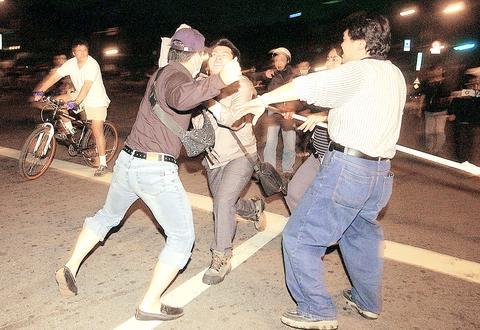
Protesters attack Huang Hsin-hao of Era News at Saturday's
demonstration at the Presidential Office.
-----------------------------------------
On April 12, 2004 ……
Gangsters involved in violent weekend clashes, police say
STAFF WRITER
Gangsters were involved in Saturday's violent protest at the Presidential Office in which 86 policemen were injured, according to Wu Su-lu, the Taipei Police Bureau's Chung-cheng First Precinct chief.
Wu told a news conference yesterday that at least two Molotov cocktaiks were flung at police in the clashes between riot police and protesters, marking the worst conflict since the protests following the March 20 election.
The police arrested 21 suspects from Saturday night until early yesterday morning.
Among those arrested are Lai Hsin-hua, 36, who police claim was in possession of three bottles and a bucket of gasoline, and Lin Hsin-te, 49, who was carrying a catapult.
Both Lai and Lin denied assaulting the police.
Lai said he was planning to set himself on fire with the gasoline.
Lin said that his catapult was for self-defense in case he was attacked by pan-green supporters.
Unlike previous protests, a number of gangsters belonging to the Bamboo Union and Four Seas Gang took part in the demonstration, Wu said.
The police said that among the 21 people who were arrested, six were found to have previous criminal records for offences including violation of the Election and Recall Law and assault, and one is a wanted criminal convicted of burglary.
Wu said that the police had video recordings of gang members creating a commotion in the crowd.
Once the identities of the suspects has been confirmed, the suspects will be arrested and taken to court, he said.
-----------------------------------------
On April 12, 2004 ……
Pan-blue alliance playing with fire, premier warns
On April 12, 2004 ……
By Ko Shu-ling, Staff Reporter
Condemning the brutality that marred Saturday’s pan-blue demonstration, Premier Yu Shyi-kun yesterday said that opposition leaders should be held accountable.
“The opposition alliance was playing with fire by summoning supporters to stage a protest, which unfortunately got out of hand,” he said.
“Whoever plays with fire will get burned. Although we warned the opposition camp about the possible consequence, they failed to constrain their supporters to prevent mishaps from occurring,” Yu said.
Although the government regrets what happened during the protest, it was not fair to let the entire nation pay the price, Yu said.
He made the statements in response to media inquires about the Cabinet’s stance on the protest during a press conference yesterday morning where the premier officially announced the appointment of the new minister of foreign affairs, Mark Chen.
Statistic made available by the city police showed that more than 120 citizens and law enforcement officers were injured during the protest. Of the 13 people who were arrested, six had criminal records.
In addition to urging the public to condemn the pan-blue alliance as irresponsible, Yu called on opposition leaders to should the responsibility and resolve controversy surrounding the election via judicial and legislative means.
“We condemn violence and irrationality, which shouldn’t have occurred during the demonstration in the first place if the people in charge had acted responsibly,” Yu said.
“While they [opposition leaders] claim that they were fighting for the cause of democracy, they were actually sabotaging democracy,” Yu said, pointing out protesters’ attacks on law enforcement officers, reporters and photographers.
-----------------------------------------
On April 12, 2004 ……
PFP legislators call Ma ` dumb,' warn him
"I just wanted to remind Ma that what he did will only make our enemies happy but make his party members sad." --- Hsieh Chang-chieh, People First Party caucus whip
REACTION: Following Saturday night's
violent pan-blue demonstration outside the Presidential Office, the People
First Party laid much of the blame at the mayor's feet.
By Jewel Huang, STAFF REPORTER
People First Party (PFP) legislators
yesterday blasted Taipei Mayor Ma Ying-Jeou as "dumb" because Ma
instructed police to disperse the protesters who were involved in violence and
bloodshed at Saturday night's pan-blue rally outside the Presidential Office.
Several PFP lawmakers held a news conference yesterday at which they warned Ma not to intervene in pan-blue rallies and not to be used by the Democratic Progressive Party (DPP) and Minister of the Interior Su Jia-chyuan. They said the DPP wants to use Ma to create divisions in the pan-blue camp. They advised Ma not to allow himself to be fooled.
"I just wanted to remind Ma that what he did will only make our enemies happy but make his party members sad," PFP caucus whip Hsieh Chang-chieh said.
Several female PFP lawmakers said that the police had trampled on them while the crowd was being dispersed and asked Ma to apologize.
When Ma visited female PFP Legislators Shen Chih-hui and Chin Huei-chu, who were slightly injured and were treated in the hospital, he promised the two lawmakers that the city government would investigate what had happened to see if police had done anything inappropriate.
Taipei City Government spokesman Wu Yu-sheng said the city will deal with Shen and Chin's cases if the news media can provide video footage as evidence of what happened.
However, Chinese Nationalist Party (KMT) Legislator Hsu Chong-hsiung asked the PFP to stop attacking Ma. Hsu said that it was time for the KMT to criticize itself because of its defeat in the presidential election and said the party should stop the street protests.
"Ma didn't do anything wrong in dispersing the crowd. Ma has no need to apologize for what he did because so many people were hurt at the rally," Hsu said.
The police suspect that gangsters were involved in Saturday's pan-blue rally and that gangsters were the ringleaders among those who caused the rally to spiral into violence that caused about 100 injuries, said Wu Su-lu, the Taipei Police Bureau's Chungcheng First Precinct chief.
At a news conference held yesterday at 9:30am -- three hours after the people concentrated on Ketagalan Boulevard had finally been dispersed by the police, Wu reported that 127 people had been injured in the dispersal. Eighty-six were police officers and 41 were members of the general public, of whom 14 were reporters, Wu said.
The police arrested 21 individuals and found that six of them had criminal records. Some of those arrested were in possession of weapons, including slingshots, knives, gas cans and stones.
"It was obvious that gangsters and mobsters en masse were involved in the rally," Wu said.
The police arrested people who assailed the Chiehshou police station, destroying the scaffolding and the barricades that separated them from the Presidential Office and from beat reporters, Wu said.
After Wu issued a command to start a third dispersal action at 12am yesterday, nearly 8,000 riot police moved toward a crowd of about 1,500 people and a violent clash broke out. People hit the police with canes and stones and threw petrol bombs at them. No one was hurt by the petrol bombs.
An elderly, retired veteran tried to kill himself with a fruit knife and was sent to the hospital.
Of the 14 reporters and photographers injured in the riot, several had been beaten by members of the crowd, who accused them of collecting evidence for the DPP.
Two cameramen suffered serious head injuries. Traffic around Ketagalan Boulevard was brought to a standstill.
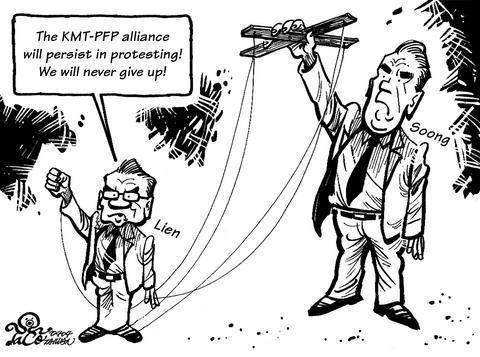
At about 2am, PFP Chairman James Soong came to Chingfu Gate, where PFP lawmakers were sitting, and tried to persuade them to leave. The lawmakers at first refused to leave, but after Soong sat with them for about five minutes, they left the scene along with Soong.
KMT Chairman Lien Chan never appeared at the rally.
At about 6am yesterday morning, nearly 100 people were removed from around Chingfu Gate by the police, and the dispersal of the crowd was complete.
Responding to accusations by PFP lawmakers that he had mismanaged the dispersal of the crowd, Ma said that the police's actions were legal and were based on the Assembly and Parade Law.
"If the police did nothing about illegal behavior, it would threaten law and order," Ma said early yesterday morning. He said that he accepted all responsibility for the dispersal.
Su praised the city's handling of Saturday's rally, saying it was the best example of cooperation that the local and central government had achieved at any point since the election.
But Su also urged Ma to think twice before approving a rally that the pan-blue camp is planning to hold on May 19.
-----------------------------------------
On April 12, 2004 ……
Blue camp wants to rally on eve of inauguration
NOT ENOUGH: The opposition yesterday
threatened that more protests could be held if its pending application for
another rally was denied.
By Chiu Yu-Tzu, STAFF REPORTER , WITH AGENCIES
In the wake of Saturday's riot in front of the Presidential Office, the pan-blue camp yesterday announced that it will soon file an application for another mass demonstration at the same place on May 19, the eve of the presidential inauguration.
"If judicial controversies pertaining to the March 20 election cannot be solved smoothly, we will keep protesting," Chinese Nationalist Party (KMT) Spokesman Justin Chou said.
Chou said that more protests might be held if the application for a demonstration was turned down by the Chung Cheng First Precinct of the Taipei Municipal Police Department.
Taipei Mayor Ma Ying-jeou, however, yesterday refused to reveal his government's stance on the issue.
"I think high-ranking officials of the pan-blue camp will discuss the issue soon. But I have to stress that the Taipei City Government will not abandon its responsibility to maintain law and order in the capital," Ma said.
In addition, Chou said that an urgent, comprehensive investigation into the identity of the instigators behind the riot on Saturday should be conducted in order to clarify who was responsible for the unrest.
He said that the pan-blue camp had nothing to do with trouble-makers with criminal records.
"We are looking forward to seeing a comprehensive investigation report that would clarify who actually instigated the riot behind the scenes," Chou said.
He said that the pan-blue camp was not associated with any rioters who used dangerous articles, such as slingshots and napalm, in the riot.
Police officers yesterday displayed weapons collected from the venue, including steel nails, metal rods, wooden sticks, bottles filled with gasoline, rocks and fire extinguishers.
Chou said that the pan-blue camp was sorry about social unrest resulting from a series of recent demonstrations involving its supporters, including mass protests in Taipei on March 27, April 3 and April 10.
"However, we suspect that an invisible power behind the scenes had been manipulating the situation in order to trigger irrational behavior at our mass meetings, which were carried out legally," Chou said.
He said President Chen Shui-bian should respond to protesters' requests immediately.
The pan-blue camp on Saturday called for the establishment of a special task force to probe the election-eve assassination attempt on Chen and Vice President Annette Lu.
Chou said yesterday that the KMT could easily gather more than 100,000 of its supporters' signatures in a single day. The amount of signatures needed for a referendum to be initiated by the public on the topic is 83,000.
Chou said that people are desperate to learn the facts behind the shooting and he did not think US forensic scientist Henry Lee had provided all the answers.
Chou said that criminal motives, political problems and disputes about the procedure of medical treatment after the shooting remained unclear.
-----------------------------------------
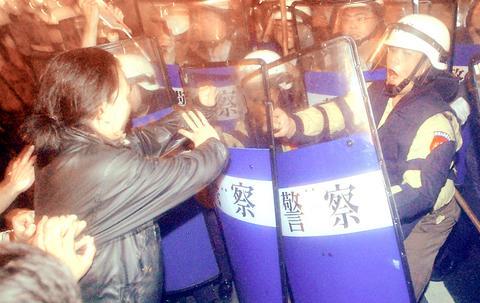
Riot police advance on demonstrators as they break up a huge protest over last month's controversial election on Saturday in Taipei.
-----------------------------------------
On April 12, 2004 ……
Lee: Chen didn't shoot himself
"President Chen Shui-bian was
shot and it wasn't self-inflicted." --- Henry Lee, forensic
scientist
NO FAKING IT: The US forensic specialist
says it is impossible that the president shot himself, though he says he cannot
determine if the shooting was staged.
AGENCIES , TAIPEI
US forensic expert Henry Lee yesterday ruled out one of the more outlandish theories on the shooting of President Chen Shui-bian when he said the wound was not self-inflicted.
But after a whirlwind 48-hour investigation, Lee left Taiwan with many questions unanswered about the mysterious attack on the eve of the presidential election that is now at the center of a political storm.
The most important of them is whether the shooting was staged -- suspicions the opposition Chinese Nationalist Party (KMT) has raised in a lawsuit to nullify Chen's election victory.
"President Chen Shui-bian was shot and it wasn't self-inflicted," Lee told reporters before leaving for Hawaii yesterday after a two-day visit to Taiwan.
When asked if the attack on Chen was staged, Lee said: "I have no idea."
"Determining whether it was or not was not my job," Lee said.
Chen was gashed across the stomach and Vice President Annette Lu was wounded in the knee by two bullets fired from a homemade handgun as they campaigned in a jeep in the southern city of Tainan on March 19.
The KMT says the shooting may have been staged to win sympathy votes. Chen won the election by a razor-thin margin.
Lee, who has worked on high-profile cases such as the O.J. Simpson murder trial, came to Taiwan after the opposition demanded that impartial foreign experts join the government probe.
The former Taipei police captain said DNA analysis showed one of the homemade bullets contained fiber fragments consistent with clothes worn by Chen on the day he was shot, but added further examination of the bullets was needed.
"Taiwan investigators need to identify the weapon and the origins of the ammunition used," Lee said.
He also pointed out the rounded heads of the bullets, which reduced their ability to penetrate, and to the amount and quality of gunpowder used as areas that needed further investigation.
"The amount of gunpowder can be adjusted to alter the bullet's destructive power," said Lee, who refused to draw any conclusions from his investigation.
Lee said investigators need to examine marks on the bullets that help them find out who made them.
After recreating the crime scene and various possible bullet paths using high-tech lasers, Lee said two shots were fired from the crowds that lined the streets to cheer on Chen, but that is was impossible to determine if the attack was staged.
It was difficult to pinpoint the location of the shooter as the crime scene was not secured immediately after the shooting, he said.
Police officers say they have no suspects so far, but are seeking two men seen on security video leaving the scene within minutes of the attack, one on foot and the other on a scooter.
The KMT had proposed special legislation to set up an independent investigation into the shooting, but the ruling party shelved the bill at a legislative session on Friday.
-----------------------------------------
On April 12, 2004 ……
Nation is being torn apart by media bias
By Chen Ping-hung
Who is it that is tearing Taiwan apart? If one asked this question during the election, one was certain to be painted either blue or green. With the election over, I still want to ask who it is, really, that is tearing Taiwan apart.
Based on the election outcome, it is very hard to assert that ethnicity lies at the center of the problem.
What really is tearing Taiwan apart is political ideology, and the media -- television in particular -- is the main culprit in this ideological confrontation.
The reason for this is that almost every TV station, which of course should be objective and fair, held to its own opinion during the election campaign. This situation was worst among the terrestrial TV stations -- when one station aired pan-blue content, another station immediately aired pan-green content. And when the loser claimed that the election was unfair, partisan terrestrial stations immediately transformed into live news stations. Not only did they suspend all other programming, but their news programs also became filled with indiscriminate criticism. Government-friendly TV stations immediately struck back.
When a TV station holds an unambiguous opinion, people of the same opinion flock to that station, causing viewer ratings to go up. TV stations then start attracting viewers according to their political beliefs, instead of according to age groups.
A particular phenomenon during the election was that as soon as people returned home, they turned on their TV sets only to look for news and political programs conforming with their own ideologies. The radical contents of these programs continuously strengthened their own position, forming a confrontational political mindset. Thus, if we now ask a pan-blue supporter which TV station is more fair, he is certain to say China Television (CTV), and if we ask a pan-green supporter the same question, the answer will be Formosa Television (FTV). These two stations were also among the three stations with the highest viewer ratings on election day, which is evidence that Taiwan really is being torn apart by the media.
When the media are transformed into a profit-based commodity, viewer ratings and advertising profit become their main management indicators. Traditionally, TV stations' market segmentation strategies for programming have focused on age groups. For example, programs with stars focus on young people and programs with local color compete for the middle-aged and older market. But how do you target news programs?
The news media have discovered that ideology is the main tool for segmenting the viewer market. In their hunt for viewer ratings, they disregard the question of what the media really are and use ideology to compete for viewers. The result is that pan-blue supporters watch CTV and pan-green supporters watch FTV, thereby planting the seeds of division.
These confrontational political ideologies are spreading with the media's vicious strategies for gaining market share. As a result, ideological political confrontation has increased, reaching its highest point during the election and tearing Taiwan apart in the follow-up. The biggest victims of the media's wilful tearing-apart of Taiwan are the Taiwanese people and society. The biggest winners are the media, with their soaring ratings and high profits.
I condemn the media's evil division of Taiwan. However, in a situation where the media are being controlled by commercial interests, maybe the media's basing their management strategies on the pursuit of one-sided ideologies will make it clear that Taiwan needs media that are not manipulated in this way.
Chen Ping-hung is an associate professor at the Graduate Institute of Mass Communication at National Taiwan Normal University.
-----------------------------------------
On April 12, 2004 ……
Thousands demand full democracy in Hong Kong march
AP , HONG KONG
Thousands of angry citizens marched yesterday to Beijing's representative office in Hong Kong, demanding full democracy and calling on the territory's unpopular leader to quit.
Hong Kongers are clamoring for the right to elect their chief executive and all lawmakers, and a crowd estimated at 15,000 people protested against a ruling by China's most powerful legislative committee that political reforms here must be approved in advance by Beijing.
After a brief standoff with police, the demonstrators were allowed to file past the rear entrance of the Chinese government's liaison office, dropping off boxes of letters that urged Beijing to reverse its ruling and allow universal suffrage.
The silhouettes of more than a dozen people inside the Chinese office could be seen looking out through shaded windows, but a receptionist told reporters no one was available for comment.
"We don't want to overthrow the central government," said Rockly Lam, a 48-year-old warehouse manager who joined the march. "We're just asking for rights we deserve."
Rally organizer Jackie Hung said 15,000 people had turned out to voice opposition to the ruling issued last Tuesday by the Standing Committee of the National People's Congress. Police declined to provide a crowd estimate.
Waving inflatable dolls of Hong Kong Chief Executive Tung Chee-hwa, the crowd chanted "step down."
The Standing Committee issued a binding interpretation of Hong Kong constitutional law that said Beijing must give advance approval for any changes in the way the territory's leader and lawmakers are selected. The demonstrators contend that instead of interpreting the law, Beijing had muscled in and amended it without consulting Hong Kong.
Full democracy is set out as a goal in Hong Kong's mini-constitution, the Basic Law, but there is no timetable and critics charge that officials are stalling to hold back pro-democracy forces viewed as troublemakers by Beijing.
Tung was selected by an 800-member committee loyal to Beijing and is viewed by many here as a puppet to the central government who favors the territory's tycoons over its middle class.
Ordinary voters choose some lawmakers and will directly elect 30 of the 60 seats in the Legislative Council in September, up from 24 last time. The rest are picked by special interest groups that tend to side with Beijing and big business.
Emboldened by a march last July 1 by 500,000 people that forced Tung to withdraw an anti-subversion bill viewed as a threat to freedom, many people are now demanding full democracy.
"China should go along with the historical trend and give us more democracy," said Gary Fan, an office worker.
When Hong Kong was returned from British to Chinese sovereignty in 1997, it was guaranteed a great deal of autonomy for at least 50 years, but critics say Beijing's ruling overstepped the bounds of the Basic Law and reneged on that promise.
"China fixed the law to its liking. How can they do that?" said another demonstrator, Kong Leung, who is 56 and unemployed.
Beijing says its ruling was legal and necessary to set the proper guidelines for the territory's political evolution.
-----------------------------------------
On April 12, 2004 ……
A nationalistic China can't let go
By Sushil Seth
If Taiwan was looking for publicity, it has gotten it in abundance as a result of its presidential election. Whether or not the nation wanted this kind of publicity is another question. But the important thing is that the democratic process, with its necessary checks and balances, will resolve the dispute, and hopefully democracy will emerge stronger.
When the administration of US President George W. Bush congratulated President Chen Shui-bian on his narrow election victory, it wasn't an endorsement of the individual but of the democratic process. It is not surprising, though, that Beijing wasn't amused by Washington's congratulatory message.
The political confusion in Taiwan arising from the presidential election was an ideal opportunity for Beijing to fish in troubled waters. China, therefore, lost no time in warning that it wouldn't sit idly by if the situation got out of control. But the US' congratulatory message spoiled the fun, thus putting Beijing in a foul mood. Washington, in effect, told Beijing to stop manufacturing a crisis as an excuse for intervention.
There are two important elements to the Taiwan situation.
The first is the country's internal political cohesion or lack of it. Although a healthy political debate is the essence of democracy, it needs to be conducted without bringing the process into disrepute.
If the democratic process comes under a cloud, there is a danger of democracy's descending into "mobocracy."
Chen's narrow victory, and the resulting opposition protests, have tended to create a sense of crisis. Even the assassination attempt was regarded by some as a stage-managed affair that was designed to tilt the election result in Chen's favor. Now that these doubts are being sorted out through legal and institutional mechanisms, not much harm is being done to democracy.
But it is important that Taiwan's political class, across the spectrum, create agreed-upon national goals to maintain internal cohesion. Political debate and competition will then center on ways of achieving these goals. For instance, it would be helpful if there were an agreed-upon national position on the question of Taiwanese identity -- whether Taiwan is a sovereign political entity or whether it would rather maintain some ambiguity and determine its status at some future time.
Without an agreed-upon national position on this fundamental issue, Taiwan will remain prone to external manipulation. Its polity will lose direction and become even more fractious. Not surprisingly, Beijing seeks to exploit Taiwan's contradictions to bring about collapse from within.
The second important element regarding Taiwan is the US' commitment to its defense under the Taiwan Relations Act. Beijing believes that because the US is stretched thin because of Iraq and the war on terrorism, China has acquired leverage that it can use to influence the US' foreign and strategic policies, particularly regarding Taiwan. China expects that because of its cooperation with the US on terrorism and North Korea, Washington, at the very least, should contain Chen on the question of Taiwan's independence.
But when Beijing sought to exploit the electoral confusion, Washington wasted no time in setting the record straight by congratulating Chen on his re-election. In other words, China was warned off Taiwan. Therefore, a continued US commitment to the defense of Taiwan is an important prerequisite for Taiwan's identity.
The important question to ask, though, is: Why should Beijing be so obsessed with incorporating Taiwan? In this connection, it is important to remember that the Communist Party in China, under Mao Zedong's leadership, used nationalism as a mobilization tool against both its external and internal enemies. Nationalism has become even more important in the post-Mao period because of China's ideological vacuum. The "greed is good" motto might motivate the rich and those who aspire to be rich, but is hardly an inclusive message for the masses. Nationalism, on the other hand, can be a rallying point -- at least until things start going wrong.
China's communist oligarchy has always portrayed Taiwan as an unfinished national project. They have no doubt in their collective mind that Taiwan belongs to China. The only question is how China should go about incorporating it. They are also convinced that they alone have the credentials to unify Taiwan with China. In this way, the Chinese Communist Party and the motherland/fatherland have become indistinguishable.
In other words, by appropriating nationalism (on Taiwan and in other matters), China's rulers have created for themselves the illusion of legitimacy. Hence, they don't feel obligated to seek popular legitimacy through the "crude" and "dangerous" instruments of regular elections and political pluralism, which they believe will lead to instability and chaos. And they, as super-patriots, are not in the business of letting down the nation. Indeed, those advocating such a path are considered the enemies of the nation. Such paranoia is reflected in branding democracy advocates in Hong Kong "unpatriotic." But there is a method to such madness. The communist oligarchy knows that it would lose power in the event of multiparty democracy.
They are not about to commit political hara-kiri.
To the Chinese leadership, the existence of Taiwan as a separate political entity with an alternative political model is dangerous blasphemy. That won't be tolerated, even in a "subjugated" (unified) Taiwan, as the Hong Kong example shows us. Thus the notion of Taiwan as China's unfinished national business will continue to be regurgitated by Beijing.
Sushil Seth is a freelance writer based in Sydney.
-----------------------------------------
On April 12, 2004 ……
Mr. Smiles and Sunshine feels the political pressure
ELECTION AFTERMATH: The head of the
Central Election Commission is known for his jovial personality, but the
refusal of the pan-blue camp to concede defeat has shown he has an angry side
as well.
By Cody Yiu, STAFF REPORTER
Central Election Commission (CEC) Chairman Huang Shih-cheng has lost his temper in public twice since the presidential election, both times while facing legislators.
Huang's anger took the media by surprise as he is known for his cheerful demeanor, even during the toughest moments of dealing with election issues.
With the referendums on March 20 a first for the country, both political camps had been waiting to see how the CEC would handle vote.
Everything from ballot pickup, to the casting of ballots to ballot counting to the validity of miscast votes had generated controversy.
Whether it is presiding over commission meetings or speaking with reporters at press conferences, Huang usually manages to keep his calm and his sense of humor.
"Make sure you get nice shots of me," he told a group of photographers at an informal press session two weeks ago, setting off roars of laughter.
Joking about with the media is part of Huang's style.
Huang was born in 1935 in Changhua County. He received a law degree from National Soochow University, followed by a doctorate from the University of Bridgeport, Connecticut.
From 1981 to 1989 he was the commissioner of Changhua County.
In the early 1990s he was a minister without portfolio. Between 1996 and 2000, he was a national policy adviser to then president Lee Teng-hui. In 1997, he was appointed as a CEC commissioner. In 2000 he was made the chairman of the CEC.
Besides his career, Huang is active in the athletic and cultural communities. Since the early 1990s, he has been involved with the National Cultural Association, of which is currently vice president, and the Chinese-Taipei Football Association, of which he is president.
Huang gets up at 5am every day and goes for a run.
Huang took offence when, on Wednesday, Chinese Nationalist Party (KMT) Legislator Chu Fong-chi referred to him as an old man.
"I run 5km a day. Can you do that?" Huang said.
Huang, practical by nature, does not like beating about the bush.
"In order to solve a problem, one not only has to explain the problem, but has to solve it," Huang says.
The CEC had its hands full trying to hold the referendum and the presidential election at the same time.
The CEC was under attack by both the pan-blue and pan-green camps. Huang, who once suffered a stroke, went through a lot of stress; however, as an experienced politician, he managed to get through the hard times.
Despite operating within a politically polarized society, Huang, who is independent of any political party, has to stay firm in his belief of neutrality and fairness. On numerous occasions, he has stressed that the CEC represents these values in its operations.
Nevertheless, due to the large number of invalid ballots in the presidential election, the CEC was accused by the pan-blue camp of allowing election workers to rig ballots at polling stations.
The election-related tension led to violence on March 27, when angry protesters smashed the glass doors of the CEC building to block the commission from posting the official results of the election on a bulletin board.
Liao I-ming, assistant professor in the department of government and law at the National University of Kaohsiung, said: "Throughout the turmoil of this past election, history has given Huang an opportunity to set an example as a wise politician."
Liao added that Huang should have altered the process by which results were posted to pacify the angry mob.
"The wording could have been varied somewhat so that the protesters have felt a little better about the situation. It was a shame that Huang was not able to do that," Liao said.
-----------------------------------------
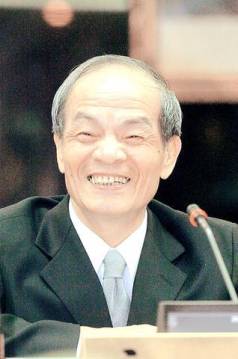
Central Election Commission Chairman Huang Shih-cheng, known for his cheerful personality, makes a habit of smiling at press conferences.
-----------------------------------------
-----------------------------------------