20040413
=======
Taiwan’s election on April 13, 2004 ……
An EU view of Taiwan's elections
By Gerrit van der Wees
During the past few weeks, Taiwan was prominently on display in the window of the world. Elections are generally exciting fare in any circumstances, but one can imagine that the Taiwanese people could have done with a bit less excitement this time around. Still, it is good to analyze the situation in Taiwan, and see how it looks from the perspective of western Europe.
Before going into the current situation, it is necessary to recall that Taiwan has come a long way from the repressive one-party state of the Chinese Nationalist Party (KMT), which held the nation in its iron grip from the mid-1940s through the end of the 1980s. The democratic transition which took place was primarily due to the hard work of the democratic movement, led by President Chen Shui-bian's Democratic Progressive Party (DPP).
In any society which goes through a major democratic transition, there are always elements which hark back to the undemocratic "good old days." In Russia and eastern Europe, there are such remnants of the communist parties. In Taiwan, at least a part of the KMT/People First Party (PFP) opposition seem to fall into this category: They cannot accept that Taiwan has become democratic and the DPP has come to power.
In addition to the democratic versus non-democratic dichotomy, there is the Taiwanese-minded orientation of Chen's DPP versus the Chinese-minded orientation of the present leadership of the KMT/PFP. During the 40 years of martial law, political power was virtually exclusively in the hands of the Chinese Mainlanders who came over with Chiang Kai-shek at the end of World War II. It is only natural that a process of democratization would bring native Taiwanese to a position of power. They represent the large majority on the island.
Still, Chen and his DPP have emphasized ethnic harmony: Anyone who loves Taiwan is considered Taiwanese, irrespective of ethnic origin. The present leadership in the KMT/PFP, on the other hand, has whipped up ethnic discord by twisting and distorting Chen's position.
Going into the election, the issue of a referendum was a major one. In any democratic society, a referendum is a commonplace mechanism to gauge the views of the population on a particular issue. In Taiwan it became a hot potato because its giant neighbor China doesn't like democracy, and the prospect of the Taiwanese people starting to use democratic means certainly looks blasphemous in the eyes of the communist dictatorship.
The problem was compounded when US President George W. Bush got into the act last December: Eager to placate visiting Chinese Premier Wen Jiabao, he berated Chen for seeking to defend Taiwan against China's missiles with the help of a referendum. The Washington Post aptly described Bush's move as a kowtow to China.
In spite of the fact that the blue camp jumped on the pro-China bandwagon and urged supporters to boycott the referendum (even the watered-down version), some 7.45 million voters expressed themselves in the referendum, with some 91 percent in favor of the purchase of additional weapons to counter China's threat. The fact that the referendum didn't make it was thus due to the high threshold -- 50 percent of the registered voters. With such a threshold most referendums wouldn't make it in western Europe either.
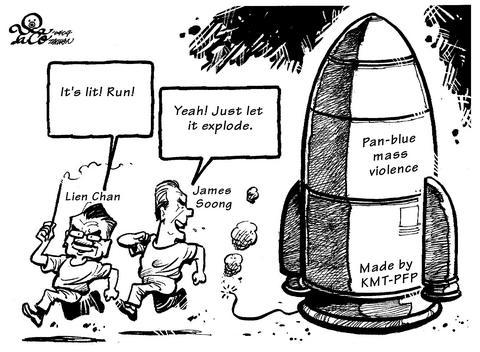
Next is the issue of the closeness of the outcome of the vote. In this, Taiwan is not unique. In many countries there have been close elections. But the essence of democracy is that the loser graciously concedes, and awaits his next turn. In Taiwan, we instead saw the spectacle of KMT Chairman Lien Chan and PFP Chairman James Soong leading angry demonstrations, whipping them into an anti-Chen frenzy. This doesn't look like democracy, but like mob politics.
Large numbers of international observers, including ourselves, can attest that the election process was orderly and that the counting was scrupulous. If there were reports of irregularities, they were of Lien and his party buying votes on a large scale, in particular paying for the tickets of thousands of China-based businessmen returning home to vote.
And then there was the assassination attempt. In any society this would have led to expressions of deep concern also from the opposition -- for the safety and well-being of the victims. But instead of focusing anger on the fact that such a reprehensible act could take place in Taiwan's traditionally peaceful society, Lien and Soong twisted things around and alleged that the assassination attempt had been staged.
This is simply ludicrous. If one would stage such a thing, then one would not do it in broad daylight, in the middle of a crowded street, with TV cameras rolling. The suggestion itself is testimony to the twisted minds of Lien and his followers.
If there are "clouds of secrecy, manipulation and mistrust" hanging over Taiwan, they are due to the hate campaigns of the pan-blue Lien-Soong ticket. They are simply sore losers who do not have the foggiest idea of what democracy is all about.
Where does Taiwan go from here? Getting back to normal is only possible if the KMT/PFP alliance atones for its mistakes and goes through a speedy reform process in which the old leadership is ditched, so that a new Taiwan-oriented leadership can come to the fore and lead the two parties toward a democratic role in society.
From the European perspective, we congratulate Chen and the DPP on his re-election, and for making democracy work in Taiwan spite of mountainous challenges. That is no small accomplishment, but the work is far from being complete. We wish Taiwan and its people well on the arduous road toward international recognition and a full and equal place as a member of the international family of nations. Many years from now, we will look back at March 2004 and conclude that it was an important watershed in Taiwan's history.
Gerrit van der Wees is editor of Taiwan Communique in the Hague.
-----------------------------------------
On April 13, 2004 ……
Pan-blues toy with security issue
By Paul Lin
Because of the tiny margin of victory in the presidential election, it is reasonable to dispute the results. However, poisoning people's minds with rumors, inciting violence and calling for a revolution is going a bit too far.
Some politicians often talk about military force and national security, and use these topics to lambast the government. This time they have produced a lot of bluster on these topics during the post-election protests. This is not only uncalled-for, but also unnerving.
The controversy about the military and national security as they relate to the election revolves around three questions. First, should any military personnel stay at their posts during the election campaign? Second, should the national security mechanism have been triggered after the assassination attempt on President Chen Shui-bian? Third, exactly how many officers and soldiers were prevented from voting?
Let's put aside the first question for now. But we do know that China's People's Liberation Army raised their degree of combat readiness from fourth to third during the campaign, which means officers and soldiers were at their posts and could not take days off.
Taiwan has no plans to invade China, but given China's increased alert, its animosity toward Taiwan and the missiles aimed at us, can we afford to send our troops away from their stations and open the gates to the enemy? Can we let all officers and soldiers go home to vote?
We should not forget that these politicians, suddenly concerned that servicemen were deprived of the right to vote, are the same people who opposed democracy in the past. We cannot help but suspect their motivations.
Their claims, ignoring the issue of national security, worry us even more. To woo young voters, they made a campaign promise that they would reduce the duration of compulsory military service to three months. But if we don't have enough soldiers on duty, the day of "Taiwan's liberation" by China isn't far off. Under such circumstances, even if the US were willing to defend Taiwan, there would be no time for US intervention.
Moreover, some people view the triggering of the national security mechanism as a conspiracy to prevent military personnel from voting. In fact, if the assassination attempt had been made during a non-election period, the national security mechanism would still have been triggered -- so of course it was triggered when an assassination attempt occurred during a tense election. Furthermore, the national security mechanism still needed to be put into effect even though the president was not incapacitated.
This is the case in every country; Taiwan is no exception. This conspiracy theory only reveals that these sophists treat China not as a country trying to get its claws into Taiwan -- but as their master.
Other people inquire how many officers and soldiers were put on standby during the election and how many should have been put on alert after the assassination attempt. Some legislators have even made an issue out of finding out the number of soldiers from specific divisions who were unable to vote. Is this statistic of great importance? The numbers are probably irrelevant to Taiwan's election results, but China would be eager to know them.
Since no one can produce statistics to verify the military's alleged support for the pan-blue camp, the figures are irrelevant to the election result. Can anyone claim that more officers and soldiers would have voted for the pan-blue camp than would have voted for the pan-green camp if they had all been able to vote? We must not forget that it is the pan-blue camp that was demanding a full recount, including spoiled ballots. But now that they do not think a full recount would be in their favor anymore, they have decided to appeal for a partial recount instead. Is this democracy? Is this justice?
Nevertheless, knowing the number of servicemen who were put on alert during the election could be useful for China should it be considering an invasion.
The pan-blue camp demanded in a flippant way that Chen bare his abdomen in public in order to prove that his wound was real. Their inquiry into the number of servicemen on duty on election day is like opening one's belly under the enemy's gaze.
People will support the military and the national security agencies' refusal to comply with such demands. As for the concern that some soldiers were able to vote but didn't, that is beside the point.
Taiwan is democratic, but with the enemy at the gate, the nation needs to keep an eye on national security. We must refuse to accede to unreasonable demands made by politicians. If they insist on making these demands, we must ask them why. If politicians claim that someone in the military or the national security agencies made some remark or another, then we must ask that that person come forward. We must not be tyrannized by certain politicians.
Paul Lin is a commentator based in New York.
-----------------------------------------
On April 13, 2004 ……
DPP files suit against KMT's Lin Feng-cheng
SLANDER: The lawsuit against the
KMT's secretary-general accuses him of libeling the ruling party when he said
it had instigated last Saturday night's violence.
By Chang Yun-ping, STAFF REPORTER
Democratic Progressive Party (DPP) Deputy Secretary-General Lee Ying-yuan yesterday filed a libel suit against Chinese Nationalist Party (KMT) Secretary-General Lin Feng-cheng for slandering the DPP by accusing it of instigating the violence that erupted during a pan-blue rally last Saturday.
Lin accused the DPP of purposefully inciting the violent confrontation on Ketagalan Boulevard on Saturday night. The rally had been called to back demands that a special task force be assembled to probe the election-eve assassination attempt on President Chen Shui-bian and Vice President Annette Lu.
Lee yesterday delivered the defamation suit to the Taipei District Court.
Afterward he condemned the KMT-People First Party (PFP) alliance for fabricating false charges against the DPP.
"This is totally barbaric politics. The truth is the KMT-PFP alliance failed to control their supporters who turned the rally into violence, but the pan-blue camp can't face this consequence and therefore accused the DPP of doing it. This is beyond the limit of our endurance," Lee said.
Lee said Lin's accusation against the DPP was groundless. He said the lawsuit was necessary to restore the party's reputation.
Lee said although the KMT-PFP alliance has said it wants a probe to find the truth of the assassination attempt, it had actually lost the courage to face the truth.
"The KMT-PFP alliance instigated the demonstrators and tolerated the violent confrontation. They ignored the truth and the rule of law. They even shamelessly boasted that their actions were [carried out] in the name of a new democratic movement of Taiwan," Lee said.
In a statement about the lawsuit he read to reporters, Lee said that Lin had betrayed his democratic conscience by accusing the DPP of being behind the violence.
"The democratic demeanor of political figures is very important to the foundation of the country's political civilization. In contrast to the democratic conscience shown by President Chen, who approved an immediate vote recount and examination of his wound to clarify the suspicions over the election results, [KMT Chairman] Lien Chan and [PFP Chairman] James Soong [have shown they] are far from possessing such a disposition by encouraging the street protests," he said.
Lee said Lin cannot justify his words by vilifying his opponents and he urged the public to condemn such "barbaric politics."
Lin has refused to retract his accusations, claiming he had "intelligence information" that showed that the DPP would instigate a vio-lent confrontation last Saturday.
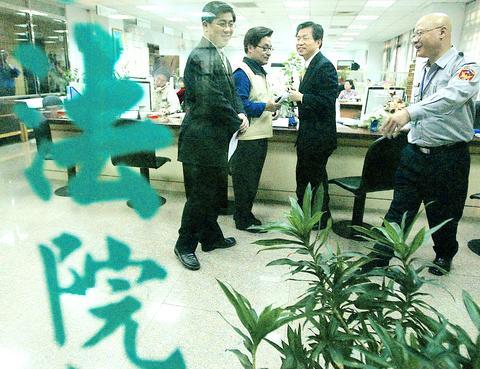
Democratic Progressive Party Deputy Secretary-General Lee Ying-yuan, second right, yesterday files a libel suit at the Taipei District Court against Chinese Nationalist Party (KMT) Secretary-General Lin Feng-cheng for slandering the DPP by accusing it of instigating violence during last Saturday's pan-blue rally in Taipei.
-----------------------------------------
On April 13, 2004 ……
DPP-KMT near agreement on recount
REUTERS , TAIPEI
The government and opposition have agreed on many aspects of a recount of the disputed presidential election and may be able to start the recount by the middle of next month, lawyers for both sides said yesterday.
At a hearing at the Taiwan High Court, both sides agreed that a full recount should be conducted by the Central Election Commission and witnessed by judges and representatives from both parties, said Wellington Koo, a lawyer for President Chen Shui-bian.
Chen defeated Chinese Nationalist Party (KMT) Chairman Lien Chan by a very small margin on March 20. Lien has filed a suit seeking to nullify Chen's victory, citing voting irregularities and a record number of invalid ballots.
"There's a high degree of consensus between the two sides. I think it is quite likely that we can have the recount before mid-May," Koo told reporters after a three-hour meeting with Lien's lawyers.
Lien's lawyers said the court also felt mid-May was a reasonable time for the recount to take place.
Koo said some details still had to be ironed out, such as who would qualify as a party representative.
Chen beat Lien by fewer than 30,000 votes out of more than 13 million cast. The suit cited a record 330,000 invalid ballots to be re-examined in the recount.
-----------------------------------------
On April 13, 2004 ……
Chaos cuts blue camp's chances in future polls
By Wang Yeh-lih
Ever since Chinese Nationalist Party
(KMT) Chairman Lien Chan claimed on election night that the election was
"unfair," the blue camp has adopted a more radical stance, trying to
seek justice through the pressure of a would-be mass movement. Through live
media coverage, the public have been treated to mostly radical politicians
giving passionate speeches at mass demonstrations. Some politicians have even
said that these protests will never end if they do not have their way.
Yet many are discovering that the pan-blue camp's political demands and methods of protest are chaotic. This more or less explains why internal opinion is divided on its post-defeat direction. Not only was Legislative Speaker Wang Jin-pyng "unable to attend" the protest held at Chiang Kai-shek Memorial Hall on April 3, but also many "pro-localization" legislators are opposing the protests out of fear of being marginalized at the legislative elections at the end of this year.
What these incumbent lawmakers care about the most is maximizing their chances of being re-elected. Previously, being either a hawk or a dove could prove profitable: Under the special multiple-member-district system, legislative candidates do not have to win support from a majority of voters. Instead, they have only needed to secure votes from a small group of die-hard supporters.
Sometimes, candidates from the same party rely on different pools of voters. The hawks are therefore attempting to attract "deep-blue" supporters at the protests, while the doves, unable to attract these elements, are worrying about the party losing its grassroots supporters.
The interests of a party and its candidate often contradict each other. Maximizing a blue-camp lawmaker's personal interest may not tally with the overall interests of the pan-blue camp.
For the hawks, for example, apart from consolidating the support of the "deep blues," it seems that their actions since the presidential election have failed to attract new supporters.
Many in the localization faction of the KMT, on the other hand, were elected with the support of local forces. But as the party's grip on local factions has loosened, the ability of the pan-green camp to appeal to grassroots sympathies has grown, together with an increase in pan-green administrative resources.
And all this occurs as Taiwanese consciousness continues to increase.
Many pan-blue lawmakers who are pro-localization are incapable of hunting for a new source of votes in the face of their radical colleagues' rigid appeals to the "deep blues."
Under such circumstances, they surely must feel that their political careers are seriously threatened.
In the previous legislative election, the percentage of votes received by the green camp exceeded 40 percent for the first time, while that of the pan-blue camp dropped to 50 percent.
For the legislative election this December, if pan-blue camp lawmakers -- of whatever tint -- do nothing but vie for existing electoral resources and care for nothing but their political careers, the resources they need to survive will soon peter out.
Today, the pan-blue alliance's most urgent task is to rethink its direction and development, rediscover mainstream thinking and explore new channels of winning votes. The blue-camp's new spring will never arrive if its political elite can only fumble about "consolidating the central leadership."
Wang Yeh-lih is a professor of political science at Tunghai University.
-----------------------------------------
-----------------------------------------