20040414
=======
Inauguration ceremony on April 14, 2004 ……
A diplomatic tale of dogs and tails
By Parris Chang
The re-election of President Chen Shui-bian and Vice President Annette Lu is another shock and great disappointment for Beijing. Although relieved that the two referendum questions failed to be ratified, Beijing is still deeply annoyed by the election outcome, given its pre-election interference and its expectations, which were largely based on incorrect information.
This is irritating to Beijing not only because Chen will stay in power for the next four years, but also because Chinese diplomatic efforts toward on the US had little effect. In an attempt to hinder Chen's re-election, Beijing tried to pressure the US into criticizing Chen before the election. After the election, Beijing even hoped the US would declare Chen's re-election invalid and refrain from issuing congratulations. However, in Beijing's eyes, Washington does not abide by its promises and fails to dance to Beijing's tune. Currently, China is still pressuring the US not to send representatives to Chen's and Lu's inauguration ceremony.
A few days ago, the planned US sale of an advanced radar system to Taiwan also provoked protests from an embarrassed Beijing. Many Chinese military experts interpret this sale as a sign of military alliance between the US and Taiwan, and say that this sends the wrong signal to Taiwan independence elements.
Besides, Beijing also knows that it no longer has the option of resorting to force against Taiwan. Washington has warned Beijing several times that it will not sit idly by if China uses force to change the status quo. Furthermore, many high-ranking Chinese officials deem the use of force against Taiwan inappropriate, saying it would lead to an intense confrontation with the US, or even a military clash.
According to American experts, China's military is content with Chen's re-election because it gives them a pretext to ask for more military funding and to prepare for war, as the Chen administration will continue to inch toward Taiwanese independence. Cross-strait relations will remain in a standoff due to the Beijing leaders' rigidity and inability to abandon the "one China" principle.
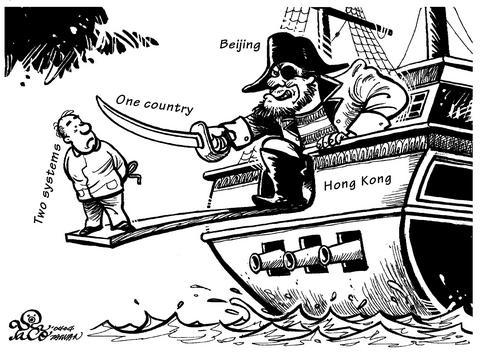
On March 26, China's Taiwan Affairs Office strongly opposed the announcement of Chen and Lu's re-election and brashly meddled in our domestic affairs. China even threatened that it would take action if the post-election situation in Taiwan were to get out of control, a clear gesture of refusal to deal with the Chen administration. With Chen's re-election and his fresh mandate of more than half of the votes cast, it becomes ever less likely that Chen will agree to the "one China" principle, diminishing Taiwan into becoming a second Hong Kong.
Chen has said many times that he is willing to open talks with China about direct flights on the basis of a maintained status quo, as part of the effort to establish a peaceful and stable framework for negotiations. But Beijing keeps stressing the "one China" principle as a prerequisite, thus blocking meaningful dialogue.
The rigid and unrealistic mentality of China's leaders has sparked criticism from the US and raised doubts inside the country. Some Chinese consider the policy on Taiwan a complete failure that must be rectified. Shanghai think-tank analyst Zhang Nianchi has suggested in a published essay that China should develop a new approach toward Taiwan and give it more diplomatic space. Only in this way can the two sides carry on dialogue and improve relations. Could Beijing's leaders exercise such generosity and wisdom?
US Vice President Dick Cheney is visiting Beijing and Shanghai this week. Initially scheduled for last spring, the visit was postponed due to the SARS outbreak. Cheney's visit is also to return the courtesy of President Hu Jintao, who visited the US two years ago. Beijing attaches great importance to its contacts with high-ranking US officials. The Chinese will attempt to take advantage of this occasion to pressure Cheney, who is seen as Taiwan-friendly, into making Taiwan-related statements in Beijing's favor.
Beijing's wishful thinking will be in vain, as Cheney is an expert on military and diplomatic problems. The outspoken Cheney is more likely to candidly suggest several Chinese policy changes. First, the US hopes that China will put more effort into fighting terrorism and dealing with the North Korea nuclear issue. Second, China should be a responsible leading power, rather than threatening Taiwan with its military might and undermining security and peace in East Asia. Third, China should initiate dialogue with Taiwan -- unconditionally.
On March 9, the Woodrow Wilson International Center for Scholars held a seminar titled "One Tail Wags Two Dogs" in Washington. Norman Fu, China Times Washington correspondent, misinterpreted the two dogs as the blue camp and green camp in the presidential election and the tail as the US or China. In fact, those who know English and international politics would know that the two dogs the seminar referred to are the US and China, and the tail is Taiwan. Indeed, some people in Washington, especially "red" scholars and officials, hold prejudices against Taiwan and view Taiwan as a trouble-maker that seeks to involve the US in the China-Taiwan conflict and trigger a war between China and the US. This is not the case.
The Americans' misunderstandings and distortions underline the need for the government to strengthen its diplomacy and publicity. Both the US and China are leading powers, and both attempt to manipulate Taiwan. Both strive to reduce the space for Taiwan's self-determination. In this light, it is not hard to understand why Washington and Beijing objected to former president Lee Teng-hui's "special state-to-state" model of cross-strait relations and Chen's model of "one country on each side" of the Taiwan Strait.
During the presidential election, the international community witnessed a surge in Taiwanese self-awareness and Taiwanese nationalism. This is an opportunity for Taiwan to strengthen its diplomatic ties with the international community. In the face of two powerful nations, the US and China, Taiwan should learn how to outwit bigger countries if it does not want to wag its tail and beg like a dog.
In the triangular relationship between the US, China and Taiwan, sometimes an inch may prove to be a long distance. The challenge to Taiwan decision-makers is how to use popular support to win more independence and international space, and how to engage in diplomatic negotiations with big countries.
Parris Chang is a Democratic Progressive Party legislator.
-----------------------------------------
On April 14, 2004 ……
Fists fly at city council meeting
ELECTION DISPUTE: A fight broke out at the Taipei City Council when a DPP councilor tried to stop his counterpart in the New Party from ruining a portrait of Chen Shui-bian.
By Jewel Huang, STAFF REPORTER
Violence broke out at the Taipei City Council yesterday as New Party city councilors damaged a portrait of President Chen Shui-bian.
The dispute over the presidential election interrupted the city council's first question-and-answer session since the election as Mayor Ma Ying-jeou was about to present a report on his handling of the pan-blue camp's rallies over the past month.
When New Party Councilor Lee Ching-yuan took his turn to speak, he accused Chen of using tricks to win the election, called the election unfair, and said Chen was not qualified to be a national leader.
After finishing his statement, Lee and fellow New Party Councilor Hou Kuan-chiung rushed to pull down a portrait of Chen that was hanging at the back of the council chambers.
Democratic Progressive Party (DPP) Councilor Chen Cheng-teh moved to stop Lee and Hou. During the fracas, the three councilors fell down and the portrait was damaged.
Lee and Hou were slightly injured and council proceedings were interrupted for nearly three hours.
When the council session resumed at 6pm, DPP caucus leader Chou Po-ya asked council speaker Wu Bi-chu to file charges against Lee for damaging public property and asked Lee to apologize for his actions.
"We felt sorry that Lee and his
party attempted to sabotage the stability of society and intended to alienate
ethnic groups with acrid remarks," Chou said, adding that the DPP caucus
will not return to the council unless Wu deals with Lee's and Hou's behavior.
Meanwhile, Lee accused DPP councilors Lo Chung-shen and Chou Wei-yu of beating him, and said it was Chen Cheng-teh who should take responsibility for damaging the portrait.
Prior to the scuffle over the portrait, councilors argued over procedural rules and engaged in fistfights.
Pan-blue camp councilors proposed a provisional bill that asked Chen Shui-bian to issue a special report explaining the March 19 assassination attempt.
DPP councilors rejected the proposal, calling it ridiculous and needless. They said it was yet another irrational request from the pan-blue camp, which still refuses to concede defeat in the election.
"Moreover, it is not the right of the city council but the right of the Legislative Yuan to ask Chen to make such a report," said DPP Councilor Wilson Tien. "I ask the pan-blue camp to stop using their imagination and false accusations to polarize the nation. Please let our society calm down."
DPP Councilor Wang Shih-chien asked Ma to rewrite his assessment of the protests, calling the report "the most ridiculous one" he has read since Ma became mayor.
"Ma was using rhetoric as if he were still the national campaign manager of the pan-blue camp," Wang said. "It is simply a statement of defeat published on behalf of Chinese Nationalist Party (KMT) Chairman Lien Chan."
People First Party Councilor Wang Yu-cheng fought with Wang Shih-chien after he made the remarks, but the two were quickly separated by other councilors.
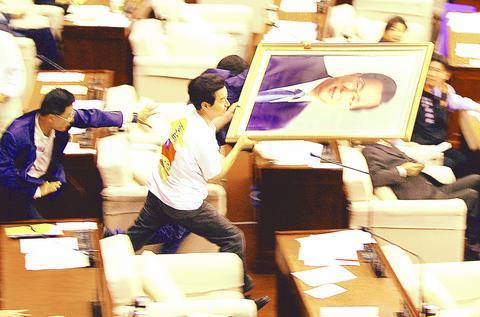
Democratic Progressive Party Councilor Chen Cheng-teh, left, runs after New Party Councilor Lee Ching-yuan, center, at the Taipei City Council yesterday to stop him from pulling down a portrait of President Chen Shui-bian. During the conflict, the councilors fell down and the portrait was damaged.
-----------------------------------------
-----------------------------------------