20040415
=======
Wake up and smell the tea on April 15, 2004 ……
Ethical competition is democracy's keystone
The post-election disorder is an
attack on the rule of law, but it is rooted in a Chinese tradition where
winners take all and losers become "bandits".
By Peng Ming-min
In Western European democracies, and Anglo-Saxon societies in particular, parents have for generations encouraged their children to participate in athletic activities and competitions. They believe this not only strengthens body and mind, but also that the competitive process promotes discipline and respect for laws, and develops a spirit of solidarity and cooperation. Healthy competition in youth is believed to provide habits helpful in social and professional life, and helps mold children into mature, law-abiding and responsible citizens.
Young people's participation in such competition has become one of the cornerstones of democracy and rule of law in Western societies. What are the lifelong habits youths learn as they participate in athletic competitions?
First, they must follow the rules, be
fair and not cheat. They cannot go to any length just to reach their goal.
Second, competition necessarily means
winning or losing. The winner must not be arrogant and boastful, and the loser
must not feel inferior and resort to abuse: the pre-competition salutes or
handshakes are a display of friendship.
Third, there are referees in a
competition. Referees are not perfect people, and unavoidably some of their
assessments will be inaccurate, but even if one is dissatisfied with their
decisions (as with court decisions), one has to accept them and abide by them.
There is a story about a boy returning home after losing a soccer game. After he vents his anger to his father, complaining that "the referee was unfair," the father uses this philosophy of life to both console and educate his son by asking "Who said that life is always fair?" If we believe that the referee has committed a grave mistake, we can file an appeal according to the rules, and patiently await a review of the verdict.
These ethics are called "sportsmanship." They are of deep social significance, and could also be called the ethics of competition. They are given great importance in Western societies, and are passed on from generation to generation. These ethics have become a basic standard for individual behavior both in public and in private, and they are the reason why democracy and the rule by law can be maintained. Thanks to universal acceptance of these unwritten ethics, their violators are spurned by the public.
These sportsmanship ethics become obvious when democratic countries hold elections. In these countries elections are seen as a competition between the policies of the different candidates, where voters are the referees and the winner is decided through popular vote. Candidates do their utmost to publicize and explain their policies to voters to let them assess which policy is more beneficial to society and the public.
For example, there are a lot of candidates when US parties first hold their preliminary elections for presidential candidates. But during the election process those receiving fewer votes, who thus have little chance of winning the nomination, drop out of the race one by one, usually proclaiming their support for another candidate whose candidacy looks stronger.
No one shouts slogans such as "fight to the end" or "scorched-earth tactics," and no one resorts to a life-and-death battle fuelled by rage and other individual emotions that completely destroy intra-party solidarity.
The same logic applies to the presidential election. If any of the parties believes that the law is being violated or that some unfairness has been committed, the ethics of competition dictate that they must air their dissent in public and call for correction in a court of law or through public debate. The campaign may be both intense and fierce, but there is no crying, kneeling or prostration. Everyone maintains their dignity and reason.
These ethics also dictate that once the election's outcome is revealed, everyone accepts it. Even if there are flaws in the process, candidates are willing to accept these flaws in the interest of social peace, and they are unwilling to disturb society with endless exaggerations and by venting their personal enmities.
During the 1960 presidential race between Richard Nixon and John Kennedy, for example, there was proof of vote-rigging in favor of Kennedy in Chicago, and some people suggested that Nixon file a lawsuit. Nixon, however, felt that since the outcome had already been made public, a lawsuit would create chaos, and he therefore accepted the results for the sake of the overall situation.
In the US presidential election in 2000, then-vice president Al Gore lost the election, but there were 1,784 questionable ballots in Florida that could have determined the winner. Gore therefore sought a recount first in the district court, then appealed to a higher court and finally the US Supreme Court, where he finally lost the appeal. Although this Supreme Court ruling is still controversial in legal circles, Gore conceded defeat, holding back his tears. He later attended George Bush's inauguration ceremony, showing his generosity and dignity.
During these weeks of uncertainty, there was no hurling of invective and there were no physical attacks. No one whipped up crowds to hold demonstrations, and no one claimed that they would lead a mob in a charge on the White House.
I don't know how we could even begin to compare Gore's magnanimity to the behavior of the loser in Taiwan's 2000 presidential election, who quietly ran abroad because he didn't want to participate in the presidential inauguration.
The more recent post-election turmoil has astounded Taiwanese and foreigners alike. Yet there are both immediate and long-term explanations for the Chinese Nationalist Party (KMT) and People First Party (PFP) being sore losers in the two consecutive elections.
One of the long-term causes for this
eruption of rage is that these losers have been steeped in Chinese culture
(they pride themselves in being "pure Chinese"). The aforementioned
ethics of competition do not exist in traditional Chinese political culture,
whose logic is that the victor becomes king and the loser becomes a bandit. To
expect them to follow the ethics of sportsmanship would be futile.
Moreover, the pan-blue candidates have always held themselves to be superior to President Chen Shui-bian. In every respect -- from family background to education, experience, command of English and ethnicity -- they deem themselves several ranks higher than Chen and thoroughly despise him. For them, their electoral defeat by Chen amounts to the disgrace of a lifetime. The passion of their revenge has not cooled down; instead, it has been set ablaze.
The opposition's behavior over the
past four years reflects this hatred. Shortly after Chen's first inauguration,
they launched a bid for his recall. They opposed any and all government
policies initiated by Chen's administration for the sake of opposing them,
taking pleasure in embarrassing the new president and his government.
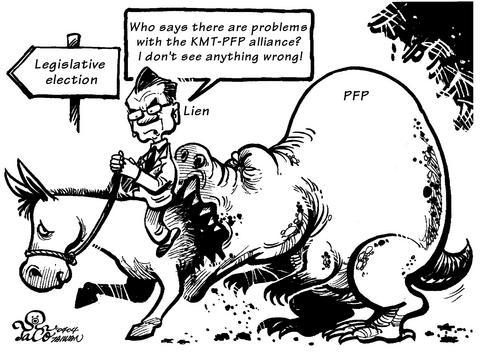
During the 2000 presidential election campaign, KMT Chairman Lien Chan and James Soong, now PFP chairman, did their best to abuse and humiliate each other, as if they were two irreconcilable enemies. Their defeat led to a surprising change in this enmity, as they forged an "iron alliance" and vowed to share their common fate. This showed us the incomparable strength of their political ambitions, and that they would go to any length to achieve their goals. It also showed the depth of their hatred for Chen, and that they would not rest until they have their revenge on him.
As far as immediate causes are concerned, Soong and Lien know very well that their political lives will be over as soon as they admit to losing the election. At that time, they will not be able to suppress calls from within their parties requesting them to resign and pass their leadership positions to the next generation. Their only way out of this predicament was therefore to claim that the election was "unfair," to demand that it be annulled, and then to demand a re-election, even though they had no evidence at all to back up such demands. By blurring the focus, blaming other people and denying their responsibility for the election loss, they thus managed to linger on with the last breath of their political lives.
The second immediate reason for their post-election behavior is that the opposition parties were overly confident, believing they could not lose the election. Their supporters congregating in front of the campaign headquarters believed victory was theirs, as they were misled by TV reports that falsified the numbers of votes won by each side. The crowds were shocked by the true results, as these were totally different from what they expected. As vote-rigging had been a trick routinely employed by the KMT during its decades of rule, the opposition supporters' immediate reaction was to presume the unexpected outcome was due to a vote-rigging effort by the DPP. The crowd's anger and indignation thus erupted as if ignited by lightning.
Third, Chen was shot on the eve of the presidential election, and the nation was in an uproar. It is doubtful whether the incident had any major impact on the election since voters had largely made up their minds by then, yet it became the best excuse for the losers to spread sensational rumors and incite their supporters. Some people even said it was unacceptable to allow one bullet to influence hundreds of thousands of votes.
In fact, even if the shooting had an
impact on the election, it was a sudden incident, as unexpected as a natural
disaster. It was not a reason to claim that the election was unfair; to do so
is much like a student stricken by an illness on exam day claiming that the
exam itself is unfair. Unexpected events are an inevitable reality of life. How
can one carry on living if one cannot even accept that?
The opposition parties are inciting crowds and students to riot. As KMT Secretary-General Lin Fong-cheng said, they will not quit -- meaning "If we can't have the presidency, then you can forget about it, too." They'd rather see their enemies perish together with them.
The losing parties have incessantly created turmoil with their slogans, which are limited to "the election was unfair," demands for a recount and new election, and claims that "the election is mired in doubt" and "the truth has not been told." Most of these claims are unsupported by any evidence, and some are a mere childish venting of spite.
Claims that "the election is mired in doubt" and that "the truth has not been told" probably refer to the shooting of the president and the large number of invalid votes. The situation surrounding the shooting is in fact very clear: Someone shot the president in an attempt to assassinate our head of state. There is no doubt about this; it's just a matter of the culprit not having been arrested yet. There are quite a number of unsolved murder cases in Taiwan. Using the fact that the culprit is on the loose to exaggerate things, and even accusing the victim of planning and orchestrating the shooting, is an attempt to confuse matters and stain the election. As this claim also assassinates the character of the shooting victims, it is childish and ridiculous in the extreme, and it underestimates the common sense of the citizens.
In any country, if the head of state is shot at -- regardless of whether he or she is injured, or how serious his or her wounds -- it's necessary to initiate the national security mechanism and mobilize military and police, placing the nation on alert. Don't forget that China, watching from the other side of the Taiwan Strait, would love to eliminate Chen.
If some people are unable to vote, it is only because they are performing their public duty. This is no different from the situation of other public servants, who sometimes are unable to vote due to the demands of their duties; for example, diplomats working abroad or emergency personnel staying on duty during elections. This normal situation does not an "unfair election" make. Besides, no one can be sure which side would benefit if these people had been able to vote.
Regarding the invalid votes, reportedly hundreds of thousands, let's not forget that during the campaign, the Alliance of Casting One Million Invalid Ballots publicly urged voters to either give up their right to vote or to cast invalid ballots in order to boycott the election. Therefore, most invalid ballots were cast by those following the alliance's call, and can also be seen as votes for that alliance. What is so strange about that?
The opposition camp has incited the public and students to create disorder. Apart from showing their unwillingness to accept defeat, perhaps they themselves do not even know what they want. They contradict themselves, are incoherent and do not know what they are talking about.
They go from claiming that "the election was unfair" to suddenly demanding that the election be annulled, before calling for a recount, and then a re-election. They call for the president to step down, then suddenly announce the election of Lien and Soong, then demand that Chen receive them before a specified deadline. They demand that Chen issue an emergency order to recount votes, then call for an "administrative recount" -- and then a "judicial recount" -- and then an "administrative and judicial recount." They demand the establishment of an investigation committee, they call for political reform, and they demand a meeting on matters of national interest. These ever-changing appeals are dizzying.
Some students willing to be used by these politicians joined the disturbance. Perhaps they thought of the past "Wild Lily Students' Movement", a true and respected student movement, and tried to copy it.
But the motives, timing, methods and demands of their campaign will not win the people's respect. Whether democracy and the rule of law can take root in Taiwan will depend on whether the ethics of competition can take root here.
Peng Ming-min is a senior advisor to the president.
-----------------------------------------
On April 15, 2004 ……
Wake up and smell the tea, China
China's Taiwan Affairs Office spokesperson, Li Weiyi, yesterday criticized President Chen Shui-bian, saying that Chen's plan to implement a new constitution by 2008 is a timetable for Taiwanese independence. Li also said that Chen is using the 2008 Beijing Olympics to promote Taiwan independence.
Li is taking advantage of US Vice President Dick Cheney's visit to China to aim this very imaginative statement at the US while also threatening Taiwan. This statement hints that severe consequences will follow if the US does not apply pressure on Taiwan concerning the writing of a new constitution and a constitutional referendum, indicating that China will take action if that happens. It is also an attempt to reduce Chen's growing prestige and influence following his re-election.
The effect of China's military threat against Taiwan has gradually weakened in recent years and every repeated threat is dismissed by Taiwan's media, which no longer take such threats seriously. Instead, these threats have helped Chen's campaign efforts, and China therefore refrained from making further threats before this presidential election. Li's relatively indirect statement is also a step forward compared to China's stronger language in the past.
However, China's frequent and wanton criticism of Taiwan's democratic development and Chinese attempts at controlling events in Taiwan still continue, and that is regrettable. China's leaders must consider the sentiments of the international community when dealing with Taiwan. In the eyes of democratic observers, China's frequent interference in Taiwan's domestic political affairs is obviously a matter of an authoritarian country interfering in the political reform of a democratic country, and that is absurd and ridiculous in the extreme.
We also want to remind Beijing that Taiwan is not Hong Kong; it is neither a Chinese colony nor a "special administrative region." The way China dominates political developments in Hong Kong is not applicable to Taiwan. Especially in the recent presidential election, the people of Taiwan used their votes to reject the pro-China candidates, Chinese Nationalist Party (KMT) Chairman Lien Chan and People First Party (PFP) Chairman James Soong. This was tantamount to saying no to China.
From former president Lee Teng-hui's electoral victory in 1996 to Chen's re-election this year, Taiwanese voters have demonstrated their will to choose their own path. Faced with such circumstances, China should adjust its ideology and speed up political reform in order to draw the two sides closer by diminishing the differences between their political systems and their democratic progress. Beijing will only spark revulsion among the Taiwanese people by intervening in Taiwan's domestic politics and employing dirty tricks to belittle Taiwan's status in the international community.
For this reason, the Ministry of Education has strictly forbidden local universities from downgrading themselves in their exchanges with China by adding the word "Taiwan" to or deleting the word "National" from their names. We know that such self-belittling actions have been taken in order to downgrade Taiwan to a Chinese region through its word games.
China must realize that exchanges with Taiwan have to be beneficial to cross-strait relations. If these exchanges are aimed only at satisfying China, they will become meaningless.
After more than 50 years of
separation, the gap between the two sides' political and social development is
obvious. As close neighbors with cultural, geographical and historical ties,
it's certainly necessary to narrow this gap. Friendly interaction is the
primary task. China's unification propaganda and tricks will only have an
effect opposite from what it intended. When will Beijing understand this simple
reasoning?
-----------------------------------------
On April 15, 2004 ……
DPP now believes it can gain majority alone, Tsai says
By Chang Yun-ping, STAFF REPORTER
Amid cutthroat competition in the year-end legislative elections, the Democratic Progressive Party (DPP) has set a goal of securing 123 seats in the 225-seat Legislative Yuan, together with its strategic partner, the Taiwan Solidarity Union (TSU).
The target was hammered out at the first meeting of the party's legislative campaign strategy group, which was established on Tuesday.
DPP legislative caucus whip Tsai Huang-lang yesterday said that as the pan-blue camp remained preoccupied by its defeat in the presidential election, the DPP is gaining confidence about the December legislative election. To secure more than the simple majority of 113 seats alone is no longer a difficult task, Tsai said.
"The DPP will have absolutely no problem in securing half of the total legislative seats," Tsai said yesterday. Such comments were a noticeable change in the party's tone, as it had previously said that it would seek to exceed half of the total legislative seats with the help of the TSU.
Tsai said the DPP alone would be able to garner 113 seats out of the 123 combined pan-green seats. However, he added that the party also hoped the TSU could work on its own to achieve the largest number of seats possible to expand the pan-green camp's "foundation" in the legislature.
TSU legislative caucus whip Chen Chien-ming yesterday said the party will seek to nominate at least 40 candidates, hoping to secure at least 30 seats.
Chen said the party will focus its campaign theme on expanding public support for Taiwanese identity and raising people's identification with Taiwan.
The party will position itself as a loyal coalition-member, while retaining its independent characteristics, Chen said.
At present, the TSU holds 12 seats and the DPP 87, compared to 66 for the Chinese Nationalist Party (KMT), 46 for the People First Party (PFP) and 12 independents, most of whom vote with the KMT-PFP alliance.
Chen said that in addition to the party's 12 incumbent law-makers who would seek re-election, the party also welcomes lawmakers from within the KMT's "localization faction" to join the TSU.
Meanwhile, Presidential Office Secretary-General Chiou I-jen said the DPP will not simply continue the "cutthroat" strategy it used in the presidential election, but would "keep cutting until the head of the pan-blue camp falls off" in order to wean supporters away from the KMT and expand new sources of support.
Chiou, the leader of the party's New Tide faction and the top campaign strategist during the presidential poll, said there are three possibilities for how the DPP would convert pan-blue support to the DPP.
First, he said a major structural
shift would occur when the KMT's grassroots politicians convert to the DPP,
including elected officials and their respective supporters.
Second, the DPP would seek cooperation with KMT grass-roots supporters and encourage them to choose among themselves a pro-DPP leader to run the election.
Third, the party would convert KMT
grassroots supporters into supporters of the DPP and its legislators.
-----------------------------------------
On April 15, 2004 ……
Illegal migrants a burden
The large number of Chinese stowaways in detention centers has created a heavy financial burden for the government, a Criminal Investigation Bureau spokesman said yesterday. He said a total of 2,237 illegal immigrants were repatriated to China last year and 674 were sent back in the first two months of this year. He said 2,155 people remain detained -- 1,132 at the Ilan center, 1,011 at the Hsinchu center and 12 at the center on Matsu. Meanwhile, the bureau warned yesterday that more young Chinese women had illegally entered the country to work in the sex industry. Statistics show that 1,962 female stowaways were arrested last year.
-----------------------------------------
On April 15, 2004 ……
Different cases, different inquires
By Wong Ping-yun
Our society often displays a blind worship of the American experience and of political stars. As long as an issue has been awarded the "American experience" label and an authoritative recommendation by a political heavyweight, it seems there is no need to look into the details of what the American experience actually entails. Nor is it necessary to study the differences between the Taiwanese and American experience. This leaves us unable to absorb knowledge from the experiences of other countries and leaves public debate reminiscent of marketing slogans on home shopping networks.
Recent mentions of the US Warren Commission in discussions about investigating the Tainan shooting are a good example of this. The "truth investigation commission" currently sought by the Chinese Nationalist Party (KMT)-People First Party (PFP) alliance cannot be compared to the Warren Commission, which investigated the assassination of US president John Kennedy, for three crucial reasons.
First, the Warren Commission was set up following an executive order by then-US president Lyndon Johnson, who also decided on the commission members. The findings of the investigation were also to be reported to the president. The investigation was entirely administrative in character. Although members included Supreme Court justices and members of Congress, all accepted the president's invitation to serve on the commission in a private capacity and did not represent the Supreme Court or Congress. Nor were they nominated by those institutions.
When Congress later passed special legislation giving the commission the right to summon witnesses and investigate evidence, the summons capacity was administrative in nature, as provided for by US law. The measure was aimed at strengthening the commission's functions and did not change its administrative character.
The KMT and the PFP legislative caucuses now want to pass special legislation setting up an investigative commission led by the president of the Control Yuan. They propose that five members should be recommended by each party caucus, and that the Control Yuan recommend four members. The commission's findings would be reported to the Control Yuan and Legislative Yuan.
This is different from the Warren inquiry as it extends the reach of the Legislative Yuan and the Control Yuan into administrative and judicial investigation. If we really think that the Warren Commission is a worthy example, then it should be President Chen Shui-bian who orders that the commission be set up, and he should invite appropriate members to take part. But would that be acceptable to the KMT and the PFP?
Second, the man suspected of assassinating Kennedy, Lee Harvey Oswald, had already been killed when the Warren Commission was established. If Oswald had no accomplices, then the judicial investigation would have had nowhere to begin. The Warren Commission therefore did not intervene directly in the ongoing investigation, thus lessening the risk of a conflict with the judiciary. Despite this, a year after the Warren Commission presented its report, there were still prosecutors who did not agree with its finding that Oswald acted alone. They investigated and brought charges against another suspect who was later found not guilty by the court.
The assassination attempt on Chen is currently being investigated by prosecutors. If the Legislative Yuan sets up a special investigative commission, it will result in grave interference in the prosecutors' investigation, and may affect a future verdict in the case. In addition, the KMT and the PFP claim that the shooting resulted in an unfair election, a claim that is also being investigated by the court. If a special commission is set up and its findings differ from the court's verdict, would this not create even fiercer confrontation and distrust in our society?
Third, the Kennedy assassination did not involve a political struggle between the government and the opposition, while the shooting of our president has become the main focus of inter-party struggle. Given this, I fear that setting up a special investigative commission that could violate the rule of law would only intensify political conflict.
As former US chief justice Earl Warren said in Watkins v. the United States in 1957, a government cannot expose for the sake of exposure. Constitutionalism dictates that any government investigation must comply with the principle of the rule of law. A silent truth will not speak up for itself. We rely on legitimate legal procedures in the quest for truths that the public can believe in.
I fear that if we abandon the rule of
law while shouting about finding the truth, we will only start another wave of
political struggle and deteriorating trust.
Wong Ping-yun is a lawyer.
-----------------------------------------
-----------------------------------------