20040416
=======
Inauguration on April 16, 2004 ……
People First Party says it will try to stop inauguration
"[Chen Shui-bian and Annette
Lu], as the defendants in two lawsuits, cannot be sworn in as the new president
and vice president." --- Chang Hsien-yao, director of the PFP's
Center for Policy Research
By Ko Shu-ling, STAFF REPORTER
The People First Party (PFP) legislative caucus yesterday threatened to file an injunction with the Taiwan High Court to stop the inauguration of President Chen Shui-bian and proposed that Legislative Speaker and Chinese Nationalist Party (KMT) Deputy Chairman Wang Jin-pyng act as Chen's proxy until the election controversy is settled.
"Chen and Vice President Annette Lu, as the defendants in two lawsuits, cannot be sworn in as the new president and vice president because the High Court is still investigating the cases," Chang Hsien-yao, director of the PFP's Center for Policy Research, told a press conference held at the legislature yesterday morning.
The pan-blue alliance has filed one lawsuit to declare the election a fraud and another to demand a recount of the ballots.
While the recount lawsuit was aimed at suspending Chen and Lu's election on the grounds of fraud, the annulment lawsuit was targeted at the Central Election Commission and seeks to nullify the March 20 election.
PFP lawmaker Hsu Yuan-kuo proposed that the legislature let the speaker become president to be in line with practices adopted by countries such as South Korea.
If Chen and Lu insisted on being sworn in as the nation's new leaders -- as required by law -- Chang said that the PFP would file an injunction.
In addition to the judicial process, Chang said that the caucus was also considering amending the Presidential and Vice Presidential Election and Recall Law to bar a president and vice president-elect involved in a "legal entanglement" from being sworn in.
According to Philip Chou, a PFP lawyer, the injunction will be filed early next month.
Chou refused to predict how the court would rule on the request, saying that the controversy was unique in the nation's history.
The PFP legislative caucus yesterday also filed a lawsuit against Presidential Office Secretary-General Chiou I-jen, accusing him of violating the Presidential and Vice Presidential Election and Recall Law by upgrading the nation's security status, as is customary before an election.
In addition, PFP and KMT lawmakers requested the Control Yuan form a task force to probe into whether Premier Yu Shyi-kun, who doubled as the DPP's campaign manager, had broken the law by presiding over the national security meeting, which is the responsibility of the president.
They also asked the government watchdog to investigate Chiu and National Security Council Secretary-General Kang Ning-hsiang for refusing to respond to inquiries about the activation of the national security mechanism.
Meanwhile, the Democratic Progressive Party (DPP) legislative caucus yesterday criticized remarks made by a PFP lawmaker, requesting that PFP Chairman James Soong apologize for the lawmaker's comments about Chen.
Likening Chen to a despotic emperor, Emperor Chou of the Shang Dynasty, and Yuan Shih-kai, a warlord in the early 1900s who overthrew the Republic of China and declared himself emperor, PFP legislator Thomas Lee encouraged the public to "shoot President Chen dead" if they run into him.
DPP legislative caucus whip Tsai Huang-lang criticized Lee's remark as "anti-democracy aimed at provoking confrontation and violence."
Branding Lee an "uncivilized instigator" and his remark "nearly insane," Cabinet Spokesman Lin Chia-lung requested Wang uphold justice and revoke Lee's legal immunity as a lawmaker and send him to the legislature's discipline committee for punishment.
"We condemn such inappropriate and shameless remarks about the president and we're sorry to hear such remarks uttered by a highly-educated intellectual and college professor," Lin said. "It'd be the appeasement of the worst sort if we kept quiet about such demented, defamatory and negative comments."
-----------------------------------------
On April 16, 2004 ……
Rule of law? Not for these 1.3 billion people
“In Jinan, they have beaten us and
threatened us to stop our pandering, now we come to Beijing and they are doing
the same. They call this rule by law.” --- Sun Shoulu, whose son
was murdered in a police station
BEIJING'S MENTALITY: People seeking
to appeal cases of injustice have traditionally traveled to the capital to seek
redress - now the door is being shut in their faces.
AFP , BEIJING
Wang Huanmei, 62, holds up color pictures of her dead son lying in a coffin dressed in a Western suit, sleeves rolled up showing long, purple bruises on both forearms, and one eye blackened.
She knows the story well. She's been telling it since 1995 when she found out that her son Sun Jie -- a college graduate -- was murdered in a police station in the Shandong provincial capital of Jinan.
"Sun Jie was handcuffed with his hands behind his back and hung from a tree and beaten to death on September 8, 1995 in the courtyard of Dajin police station of Jinan's Huaiyin district," Wang said.
"He was beaten to death by three people, including the police chief of the Dajin station Xu Fang," she said.
Her problem is that after years of fruitless efforts to get Jinan and Shandong officials to investigate her son's death, she is now being threatened with arrest for bringing the case to the complaints bureau of the State Council, China's Cabinet, in Beijing.
Wang is not alone.
Dozens of petitioners who gather around the Yongdingmen Train Station in southern Beijing, near the State Council's complaints bureau, are being rounded up by police, beaten and sent back to their hometowns, they said.
The police action has come since National People's Congress (NPC) Chairman Wu Bangguo last month ordered local governments to stop petitioners coming to the capital and mandated local complaints bureaus to handle the issues locally.
The new order has left petitioners questioning the sincerity of China's government, which was sworn in last year with a pledge to be open and honest, to give priority to the demands of the people and to rule the country by law.
It was also bad news for people like Wang, who say government protectionism and corruption at the local level -- especially among the police -- are the reasons why they can't get justice in the first place.
"We cannot get justice in Shandong, so we've been coming here to Beijing for several years now," said Wang's husband, Sun Shoulu, 62.
"In Jinan, they have beaten us and threatened us to stop our pandering, now we come to Beijing and they are doing the same. They call this rule by law," Sun said.
Sun laughed off as "a sham" and "worthless decoration" a new amendment to China's Constitution that calls for the protection of human rights, passed by the NPC last month.
"After all these years coming to Beijing, they haven't replied to one of our petitions," he said.
The central government mandate has also jeopardized hundreds of years of Chinese tradition that have allowed local peasants to come to the capital to petition the emperor's court over injustices in the hinterlands.
With a weak civil society, no democratic elections and a press that is controlled by the state, China's system of complaint departments has long been seen as one of the few official channels to openly air grievances.
"I've been threatened, beaten and jailed by the police for trying to petition," said Du Mingrong, a woman from Baishan city, Jilin Province.
Du originally came to Beijing to petition a refusal by Baishan police to investigate the murder of her mother, but is now complaining about a policeman beating her up at the complaints bureau of the Supreme People's Court, the country's highest court, last year.
Like most other petitioners, she has reams of documents, including typed and handwritten petitions to different government organs at all levels.
"A policeman named Tian beat me with an electric baton inside the Supreme People's Court compound last year. The Yongdingmen police are now cracking down on petitioners that come to Beijing and in Baishan they threatened to throw me in an insanity asylum if I cause any more trouble," Du said.
Before last month's meeting of the NPC, a park-like area near the Yongdingmen train station had become known as "complaints village" for the amount of people camped out in cardboard huts or in the open air waiting to table complaints to the government.
But the area was largely "cleaned up" last month with thousands of petitioners being hauled off to a gymnasium in western Beijing where they were processed and forcefully sent back to their hometowns.
During the NPC, thousands of petitioners daily gathered in the area in front of the State Council complaint's bureau to table petitions, but this week no more than 15 people were seen milling about at any given time.
Now only a few people gather at the former "complaints village," with many of their grievances involving unsolved killings of loved ones.
"I've been sleeping on the street under an underpass because to sleep here [in the village] the police will catch you and send you back," said Qian Lili, 40, from Shandong's Zibo city.
Qian's eight-year-old son was murdered by her ex-husband's new wife in 1999, but the crime was not punished due to a plea of insanity which Qian says is bogus.
"You have to stay in Beijing to complain because there are so many ministries and departments. You can complain at the State Council, Supreme People's Court, All China's Women's Federation, National People's Congress and the Supreme People's Procuratorate," she said.
-----------------------------------------
On April 16, 2004 ……
Editorial: Lien lets the small potatoes fry
During a Tuesday meeting between Chinese Nationalist Party (KMT) lawmakers and KMT Vice Chairman and Legislative Yuan Speaker Wang Jin-pyng, Legislator Lee Chia-chin suggested that "the vice party chairmen, secretary-generals and top-ranking party officials should all step down to show accountability for the election defeat."
Lee's words brought to the surface an issue that had been on the minds of many KMT members since the election -- that someone within the KMT has to shoulder the responsibility for the defeat.
While not many people dare to say aloud the name of the person who more than anyone else should take the responsibility -- KMT Chairman Lien Chan -- at least the issue of stepping down as a show of accountability is no longer taboo within the party.
Lien has to be feeling the heat now, although party members continue to call for consolidation of the party leadership and his name was conveniently omitted from all discussions about resignation.
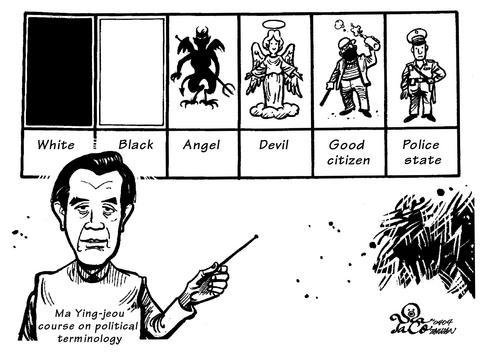
Not only was Lee's statement echoed by other KMT members, but Taipei Mayor Ma Ying-jeou, another KMT deputy chairman, also said he is willing to resign as vice chairman. Ma's statement makes him the second vice chairman to indicate a willingness to resign.
If Lien had a shred of integrity left, he would feel the pressure. If all the small potatoes in the party resign, what is his excuse for not resigning? After all, he was the one who was defeated in the election. If he sits idly by as these people take the hit for him, he will lose all respect from others. For Lien to dodge responsibility would be feudal and entirely at odds with democracy's fundamental principles. Unlike in the feudal era, when leaders would never admit their mistakes and sacrifice their supporters to secure power meant virtually nothing, a real leader in any democracy is always the first to take accountability.
It isn't as if Lien has not had his chances. This presidential election marks the third major defeat the KMT has suffered under his leadership, the first being the 2000 presidential election and the second being the last legislative election, in which the KMT lost so many seats that lost its legislative majority and fell behind the Democratic Progressive Party to become the second-largest party in the legislature.
The strange thing is this: Lien
always says he is not to blame. In the 2000 election, the problem was the
so-called "dump Lien to save Chen" (Shui-bian) effect and the
supposed betrayal of then-president Lee Teng-hui. This time, the bullets that
injured Chen and Vice President Annette Lu on election eve were to blame. In
the last legislative election, Lien saw no need to bother offering any
scapegoats for his party's defeat.
Under the circumstances, it is not surprising that Lien has said that Chen was the "only one to blame" for the violence that erupted as a result of the rally organized by his party last Saturday after he went home for supper and a nice hot shower.
It is in times like these that one sees clearly how much better a man Lee was than Lien is. When asked by Lien and Ma to step down as party chairman after the 2000 election, he did so immediately in order to take responsibility for the defeat. One cannot help but wonder what has happened to Lien's moral courage over the past four years.
-----------------------------------------
-----------------------------------------