20040418
=======
China faces urban poor on April 18, 2004 ……
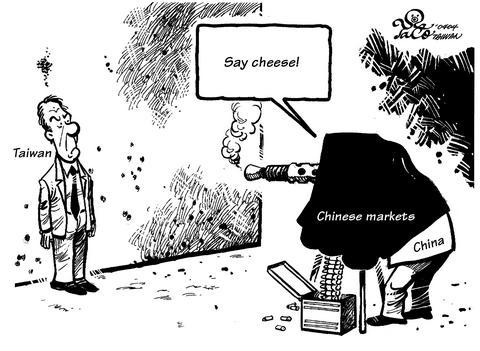
China faces flood of urban poor
AFP , BEIJING
Qing Guiyun and her husband Chen Hao spend most of their days in a pedestrian underpass in Beijing's busy Chaoyang business district, she peddling books and he seeking jobs as a part-time home repairman or carpenter.
They are two of some 2.8 million migrant workers, most of whom have left rural areas to seek a fortune in economically booming Beijing. Up to 130 million economic migrants are currently descending on China's cities, mainly along its prosperous eastern seaboard.
Some of these migrants have found success beyond their wildest dreams. Others remain in the grip of grinding poverty.
"It has been really hard to make money here. We're lucky if we can make 500 yuan (US$60 dollars) a month between us," said Qing, who hails from rural Guizhou province, one of China's poorest regions.
The two share a small apartment with several other migrant workers and enjoy no social or health benefits from the government.
"We have to pay 200 yuan for rent every month and then we need to eat, so it is hard to send any money home," Qing said. "We rarely buy clothes."
According to a report on China's poverty published last month by the Asian Development Bank (ADB), Qing and Chen are a part of a growing army of migrants on the brink of urban poverty, a phenomenon that is likely to get worse before it gets better due to the huge influx of people into cities.
Although China has had resounding some successes in reducing poverty among its 750 million rural residents since it began economic reforms in 1978, in recent years poverty has grown, the report said.
"China's success in reducing poverty reflects sustained rapid economic growth, the mainstreaming of poverty reduction efforts and significant budget allocations for poverty reduction," said David Sobel, one of the authors of the report.
But "there are no official national figures on urban poverty, as urban poverty is handled at the local level ... so our report makes the best estimates of given data."
The report estimates that in 31 major Chinese cities up to 10.3 percent of the registered urban population was impoverished.
When extrapolated to China's 639 cities, this would indicate that up to 48 million registered urban dwellers live below the minimum living standard in China's cities, while some 15 percent of anywhere between 40 million and 130 million migrant workers are also impoverished in the cities.
While much of the urban poverty has come from lay-offs at state-run enterprises, which amounted to some 47 million job losses between 1996 and 2000, the report said, millions of economic migrants will boost the numbers in future.
Already the government is gearing up for the influx and has begun to set up a social security network.
Urban poor receiving minimum-living subsidies rose from 4 million in 2001 to 21 million last year, the ADB report said.
-----------------------------------------
On April 18, 2004 ……
Council's fight puts portrait in limelight
By Pu Ta-chung
A fight broke out at the Taipei City Council on April 13, when some Democratic Progressive Party (DPP) councilors' discontent over and boycott of Taipei Mayor Ma Ying-jeou's administrative report triggered a protest by some blue-camp councilors. As a result, New Party Councilor Lee Ching-yuan pulled down a portrait of President Chen Shui-bian that was hanging at the back of the council chamber and was chased and beaten by some DPP councilors. This case re-minds us of the pan-green camp's damaging portraits of the two presidents Chiang in the past. Things change with the passing of time. The changed positions of the two camps make us sigh.
The hanging of a presidential portrait undoubtedly holds an implication of power. In an authoritarian regime, leaders' portraits are a tool to win over or awe their friends, and to tame and monitor their enemies. However, in a democratic society, the hanging of a presidential portrait symbolizes the legal rule authorized by a democratic mechanism.
It actually symbolizes, and gives a human face to, authority. For both systems, leaders' portraits have two social regulatory functions: Glorification and oppression. This is the so-called "portrait politics," under which a presidential portrait is in fact a re-creation of honor, status and position, hinting that the president's social and moral role and authority is supreme.
The key to Lee's case is not the portrait. Rather, it's the compulsory hanging of a presidential portrait at all government agencies as prescribed by law. This is also where the core of portrait politics lies. Through their portraits, leaders' character, spirit, appearance and authority can be directly branded on the minds of both their subordinates and their people, transforming that into loyalty to the leaders. That's why leaders at all times and in all countries are always so obsessed with printing, circulating and hanging their own portraits.
The power of a national leader in a democratic system comes through the authorization of a majority of his or her people. Logically, the legitimacy of hanging his or her portrait is greater than that of a dictator. His or her portrait also represents a country and its government in an abstract way and is a symbol of political power.
Therefore, the tearing up of the portrait of a directly elected president and that of a dictator have very different meanings. The former is a denial of a majority decision and people's power. The latter is a challenge to dictatorship and even a symbol of democratic revolution. The two should not be mentioned in the same breath.
The blue-camp supporters' refusal to accept the results of the presidential election is understandable. They are not giving up democracy now and believe that Chen used tricks that abused democracy in order to win the election, and therefore refuse to admit his presidential status.
This shows that they agree with democracy and do not intend to destroy it.
Nevertheless, until a judicial recount and the official investigation prove that Chen was truly elected through dirty tricks, we must accept the fact that he was legally elected. This is not only a rational attitude but also the manner of a civilized person. In other words, since the judicial system has not yet come up with its conclusion, Chen is still the president of Taiwan -- no matter how much you hate him.
On the premise of this democratic issue, hanging Chen's portraits is legal and legitimate. Lee's removal of the portrait was indeed tedious and ignorant, and was also an example of negative, anti-democratic behavior.
Pu Ta-chung is the chief editorial writer of the Apple Daily.
-----------------------------------------
On April 18, 2004 ……
China misreads Chen reform plan
`Chen's blueprint for adopting a new constitution in 2006 and implementing it in 2008 was drafted to meet Taiwan's practical needs. This constitutional and political reform project intends to turn Taiwan into a normal country -- without touching on the issue of independence.'
By the Liberty Times editorial
China's Taiwan Affairs Office spokesperson Lee Weiyi last week launched verbal attacks against President Chen Shui-bian, disputing Chen's recent statement that to "protect Taiwan and stand up against China" is our nation's mainstream popular will. Instead, according to Lee, the statement is Chen's confession of creating cross-strait antagonism and pushing for Taiwan's independence.
Lee alleged that Chen on one hand declared an intention to build a "cross-strait peace and stability framework" and proposed the "one peace" principle, yet, on the other hand, repeatedly proposed a referendum on a new constitution in 2006 and implementation of the new constitution in 2008, so as to make Taiwan a complete country. Lee called these proposals a timetable for Taiwan's independence that will necessarily increase tensions within the region.
Lee also said that the communist regime would never tolerate Taiwan's independence or allow anyone to divide Taiwan from China in any manner, and that no one should underestimate the determination of the Chinese government and people to keep Chinese territory intact, regardless of the price.
Lee's attack marked the first time
since the presidential election that China explicitly voiced its stance on
Chen's proposals. By calling the Democratic Progressive Party's (DPP) schedule
for constitutional and political reforms an "independence timetable,"
China has indicated that the likelihood of the two sides re-opening dialogue is
very low during Chen's second term. China will continue to adopt cutthroat
strategies such as boycotts, diplomatic isolation and other obstructions to
oppose Taiwan. The chances for positive interactions between the two sides
remain remote.
This disheartening prospect is further confirmed by last week's request by Chinese Central Military Commission Chairman Jiang Zemin to US Vice President Dick Cheney that the US cease arms sales to Taiwan. Cutting the arms sales would signal US disapproval of Taiwan's independence, Jiang said, as would US repetition of the same old rhetoric about peaceful unification and "one country, two systems."
In fact, Jiang, Chinese Premier Wen Jiabao and Chinese President Hu Jintao all took turns pressuring Cheney on the issue of Taiwan. In other words, the demonstration of the popular will in the presidential election and referendum seemed incapable of disabusing these leaders of their "one China" dream. This "new Chinese empire," as depicted by Ross Terrill, continues to live in the myth of "one China" by not only casting reality and history into the dustbin but also attempting to manipulate Taiwan through US pressure.
Since then China has made and carried out more than its share of threats about not tolerating those it says would undermine its sovereignty and territory. It has employed military coercion and a long diplomatic siege against Taiwan, and has deliberately interfered with US arms sales to Taiwan. Yet the people of Taiwan have gotten used to these threats and remain unmoved, and democracy in Taiwan continues to evolve at its own pace. It will neither be derailed nor reversed as a result of Chinese meddling.
However, history provides ample evidence that China treats surrounding countries in the same way an empire treats its vassal states. It is ready at any time to use force against neighbors unwilling to be subsumed. Xinjiang, East Turkestan and Tibet are inhabited by races completely unrelated to the Han people, and these areas have in various eras fought with and co-existed with China. Thus historically they cannot be called inseparable parts of Chinese territory. Yet China forcibly took over both East Turkestan and Tibet, where it implements a policy of racial division in an attempt to suppress all sentiment for independence. China also sent troops into India and waged a so-called "punitive war" against Vietnam.
Therefore, although China claims that it is sincere about making its "utmost effort" to seek peaceful unification with Taiwan, our citizens can never be too careful about China's military ambitions.
After all, China is a totalitarian regime; it can do as it pleases with absolutely no regard for the popular will. Once something stands in the way of its ambitions, no one should overlook China's intention to fight until mutual destruction.
We must not forget that China calls Taiwan's independence a condition for the use of force against our country. Therefore, in labeling Chen's plan to adopt a new constitution as "an independence timetable," it is obviously looking for an excuse to use force.
However, it is a grave error to view the referendum as a mea-sure that promotes Taiwan's independence.
Democratic reforms have produced a political system where Taiwan's top officials -- from the president to village chiefs -- are all chosen through regular elections. The elected legislature also has become a symbol of government by the people. So Taiwan is already a sovereign and independent country.
Taiwan's independence is the reality of the status quo. There is no need for any so-called "Taiwan independence" timetable to prove what is already a fact.
Chen's blueprint for adopting a new constitution in 2006 and implementing it in 2008 was drafted to meet practical needs. This constitutional and political reform project intends to turn Taiwan into a normal country -- without touching on the issue of independence.
While Taiwan is already an independent country, its political and constitutional framework continues to operate on the model of "greater China" brought over by an alien regime. Not only are the targets and goals of this model incompatible with reality, but it is unclear whether the country's five-branch government structure can be amended to conform with world trends toward three-branch governments.
Whether to have a presidential, semi-presidential or Cabinet form of government remains a serious question for constitutional and political reformers.
In other words, if Taiwan is a new car, its existing Constitution is an old engine.
While this old engine has gone through multiple repairs to strengthen it, repairs are no longer enough; the car needs a new engine.
The proposed 2006 referendum on the adoption of a new constitution is intended to resolve these controversies and further Taiwan's democratic development.
In other words, the referendum is a necessary milestone for Taiwan, because only through such reforms can Taiwan become a normal country. No country's political or constitutional reform should be subject to other countries' meddling.
Taiwan does not belong to China, so China has no right to interfere with plans to have a referendum decide the issue of a new constitution. Regardless of China's intimidation, Taiwan's people will continue to pursue this path of reform.
-----------------------------------------
-----------------------------------------