20040421
=======
Empire’s China on April 21, 2004 ……
Chen calls China an `empire'
CROSS-STRAIT TIES: The president said Beijing's `one China' principle was a political myth that it was using to consolidate its power within a `dictatorial empire'
By Lin Chieh-yu, STAFF REPORTER
President Chen Shui-bian yesterday compared the Chinese Communist Party's rule to those of ancient Chinese imperial dynasties, saying that the "dictatorial empire" developed by Beijing would collapse sooner or later.
"The `one China' policy is actually a political myth to be used for consolidating the new `Chinese Empire,'" Chen said when he met Ross Terrill, author of The New Chinese Empire and head researcher at Harvard University's Fairbank Center for East Asian Research.
"I have noticed that the book pointed out the fact that the concept of `China' was born in late phase of the Manchu Dynasty, not 5,000 years ago," Chen said.
"And I agree with the perspective that the major difference between a modern nation and an empire is how they are created: an empire is built on military force while a modern state is born on the basis of all inhabitants' approval," Chen said.
"Therefore, the Chinese Communist regime, which is nothing but a reproduction of an ancient Chinese autocratic empire, will fall someday as its imperial predecessors in Chinese history did."
During the meeting, Chen endorsed Terrill's many points of view in his book, and he urged China to learn from Taiwan's democratic experiences.
In his book, Terrill says that the end of the Chinese party-state is at hand. He points to a number of conditions that might lead to the collapse of China, some of which played key roles in the fall of earlier dynasties, such as the Chinese polity's inability to handle succession and legitimacy issues; a revolt by farmers, especially in the peripheral provinces; and the emperor's misjudgment of the power of outsiders.
Chen also echoed Vice President Annette Lu, who stressed on Monday that the major issue in Taiwan is nationalistic identity rather than ethnic conflicts, saying that more than 50 percent of people in Taiwan recognize that they are Taiwanese and that the percentage is increasing.
"Though my ancestral home was in Shao-an County in Fujian Province, southeast China, this does not affect the fact that I recognize Taiwan as my motherland," Chen said.
"Where my ancestors came from is one thing, but nationalistic identification is another, and they should not be confused," Chen said.
He said that the concept of China is significant in the fields of culture, civilization and even the way of life.
"But a political `China' will be built through democratic procedures, especially relying on the development of democracy," he said.
Terrill agreed that every election in Taiwan had facilitated the consensus of a new nationalistic identification.
Meanwhile, Chen reaffirmed that his promise of writing a new constitution was an undertaking in line with democratic processes and should not be described as a timetable for Taiwan independence.
"Beijing assumes that Taiwan's democratic reform, including the realization of a new constitution for meeting Taiwan's reality, is a move toward independence," Chen said.
"It is immoral and irresponsible," Chen added, "and the constitutional move will not be postponed because of Beijing's opposition."
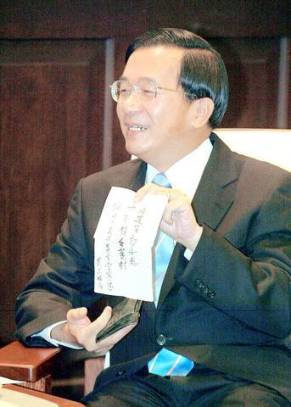
President Chen Shui-bian takes out from his wallet a note with his ancestral home address on it during a meeting with Ross Terrill, the author of The New Chinese Empire: And What It Means for the United States. At the press conference in the Presidential Office yesterday, Chen stressed that he always bears his origin in mind.
-----------------------------------------
On April 21, 2004 ……
I am not responsible for what I said, Sisy Chen says
"Statements I made ... were not
my personal opinion." --- Sisy Chen, independent legislator
By Huang Tai-lin, STAFF REPORTER
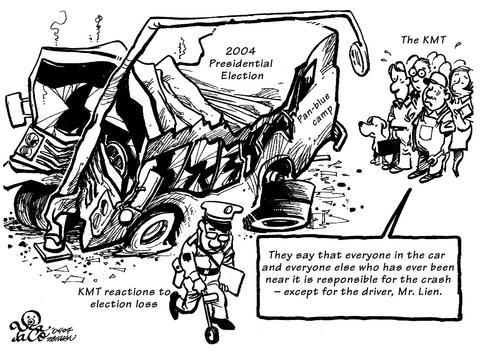
Independent Legislator Sisy Chen yesterday called on the Chinese Nationalist Party (KMT) not to blame her for the KMT-People First Party (PFP) alliance's defeat in last month's election.
She also said that all of the allegations she made on the eve of the election concerning the assassination attempt on President Chen Shui-bian and Vice President Annette Lu were based on information provided by the alliance's campaign headquarters, in an apparent challenge to the veracity of comments made by Taipei Mayor Ma Ying-jeou on March 19.
Her remarks came in the midst of a storm of criticism from a number of pan-blue legislators who, believing that her baseless allegations at the March 19 press conference had provoked resentment in undecided voters and may have drawn support to President Chen Shui-bian, and that she should be responsible for the defeat of the alliance in the March 20 presidential election.
On Monday, KMT Spokesman Alex Tsai directed the blame for the pan-blues' election defeat to Sisy Chen, saying that there were party members who thought that it was because party Secretary-General Lin Feng-cheng "put too much trust in Sisy Chen" that as a result ended in the party losing the presidential election last month.
Defending herself, Sisy Chen placed a phone call to a call-in TV talk show late Monday night.
The topic of the call-in program then was whether Sisy Chen should be responsible for the pan-blue camp's defeat in the election.
Sisy Chen, a former spokeswoman for the Democratic Progressive Party (DPP) who now supports the pan-blue camp and has been acting as its "advisor," held a press conference at the KMT-PFP alliance's campaign headquarters at midnight on March 19, saying that the hospital had faked the medical records of Chen Shui-bian and Lu, who were shot and wounded in an assassination attempt earlier that afternoon.
At the press conference -- with Taipei Mayor Ma Ying-jeou also present in his capacity as the national chief of the alliance's campaign -- Sisy Chen insinuated that the shooting was "just a trick" to win sympathy and claimed to have information from "an anonymous nurse" that the national security system was involved in the conspiracy. She has not at any time produced evidence to back her claims.
"Statements I made during the March 19 press conference relevant to the election-eve shooting [of Chen Shui-bian and Lu] were not my personal opinion," Sisy Chen said on Monday, contradicting a statement made on March 19 by Ma.
At the press conference, Ma made a point of saying that everything Sisy Chen said during the conference was her own opinion. At that time she did not contest his assertion, and told reporters that Ma included the disclaimer with her acquiesence.
A number of pan-blue legislators believe that her "wild allegations" at the March 19 press conference had turned off undecided voters and led them to support Chen Shui-bian.
"I can tell everyone that all the information was provided by the [KMT-PFP] alliance's national campaign headquarters," she said, adding that KMT Chairman Lien Chan, PFP Chairman James Soong, Legislative Speaker Wang Jin-pyng -- who then doubled as the director-general of the alliance's national campaign -- and Ma knew about what she was going to say at the press conference before it was held.
In response to Sisy Chen's remarks, Ma yesterday said that although he was present at the press conference, he knew only part of what she was going to say at the press conference beforehand.
Although not a member of the alliance, the sharp-tongued Sisy Chen, one of the president's most obdurate critics, has been a great boost to the pan-blue camp. While her opinions and advice had been valued by the alliance's leaders, she also drew ire from some members of the pan-blue camp, who accused her of meddling.
-----------------------------------------
On April 21, 2004 ……
Hankuang exercise focuses on 2006
LOOKING AHEAD: The Ministry of Defense said that this year's military exercise will last until November and would simulate conditions in a war with China in 2006
By Brian Hsu, STAFF REPORTER
The 20th annual Hankuang exercise, which is to kick off this month and will not be concluded until November, is to feature a computer simulation of joint operations in a war with China in 2006, the Ministry of National Defense said yesterday.
The ministry denied any political considerations in the choice of that year as the time of a possible war with China.
The year 2006 has been announced by President Chen Shui-bian as the time for writing a new constitution, a move considered by China to be a step toward independence.
Major General Li Chieh-chia, chief of the joint operations department of the office of the deputy chief of the general staff for operations and plans, said there were no political considerations in the arrangement of courses for the Hankuang exercise.
Li did not specify the content of the computer simulation, such as what type of war could possibly break out in the Taiwan Strait in 2006.
"The joint operations mechanism is to be tested in the exercise. The mechanism was developed from plans worked out in 2001. It was incorporated into the existing structure of the military on Feb. 1," Li said.
"In the Hankuang No. 20 exercise, all participating troops will maneuver in joint operations," he said.
Though not clearly describing what sort of joint operations were to be adopted in the exercise, Li stressed that they would play a vital role in the defense of the country against China's possible modes of war in the future. He said these would be focused on "non-linear," "no-contact" and "asymmetrical" types of warfare.
The Hankuang exercise is to be divided into three stages: The preparations of joint operations war plans, the computer simulation of joint operations in an imaginary war in 2006 and the evaluation of the effectiveness of joint operations.
The first two stages will deal mainly with staff planning, while the third one is to involve real-life deployment of troops, mainly in the south of the country. The last stage will not be open to the press.
A defense official, who spoke on condition of anonymity, said a new supercomputer bought from the US is to be used for the first time in this year's Hankuang exercise.
"The supercomputer is to run the simulation of a war in 2006. The operating system was provided by the US. It is expected to be better than a similar one developed by the Chung Shan Institute of Science and Technology for another supercomputer that had been used in the past few years' Hankuang-series exercises," the official said.
-----------------------------------------
On April 21, 2004 ……
Brazil can teach Taiwan
By S.A. Matsuyama, Sao Paulo, Brazil
When I arrived here 15 years ago, I noticed that many people didn't know who they really were. When I asked if they were Taiwanese or Chinese, they appeared to be reluctant when they said "I am Taiwanese."
Being born in Brazil from Japanese parents, I had the same identification problem. People used to call me Japanese from my looks, but I consider myself Brazilian, because I was born in Brazil.
Brazil is a country originally discovered and colonized by Portuguese, but during the development of the land, many different ethnic groups immigrated to Brazil. These included people from Europe (Italy, Poland, Germany, etc.), Asia (Japan, China, Korea, etc.), Africa (black ethnic) and of course we cannot forget the Indians, who originally lived in Brazil before the colonization.
All live there in harmony. We respect our roots, where our ancestors came from, but we cannot deny that we were born in Brazil and we have affection for our land.
In my opinion, the situation in Taiwan is kind of similar. The self-identification as Taiwanese has been developing during these years and more and more people have the confidence and pride to identify themselves as Taiwanese.
Of course, some are still reluctant to accept the fact of who they really are, but I can feel the Taiwanese identity growing stronger and stronger. Especially after the rapid economic development, many Taiwanese began to go abroad and started to realize this. When asked if they are Chinese, the most common answer is, "No, I am Taiwanese."
Indeed Taiwanese cannot deny their roots; their ancestors may have come from different parts of China, but we must give value to the land where we were born and that we are living in. We must feel gratitude to the land that has been providing us the comfort of home. If people put aside ethnic differences and start to care more about this homeland, maybe politicians would not easily manipulate them.
I hope more Taiwanese will become conscious about what is really important to their lives, and will give less importance to political controversies. Let the court settle the electoral differences and let us center ourselves in things that are really meaningful to all of us. Taiwan deserves our care!
-----------------------------------------
-----------------------------------------