20040422
=======
Who is Judas? On April 22, 2004 ……
Dalai Lama's nephew praises book on China
By Melody Chen, STAFF REPORTER
A nephew of the Dalai Lama and former member of the Tibetan parliament-in-exile, Khedroob Thondup, 52, yesterday expressed appreciation for Ross Terrill's new book, The New Chinese Empire, at a question-and-answer seminar the author held with academics and officials at the Taiwan Research Institute.
Terrill met with President Chen Shui-bian on Tuesday to discuss the book.
The seminar was held to illustrate the main ideas in the book.
Born in Calcutta, Khedroob was educated at a well-known Jesuit school in Darjeeling, India, and later at the University of San Francisco, where he was awarded an MBA.
After returning to India, he served as special assistant to the Dalai Lama and traveled extensively with him. In 1980, Khedroob was part of a special team that started dialogue between the Tibetan government-in-exile and the People's Republic of China (PRC).
Describing Tibet at the seminar as
"one of the most oppressed autonomous regions without any of the freedoms
that have been taken for granted in Taiwan," Khedroob, who now lives in
Taiwan, lamented Beijing's grip on Tibet's religious freedom and its abuse of
human rights in that country.
He asked the author, a renowned China expert, whether a genuine autonomy is acceptable to Beijing.
Terrill's answer to Khedroob's question was less than encouraging.
"Ask the people in Hong Kong in five years' time and you will have the answer," Terrill said.
The people of Hong Kong, Terrill said, had autonomy promised to them but they will find that the Communist Party will refrain from honoring that pledge.
Noting that Beijing has recently rewritten Hong Kong's Basic Law, Terrill questioned the completeness of an autonomy "that is not guaranteed by law."
If China were to give Taiwan autonomy, according to Terrill, that autonomy would become "a tight noose" around the country's neck.
Urging the Taiwanese people to unite, Terrill predicted that Taiwan would eventually become an independent country. Taiwan's status preserves a balance of power in East Asia, but most countries, though aware of the situation, would not like to talk much about it, he said.
The Chinese leadership, dominated by their imperial mentality, craves respect and does not pay much attention to their country's neighbors, Terril said.
China's attitude towards Taiwan has been "arrogant and insulting," he said, referring to Beijing's labeling of Vice President Annette Lu as "scum of the nation" and its vitriol against Chen.
Lai I-chung, director of foreign policy studies at the Taiwan Thinktank, asked Terrill what might happen to the power vacuum left by China should the country collapse in the way the Soviet Union did.
Terril said it is possible that a democratic federation could replace the China of today.
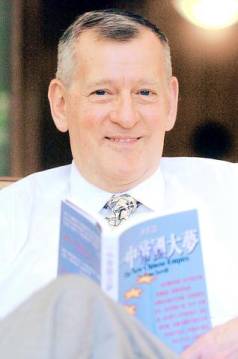
Ross Terrill, head researcher at Harvard University's Fairbank Center for East Asian Studies and author of the book ``The New Chinese Empire.''
-----------------------------------------
On April 22, 2004 ……
If Taiwan is playing Christ, who is Judas?
By Cao Chang-ching
Global box office sales for the Hollywood masterpiece The Passion of the Christ have already reached US$450 million (NT$1.5 billion), making it the eighth-highest grossing film in history. It depicts the last 12 hours of Jesus Christ's life, during which he was betrayed, humiliated, tortured and nailed on a cross to die.
Watching the film, one cannot but think of Taiwan, which is also suffering now, with its democratic election smeared, the elected president defamed, prosecutors' offices attacked, police stations smashed, the Central Election Commission trampled, as well as police and journalists beaten and hundreds of people wounded in only one night. Even the presidential inauguration ceremony risks being disturbed.
Since the removal of the bans on publication and political parties, Taiwan has gradually moved towards democracy and the rule of law. The peaceful transfer of power four years ago received worldwide praise, and the international community now sees it as one of the models for democracy in Asia. Every step Taiwan has taken towards democracy has been the envy of the Chinese people living under a dictatorship across the Taiwan Strait. Taiwan has even become their most powerful weapon in their pursuit of liberal democracy: a democratic system is definitely feasible for a Chinese society.
However, Taiwan's image has been
severely tarnished through the international media's coverage of the violence
resulting from demonstrations incited by those who lost the election. This has
even become an excuse for Beijing to prevent the implementation of direct
elections in Hong Kong and democracy in China -- if it doesn't, these two
places will go the same way as Taiwan.
Those who prostrated themselves to
kiss the ground to show their love for Taiwan now stand up to slap Taiwan right
in the face. The hate-filled mobs remind us of the villains in the film who
whipped Jesus Christ with a grin. Every lash of the whip makes those who truly
love and cherish Taiwan weep inside.
We cannot allow Taiwan, a country
ruled by law, to be hijacked by villains and let people suffer. There have been
media reports that a businessman wanted to donate NT$100 million to pay for the
vote recount, in the hope that it will bring tranquility. This echoes the will
of most people. Given the extent of Chinese intimidation, Taiwan cannot afford
domestic unrest or mob rule. Taiwan has to restore social order and cherish its
achievements and image. Let Taiwan move through this ordeal and stand tall
again.
Cao Chang-ching is a writer based in the US.
-----------------------------------------
-----------------------------------------