20040423
=======
Moves toward independence on April 23, 2004 ……
US warns Chen against moves toward independence
RESTRAINT: US Assistant Secretary of State James Kelly said Taiwan risked losing US support if it pursues constitutional change that unilaterally changes the status quo
By Charles Snyder, STAFF REPORTER IN WASHINGTON
The Bush administration has warned President Chen Shui-bian to exercise restraint in his efforts to write a new constitution for Taiwan, saying that if he goes too far in Washington's eyes, he will risk facing the loss of American support for the new document.
Assistant Secretary of State for East Asia James Kelly delivered the warning in testimony to a hearing of the House International Relations Committee.
The hearing, which was held to coincide with the 25th anniversary of the Taiwan Relations Act, provided Kelly with the opportunity to give the most detailed and comprehensive explanation of US policy toward Taiwan since last month's presidential elections.
"There are limitations with respect to what the United States will support as Taiwan considers possible changes to its Constitution," Kelly said. "We are uncertain about the means being discussed for changing the Constitution. We do no one any favors if we are unclear in our expectations or obfuscate where those limitations are.
"The president's policy regarding our opposition to unilateral changes to the status quo will be reinforced in this dialogue with Taiwan about its political evolution," he added.
Kelly did not spell out the areas or the methods with which the Bush administration takes issues, and he did not say whether Washington's objections centered on proposals for a referendum on the new constitution.
His comments were a reference to US President George W. Bush's statement last December after his meeting with Chinese Premier Wen Jiabao, in which Bush chastised Chen for holding the election-day referendum and criticized him for moving to change the status quo.
A senior administration official, speaking on condition of anonymity, said later that Washington would not object to constitutional revisions "for the purpose of good government, strengthening democracy. That's a legitimate goal," he said.
Washington would object to a new constitution that changed the status quo, he said.
"President Chen Shui-bian has said that the status quo is that Taiwan is already an independent country. We do not endorse that view. We took that as a political statement," the senior official said. "We would take a dim view of any effort to enshrine that concept that Taiwan is an independent sovereign country in the process of constitutional revision."
Nevertheless, the official said, "at the end of the day, Taiwan is a democracy, and Taiwan should, if the people support it and think it's necessary, revise its Constitution."
The issue is the "strategic context" of any changes, the official said. That would depend on whether cross-strait dialogue was resumed, "the degree to which Beijing feels that the intention is not to separate Taiwan," and other factors.
"Right now, the context, or the frame of the environment, for this is not good," the official said, "because there is deep suspicion around the world that the intention is to use constitutional revision to enshrine sovereignty and independence, and the entire world has an interest in peace and stability in the Strait."
"Chen Shui-bian's Cabinet knows this, and they'll have to figure out the right ways to answer these concerns around the world," he said.
Kelly's comments on the Constitution were coupled with a warning to Chen to take Beijing seriously when it threatens hostilities over what it sees as Chen's moves toward independence through such acts as holding referendums and framing a new constitution.
"It would be irresponsible of us and of Taiwan's leaders to treat [China's bellicose] statements as empty threats," Kelly said. "PRC military modernization and the increasing threat to Taiwan indicate to us that Beijing is preparing itself to react. We encourage the people of Taiwan to regard this threat equally seriously.
"We look to President Chen to exercise the kind of responsible, democratic and restrained leadership that will be necessary to ensure a peaceful and prosperous future for Taiwan," he said.
Moves toward independence "carry the potential for a response from the PRC, a dangerous, objectionable and foolish response that could destroy much of what Taiwan has built and crush its hopes for the future," Kelly said.
-----------------------------------------
On April 23, 2004 ……
Presidential Office defends plan for new constitution
By Ko Shu-ling, STAFF REPORTER
President Chen Shui-bian's plan to enact a new constitution in 2008 is not a timetable for independence, the Presidential Office said yesterday.
"We'd like to make it clear to the public and the international community that the president has been making good on his `five noes' promise over the past four years," Presidential Office Spokesman James Huang said yesterday.
The president's plan to rewrite the Constitution is designed to strengthen democracy, he said, adding that it will not change the status quo across the Taiwan Strait.
"The president has made it clear on various occasions that the new constitution is part of the nation's democratization process, not a timetable for independence," Huang said.
"The constitutional reform will proceed under the premise of maintaining the status quo across the Taiwan Strait," he said. "Our resolve to establish a peace and stability framework for cross-strait interaction hasn't changed."
Huang made the remarks in response to a warning by US Assistant Secretary of State James Kelly at the US House of Representatives on Wednesday that Taiwan should not go too far in rewriting the constitution.
While pro-independence Chinese-language newspapers emphasized Kelly's praise for Taiwan's vibrant democracy, pro-unification media underscored the US government's opposition to Taiwan independence.
Cabinet Spokesman Lin Chia-lung said Kelly's remarks were "positive" and "friendly," adding that he didn't see any change to the US government's cross-strait policy. He said the US was not concerned about Taiwan's democratic development, but instead about China's distorting Taiwan's democratization process by calling it a timetable for independence and using it as an excuse to use force against Taiwan.
"We will not allow China to unilaterally interpret cross-strait relations or the `one China' policy," Lin said.
Responding to the US House of Representatives' resolution to support Taiwan's bid to join the World Health Organization as an observer, Lin said that he was confident Taiwan stands a greater chance of joining the organization this year thanks to the US government's backing.
-----------------------------------------
On April 23, 2004 ……
US Congress presses for Chen visit
By Charles Snyder, STAFF REPORTER IN WASHINGTON
Several congressmen urged the George W. Bush administration to allow visits to Washington by President Chen Shui-bian and other top Taiwanese leaders Wednesday, but received a cool response from Assistant Secretary of State for East Asia James Kelly.
The congressmen, members of the House International Relations Committee, made their pitches during a hearing on the 25th anniversary of the Taiwan Relations Act.
Leading the charge was Tom Lantos of California, the committee's ranking Democrat.
"I, for the life of me, cannot understand the continued insistence of this administration on truly absurd diplomatic policies such as denying the president of Taiwan the right to visit Washington, DC, the right to meet with members of Congress here in our nation's capital," he said.
The policy "allows Beijing to make policy for members of the United States Congress as to where they may have the opportunity to meet with the head of a very friendly government," he said.
Addressing his remarks to committee chairman Henry Hyde, one of Taiwan's leading supporters in Congress, Lantos said, "It is my fondest hope that both you and I will have the honor of greeting President Chen in Washington in the foreseeable future."
Dan Burton, an Indiana Republican, urged that the Taiwan Relations Act be amended to allow for visits to Washington by Chen and other Taiwanese leaders.
He said that the act "still has a lot of problems, one of which is that we ought to recognize their head of state and treat him or her, whoever it is that's elected to that position, as a head of state."
"If I had my way, I would alter the Taiwan Relations Act to allow the head of state from Taiwan to be able to visit the United States as a head of state, and discuss problems directly with our president," he said.
Kelly, however, threw cold water on these and other similar suggestions raised during the hearing.
"I think any changes of that sort would have to be very carefully made," he said.
Policies such as that which bars Chen and others from visiting Washington "are continued only because of the reasons and messages that a change would convey.
Reception of a government leader in the United States constitutes a recognition that goes way beyond celebrating a democratic process, and would compromise the `one China' policy that has marked our relations with Taiwan and the PRC since 1979," Kelly said.
Current US rules allow Chen and other top Taiwanese leaders to secure transit visas for travel usually to Latin America to attend various functions in those countries. The transits are usually good for stopovers in New York and Los Angeles.
Several members of the committee have made the trip to New York in recent years to hold meetings or dinners with Chen during those transits.
-----------------------------------------
On April 23, 2004 ……
Chen must seize this moment to push reform
By Liu Kuan-teh
Despite the opposition's continued refusal to accept the outcome of the presidential election, the result is a watershed for reshaping the nation's political landscape. It not only granted President Chen Shui-bian a new mandate to continue reforms with more than 50 percent of the vote, it also increased the chances of the pan-green camp gaining a majority in the Legislative Yuan at year's end.
That explains why the Democratic Progressive Party (DPP) has been busy drawing up plans for the December legislative elections. If the DPP, along with its green-camp partner, the Taiwan Solidarity Union, can win more than half of the legislature's seats, then the full transfer of political power will have finally been accomplished.
With the opposition camp having opposed Chen for four years by blocking everything he has proposed, the only effective way to bring healthy competition back to national politics is to let the president do his job -- with solid support from the legislature.
Strategically speaking, Chen and the DPP's top priority is not to attract more defectors from the Chinese Nationalist Party (KMT) to cobble together a majority in the legislature; rather, it is to initiate reform of the Legislative Yuan itself.
During the presidential election, the pan-blue camp echoed Chen's call for a reduction in the number of legislative seats. Whether or not the KMT and the People First Party (PFP) will stand by this is doubtful, but it is in any event Chen's job to make use of public support for legislative reform in the next election campaign and thus pave the way for a constructive second term.
It is generally acknowledged that current political instability is the result of conflict between the DPP government and the opposition in the Legislative Yuan. Several public surveys have named the opposition as the main source of political disorder. Reducing the number of seats in the legislature and reforming the electoral system have not only attracted popular support but are also a political necessity.
Overhauling the single non-transferable system of voting will also contribute to the success of legislative reform. The system is nothing less than a cancer within this democracy. As long as legislators are able to secure an often minimal core vote, they can do whatever they like in obstructing the legislative process or humiliating government officials. The lack of legislative efficiency is also closely associated with this voting system.
In this regard, constitutional change, as Chen said during the campaign, is needed when it comes to reforming the electoral process. The aim of this is to enhance the legitimacy of individual legislators and clean up and make efficient the proceedings of the legislature as a whole.
A smart leader measures the public pulse and executes timely and decisive reforms. Chen has been entrusted with Taiwan's continuing democratization by voters. The reform of the Legislative Yuan is the first step toward building a mature civil society and mature political institutions.
As the KMT and the PFP entangle themselves in finger-pointing and struggle to work out a strategy choosing candidates for the legislative poll, the DPP should seize its opportunity and offer a clear and feasible reform agenda to voters.
There is no time for Chen and his party to be complacent about their victory, for greater challenges lie ahead. Whoever can ride this momentum will win public support later this year.
Liu Kuan-teh is a Taipei-based political commentator.
-----------------------------------------
On April 23, 2004 ……
Just who can save James Soong?
By Paul Lin
During the pan-blue alliance's April 10 protests, People First Party (PFP) Chairman James Soong once again made defamatory and inflammatory remarks, saying that in Taiwan, there are no mobs, but only a tyrannical government. He then shirked his responsibility and left for some unknown place together with Chinese Nationalist Party (KMT) Chairman Lien Chan, leaving some of the protesters they had whipped up to fight with police (in Soong's eyes, the police force is a representative of the "tyrannical government") and create yet another instance of bloodshed, following the April 3 clashes.
The general secretaries of the KMT and the PFP refused to acknowledge their responsibility, instead saying that the trouble-makers had been sent by the Democratic Progressive Party (DPP). This series of base and violent tricks bears the mark of Soong.
Prior to these events, Vice President Annette Lu had issued a statement of the events on March 19 in an attempt to help clarify the shooting of her and President Chen Shui-bian. In the statement, she mentioned that when inspecting her own wound, she had touched the lower part of Chen's jacket and noticed that "it was moist," and that was how she realized there had been a shooting.
Soong later made some insinuations, wondering how Lu could touch a man in such a "sensitive spot." Soong's words reminded us of the time the Special Report VCDs came out -- he then cursed "Vile!" six times consecutively, with a stern look on his face. The Special Report VCDs were not vile as Soong claimed, but his insinuations indeed revealed the baseness of his mentality.
Not only does Soong have a base mentality, he also has the mentality of a mobster. When he visited the "hunger-striking" students at the Chiang Kai-shek Memorial on April 5, he actually told these peacefully protesting students that if Chen didn't give them a favorable response, "I will join you in a charge on the Presidential Office on April 10." Only following criticism did he say that he would enter the Presidential Office peacefully, and that he opposes violence. But why the need for saying "charge" if he was going to enter the Presidential Office peacefully?
Even though Soong has said that he opposes violence, that does not conform with his true thinking. Some PFP legislators, such as Chiu Yi, Shen Chih-hui, Lee Ching-hua and Liu Wen-hsiung, were passionate in their violent language and actions. They kept it up for quite some time, but Soong directed no criticism at them. As PFP chairman, can Soong escape the suspicion of having initiated their actions from behind the scenes? The "Friends of James Soong Association" has said that the thoughts of Chairman Soong are their thoughts. Can Taiwan remain peaceful and calm if he keeps communicating these base and violent thoughts to his supporters?
In its reporting on the political situation in Taiwan, the slightly pan-blue leaning Hong Kong-based Apple Daily was forced to say in a report on Soong's statements that, "Today, with a growing Taiwanese self-awareness, we have reached the point where it is time to say goodbye to Provincial Governor Soong.
"Soong, who commanded high levels of public prestige during his time as provincial governor of Taiwan, must now come to terms with his loss of power if he wants to avoid putting his foot in his mouth and loosing his bearings altogether."
Smart as he is, Soong has naturally thought about this and made attempts to save himself from collapse. During the protests on March 27, he took to the stage to say that if bringing the truth to light meant that the election outcome might be overturned, he would be willing to give up his run for the vice presidency and sacrifice everything to assist Lien.
Obviously, Soong wanted to show the magnanimity of his motives and that he was not enamored with power. I've heard it said that some PFP politicians and supporters were moved to tears, and that KMT heavyweights praised him for not making a fuss over his individual position.
But on April 6, during a press conference following Soong's meeting with an American think-tank, he answered a question regarding PFP Legislator Lee Yong-ping's suggestion a few days ago that Lien and Soong run for a seat in the legislature, by saying that it didn't make any sense. Instead, he asked, "Have you ever heard of a president and a vice president doubling as legislators?"
These are really astonishing words because, currently, the outcome of the election is that Chen and Lu won, not Lien and Soong. Where did this talk of Lien and Soong winning come from? And even if Lien and Soong's protests are successful and the election result is overturned, making Lien and Soong president and vice president, didn't Soong say on March 27 that he was willing to give up the vice presidential seat?
How can it be that only a little over a week later, he had already forgotten these words, and was putting himself in a position he has not yet achieved -- although he is doing all he can to think up ways of getting there?
This shows us that his talk of giving up the vice presidency on March 27 was nothing but an attempt at tricking the public and stirring up public emotion.
Soong's series of statements are not simply a matter of putting his foot in his mouth. Rather, his words are simply incoherent because he is at his wit's end. He then suddenly came up with "a new thought." On April 10, during another of the pan-blue camp's gatherings, he called for the rebuilding of fair and just core values and the setting up of a New Taiwanese Democratic Alliance (the leader of this alliance will probably be none other than Soong) aimed at uniting more "democrats" without party and faction affiliations and starting up a new democratic movement in Taiwan.
Without going on about "New Democracy" and further discussion of Soong's contributions to Taiwan's democracy movement, it is obvious that Soong is preparing to abandon Lien by looking for a new platform through which he can prolong his political life.
The question is: which independents
would walk into his trap? Perhaps the Mainlander orators in the army or
politicians unwilling to accept that they are past their prime such as [former
DPP chairman] Hsu Hsin-liang might cast off their disguises and come to the
rescue of Chairman Soong. But unless Soong's abnormal mind is thoroughly turned
around, it must really be doubted whether an emergency rescue would be enough
to save his skin.
Paul Lin is a commentator based in New York.
-----------------------------------------
-----------------------------------------
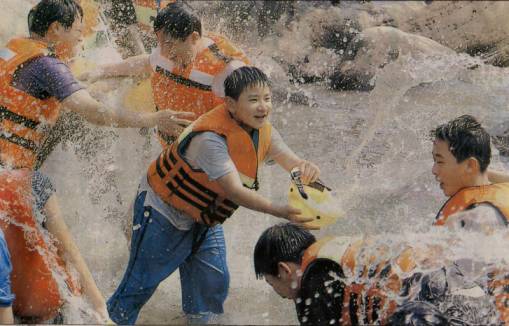
UP THE CREEK
Students and teachers from Chihshan Middle School in Taipei play in Waishuang Creek yesterday after followed the creek upstream to its source.
-----------------------------------------