20040424
=======
Don’t panic over Kelly’s remarks on April 24, 2004 ……
Don't panic over Kelly's remarks
Presenting a review of US policy toward Taiwan, Assistant Secretary of State for East Asia James Kelly testified at a House International Relations Committee hearing on Wednesday in Washington.
Kelly's comments were considered the
first official response to recent developments in the Taiwan Strait. While
reiterating the US' "one China" policy based on the three Joint
Communiques and the Taiwan Relations Act, Kelly reminded President Chen
Shui-bian of several "uncomfortable realities" that constitute severe
challenges to future US-Taiwan relations.
These uncomfortable realities are closely associated with growing misconceptions about Taiwan's status, a lack of trust regarding Chen's steps toward constitutional reform and a potential military crisis originating from China's reckless and irrational miscalculations. It is Washington's conviction that all these circumstances could drag Washington into an unnecessary military conflict with Beijing. Entangled in his own global fight against terrorism, the mishandling of the Iraq fiasco and cost-benefit calculations surrounding the upcoming US election, the last thing that US President George W. Bush wants is more trouble abroad.
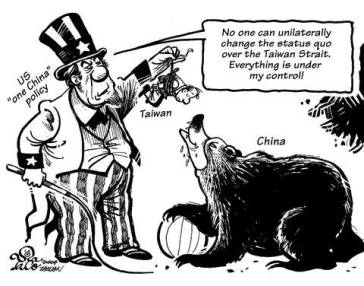
Chen's continuing push for recognition of the reality that Taiwan is a de facto independent and sovereign state -- with a new mandate after the recent presidential election -- coupled with his pledge to enact a new constitution through a referendum, caused Washington to draw a "red line" before Chen makes his inaugural speech on May 20. Therefore, Kelly's comments should be read from a broad and strategic perspective; we should not simply take one paragraph out of context. The main reason that Kelly emphasized the "US definition of the status quo" was to establish a "preventive mechanism" to enable the US to monitor every step of Chen's constitutional reform process.
Despite the fact that the Chen administration has outlined the constitutional revision process as a series of moves toward establishing good governance and improved political institutions, and has sworn that the process will have no bearing on the status quo, Washington is still "uncertain" about the context in which Taiwan's government will pursue its reform agenda and about which concrete proposals the agenda might contain. Hence, as Kelly pointed out: "There are limitations with respect to what the US will support as Taiwan considers possible changes to its Constitution."
The US concern over Chen's next step is understand-able, but not necessarily unsolvable. What distinguishes democratic Taiwan from authoritarian China is transparency in decision-making and a democratic system of checks and balances.
While Washington worries about Beijing's "dangerous, objectionable and foolish response" to Taiwan's constitutional changes in the near future -- which might endanger US interests in Asia -- Beijing's response does not justify stopping Taiwanese people from upgrading their democracy. In other words, it is not up to Beijing to decide what Taiwan can or cannot do.
What the US should work harder at is pushing China toward democratic openness and renouncing the use of force against Taiwan. Taiwan is a free and pluralist society where diverse points of view can be valued and added into decision-making processes. Chen is not a dictator but a democratically elected president. Leaders from Zhongnanhai are the troublemakers.
To look on the bright side, though, there is an urgent need for both Taipei and Washington to build efficient, candid and constructive channels of communication. High-ranking and bilateral talks must be instituted on a regular basis as a way to straighten things out.
No matter how the Chen administration plans to engage its Chinese counterparts on framing a peaceful and stable interaction, Washington can play the role of balancer and facilitator. As Taiwan deepens its democracy by redesigning its Constitution, the US can be of considerable help by providing advice based on its own constitutional experience.
-----------------------------------------
On April 24, 2004 ……
Pentagon warns of rising missile threat
"The deployed inventory number
is 500 to 550 SRBMs, all deployed opposite Taiwan, and increasing at a rate of
75 a year." --- Richard Lawless, deputy assistant secretary of
defense
CROSS-STRAIT THREAT: A top US defense official told a Senate hearing that not only are the numbers of missiles increasing, their accuracy and lethality are, too
By Charles Snyder, STAFF REPORTER IN WASHINGTON
China has substantially increased its missile force facing Taiwan, a Pentagon official disclosed on Thursday.
Deputy Assistant Secretary of Defense Richard Lawless told a Senate hearing that China now has as many as 550 short-range ballistic missiles (SRBM) deployed against Taiwan. That is 50 missiles more than the 500-missile figure US authorities and other experts have been using in assessing the missile threat to Taiwan.
Lawless, whose job is to oversee Asia-Pacific security affairs, said the new figure will be used in the annual report on Chinese military power that the Pentagon will soon send to Congress.
"China continues to improve quantitatively and qualitatively the capabilities of its conventional armed SRBM force," Lawless told a hearing of the East Asian and Pacific affairs subcommittee of the Senate Foreign Relations Committee.
"The deployed inventory number is 500 to 550 SRBMs, all deployed opposite Taiwan, and increasing at a rate of 75 a year. The accuracy and lethality of this force also are expected to increase through use of satellite-aided guidance systems," Lawless said.
The 75-a-year increase is the same figure that has generally been used over the past year or two.
Lawless told the committee that China in recent years has accelerated its capability to move against Taiwan if needed, aided by growth in the Chinese economy which has allowed Beijing to boost its defense budget to a figure estimated by the Pentagon to be US$50 billion to US$60 billion for this year.
"In recent years, the PLA [People's Liberation Army] has accelerated reform and modernization so as to have a variety of credible military options to deter moves by Taiwan toward permanent separation or, if required, to compel by force the integration of Taiwan under mainland authority," Lawless said.
"A second set of objectives, though no less important, includes capabilities to deter, delay or disrupt third-party intervention in a cross-strait military crisis," he said, referring to Beijing's continued efforts to impede Washington from coming to Taipei's aid in the case of hostilities.
"The PLA has made progress in meeting those goals through acquiring and deploying new weapons systems, promulgating a new doctrine for modern warfare, reforming institutions and improving training. The PLA's determined focus on preparing for conflict in the Taiwan Strait raises serious doubts over Beijing's declared policy of seeking `peaceful reunification' under the `one country, two systems' model," he said.
Meanwhile, the congressionally established US-China Economic and Security Review Commission studying China's Taiwan policy will recommend later this month a basic review of Washington's policy toward Taiwan, it was learned. The panel feels the review is warranted in view of the growing Chinese military might and Beijing's efforts to isolate and marginalize Taiwan internationally.
The commission's chairman and vice chairman, Roger Robinson and Richard D'Amato, told the Senate committee that their panel will recommend that Congress be given an enhanced role in Taiwan policy-making, in order to better coordinate US defense assistance to Taipei in the face of a growing Chinese threat.
Congress and the administration should also eye ways to get more directly involved in a resumption in official cross-strait talks, they said.
The two men, who were in Taiwan during last month's presidential election, praised the election, saying it was "proof" of the strength of Taiwan's democracy.
"The system was sorely tested but appears to have emerged intact and resilient," they said.
President Chen Shui-bian's victory, if upheld in the courts, "will appear to be vindication for Chen's campaign that stressed Taiwan's separate identity and a mandate for his plans for constitutional reform," they said.
-----------------------------------------
-----------------------------------------