20040425
=======
Who cover up their faults on April 25, 2004 ……
Lien, Soong cover up own faults: Lee
NOT QUALIFIED: Former president Lee
Teng-hui said yesterday that the opposition leaders left their supporters in
the lurch after the election and are not fit to govern.
By Chang Yun-ping, STAFF REPORTER
Former president Lee Teng-hui yesterday said the opposition parties lost the presidential election because they went against the Taiwanese people's pursuit of an independent Taiwanese identity and expectations of a younger leadership generation.
"If the Chinese Nationalist Party (KMT) cannot do a self-examination of its own problems and continues with the old leadership, it is dodging its problems and will eventually lose the competition in Taiwan's party politics," Lee said.
Lee said the KMT leaders' call for consolidating leadership was similar to what Chiang Kai-shek had been doing early in the 1950s, which Lee said was irrelevant to the people's well-being.
As the host of a seminar held by
Taiwan Advocates to discuss the implications of the presidential election on
the development of civil society in Taiwan, Lee lambasted KMT Chairman Lien
Chan and People First Party (PFP)
Chairman James Soong for being irresponsible in stirring up the demonstrations
in front of the Presidential Office as a way to cover up their own faults.
Lee said Lien and Soong were not qualified to take the steering wheel of the country, as they have erred too much in being unwilling to concede their defeat in the election and leaving the demonstrating crowds on the streets to shoulder the responsibility for the chaos of an illegal assembly.
"It is such a pity that the
defeated candidates were not willing to take their defeat and reflect on their
loss, but stirred up demonstrations to cover up their own faults and even
sacrifice the future development of their own party.
"They led their supporters to take to the streets, but then they left their supporters on the streets and went back home to sleep or, even worse, to play mahjong," Lee said.
He said that since the election, the public has to reexamine whether the rule of law is respected by the entire public and whether mutual trust and respect are undermined by media reports slanted by political influences.
Lee pinpointed certain political figures who concurrently hosted news talk shows, such as independent Legislator Sisy Chen, who he said have told lies and made groundless accusations to question the professionalism of social institutions.
"These accusations and verbal spam rife in Taiwanese society have eroded people's trust and respect for each other and for the country's social institutions," Lee said.
Lee, who yesterday made his first public appearance since the presidential election, also responded to the hot topic of ethnicity and Democratic Progressive Party (DPP) Legislator Shen Fu-hsiung's recent remarks that political figures should stop cashing in on ethnic differences by accusing each other of not loving Taiwan.
"Some people recently have said that we should stop saying `I love Taiwan,' but I think all of the 23 million people of Taiwan should not avoid facing this question. Furthermore, the people of Taiwan have used their wisdom to judge what true love for Taiwan is by judging the difference between policies about Taiwan identity of the KMT and DPP," Lee said.
Sociologist Michael Hsiao, a national policy advisor to the president, yesterday said at the seminar that the post-election demonstrations were never the continuation of social movements Taiwan's public started in the 1980s.
Hsiao said the past social movements were mostly oriented toward democratization or improvement of public policy, while the recent protests, which were mobilized by political forces for private interests, were just ugly.
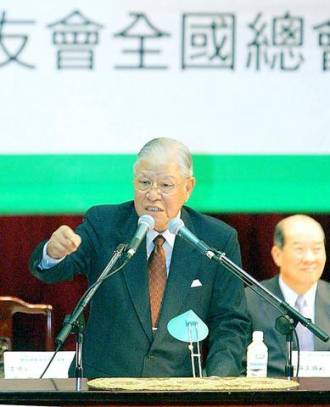
Former president Lee Teng-hui lambasts the pan-blue camp for destroying democracy and the rule of law in Taiwan during a seminar held at Taipei International Convention Center yesterday. The seminar, organized by Taiwan Advocates, discussed the implications of the presidential election on the development of a civil society in Taiwan.
-----------------------------------------
On April 25, 2004 ……
Planning for the future
Ross Terrill is an associate researcher at The Fairbank Center for East Asian Research, Harvard University, and a long-time China expert. He has spent more than 40 years studying communist Chinese society and was one of the very few Western journalists allowed to enter China before the Cultural Revolution. Author of the book ``The New Chinese Empire,'' Terrill spoke to `Taipei Times' staff reporter Chang Yun-ping in a recent interview, in which he said there was a new willingness in the US to accept the idea of an independent Taiwan and that US-Taiwan relations, which soured during the presidential election, would soon be repaired. He also suggested that Taiwan include a section in its planned constitution that would leave open the possibility for Taiwan to form a nation with another Chinese nation, such as China.
Taipei Times: In your previous talks to the local media, you've mentioned that President Chen Shui-bian should slow down the schedule for formulating a new constitution. But Chen has stressed he will go ahead with his own schedule despite China's opposition. What do you think of this?
Terrill: China's opposition is one thing, but carrying the people in Taiwan with him is a different thing. I was referring to the desirability that after a difficult election that the unity of Taiwan's people be maintained. What I meant is that President Chen should take the steps in a way that carries as much support as possible from as many Taiwan's people as possible. My idea that is that Chen should take into consideration the whole Taiwanese people to mend the fences of ethnic conflicts and let the society heal before he could go ahead with rewriting the constitution. He has shown he can increase his support. He went up from 39 percent in 2000 to more than 50 percent in 2004. If he can persuade even more people, then he is on the right track. It means the constitutional change is soundly based.
TT: Why would you suggest that Taiwan include a section in its new constitution that would allow Taiwan to form a nation with another Chinese nation in the future?
Terrill: The idea behind my remark is for democracy, history is never closed. Only for a dictatorship can you say history is frozen. And the boundaries of the countries have changed and if they change [it is] by the agreement of the people. That's one thing. If they change by war, that causes a lot of suffering. In the 1990s, Czechoslovakia was divided into two, the Czech Republic and Slovakia, as the two sides came to an agreement. In the future, if the two decided to come back together, that's their business. One day, in the South Pacific, some of the small countries of the South Pacific may join a federation. They are very weak, the islands of the South Pacific. In 1900 and 1901, New Zealand and Australia almost joined a federation. At the last moment, New Zealand changed its mind. But if you read the Australian Constitution today, there is a section that says there is place for New Zealand if they want to come in. The important thing is this is done by the agreement of the people.
TT: Is such a suggestion a way to
defuse China's anger?
Terrill: It depends on how you write the constitution. It can be very open to other countries. Who would have expected France and Germany to be entering into a union? Only 55 years ago, they fought each other. The European Union is a case before our eyes of many different countries starting to get quite close to uniting. My point is in the future there are all sorts of possibilities. We have the Association of South East Asian Nations (ASEAN). Who knows, one day Taiwan may be part of that. Beijing would be angry. They may be angry this year, but 10 years from now, they may not be angry. Taiwan went into APEC, many people said Beijing would not permit that, but they did permit it. Therefore you may write a constitution that leads the doors open to associations of one kind or another with another country, including China.
TT: What's the implication of an
imperial China on the world and its relations with a democratic Taiwan?
Terrill: Historically, China was used to expecting respect from the neighboring peoples, who had to bring gifts and pay tribute to China and behave themselves and say the right words. In some cases, the king of China's neighboring countries had to send a mission to Beijing to get the new king approved, like the king of the Ryukus. Beijing had to bless him. If they did it this way, Beijing was happy because it showed Beijing that the world is working the way the world should work.
But there is hangover from this. It doesn't fit the modern world. The Chinese political system has lasted for a very long time so the legacy of the system is still there. Mao Zedong used to call himself the emperor with his staff members sitting around him. Was he joking? Maybe he was partly joking, but he was partly serious. And the older he got, the more he read the ancient books. And he liked Qin Shi Huang [the tyrannical first emperor of China] for his toughness. This tradition is not yet dead, that the same Chinese system wanted tribute paid and beautiful words said about the Chinese emperor. The "one China" idea in the 1970s was in its tradition.
However, after that, what happened? Although the American side acknowledged this "one China," which made Beijing happy, the Americans then busily set up the Taiwan Relations Act. And they have a big office in Taipei. So the situation on the ground for Taiwan didn't change. This is also a long tradition in China -- that is to get the principle right. But then if the principle is right, you can do what you want. There is some value in this. That's why sometimes it's better to move slowly than to rush.
TT: What's your understanding of US-Taiwan communication? Do you think there is any misunderstanding or mistrust on Washington's part toward President Chen and will communication improve in Chen's second term?
Terrill: First of all, the war on Iraq is providing a distraction for the US and the White House doesn't want fires burning everywhere. But during the election, something very interesting happened. The opinion in the House of Representatives in Washington was very favorable to Chen and it wanted to pass a resolution supporting his right to call a referendum. But the White House persuaded it not to. The point of the story is that there is a great deal of support for Taiwan and there is quite a lot of support for Chen. And what is quite new to this support is that there are quite a few congressmen who, it turns out, are ready to say an independent Taiwan is fine. So the American government is not only the White House, but also the Congress. If you take the whole picture, especially now Chen has been re-elected and after the Iraq picture comes down a little bit, I think the relations between Taipei and Washington will be repaired.
TT: How significant is this new
support?
Terrill: Well, it's a bit unusual now because the Republicans control both [the White House and the Congress] and it's the Republican leader of the House who agreed to hold back on the resolutions because of his respect for President Bush. But maybe they did it because they thought Chen was going to lose. Maybe they miscalculated. But in the broad picture for three and a half years, President Bush has been more pro-Taiwan than Clinton. So you have to bear in mind that we have also had a situation in Washington where the Congress is in the hands of one party and the White House in the hands of another party and this causes conflicts in China policy and Taiwan policy. At the moment, it's in the hands of the same party and the situation before the election was a little bit special because of Iraq and because many people thought Lien Chan and James Soong would win the election. A lot of congressmen are now upset because they wished the resolution had been passed because it would make them look good. They miscalculated the situation.
TT: How would Beijing react to the emergence of Taiwanese nationalism and adjust its policies towards Taiwan? Will it change?
Terrill: In the long run, yes, they will change. You see, at first, they thought Lee Teng-hui (李登輝) was a problem, that he was a crazy man, but then Chen was elected and then was elected again. They must realize the problem was not one crazy man or two crazy men. Moreover, if you look at the weeks before the election, the KMT was also influenced by the DPP position. So is everybody crazy? Beijing can't come to a conclusion that everybody is crazy. They have to come to another conclusion that this change in Taiwan politics is permanent.
Something different is happening here. In the lead-up to the election, I didn't hear Lien Chan talking all the time about "one China." And he said that to have another look at the Constitution was reasonable. And he said yes, it's possible to hold a referendum. All these ideas came originally from Chen Shui-bian. If they were the ideas of one crazy man, Lien Chan would not have adjusted his positions. To be exact, the correct interpretation is that going back to Lee Teng-hui, Lee was an expression of some change of route. Within Taiwan and even within the KMT, Chen Shui-bian is another expression. If the KMT picks a new leader we may find this new leader is also an expression that is more and more of Taiwan identity. Elections create a sense of belonging to this place. And that you can not stop.
There are three things that Beijing could do to Taiwan. They could attack you, wreck their whole foreign policies, wreck their whole foreign economic policies and lose their exports to the US. But there is always going to be a reason not to attack. It may be Hong Kong, it may be Xinjiang, and the 2008 Olympics Games. There will always be horrible results for China if they attack Taiwan in my opinion. China has missed their chance to attack Taiwan. The second thing they could do is to ignore the problem, as the current economic links with Taiwan are OK and they would wait for the dust to settle. The third thing is that they could start a policy of all smiles to have Taiwan join the World Health Organization (WHO) and other international organizations. Later on, there will be unification. But for the time being, it's good for the people of Taiwan and it's good for world health to have them in the WHO. If they did something like this, it may confuse many people in Taiwan and it may improve Beijing's image and keep everybody guessing. It will be skillful diplomacy on their part. If you ask me do I expect them to do it tomorrow, no. But if you think about it, it would be a reasonable thing to do.
TT: China is likely to block Taiwan's WHO entry this year, after the WHO secretary-general said that Taiwan is part of China following his meeting with Chinese health minister Gao Qiang. China seems to be ready to repeat its previous policy of blocking Taiwan from joining every international organization that requires statehood. What do you think of this?
Terrill: Well, they will be criticized for this. Japan is now critical of Beijing on this spot. They didn't used to be, but now they are. It's just my suggestion that if Beijing truly wants to be a modern nation and if they wanted to join the international community, they keep saying that they want to join the international community, then they should have some truly international values and international goals. At the moment, everything is all about China. Let them talk about one world, not just one China. Let them teach young people about globalization and mutual respect, and then China can make an enormous contribution to the world.
TT: James Lilley, the former US ambassador to Beijing and former chairman of the American Institute in Taiwan, has suggested the US play a more active role in helping the Taiwan Strait become a non-military zone. Do you think the US should play a more active role to bring the two sides closer?
Terrill: For many years, Beijing said "it's nobody's business but ours." Now they are starting to ask other countries to help, including the US, Australia and Japan. What's the meaning of this? I think they are running out of solutions. But the real way to make this proposal, like what James Lilley said, is for Beijing to make proposals to Chen Shui-bian. But Beijing is not willing to do that. And I don't think the US is going to do the work of Beijing for it. On the other hand, there is a new feeling in the Bush administration that if that was something the US could do, they wouldn't rule it out. But their position is the US hasn't seen a proposal that it could come in and negotiate; but if there is one, the US wouldn't rule it out. I don't know why they are saying this, but they are saying it very recently.
Meanwhile, the precondition for doing that is for Iraq to settle down. But frankly I can't see any American interest in getting into this. I believe the American interest is to continue to guarantee the defense of Taiwan against any attack and to keep the equilibrium of nations in East Asia. That makes the region stable. It's been stable ever since the end of the Vietnam War and the region is mainly bilateral security pacts between the US and various countries. These are the important things for global peace of the region. If something went wrong with that, we have big problems. But this US-laid security system, even though it's not multilateral, is quite successful. It stops Beijing grabbing Xisha and Nansha and stops Japan and China confronting each other. It does many useful things. And in this context it's not urgent, about Taiwan, for American interests. And President Chen has to take that into account. That's why there is some truth to the American ideal that they want the status quo to continue because it's peaceful. What is wrong with this statement is that you can't freeze the status quo in Taiwan's politics because in a democracy, nothing is frozen, which leads to me to say that the maximum support that Chen can get for his constitution will be reassuring to the US and make it more and more difficult for Beijing to play any tricks.
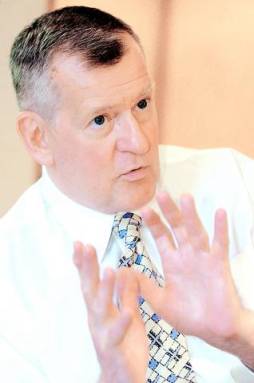
Ross Terrill, associate researcher at the Fairbank Center for East Asian Research, Harvard University, says that there is a new willingness in the US to accept the idea of an independent Taiwan.
-----------------------------------------
On April 25, 2004 ……
Chen calls on opposition to trust judiciary
AFP , TAIPEI
President Chen Shui-bian yesterday called on the opposition to trust the nation's judiciary ahead of a recount of last month's disputed presidential poll.
The Chinese Nationalist Party (KMT)-led opposition has filed a lawsuit demanding a recount and nullification of the March 20 vote, which it says was marred by irregularities and an unsolved election-eve shooting of Chen and Vice President Annette Lu.
The High Court has ruled that a comprehensive recount should begin on May 10 at the latest, in order to be completed before Chen's scheduled inauguration on May 20.
"I firmly support a legal settlement of the election dispute," Chen said while addressing trainees at a leadership school affiliated with the Democratic Progressive Party.
"But I'm very worried how government authority is to be enforced if there is no trust in the judiciary, investigators, professional physicians or even international forensic experts," he said.
The opposition argues the shooting, which left Chen and Lu slightly injured, mobilized a sympathy vote in Chen's favor. He won by 0.22 percent, or less than 30,000 votes, over KMT Chairman Lien Chan.
The opposition has challenged government efforts to investigate the incident, despite the involvement of US forensics experts, and claims it may have been staged, an allegation Chen denies.
Opposition supporters have staged a string of protests, several of which turned violent.
In the worst case, protesters on April 10 targeted police with gas bombs and slingshots, leading to clashes which left more than 140 injured.
Chen also accused the opposition of trying to justify the violent acts as patriotic.
The opposition has threatened to hold another massive rally on May 19 or on inauguration day unless he agrees to set up an independent investigation to probe the shooting.
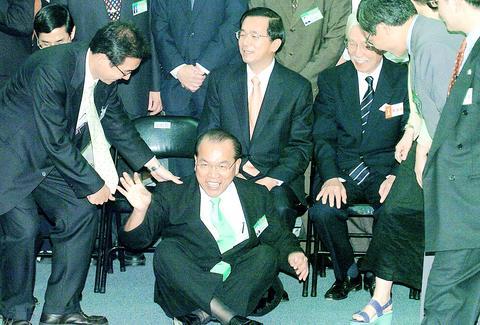
A member of the Ketagalan Institute takes a seat in front of President Chen Shui-bian, the founder of the institute, at the school's opening ceremony in Taipei yesterday.
-----------------------------------------
On April 25, 2004 ……
US and Japan stand up for Taiwan at WTO meet
CNA , GENEVA
The US and Japanese representatives to the WTO spoke out on Friday in support of Taiwan's bid to join the Government Procurement Agreement (GPA) , according to a Taiwanese representative to the WTO.
Kao Shuo-tai, Taiwan's deputy representative to the WTO, said that the US representative, whose name Kao did not mention, said at a WTO committee on the GPA that his government supports Taiwan's membership in the GPA.
The GPA ensures that foreign companies enjoy the same rights as domestic companies in bidding on procurement contracts handed out by governments in GPA member states.
The US representative said that US many companies would look forward to the opportunity to supply the Taiwanese government with goods and services if Taiwan were made a member of the GPA.
The Japanese representative, whose name Kao also did not mention, expressed Tokyo's hope that Taiwan would be able to sign the agreement as soon as possible and noted that there are only a few questions remaining to be settled.
The US and Japanese representatives made their comments after Kao complained to the committee that Taiwan's attempts to join the GPA have been hindered by "non-economic factors" despite Taiwan's finishing its bilateral negotiations with all GPA members within one year.
Without naming China, Kao said that everyone on the committee knows that Beijing's boycott of Taiwan is the problem.
Taiwan trade officials in Geneva said Taiwan is trying to fulfill a promise it made before entering the WTO by signing the GPA.
The officials said that the nation had conceded as much as it could to conclude all bilateral negotiations before December 2002.
However, Taiwan has still been unable to sign the agreement because of Chinese resistance.
The officials said that Taiwan has done its best and should not be blamed for not being included in the agreement.
-----------------------------------------
On April 25, 2004 ……
China's `pipeline' is a blocked sewer
As SARS surfaces again in China, nearby Taiwan has no direct and immediate channel to information about the disease from either the Chinese government or the World Health Organization (WHO). Instead it must rely on itself in seeking such information from indirect and unofficial channels. This shows up not only the lies uttered by Chinese officials to the WHO about the "open and smooth-running" channel of WHO information to Taiwan via China, but also emphasizes Taiwan's dire need to obtain WHO observer status.
It is indeed ironic that only last Tuesday, Chinese Vice Health Minister Gao Qiang indicated during a visit by World Health Organization (WHO) Director-General Lee Jong-wook to Beijing that Taiwan has a useful pipeline for this information, but instead is using all kinds of excuses to join the WHO merely for the purpose of dividing the Chinese "motherland."
Yet on Thursday, Taiwan's Department of Health Director-general Chen Chien-jen had to learn about China's SARS outbreak through news reports on TV and the Internet, which featured the Chinese Ministry of Health's evening announcement of "a suspected case of SARS." As for more detailed information, according to Chen, Taiwan has had to rely on informal channels, such as sympathetic WHO officials.
Taiwan's Mainland Affairs Council (MAC) fares no better in terms of information flow. It has been relying on the WHO Web site and Taiwanese businessmen in China to get information. The closest thing to an official Chinese report was a letter Taiwan's Red Cross received on Thursday from the Chinese Red Cross.
Under these circumstances it is no wonder that Chen Ming-tung, MAC deputy director-general, on Friday criticized Beijing as "inhumane" for refusing to offer first-hand information on the outbreak and for deliberately concealing the relevant information in an attempt to protect its own reputation.
Indeed, Beijing appears not to have learned from the lesson of last year's SARS epidemic, during which it deliberately concealed and lied about the epidemic's outbreak and gravity, not only to the world but even to its own people.
Despite a vow on Friday by Chinese Vice Health Minister Zhu Qingsheng during a meeting of Asian health ministers in Malaysia that China will react quickly this time, Beijing clearly has neither acted quickly nor done nearly enough thus far.
Beijing waited until Thursday to concede that a first case of SARS had possibly been found, despite the fact that the lab worker in question first began to exhibit symptoms of the disease on March 25, almost a month ago. Despite these early symptoms, she and her mother took several train trips between Beijing and Anhui, possibly exposing many more people to the virus. This is not to mention all the people she came into contact with at the hospital where she was treated and at her workplace -- a research lab that wasn't closed for decontamination until yesterday.
In view of all this, Chen Chien-jen has expressed the hope that all countries in the Asia-Pacific region, not just China, should immediately notify all countries in the region on receiving information concerning new SARS infections. That was precisely what Taiwan did a few months ago when a lab worker contracted SARS.
Taiwan has more to fear from such irresponsible behavior on China's part than any other nation, considering both its geographical proximity and the volume of private-sector exchanges between the countries. After all, it was all thanks to China that so many Taiwanese died of SARS last year.
Under the circumstances, it is truly unforgivable for China to continue to oppose Taiwan's WHO observer status.
-----------------------------------------
On April 25, 2004 ……
It'll take action to be an observer
`China claimed that its "central government has always cared about Taiwanese people's health and welfare, pushed for cross-strait health and medical exchanges, and welcomed Taiwan to participate in the Chinese delegation" to the World Health Assembly.'
On May 17, the World Health Assembly will convene in Geneva, and Taiwan will again fight to gain observer status. New Minister of Foreign Affairs Mark Chen indicated optimistically that Taiwan's years of efforts to participate in the World Health Organization (WHO) may very well be repaid handsomely at this event.
The attitude of countries such as the US and Japan toward Taiwan's attempt to obtain observer status has become much more positive than in previous years.
The US may even submit the proposal for Taiwan's participation to the assembly, and does not rule out the possibility of asking for a vote on the issue. Department of Health Director-General Chen Chien-jen also suggests that Taiwan has a better chance of becoming an observer this year.
The biggest obstacle to Taiwan's
participation in the international community is China. China has consistently
boycotted Taiwan's participation in international forums of all natures, from
political, to economic, to sports, to cultural, to medical organizations. It
absolutely does not permit Taiwan's people to have any footing in the
international community.
Taiwan -- despite its millions of
citizens, economic vitality and acclaimed democracy -- is actually excluded
from international activities that are universally deemed as compatible with
fundamental human rights valued by modern civilized society. This has kept
Taiwan from engaging with the international community and fulfilling its
responsibilities as a member of the global village.
Therefore, while the courage and determination of the government officials trying to lead Taiwan out of this diplomatic stalemate are admirable, obtaining this observer status and eventually taking part in the WHO are not goals that can be accomplished within a short period of time. Our citizens must be psychologically ready for a long effort.
For as our nation seeks WHO observer status, China has also intensified its obstructions. WHO Director General Lee Jong-wook recently indicated in Beijing that according to the relevant WHO regulations the organization is open to all countries, and therefore, in comparison with other international organizations, it is relatively easier to join the WHO.
However, a very key word is "country," meaning that WHO membership is available only to sovereign countries, Lee said. Therefore, he told top-ranking Chinese officials, Taiwan has no hope of obtaining WHO observer status.
Lee even fabricated the lie that WHO abides by the "one China" principle, and said the organization will handle issues involving Taiwan according to this principle.
However, this biased statement was immediately clarified by the WHO, where a spokesperson pointed out that the issue of Taiwan participating in the WHO has long existed, that the WHO does not have any "one China" policy, and that member countries have the power to decide everything.
Lee's pro-China statements are indeed sickening. Chen Chien-jen has already pointed out that at least five WHO observers are not sovereign countries, including the Red Cross and PLO, and that two areas that are not nations are considered member states.
Obviously, Lee's statement that WHO members must be sovereign states was quite untrue, fabricated solely to pander to China. Taiwan is already a sovereign country, and WHO's continued exclusion of Taiwan from participating is not only groundless but will ultimately damage this humanitarian organization. It is known for promoting health care and protecting human lives with policies that transcend differences of race, religion, sex, culture and politics.
Clearly that reputation is being spoiled in this disgraceful instance, in which Lee spread lies about WHO's "one China" policy and otherwise sang and danced to delight the Chinese. President Hu Jintao and Premier Wen Jiabao specifically discussed WHO's supposed "one China" policy with Lee, and China claimed that its "central government has always cared about Taiwanese people's health and welfare, pushed for cross-strait health and medical exchanges, and welcomed Taiwan to participate in the Chinese delegation" to the World Health Assembly.
Chinese Vice Health Minister Gao Qiang lied through his teeth in saying that "Taiwan's channel to information from the WHO is smooth and open, and that the Taiwan authorities' attempt to squeeze into the WHO through various excuses is made solely to justify its division of the mother country."
The truth of the matter is that the standard of medical care in Taiwan is definitely better than that in China. Taiwan has no need to be "taken care of" by China, which is incapable of caring for Taiwan. China repeated its "one China" myth to obstruct Taiwan's attainment of WHO observer status after China spread SARS to Taiwan, leaving this nation in dire need of the WHO's help. Some ranking Chinese officials even openly made heartless comments to the effect of "Who gives a damn about you guys?" -- ignoring the fact that Taiwan's people were fighting for their lives against the epidemic.
The big talk by other Chinese leaders about how they care about the health of Taiwanese and how they welcome Taiwan to join China's WHO delegation reveals only the phony and heartless side of Beijing.
Chen, Taiwan's top health official, cited four major arguments for Taiwan's WHO observer status this year, including that Taiwan's health care should not suffer as a result of Chinese obstruction. Taiwan is willing to share its public health progress and furnish medical assistance, particularly to help other countries match its successes in implementing WHO disease-prevention strategies against AIDS, malaria and tobacco-related hazards to human health.
Taiwan's efforts to obtain WHO observer status are motivated neither by selfish political agendas nor fabricated from political expediency. Rather, these efforts seek to protect health care rights and to share public health accomplishments for the greater good of humanity.
Chinese obstruction of these altruistic goals are not only futile but will also deepen the divisions between Taiwan and China, forcing the two sides further apart.
-----------------------------------------
-----------------------------------------