20040426
=======
Unsuccessful coup on April 26, 2004 ……
Protests were `unsuccessful coup': Chen
BACKLASH: President Chen Shui-bian
yesterday called the pan-blue protests in Taipei an unsuccessful coup d'etat,
whereupon the alliance threatened legal action.
By Jimmy Chuang, STAFF REPORTER
President Chen Shui-bian yesterday said that the Chinese Nationalist Party (KMT)-People First Party (PFP) alliance's protests in front of the Presidential Office from March 20 to March 27 were an "unsuccessful coup d'etat."
"Thank God it was not successful. Otherwise, I would not have had the opportunity to stand up here and speak with all of you and celebrate your school's anniversary. It is our fate," Chen said.
Chen made his remarks while he was attending the anniversary ceremony of the National Chiayi Senior High School yesterday morning. He said that Taiwan is blessed because both the assassination attempt on the lives of Vice President Annette Lu and himself, and the "seven-day coup d'etat," were unsuccessful. Moreover, Lu and he also won re-election.
Chen encouraged the students at the celebration to work hard, study hard and play hard. He called the high school a "premiers' alma mater" because former premiers Vincent Siew and Chang Chun-hsiung are both alumni.
In addition to criticizing the KMT-PFP alliance's protest activities, Chen also encouraged his fellow Democratic Progressive Party (DPP) members to work hard for the year-end legislature election.
"I hope that half of the 225 seats in the Legislative Yuan will be filled by DPP members," Chen said.
"Maybe our future Legislative Yuan speaker will be a Chiayi Senior High School alumnus, too," he said.
In response to Chen's remarks, KMT Cultural and Communications Affairs Committee Director Alex Tsai immediately issued a press release.
Tsai said in the press release that all the protest activities in front of the Presidential Office from March 20 to March 27 had been totally legal, authorized and had peaceful endings.
In addition, all the protesters' requests, including the recounting of ballots and the investigation of the assassination attempt, were reasonable.
Under an agreement by both parties, a full recount was scheduled to begin on May 10 and both parties hoped to finish the recount process before May 20. However, the DPP and the KMT-PFP alliance have yet to come up with an agreement on how a disputed ballot should be recognized and who will be responsible for paying all the expenses regarding the recount.
As for the assassination attempt, the investigation is at the same stage as a couple of weeks ago, as investigators had difficulties identifying the potential gunmen as well as the pistol, which is believed to be a homemade firearm.
"He [Chen] said just a few days ago that Taiwanese people should reunify and work together for our future. However, now he made up a charge against us. I do not know what kind of logic that is," Tsai said.
Tsai also said that the alliance will consider filing a slander suit against Chen if he is unable to provide evidence to prove his remarks against the alliance, or fails to apologize to the alliance within 24 hours.
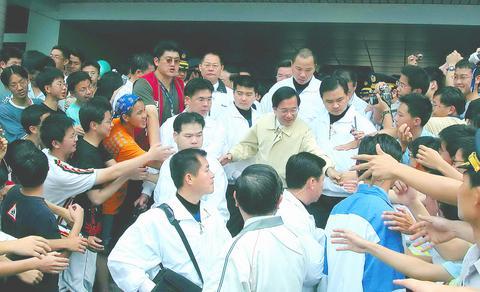
Students surround President Chen Shui-bian and stretch out their arms in the hope of shaking hands with him at National Chiayi Senior High School yesterday.
-----------------------------------------
On April 26, 2004 ……
KMT fails to reflect on its mistakes in election loss
`Lien's most superb feat is turning
his failure into the very shield with which to defend himself.'
By Chin Heng-wei
After an election defeat, one should step back and seek reform, for political accountability but also and more importantly to maintain vitality within the party.
But this is still not enough, and politicians should make promises to the electorate to be given a second chance. They should earn back the electorate's trust with promises of reform. This may well be the normal track of party politics in a democratic society, but it does not apply to the Chinese Nationalist Party (KMT). The KMT is an exception to the rules.
If this is not the case, why is the KMT's core leadership still sitting pretty after its defeat in the 2000 presidential election, a second Waterloo in the 2001 legislative elections and the latest blow in last month's presidential election? Despite this string of setbacks, the KMT's chairman, Lien Chan, is still on his throne.
The problem is that if the KMT continues to procrastinate on far-reaching reforms and reflection, the day of party disintegration is not far off. Especially if the KMT concedes its status as the biggest opposition party in the legislature to the People First Party (PFP) in the year-end election, the last chapter of the KMT's century-long history will come to an end.
This is why some concerned people in the KMT are crying out for generational change and demanding accountability.
Lien is not the product of a democratic society. Instead, he is the successor raised and trained by Chiang Kai-shek's dynasty and his expertise is in inciting internal clashes.
Is he good at what he is doing? How else could he have driven out former KMT chairman Lee Teng-hui and pressured PFP Chairman James Soong to forge a joint ticket with him? And how else could he have completed the project to consolidate the KMT's core leadership even after a series of fiascos?
Yet this is not Lien's secret weapon. Lien's most superb feat is turning his failure into the very shield with which to defend himself. In the face of overwhelming pressure for reforms, Lien says that the KMT does not have any political capital to be divided. He says the KMT must unite or it will fall into the enemy's grip. Lien concluded that the reforms are in the KMT's hands, not in the Democratic Progressive Party's (DPP), let alone in President Chen Shui-bian's. Lien's strategy is obvious -- taking the DPP and Chen as excuses to block the KMT's would-be reformers' hope for a party revival and politicizing the advantaged position of the rival party to meet his own ends of consolidating the KMT core leadership. Despite the fact that Lien always replaces an "I" with a "we" to back up his claims, it is Lien alone who is pulling the strings behind the scenes.
The greatest problem for the KMT is not the DPP's opportunism. Even if there were such an opportunistic DPP, it is up to the public to decide whether the DPP is to be trusted. We can clearly see through Lien's ruse of using Chen as a weapon to defend his own position, and this ruse only proves that Lien can turn his shortcomings to his advantages, hoping to turn defeat into a victory.
Chin Heng-wei is the editor in chief of Contemporary Monthly magazine.
-----------------------------------------
On April 26, 2004 ……
Lien is a test democracy will pass
`It was Lien's KMT that fostered a sense of distrust in government ... Ironically, with the help of melodrama, hearsay and mass media, Lien is now able to capitalize on these lingering sentiments.'
By Hsiao Bi-khim
The opposition pan-blue camp has called for an electoral recount and an investigation of the March 19 shooting incident, demands to which President Chen Shui-bian's administration and the Democratic Progressive Party (DPP) have responded with the utmost sincerity and substantive action. But it appears that no amount of goodwill and effort will appease the bitter feelings of the losers, Chinese Nationalist Party (KMT) Chairman Lien Chan and People First Party (PFP) Chairman James Soong.
Given that Lien and Soong were upholders of this country's authoritarian past, it is not surprising that they are unwilling to accept the results of a fairly contested election. Chen's re-election dashed their hopes of returning to power and proved that the democratic reforms promoted by the DPP are here to stay.
Nevertheless, since we of the pan-green camp recognize that this election was indeed an extremely tight race, we have fully respected their right to a legal recount and have further agreed to statutory revisions for an administrative recount.
A comprehensive and transparent investigation of the shooting is under way, and the DPP has already met the opposition's demand that foreign forensic experts participate in this investigation. That such an act of violence occurred on the election's eve was a terrible shock and a day of sadness for the nation, for we had prided ourselves on the peaceful nature of Taiwan's democratic transition. More than anyone else, the president is eager to find out the truth behind the attempted assassination.
Yet because Lien refuses to accept his defeat, what could have been a further step in Taiwan's democratic consolidation has turned out to be its biggest test.
A strong democracy requires that the general population possess a basic confidence in government institutions' legitimacy and soundness. Even though his claims completely lack evidence, Lien appears determined to undermine both the election's legitimacy and trust in the government. During one of modern history's longest periods of martial law it was Lien's KMT that fostered a sense of distrust in government among the Taiwanese people. Ironically, with the help of melodrama, hearsay and mass media, Lien is now able to capitalize on these lingering sentiments.
The KMT is known for its history of
human rights violations and authoritarian rule, whereas the DPP has been at the
forefront of Taiwan's democratic movement. When we were Taiwan's only
opposition party, we fought in numerous unfair elections rigged by the KMT. To
accuse us of election fraud is a grave insult to those who have dedicated their
lives to and even sacrificed their lives for democracy.
Democracy also requires mature political leaders and parties. As the vote was tallied on the evening of March 20, Lien chose to incite crowds with a fiery, bitter speech. Meanwhile, the president expressed his highest respect for Lien, and urged supporters to cast aside political differences and embrace the pan-blue camp. While the blue camp organized mass protests and stormed government buildings, the DPP urged supporters to exercise restraint and strictly forbade local party branches from organizing any confrontational activities. On the weekend of April 10, as the pan-blue camp continued with demonstrations that ended in violence, DPP delegates met to reform our party mechanisms for nominating candidates.
It is obvious which side is committed to Taiwan's stability and ongoing democratization, and which side is merely seeking political gain at the expense of social order.
Democracy -- particularly in Taiwan's case -- requires support from the international community. China has regarded any act of democratic consolidation, from our first parliamentary election to the presidential election and recent referenda, as a move toward independence deserving political and even military suppression. Such threats to our very survival and the discrediting of democracy are not only unjust but also harmful to Asia-Pacific stability.
If one hopes for China's rapid political liberalization, then Taiwan's democracy must be allowed to flourish. Taiwan's experience has proven that democracy can be compatible with so-called Asian values, and our close cultural and economic ties with China can play a strategic liberalizing influence. It is unfortunate that the post-election controversy generated by the blue camp has been manipulated by China in an attempt to belittle Hong Kong's democratic movement. We must not allow the blue camp's actions to continue to harm Taiwan's international image.
It is with sadness that we have witnessed the blue camp's demonstrations turn violent. We are appalled that Lien still refuses to take responsibility for events spinning out of control, and still blames Chen and the DPP.
Recent events represent a surge of reactionary forces against the ongoing consolidation of democracy. Despite these challenges, we have faith in this country's people and democratic institutions. Having won over half of the votes, the president is in a position of strength. Polls also indicate that the public disapproves of the blue camp's actions.
As we weather this storm, we are confident that Taiwan's democracy will emerge stronger than ever before.
Hsiao Bi-khim is a legislatior and director of international affairs
for the Democratic Progressive Party.
-----------------------------------------
-----------------------------------------