20040427
=======
AIT on April 27, 2004 ……
AIT calls on Taiwan to heed threats
CROSS-STRAIT TENSION: The deputy director of the American Institute in Taiwan said China's threats must be taken seriously and that the US is against changing the status quo
By Stephanie Wen, STAFF REPORTER
American Institute in Taiwan (AIT) deputy director David Keegan warned the country against changing the status quo, saying China's threats are real, while telling Beijing to refrain from using force or coercion.
Keegan was speaking in place of AIT director Douglas Paal at a symposium at the Ministry of Foreign Affairs yesterday, "The 25th Anniversary of the Taiwan Relations Act (TRA): The future and prospects of US-Taiwan Relations."
Keegan was received by Vice Minister of Foreign Affairs Francisco Hwang, who was standing in for Minister Mark Chen.
AIT spokesman Richard Shih dismissed a report in the Chinese-language media that Paal and Chen were absent because of the sensitive timing of a visit by Presidential Office Secretary-General Chiu I-jen to the US.
"Their absence was purely coincidental. Both had to be away for other matters," Shih said.
Keegan reiterated the core principles of US policy toward Taiwan: that the US remains committed to its "one China" policy based on the three Joint Communiques and the TRA.
"While the US does not support changing the status quo as the US defines it, the US also strongly opposes the use of force or coercion by the PRC. It would, however, be irresponsible to treat these statements as empty threats," Keegan said.
"We look to President Chen [Shui-bian] for responsible, democratic and restrained leadership," he said.
Keegan said that while the plan for a new constitution is not yet clear, the US will speak bluntly of its opposition to unilateral changes to the status quo.
However, Keegan also said the US is a strong supporter of Taiwan's participation in international organizations such as the World Health Organization and hopes that dialogue between two sides of the Taiwan Strait will resume soon.
Keegan's speech was largely a reiteration of US Assistant Secretary of State for East Asia James Kelly's address to the House International Relations Committee last Wednesday.
Democratic Progressive Party (DPP) Legislator Parris Chang said that both Keegan and Kelly stressed there had been no change in either US adherence to the TRA or its arms sales policy to Taiwan.
"Any improvement in the US-Taiwan relationship will hinge on the definition of `status quo,'" Chang said. "A mutual understanding of the term `status quo' requires further discussion."
Joanne Chang, a research fellow at Academia Sinica's Institute of European and American Studies, was more optimistic.
"Over the past 25 years we have seen the growth of the Taiwan-US relationship through military, economic and political exchanges, and see it strengthening," she said.
"The `one China' policy has shown itself to be more flexible than we thought. It is time to rethink the framework on which US policy is based," Chang said, adding the "one China" policy cannot be a precondition for resuming cross-strait talks.
Richard Vuylsteke, executive director of the American Chamber of Commerce in Taipei, said the TRA and US policy must be altered given that Taiwan has become a multi-party democracy since the lifting of Martial Law in 1987.
Vuylsteke said the TRA has been a success over the past 25 years in that there has not been a war.
He said the changing global economy may also affect Taiwan-US relations.
Referring to Keegan's remark that Taiwan is the 8th-largest trading partner for the US, Vuylsteke said, "If Taiwan drops to the 12th or 14th position while China becomes the first, will that change the relationship between US and Taiwan? It is an issue we should think about. Economics is an important aspect of the whole picture."
-----------------------------------------
On April 27, 2004 ……
No coup possible: defense ministry
By Brian Hsu, STAFF REPORTER
The Ministry of National Defense yesterday clarified that President Chen Shui-bian was not referring to a military coup d'etat when he described the pan-blue camp's post-election protests as a failed coup attempt.
Ministry spokesman Major General Huang Suei-sheng said the military has been quite stable since the elections and that there was no possibility of a military coup.
Huang also rebuffed rumors that some military leaders had accepted offers of high positions from the pan-blue team in exchange for their support for the Chinese Nationalist Party (KMT) Chairman Lien Chan and People First Party (PFP) Chairman James Soong's ticket.
"We have not found any evidence to support these allegations. We hope the public will have confidence in the military, which will not try to interfere with politics," Huang said.
He made the remarks in a phone interview yesterday with the Taipei Times in response to questions about Chen's comments.
Huang urged the public to notice that Chen was not talking about an attempted military coup.
The ministry's political warfare department head, General Chen Pan-chih, said in a recent meeting with the press that the military did not experience any instability after the March 20 election.
As the chief of the military's disciplinary watchdog, General Chen stressed that the military has experienced high morale over the past month.
A PFP lawmaker, who declined to be identified, said the ministry might be speaking the truth but that it was not the whole truth.
"I have heard that some generals were quite disappointed with the pan-blue camp's loss in the presidential election. They were not planning to launch a coup. They were thinking of retiring early to express their disappointment," the lawmaker said.
He refused to identify the generals he was referring to.
So far there have been no reports of any generals seeking early retirement since the elections.
There might be some generals who were very disappointed with the election results, but they could not be as many in number as those who were upset about the recent appointment of Lieutenant General Chen Ti-tuan.
The three-star general was assigned to head the Armed Forces Reserve Command -- a move said to have disappointed several lieutenant generals who were either older or who considered themselves better qualified.
-----------------------------------------
On April 27, 2004 ……
No democracy yet, China tells HK
ASSERTING AUTHORITY: The decision by the Standing Committee of the National People's Congress to stamp out hopes for democracy is expected to fuel resentment
REUTERS , BEIJING AND HONG KONG
China's National People's Congress (NPC) yesterday dashed the hopes of Hong Kong people to directly elect their leaders in polls in 2007 and 2008, reinforcing Beijing's full control over democratic progress in the territory.
The decision came after China's top members of parliament voted on political reforms for the territory, where calls have mounted for more voting rights because of growing frustration with the China-backed administration.
"There will be no universal suffrage for electing the third chief executive in 2007," Tsang Hin-chi, a Hong Kong member of the Standing Committee of the NPC, told reporters in Beijing.
"There will be no universal suffrage for all legislators," he said, referring to elections due in 2008.
His comments were carried live on Hong Kong's Cable Television.
The move is part of a campaign by Beijing since the start of the year to contain Hong Kong's democratic aspirations that it fears could produce leaders who will challenge its control.
Hong Kong Chief Executive Tung Chee-hwa called for calm.
"Some people are worried about the ... decision. I hope they'll be rational and calm, and let's work hard together to seek a consensus on constitutional reforms," he said.
Democracy advocates accused Beijing of reneging on a promise of a high degree of autonomy under a "one country, two systems" formula that it made Hong Kong when it took the territory back from Britain in 1997.
"This has killed the `one country, two systems' principle and our high degree of autonomy. We have to tell the world that we don't accept Beijing running Hong Kong," said Lee Cheuk-yan, a prominent pro-democracy lawmaker and workers rights champion.
Others called on voters to back the democracy camp in legislative elections in September, when Beijing fears opposition politicians could win a majority.
The People's Daily, mouthpiece of China's Communist Party, said in a commentary that the decision by parliament would be "conducive to cooling recent disputes over the issue of the development of Hong Kong society's political system."
"On the issue of the development of Hong Kong's political system, any action deviating from the tracks of the Basic Law will not be allowed," the commentary said.
"Its fundamental objective is to maintain Hong Kong's long-term prosperity and stability as well as the overall rights and good fortune of Hong Kong residents," the paper said.
Half of Hong Kong's Legislative Council is chosen via direct election, while the other half is selected by largely pro-Beijing professional and business groups.
"If Hong Kong people do not accept such high-handedness, they must stand up and express their anger on July 1," said pro-democracy lawmaker Albert Chan, referring to an anti-Beijing protest on that date last year attended by half a million people.
Beijing worries democratic reform in Hong Kong could stir democratic dreams elsewhere in China.
Alarmed by residents' demands to elect their leaders as soon as 2007, as is possible under the city's constitution, Beijing revised that framework this month to require the territory to obtain Beijing's approval before it can even initiate any electoral reforms.
By calling the shots now, Beijing wants to remove the issue of political change from the agenda of opposition politicians in the September elections.
Political analysts said this will only fuel the controversy.
"I don't think the row will stop. Most people want popular direct elections in '07 and '08. After the NPC ruling, there will be dissatisfaction and opposition, and the local government will continue to be under pressure," said Cheung Chor-yung, a social studies lecturer at the City University of Hong Kong.
The NPC also voted to let changes be made in time for the two elections in 2007 and 2008, but stressed that any amendments must follow the principle of "gradual and orderly progress" as laid down in the constitution.
Yeung Sum, leader of the Democratic Party, vowed never to give up, hinting at more trouble ahead for Beijing.
"We'll never give up our fight for universal suffrage ... I'm worried the ruling will impact on investor views of the 'one country, two systems' blueprint ... The move will extend the Hong Kong government's governance crisis," Yeung said.
-----------------------------------------
On April 27, 2004 ……
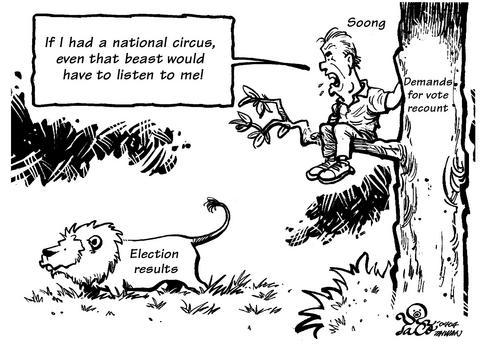
Pan-blue efforts deserve coup label
As the pan-blue camp represented by Taipei Mayor Ma Ying-jeou said yesterday, "coup d'etat" is not a facile one-liner to be used at will.
Over the weekend, both President Chen Shui-bian and former president Lee Teng-hui had coincidentally applied the terms "coup" and "unsuccessful coup" to describe the mass protests spearheaded by the Chinese Nationalist Party (KMT) and the People First Party (PFP) in front of the Presidential Office starting on March 20.
The question we need to ask, however, is how the blue camp's and protesters' behavior has shaped the viewpoints of most Taiwanese people and the global media.
During the week of protests, pan-blue presidential candidate and KMT chairman Lien Chan told a seething crowd that Chen's victory amounted to "stealing the nation." His wife, Lien Fang Yu, also visited the fuming mob to demand a new election.
People First Party chairman James Soong, Lien's running mate, even made the groundless announcement to protesters that about a million military and police personnel could be recruited to join the demonstration. Soong further smeared Chen as "the vote-rigging president." A few days later, someone who purported to be a retired navy official showed up in uniform at the Chiang Kai-shek Memorial, calling on the army to respond favorably to the pan-blue camp's protests.
On March 26, when the Central Election Commission announced the president's election in conformity with the law, KMT and PFP legislators and city council members launched mass protests in Taipei, Taichung and Kaohsiung. After crowds besieged the commission and local courts, some protesters committed vandalism, beat up police officers, smashed the commission building's glass doors and threatened the safety of security personnel behind the doors. PFP civil servants publicly announced there and on television that they would launch a revolution to oust Chen and his administration.
Obviously, the pan-blue camp did not abide by the laws of a constitutional democracy during its post-election demonstrations. Ignoring the country's laws, the election's losers rashly defamed the head of the nation, refused to wait for the judicial authorities' investigation into the supposed controversies, and publicly called upon their supporters to take illegal actions. Weren't these actions consistent with a coup?
Incomprehensibly, Ma refused to enforce the nation's laws against these demonstrations. What enormous political pressures forced him to make such a ridiculous decision? We hope Ma, who has fiercely opposed characterizations of blue efforts as a coup, will come forward to explain the reasons he made that decision, and how it relates to the pan-blue camp.
The post-election demonstrations that resulted in bloodshed on April 10 have scarred the minds of Taiwan's people. Everyone is allowed to describe these searing images of violence in their own words -- including the words "coup d'etat."
-----------------------------------------
-----------------------------------------