20040428
=======
Who could give Taiwan a hand on April 28, 2004 ……
Chen seeks support for WHO bid
DEMOCRATIC SPIRIT: President Chen Shui-bian, speaking in a teleconference, asked a group of Nordic countries to help Taiwan gain entry to the World Health Organization
By Lin Chieh-yu, STAFF REPORTER
President Chen Shui-bian yesterday urged five Nordic countries to ask the EU to support Taiwan's bid to join the World Health Organization (WHO) and to keep the embargo on weapons sales to China.
"I hope that our friends from northern Europe will also lend a hand to Taiwan by asking the EU and its allies not to rashly remove the arms embargo on China before it improves on democratic and human rights issues as well as withdraws its ballistic missiles and military deployments targeting Taiwan," Chen said.
"I also expect that our Nordic friends, based on their founding spirit, can assist with Taiwan's bid to enter the WHO and to participate on an equal footing in every international organization," Chen said.
Chen was speaking in a teleconference last night called "Nordic Conference on Taiwan." The teleconference gathered about 30 lawmakers from Denmark, Norway, Finland, Sweden and Iceland, speaking in Copenhagen.
Chen said that in his second term, he will continue to deepen democracy, protect human rights and enhance the market economy.
On constitutional reform, he said the current Constitution was introduced more than five decades ago and that many parts of it fail to meet the country's needs.
"Sections relating to the protection of human rights, the streamlining of government agencies and the number of legislators need to be changed in keeping with the times," Chen said.
"We will create a new constitution for Taiwan. This new constitution will have to be decided upon by the people as a whole, and shall therefore be put to a referendum," he said.
Chen also stressed that he has asked Beijing to work toward a framework for long-term, stable and peaceful interaction.
"We sincerely hope to reopen dialogue with China as soon as possible," Chen said.
Presidential Office spokesman James Huang said teleconferences with Nordic countries have been held in 1996, 1999 and last year.
In the 1996 meeting, a resolution was reached to appeal to European countries to support Taiwan's achievements in democracy and human rights, Huang said.
Huang said many of the world's major democracies have voiced their support for allowing Taiwan to become a WHO member.
-----------------------------------------
On April 28, 2004 ……
Mutual trust is the key: Mark Chen
By Melody Chen, STAFF REPORTER , IN TAINAN
The government is seeking to allay US concerns about its policies, Minister of Foreign Affairs Mark Chen said yesterday.
Chen was commenting on Presidential Office Secretary-General Chiou I-jen's visit to the US.
Chen said it was very important to rebuild mutual trust between Taiwan and the US and that the government would keep in close contact with the American Institute in Taiwan (AIT).
Chen said that both the US and China were paying close attention to preparations for President Chen Shui-bian's May 20 inauguration speech on constitutional reform for 2006.
Chiou, who arrived in Washington on Monday, met with senior US officials, reportedly including Deputy Secretary of State Richard Armitage.
Mark Chen said he did not know whom Chiou would be meeting in Washington nor what he planned to talk about there.
"I knew about his visit after reading the newspapers. I will ask him about the details of the trip after he comes back," he said.
On Monday, AIT Deputy Director David Keegan warned Taiwan not to change the cross-strait status quo, adding that the US was looking to Chen Shui-bian for "responsible, democratic and restrained leadership" during a symposium on the Taiwan Relations Act held at the Ministry of Foreign Affairs.
Vice Minister of Foreign Affairs Francisco Hwang stood in for Mark Chen at the symposium. Mark Chen said he did not appear at the symposium because AIT Director Douglas Paal did not attend.
Without explaining why Paal could not attend the symposium, Mark Chen said that Keegan's comments were mostly identical to those of US Assistant Secretary of State for East Asia James Kelly on Taiwan during a hearing of the US House of Representatives' International Relations Committee last week.
Both Kelly and Keegan warned Taiwan against moving towards independence.
Mark Chen said Taiwan had to be careful not to hurt US interests while looking after its own.
He noted that one of his utmost duties was to safeguard Taiwan's security.
Chen was speaking during a visit to the Asian Vegetable Research and Development Center in Tainan. Chen was attending at the invitation of center director Thomas Lumpkin.
-----------------------------------------
On April 28, 2004 ……
China tells US, UK to butt out
`WE ARE CHINESE': After steamrolling
hopes for a quick transition to full democracy in Hong Kong, China is telling
the US and Britain to keep their criticisms to themselves
AP, HONG KONG
China has told the US and former colonial master Britain to mind their own business over its refusal to allow full democracy for Hong Kong any time soon.
"We are Chinese," Foreign Minister Li Zhaoxing told reporters in Shanghai yesterday after Washington and London criticized Beijing for blocking political reform.
"Are you clear on that? Hong Kong is China's Hong Kong."
Li added: "Do you think Hong Kong was democratic under British rule? Did the British raise concerns about that? Did the Americans raise concerns? No. Why don't you take a look at this double standard?"
China's most powerful legislative panel told Hong Kong citizens in a ruling on Monday that they cannot democratically choose a successor to unpopular Chief Executive Tung Chee-hwa in 2007.
Beijing also said Hong Kong will be allowed to directly elect only some, and not all, its lawmakers in 2008.
Many Hong Kongers, who want a fully democratic political system for the territory, have responded with a mix of defiance and resignation.
Student activists burned a copy of Hong Kong's mini-constitution, the Basic Law. Pro-democracy lawmakers chanted slogans and unfurled a banner before storming out of a meeting with a top mainland legislative official.
The Standard newspaper yesterday lamented "a sad day for China."
"Yesterday's ruling from the Standing Committee of the National People's Congress that there will be no democracy for Hong Kong was bad enough," The Standard wrote in an editorial. "The way it was delivered showed contempt for Hong Kong's people. Tragically, the ruling also mocks China's desire to be one of the world's trusted leading nations."
Critics say the decision violates China's agreement to grant Hong Kong a great deal of autonomy after the former British colony was handed back in July 1997.
Beijing said full democracy remains a goal for Hong Kong, but that a quick shift to universal suffrage poses too many risks of social and economic instability.
The US Department of State disagreed, saying international confidence in Hong Kong is based on its rule of law and a high degree of autonomy.
"We're disappointed by the decision, as we believe it doesn't adequately reflect the expressed wishes of the Hong Kong people for universal suffrage and democracy," State Department spokesman Richard Boucher said in Washington.
British Foreign Office Minister Bill Rammell said in London that Beijing had acted inconsistently with its handover promises.
Many Hong Kong residents had expected Beijing to clamp down, but they still were disappointed.
"Hong Kong doesn't want to fight with the central government," said Dolby Tong, a 32-year-old shipping salesman. "We just want to choose our own government which reflects citizens' voices."
Ordinary Hong Kongers now have no say in choosing their leader. They will get to pick 30 of the 60 legislators here in September, but they won't get to elect more than half any time soon, Beijing ruled. The rest are picked by special interest groups, such as businessmen and bankers, who tend to side with Beijing.
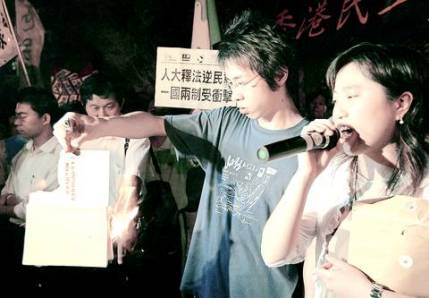
Pro-democracy protesters burn a copy of the Basic Law during a protest against China's decision on local political reforms outside the government house in Hong Kong on Monday. China's parliament dashed hopes in the territory for a speedy move to full democracy on Monday, saying residents in the former British colony will not be able to directly elect their leader and all lawmakers in 2007 and 2008.
-----------------------------------------
On April 28, 2004 ……
How far will China go on Taiwan?
By Sushil Seth
It must be hard for Beijing to live with another four years of President Chen Shui-bian. China's politics vis-a-vis Taiwan have been personality-oriented. When Lee Teng-hui was president, he took all the personal abuse and vilification for advocating Taiwan's sovereignty. It has been Chen's turn in the past four years.
There is obviously a purpose in personalizing such vilification. In this way, Chen becomes the villain and at odds with the people of Taiwan, who supposedly long for unification with the mainland. China's failure in regard to Taiwan is thus simplified by focusing on personalities rather than policies, notwithstanding the fact that Chen won 50 percent of the vote. And it also helps to mobilize the people in China in a supposedly national cause jointly desired by the people across the Taiwan Strait.
By simultaneously maintaining military pressure, the Taiwanese are urged to get rid of their of-fending and traitorous president or else suffer the consequences. It is true that, unlike the past two presidential elections in 1996 and 2000, this time the military threat was less explicit. But the missile buildup targeting Taiwan makes the military threat an ongoing consideration.
Which brings us to Taiwan's security situation. That is: how will Taiwan cope with this nightmare? The country remains in a virtual state of siege, further reinforced by Beijing's moves to prevent Taiwan from projecting an international personality through diplomatic ties. China hopes that the resultant claustrophobia will turn the people of Taiwan against its leaders who champion a distinct Taiwanese identity.
The problem is that this hasn't worked so far. Taiwan has been under virtual siege, both psychologically and militarily, for a long time. Despite this, Chen was still able to poll 50.1 percent of the vote, an increase of about 11 percent. In other words, China's heavy-handed approach is simply proving counterproductive. The way Beijing is riding roughshod over the "one country, two systems" principle in Hong Kong is bound to further rally people against China.
What then are China's options? Beijing seems commit-ted to bringing about Taiwan's "unification" by force, if necessary. It has warned that Chen's planned constitutional referendum and its enactment will not be tolerated.
Premier Wen Jiabao has said China would pay "any price to safeguard the unity of the motherland." According to Chinese military sources, the country would be prepared to forgo the 2008 Olympic Games and brace for an economic downturn, including a drop in foreign investments, as well as to incur military casualties to achieve this goal.
But there is ambiguity in the Chinese position. For instance, the adoption of a new constitution doesn't by itself make Taiwan formally independent. Indeed, Beijing had even regarded the presidential elections in 1996 and 2000 as moves toward independence. And its fury and military threats to stop the process were to no avail. The direct presidential elections are a part of Taiwan's democratic process -- and China has to lump it.
Therefore, going by past experience, one could hazard the guess that as long as there is no formal declaration of Taiwan's independence, China would do all the threatening (including deployment of more missiles) without actually invading the island. Of course, this is subject to a clear American resolve to defend Taiwan in the event of a Chinese attack. And to this end, Beijing would now and then test US commitment by upping the ante, say at the time of the planned constitutional referendum in 2006.
So far the US commitment is quite solid, subject to the essential maintenance of the status quo. President George W. Bush has said, "We oppose any unilateral decision, by either China or Taiwan, to change the status quo." But the visiting Wen was also reportedly told last December "in no uncertain terms that we, the United States, would have to get involved if China tried to use coercion or force to unilaterally change the status of Taiwan." The US commitment now apparently extends even to coercive measures by China.
How the US will interpret Chen's referendum exercise in the face of Chinese threats will depend on a host of factors, including the Iraq situation, the "war on terrorism" and North Korean nuclear proliferation. In other words, it depends on how overstretched America will be militarily and China's consequent leverage.
The People's Liberation Army newspaper has bluntly said: "The United States should not expect that China would still engage in all-round cooperation with it even if it connives at and gives tacit permission to the separatist activities carried out by a locality of China."
It is clear, though, that the US will
not allow China to attack and annex Taiwan. China's global strategy militates
against the emergence of any power that might challenge its dominance. A
forcible takeover of Taiwan by China will strongly undermine US supremacy.
Taiwan is very vulnerable without a US security guarantee. Any amount of weaponry it might buy from the US will not significantly alter this situation. It might buy some time until the US military comes to its rescue. But knowing that the US is committed to Taiwan will be an overriding deterrent for China.
A military invasion of Taiwan will have to be a huge affair involving almost all elements of the Chinese armed forces. It will not only involve attacking the country but also securing it after a successful invasion, a tall task considering China's relative military backwardness. At the same time, China's invading force will be exposed to constant enemy action.
It is a big risk for China to take for an essentially political objective. China is therefore likely to continue its efforts to weaken Taiwan from within with military threats, psychological pressure, economic allurements and punishments, and by fostering political divisions.
In any case, as Chen has said, "we have no intention of changing the status quo" but instead seek to "defend Taiwan's independent status quo and ensure that it cannot be changed."
Sushil Seth is a freelance writer based in Sydney.
-----------------------------------------
On April 28, 2004 ……
Thinking: a critical ability
By Florence Chiu, Pingtung
Teachers should be able to cultivate critical thinking in students not by expressing sympathy toward a particular political party or leader, but by offering objective observations.
Just before the presidential election, I asked my adult students if they would vote in the referendum. They said that a famous media celebrity advocated not casting referendum ballots and that they would follow what she had said, seemingly without understanding the reasons why.
Students seem to be so uncritical and easily influenced by how they are brought up, or simply because they believe authoritarian voices with whom they identify.
I was stunned when a 20-year-old student, who had just voted for the first time, asked me if I, in my mid-30s, had experienced the February 28 Incident.
Other older students did not know when this incident happened either. Ignorance of our own history and current events still appears to be prevalent among today's youngsters.
Looking back to my school days, I experienced a time when martial law was still in force, preventing us from publicly articulating our opinions or political inclinations.
For a long time, "political issues" were considered taboo topics for discussion in the classroom. Our exam-driven curriculum and its emphasis on rote memorization prevented us from thinking critically.
Paulo Freire, an advocate of pedagogy for the oppressed, insisted on promoting rationality in the teaching process via critical thinking and problem-solving to develop personal awareness in thinking.
This may sound radical to Taiwanese teachers, but the classroom is a place where we should cultivate independent thought. We teachers and students have been silenced because of our culture and old rhetorical systems.
To develop the ability to think critically in the classroom, I adopt doubt, belief and two-way dialogue as advocated by Peter Elbow. I distinguish between verified facts and rumors or media speculation to demonstrate how this dialectical dialogue can encourage students to think from different perspectives.
For example, from March 19 on, rumors quickly spread among the public that the pan-green camp staged the shooting of President Chen Shui-bian and Vice President Annette Lu in order to deliver more votes and win the election.
Given the sarcastic tone of the public figures who hinted the shooting was faked, we should be skeptical of their demands that Chen acquit himself with evidence of his innocence, and instead judge the appropriateness of their statements. We should then provide counterarguments to their claims.
The pan-blue camp's line of reasoning was not based on "reasonable doubt," but instead on questioning everything that Chen did.
The reasons for this "reasonable doubt" needed to be verified, but instead, without any evidence, half of the general public became skeptical about the circumstances of the shooting.
The more often politicians expressed suspicion over the shooting, the more likely the general public was to believe them. After the blue camp requested that a prominent forensics expert, Henry Lee, come to Taiwan to assist the investigation, the bullets were determined to be real and the shooting verified. Our society therefore wasted a huge amount of resources verifying the shooting's authenticity.
We tend to watch news without critically analyzing the information we receive, simply believing instead whatever public figures claim.
Media representations offer a powerful tool to affect the way the public perceives and judges. If teachers cannot encourage students to think critically from a dialectical perspective, it is inevitable that the truth as they understand it will be distorted by blind trust in the media.
If we love Taiwan, we must teach our next generation well and provide them with a more democratic environment.
The ability to think critically must not be neglected. Political issues are not taboo issues, but prime material for training children to acquire this ability.
-----------------------------------------
On April 28, 2004 ……
Who's really rocking the boat?
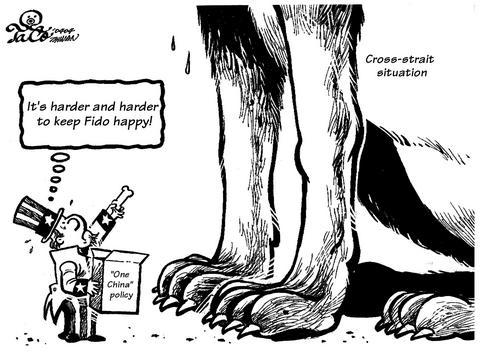
Presidential Office Secretary-General Chiou I-jen has been dispatched to Washington for wide-ranging discussions. The topics of these talks are expected to include the contents of President Chen Shui-bian's inauguration speech and Taiwan and US foreign policy in general, as well as seeking a future framework for the bilateral relationship, which went through a difficult period during the presidential campaign.
The US has already sent a clear
post-election message through Assistant Secretary of State for East Asia James
Kelly. It does not want to see any changes in the cross-strait status quo, and
any change in that status quo must be achieved peacefully. The "status
quo," as defined by the US, means that Beijing must not use military force
against Taiwan, that Taipei must be cautious in its handling of cross-strait
issues and that neither side may issue statements or take actions that
unilaterally change Taiwan's status.
There are reasons for the US concerns. Beijing stresses its sincerity in resolving the Taiwan issue peacefully, yet it also increases its deployment of missiles aimed at Taiwan and raises its preparedness for a military attack. Taiwan issues repeated guarantees that there is no schedule for independence, but it has held a referendum on this issue and plans to write a new constitution to reaffirm itself as independent and sovereign. These actions have made Beijing firmly believe that Taiwan is moving toward independence, and that is a situation the US is not happy about.
However, the status quo is not a static situation but a dynamic and interactive process. While Chen announced last year that there were 496 missiles aimed at Taiwan, the number may now have reached 550. This situation deepens Taiwan's sense of crisis and its fears that the status quo may be changed by Chinese violence. US arms sales to Taiwan must therefore be strengthened to maintain national security.
Regarding Taiwan's planned 2006 referendum on constitutional reform, Kelly bluntly said "there are limitations with respect to what the United States will support." He also said "We do no one any favors if we are unclear in our expectations or obfuscate where those limitations are. The president's policy regarding our opposition to unilateral changes to the status quo will be reinforced in this dialogue with Taiwan about its political evolution."
Taiwan's constitutional reforms aim to remake the legislature, downsize the government and streamline the bureaucracy. These efforts are undertaken to deepen democracy, and do not involve any changes to the status quo. The surge in Taiwanese identity was played a critical role in Chen's electoral victory. This is a mainstream trend, but judging from post-election social divisions, there's no social consensus regarding a change of national flag and title.
After his re-election, Chen proposed establishing a "cross-strait peace development commission" and guidelines for peaceful development across the Taiwan Strait. He also said he's willing to open direct links and to appoint a representative to Beijing to smooth communication and reduce tensions.
Taiwan has thus taken the initiative to show its good will. This could be seen as an effort to change the status quo, but such change should be welcomed by Taiwan and the international community.
On Monday, China's National People's Congress vetoed Hong Kong residents' right to directly elect their chief executive. This vote leaves Beijing's "one country, two systems" policy on the fringe of bankruptcy, and is unacceptable to Hong Kongers, not to mention to much more democratic Taiwan.
The ball is now in China's court. The region's future depends on how Beijing will view these opportunities for cross-strait interaction offered by the March 20 election.
-----------------------------------------
-----------------------------------------