20040430
=======
Beijing’s stance is nothing new on April 30, 2004 ……
Beijing's stance is nothing new
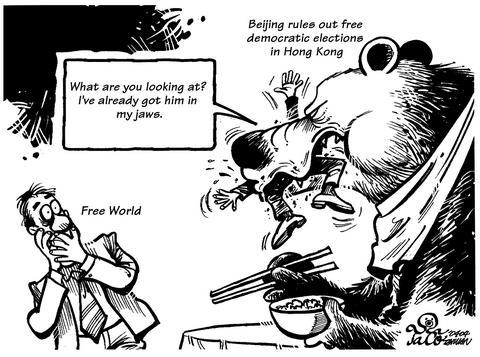
Surely no one could be surprised by the decision of the Central Standing Committee of China's National People's Congress (NPC) on Monday to bar Hong Kong's people from electing their chief executive in 2007 and all members of the Legislative Council (Legco) in 2008. After all, on April 6 the Central Standing Committee issued a binding interpretation of the Hong Kong Basic Law that said Beijing must give advance approval for any changes in the way the territory's leader and lawmakers are selected. People knew this was coming.
This turn of events -- however predictable it might have been -- was nevertheless disappointing to the people of Hong Kong. The decision was obviously highly inconsistent with Beijing's guarantee to offer Hong Kong a "high degree of autonomy" under the Joint Declaration between China and Britain over the handover of Hong Kong's sovereignty in 1997.
Also disappointed were the US and Britain, which issued statements with respect to the decision. British Foreign Minister Bill Rammell on Monday expressed his concern and the hope to meet with the Chinese ambassador to Britain. On the other hand, US State Department spokesperson Richard Boucher said that the US was "disappointed by the decision."
With all international eyes on it, Beijing remains unfazed, as usual, in facing international pressure and concerns regarding democracy and human rights issues and uses nationalism to justify itself. In fact, its initial response to the international concerns was hostile -- to say the least. For example, Chinese Foreign Minister Li Zhaoxing said on Tuesday to reporters: "We are Chinese. Are you clear on that? Hong Kong is China's Hong Kong."
While Chinese Premier Wen Jiabao pledged on Wednesday to "ultimately" allow direct election of the territory's chief executive and legislature, he gave no timeframe. The problem is it has become increasingly difficult to believe the words and promises from Beijing when it comes to democracy. Didn't the people of Hong Kong also have high hopes about the guarantee by Beijing about "Hong Kong people ruling Hong Kong" before the handover?
At least Hong Kong had Britain to advocate its interests prior to 1997. After the handover, who is going to do that? Hong Kong Chief Executive Tung Chee-hwa? Wasn't he the one who made the recommendations upon which the Central Standing Committee of the NPC based its decision on Monday?
It is time for the world to realize that Beijing has no genuine wish to implement democracy in any part of China. In fact, it has virtually no concept of what democracy is -- as demonstrated by the statement of Qiao Xiaoyang, deputy secretary-general of the NPC Central Standing Committee, on Tuesday in Hong Kong, that: "Governments who are led by the nose by public opinion are irresponsible." If this reflects the sentiment of the entire Chinese leadership regarding democracy, just about all hopes have been dashed for a democratic breakthrough in any part of China.
In fact, it is probably safe to conclude that Beijing is not only clueless about what democracy is, but it actually fears democracy. Beijing was obviously taken aback by the demonstration in Hong Kong on July 1 last year in which more than 500,000 people participated and which forced Tung to withdraw an anti-subversion bill. After that incident, Beijing probably decided it was high time to put the brakes on demands for democracy, which reinforced its decision to ban popular elections in the region in the immediate future.
Under the circumstances, the people of Taiwan should have even more appreciation for their hard-earned democracy and not be discouraged by recent political controversies over the outcome of the presidential election.
-----------------------------------------
On April 30, 2004 ……
The joke's on Jackie
By Chen Huiying, Ohio
Jackie Chan's remarks about the presidential election being the biggest joke in the world really puzzled me, as I visited Taipei during the two weeks before and after March 20 and witnessed what was a very serious election with a turnout of about 80 percent.
The voting booth I visited was operated in a very orderly fashion.
Even when the pan-blue camp staged rallies I traveled around town and it seemed to me everything was business-as-usual, which only demonstrates that Taiwan is a true democratic country.
Jackie Chan, you have no idea what you are talking about, and I feel embarrassed for you!
-----------------------------------------
On April 30, 2004 ……
Hong Kong is discredited
By Vincent Wang, Richmond, Virginia
China's denial of universal suffrage in electing Hong Kong's chief executive in 2007 and legislature in 2008 raises serious problems of credibility in its "one country, two systems" principle.
Under this scheme, affluent and educated Hong Kong residents are expected to rely only on Beijing's goodwill to protect their rights and freedoms. But they lack such customary institutional safeguards as a popularly elected executive, a legislature elected by universal franchise, an independent judiciary with powers of review or a federal framework including separation of powers.
Evidence from the last seven years shows that when the communist leadership feels insecure or indecisive, Hong Kong's democratization is sacrificed.
Beijing's track record discredits its attempt to incorporate other free and democratic societies, such as Taiwan.
-----------------------------------------
On April 30, 2004 ……
HK's fight for democracy rages on
By Emily Lau
Seven years after Britain handed Hong Kong over to the People's Republic of China (PRC), Beijing has lost patience with the Hong Kong people's demand for democracy. Within one month, the Chinese Government has moved with lightning speed to snuff out the people's desire for constitutional reforms.
On April 26, the Standing Committee of the National People's Congress (NPC), China's rubber stamp parliament, ruled out direct election by universal suffrage for Hong Kong's chief executive in 2007. It also rejected direct election for all members of the lawmaking Legislative Council (Legco) in 2008 by stipulating that half the Legco members be directly elected and the other half continue to be returned by functional constituencies consisting mainly of chambers of commerce, business and other professional people.
With this decision, Beijing has shattered the Hong Kong people's hope for speeding up the pace of democracy. It has ridden roughshod over public opinion and runs the risk of provoking strong reactions from many sectors of the community. With such blatant intervention, Beijing has abandoned any pretense of giving the territory "a high degree of autonomy" under former leader Deng Xiaoping's concept of "one country, two systems."
In so doing, Beijing has also ignored stipulations in Annex I and II of the Basic Law, which provide for a mechanism to change the method of elections in 2007 and 2008. Although the mechanism has not been activated and public consultation has not commenced, the NPC Standing Committee decided to rule out direct elections in 2007 and 2008 because Hong Kong "does not have such conditions." This is most offensive and humiliating.
Not only does Beijing have no respect for the wishes of the Hong Kong people, it does not even abide by the Basic Law. Furthermore, it is questionable whether the Standing Committee has the power to make such a legally binding declaration. If this is really the case, the Basic Law will be reduced to nothing but scrap paper. In future, the Standing Committee can make declarations with impunity on any subject and make them binding on the territory. This is sheer lawlessness.
Ever since the massive demonstrations on July 1 last year which attracted well over half a million protesters, the Hong Kong people have shown signs of heightened political awareness and maturity.
The peaceful and orderly protests have won praise and admiration from the international community.
Subsequent to these historic marches, a much-criticized law on national security based on Article 23 of the Basic Law had to be withdrawn from Legco, because the usually pro-government Liberal Party refused to support the bill.
The development no doubt angered Beijing, which saw Tung Chee-hwa as both ineffectual and incompetent.
A few months later, there was further bad news for Beijing. On Nov. 23, the pro-Beijing political party Democratic Alliance for the Betterment of Hong Kong (DAB) was trounced in local district council elections. That must have set alarm bells ringing in the capital. When Tung went to Beijing in early December, President Hu Jintao expressed grave concern about developments in the territory. Perhaps it was at that juncture that the central government decided to put the brakes on the democratization process.
There is little doubt that Beijing has lost confidence in Tung. Beijing was unhappy with his inability to enact legislation on national security and was shocked by the poor performance of the DAB in the district council elections, because the DAB specifically named the unpopular Tung as a reason for its electoral defeat.
Looking to the future, Beijing is concerned that many people will take to the streets again on July 1 this year to press their demands for democratic elections in 2007 and 2008. It is also worried that the DAB will be humiliated again in the Legco elections to be held on Sept. 12.
On the other hand, pro-democracy parties have said they will try to win at least half of the 60 seats in Legco so that they can exert more influence on the Tung administration. Beijing regards such a scenario as anathema and is said to be concerned that the situation may get out of hand. As Hong Kong enters the Legco election campaign period, many pro-democracy candidates have vowed to make direct elections in 2007 and 2008 the central plank of their platform.
I understand the central government has concerns but I think those worries are unfounded. Beijing should know the pro-democracy movement is not hellbent on creating chaos. We are not trying to make Hong Kong independent or to overthrow the Communist Party. We just want what we have been promised in the 1984 Sino-British Joint Declaration and the Basic Law -- a high degree of autonomy and Hong Kong people ruling Hong Kong.
In order to help the pro-Beijing and pro-business parties win the September election, Beijing decided to act swiftly to scotch demands for direct election in 2007 and 2008. The decision by the Standing Committee is an attempt to lay the matter to rest. However, the pro-democracy camp will not allow the issue to be forgotten.
We will urge the more than 1.5 million people who have not yet registered as voters to register before the deadline on May 16. We will urge the people to take part in the demonstration on July 1 to press their demands for democracy. We will mobilize the people to vote on Sept. 12 and turn that occasion into a quasi-referendum on direct elections in 2007 and 2008. Although Beijing has spoken, we refuse to be intimidated into silence.
The fight for democracy will go on.
On April 26, over 30 pro-democracy Legco members and district council chairmen and vice-chairmen walked out of a meeting with Chinese and Hong Kong officials. Before we left the meeting room, Yeung Sum, chairman of the Democratic Party, read out a letter which said we welcome dialogue with Beijing but could not accept a fait accompli. We then unfurled a banner saying we oppose Hong Kong being run by Beijing cadres and vowed the fight for democracy will go on.
The Frontier Party held a "black news conference" on April 27 to protest against the central government's rough handling of the democratization issue and its blatant disregard for Hong Kong public opinion.
Thirty-odd Frontier members all dressed up in black. We stressed this was not a sign of death, but a sign of protest against the central government.
In a sign of continuing protest, I said I would wear black every day in the coming month to exhibit my anger and disgust, and I invited all like-minded people to take similar action to give vent to their pent-up feelings.
In the coming weeks and months, I will consult Legco members and non-governmental organizations in order to map out the way forward.
I will also attend the meeting of the Civil Rights Front, the umbrella grouping which organized the July 1 march last year. In planning our way forward, we must work closely with other political parties and civil society to build a strong consensus.
Last year, when Hu and Premier Wen Jiabao came to power, there was a wave of optimism that a more enlightened leadership had taken over. If this is true, how can Hu and Wen allow such high-handed and unreasonable behavior?
How can they ignore the wishes of the Hong Kong people and violate stipulations in the Basic Law? I hope Hu and Wen know that many Hong Kong people cannot accept the NPC Standing Committee's decision and I urge them to come out to explain why Beijing acted in such a way. In taking such drastic action, China and Hong Kong have to pay a heavy price.
Emily Lau is a legislative councilor in Hong Kong and convener of the
Frontier Party.
-----------------------------------------
-----------------------------------------