20040502
=======
The dream of the blue chamber on May 1, 2004 ……
The dream of the blue chamber
By Lao Pao
Since the presidential election, the defeated candidates -- Chinese Nationalist Party (KMT) Chairman Lien Chan and People First Party Chairman James Soong -- have engaged in opposition activities, from a near coup d'etat via street protests incorporating criminal gangs to a media war of words.
Although these political voices are getting weaker, they certainly have received ample attention and recognition from part of society. We can see several ethnic factors behind these phenomena, but I think we should give more consideration to the remaining reasons these people wish for a "restoration of the old power."
This phrase refers to the forces remaining from the anti-democratic, anti-localization government that brutally enforced martial-law rule under presidents Chiang Kai-shek and Chiang Ching-kuo.
These remnant forces have held their positions and power within public institutions and major unificationist media organizations, and they escaped reform during the presidency of Lee Teng-hui. Indeed, they went from bad to worse during President Chen Shui-bian's first term, and tried to use the recent presidential election to grab a new hold on power and return to the palace of illusions maintained under the two Chiangs.
Lien made his view of history clear prior to the presidential election by wiping from the pages of KMT party history its 12 years under Lee's leadership. The way Lien crudely deleted history and regressed to idealizing the time of the two Chiangs showed his imperial aspirations and brought to light his wish to restore the old power.
What was the Chiang era like? Chiang Kai-shek created a legend aimed at deceiving the public. He declared that the Chinese communists had "stolen" China, and that he was on a holy mission to lead us all in a counterattack on China and on its communist leadership to restore the motherland. This sounds very much like Lien and Soong.
In fact, the corrupt KMT had lost the war and run off to Taiwan, soundly beaten by the Chinese Communist Party (CCP). But Chiang did not allow anyone to say that he had "lost the war." "Retreat" even had to be called "backwards advance."
Today, as people following the presidential election blame Lien and Soong for being sore losers, the unificationist United Daily News says that it's not a matter of them being sore losers -- but rather of Chen being a "sore winner"! This is but a new version of the old "backwards advance" and will be laughed at by future generations.
Lien and Soong's statements that "the presidential election isn't over yet," "Chen has stolen the nation," "Chen isn't elected yet" or "the election is invalid" and other such talk sound like Chiang saying that the CCP had stolen China and his promises to launch a counterattack.
When we look back at Chiang's words of 50 years ago, we may feel that his attack on China sounds ridiculous, but at the time, few people in Taiwan dared air any doubts -- Lei Chen was thrown in prison merely for saying that a counterattack would be hopeless.
Under the vicious restrictions of martial law, society entered a political limbo where every statement was met with blind, unquestioning belief. Maybe Lien and Soong believe they possess Chiang's powers to enforce such blind credulity.
Lien and Soong echo Chiang's dictates: Where he insisted that the enemy must be destroyed and that a communist China must never be recognized, they maintain their refusals to accept that Chen was re-elected.
I find this denial tragic, but in the eyes of those believing in a restoration of the old power, this fabrication holds a certain degree of attraction.
Chiang's believers professed certainty that he would launch a counterattack on China; it has even been reported that some of Chiang's generals tried to commit suicide when they became convinced that a counterattack was only a dream.
But Lien and Soong's lies for those seeking the restoration of the old regime cannot compare to Chiang's lies 50 years ago. Today, people are likely to ask why Lien and Soong went home instead of joining the street demonstrations along with those they would presume to represent.
People also are likely to discover that these confrontations and slogans refusing to accept the loss merely provide an excuse for Lien and Soong to remain in their positions after losing the election.
Taipei Mayor Ma Ying-jeou said he would be willing to resign from his KMT vice chairmanship as a result of the failed election campaign. This was intended to tell Lien: "Following the last presidential election, you had Lee resign to take responsibility for the loss. This time, I'd better shoulder responsibility by resigning, since you never have to take responsibility for your actions."
Lien and Soong live in the wrong era. Fifty years ago, they wouldn't have had to call for a mere attack on the Presidential Office and Chen; they could have called for a "counterattack" on China. But they shouldn't worry too much. They may not be able to attack the Presidential Office, but given their financial strength, they could learn from Taiwanese businessmen who currently are "attacking the mainland" and go to China to play emperor.
That is a dream that could come true, and something that even Chiang Kai-shek was unable to do. Life holds both success and failure -- shouldn't we see the end of this palace dream?
Lao Pao is a political commentator.
-----------------------------------------
On May 2, 2004 ……
The status quo is far from static
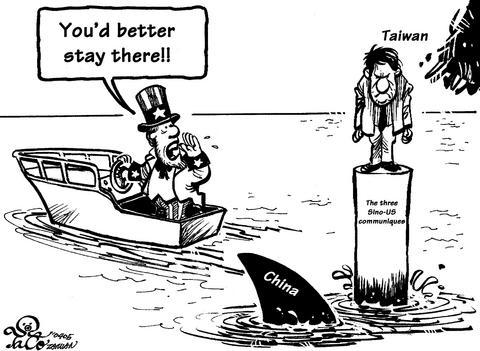
On Thursday, US Deputy Secretary of State Richard Armitage announced in a televised interview that the US has some specific hopes regarding the May 20 inauguration speech of President Chen Shui-bian. Specifically, the US hopes Chen will reiterate the "five noes" pledge he made four years ago.
High-ranking Presidential Office staff members immediately indicated in private that the so-called "five noes" pledge will be reiterated in the inauguration speech, although not in exactly the same words.
Because this all came about after a US visit by Presidential Office Secretary-General Chiou I-Jen, it is reasonable to believe that the Chen government and the Bush administration reached agreement about the basic framework of Taiwan's cross-strait policy for the next four years. Under the so-called "five noes" pledge, Chen had promised during his first presidential speech four years ago that as long as China did not use force against Taiwan, his government would not declare independence, change the name of the country, incorporate the "special state-to-state" discourse of former president Lee Teng-hui in the Constitution, or hold any referendum on independence or unification issues. In a nutshell, this was a vow not to change the cross-strait status quo.
Reviewing Chen's first term, despite controversies and debates regarding the cross-strait policy, it is safe to conclude that he kept his word. Neither Lee's "special state-to-state" discourse nor Chen's own talk about "one country on each side" of the Taiwan Strait, which many deem to be a continuation of Lee's policy, have been incorporated into the Constitution. The defensive referendum held simultaneously with the presidential election, which had supposedly caused much concern in the US, had nothing to do with the independence-unification issue.
However, does this mean that the cross-strait status quo has been maintained? Obviously this is not the case. For one, consistent with the rise of nativist consciousness in Taiwan in past decades, the Taiwanese sense of national identity has reached an all-time high -- although many still feel that there is a long way to go in this regard. This is demonstrated by Chen's electoral defeat of KMT Chairman Lien Chan, who had advocated casting aside the issue of sovereignty during the election campaign.
Moreover, one can hardly argue that the cross-strait status quo is being maintained when the imbalance between the military powers on both sides of the Taiwan Strait has reached a new extreme. This was confirmed by US Assistant Secretary of State for East Asian and Pacific Affairs James Kelly during a congressional hearing last week, in which he said that over the past 25 years China has repeatedly reassured the US of its willingness to peacefully resolve the Taiwan issue, but in practice it has continued to increase the number of missiles targeting Taiwan by 50 to 75 each year.
So while all expectations are on Taiwan to exercise self-restraint, which Taiwan has largely done, what is being done to keep China from losing control? Can anything be done to accomplish that goal?
If maintaining the status quo means that Taiwan cannot have any presence in the international community -- even when sensitive sovereignty issues are not touched, as in the inability of Taiwan to merely obtain observer status as a "health entity" -- it is no wonder that the popular will in Taiwan is hungrily looking for other options.
-----------------------------------------
On May 2, 2004 ……
It's China's turn to bend a little
By the Liberty Times editorial
Advertising President Chen Shui-bian recently told a Taichung gathering that he had decided to transform the nine-member cross-strait affairs task force into a "cross-strait peace development committee." This committee is intended to issue "cross-strait peace development guidelines" as the basis of implementing government policy to establish cross-strait consensus.
Chen emphasized that while Taiwan is facing Chinese military threats, a diplomatic siege and economic challenges, it could not afford to be divided, and that its people must have a clear concept of national identity and an awareness of potential crisis, and should not mistake an enemy state for one's own country.
The peace and stability of the Taiwan Strait is not only compatible with the interests of Taiwan and neighboring countries, but is also constructive for the entire international order.
Therefore not only has Taiwan long endeavored to protect the stability of the Taiwan Strait, but the international community has given a high priority to the situation here.
Over the past decade, with the end of the Cold-War era and also of the so-called "period of Communist rebellion" that rationalized martial law, the government has long regarded pushing for cross-strait peace as a standing policy.
Both the Chinese Nationalist Party (KMT) governments and the current Democratic Progressive Party (DPP) government have demonstrated sincerity in seeking cross-strait peace through action.
Yet these efforts seeking cross-strait peace have been consistently met with a cold shoulder by China. Chen's proposal for "cross-strait peace development guidelines" was no exception. This situation highlights the reality that the potential threat to cross-strait peace comes from China, not Taiwan.
It is very easy to appreciate this fact, since China has never ceased efforts to eradicate Taiwan's sovereignty and to change the sovereign status quo of Taiwan.
China continues to escalate its military threats with no intention to hide its military deployments in this regard. This is not to mention the economic unification propaganda efforts it has waged.
On the surface, China may have sugar-coated its poison, declaring that it will "peacefully unify" Taiwan under a policy of "one country, two systems." In reality, China has always adopted a two-handed policy of peace and war.
On the one hand, it puts on the act of seeking peaceful unification, while on the other hand actively prepares both militarily and economically.
US military officials have said during congressional hearings that the People's Liberation Army is determined to focus on preparing for military conflict in the Taiwan Strait. The quantity and quality of its short-range missiles targeting Taiwan have drastically escalated. Talk about so-called peaceful unification under "one country, two systems" is thus laughable.
Recognizing China's ambition, US warnings against China about using force against Taiwan have become more direct. Not long after the presidential election, the US announced the sale of long-range radar defense systems to Taiwan.
That the US is concerned about imbalanced military power between the two sides of the Taiwan Strait goes without saying. Taiwan hopes to seek peace, yet China is getting ready for use of force.
Under the circumstances, Taiwan has no choice but to continue to strengthen its defensive capability. This is a destiny we cannot escape. Regrettably, the unification camp has accused the government of engaging in an arms race against China, completely ignoring that Chinese military threats are offensive in nature, while our national defense is defensive.
The unification camp has also erroneously claimed that the obstacle to cross-strait peace is the government's refusal to accept the "one China" principle. They echoed the Beijing leadership in saying that if Taiwan accepts this principle and concedes that it is part of China, cross-strait tension will turn into peace.
They must seriously rethink such statements. Such an approach is not seeking cross-strait peace, but surrendering to Chinese threats. Once Taiwan surrenders to China, it can only helplessly sit back and watch. What kind of peace would that be?
The so-called "cross-strait peace" really is peace between two countries. Therefore this kind of peace must be based on reciprocity and equality, and not conditioned on sacrificing Taiwan's sovereignty.
Thus the principle of "unification under one country, two systems" is a complete fraud. It is invasion under the empty slogan of peace, and is more accurately depicted instead as "euthanasia of sovereignty."
So in the process of seeking cross-strait peace, the government must insist on equal footing in sovereignty between the two sides.
Taiwan should continue to seek cross-strait peace and to try to expand its international space simultaneously.
As a sovereign country, Taiwan is entitled to participate in international organizations and to establish formal diplomatic ties with other nations. China seeks to have all of Taiwan's allies sever diplomatic ties, blocking the nation's space for diplomacy.
Under these circumstances, some people actually say that to seek cross-strait peace, the government should not generate friction in the international community.
This is completely reversing cause and effect, as both the cross-strait relationship and international space are critical to Taiwan's future.
"Taiwanese unity, a secure cross-strait relationship, a stable society, and economic prosperity" is how Chen has summarized his policy goals since his re-election. The "cross-strait peace development guidelines" derive from this policy goal. Surely most people agree with the goal of cross-strait peace, and the international community would be more than happy to see it happen.
The government should refrain from wishful thinking and from unilaterally expressing goodwill at all costs, including sacrificing industries, the economy and job opportunities. It takes two to tango. Cross-strait peace is a goal that awaits hard work from both sides of the Taiwan Strait.
If China does not give up its
proclaimed right to use force against Taiwan and the "one China"
principle, peace will not be easily obtainable.
We believe if China does not reciprocate with basic goodwill, then instead of wasting time on this topic the government might as well put its focus on Taiwanese unity, social stability and economic prosperity, because these issues are not only within our control but are the most powerful bargaining chips in efforts to seek cross-strait peace.
-----------------------------------------
-----------------------------------------