20040503
=======
Media watchdog’s problems on May 3, 2004 ……
Media watchdog's bark is worse than her bite
Connie Lin, the Broadcasting Development Foundation's chief executive officer and the Media Monitor Alliance's secretary-general, has been accused by some in the pan-blue camp of being biased in her criticism of news organizations. Lin spoke with `Taipei Times' staff reporter Cody Yiu about her goals for the alliance
Taipei Times: Could you talk about
your background and previous work experience before you joined the Broadcasting
Development Foundation?
Connie Lin: I come from a business family, so many business and marketing concepts I acquired when I was younger influence my thinking today. I have studied in the US and France, and these experiences too have strongly affected on me. I am part of the second Taiwanese generation of a Mainlander family, but my maternal family is Hoklo with a strong Japanese influence. With my Mainlander, Hoklo, Japanese and Western background, my thinking is certainly well-rounded.
In the past, I have worked for my family's business and have taken charge of some projects, and I also worked as chief secretary for former China Airlines president Christine Tsung, as well as serving as a staff member at the Ministry of Economic Affairs.
Due to my Mainlander background, when I heard about the establishment of the Democratic Progressive Party's (DPP) Department of Ethnic Affairs, I realized the DPP was focusing on ethnic balance, and therefore I worked with this department for two months.
TT: Being a CEO at such a young age,
do you have any thoughts about being young and capable?
Lin: I was born in 1971. There had been talk that the BDF had previously been led by older people. In the past, the BDF had only had one CEO who was not a GIO officer. Before that, the GIO director-general acted as the BDF's president and the GIO deputy director-general acted as the CEO.
Thus the CEO position had not been highly regarded. If I excel in my job, my experience will not only be to my advantage, but will also encourage the younger generation.
Taiwan's political environment and social structure emphasize age, unlike other countries where one is judged by capability and efficiency. Since last year, I have achieved quite a lot of accomplishments, which provides evidence to others that they should give young people better work opportunities and have faith that they have great potential to perform in demanding jobs.
When I started my CEO job, the BDF's president, Lu Shih-hsiang, provided me with valuable professional advice. This is unlike the Chinese Nationalist Party (KMT) or the People First Party (PFP), where the hierarchies are based on age. If I wished to wait for an opportunity with such groups, it might haven taken ages.
TT: How and why did you join the
Gao-Seng-Lang Association for Taiwan Independence (GATI)?
Lin: Back in 1998, when I had just returned to Taiwan from my studies abroad, I met Liao Chung-shan, who asked me to help host a radio program for GATI, and I did this. However, I had several annual commitments abroad and asked Liao to cover the program for me during these travels.
In 1999, I heard Liao had health problems, and out of respect for him I was more involved with GATI from then until 2000 and became an executive member.
At GATI, I became acquainted with Chen Shih-meng, a former Presidential Office secretary-general), who was then the president of GATI. Chen's scholarly ideas and lack of interest in power inspired me greatly.
TT : As a Media Monitor Alliance
spokeswoman, you have been incisive and sometimes blunt in your speeches. How
do you handle the stress that comes with your job?
Lin: When I was studying public relations, I read a lot of books on the topic of being a spokesperson. To me, a successful spokesperson is able to focus her or his speech on the issue being addressed, and avoids being caught up in emotional reactions.
Several ideologies that are compatible with my faith are what keep me going. Although I am in no position to manipulate others, I hope my ideologies are rational ones that are supported by the majority of the people, and that I am able to persuade others to climb on the bandwagon. What we are doing is a social movement, and it is similar to the concept of doing religious ministry.
TT: As the alliance is a relatively
new organization, how do you see its role changing in the future?
Lin: In order to stay humble, we refer to what we do as "observing the media," but I would say what we do in fact is to monitor the media. In Taiwan it is common to use adjectives or impressions to support generalizations. We make sure that before we take any ideas or claims to the public, we have substantial evidence to back up our claims.
Before we take on a certain media agency, we first follow a strict set of procedures, such as receiving complaints from the public, conducting research or monitoring the issue. Once we have the actual evidence on hand, we will request that particular news organization to change their procedures to make an improvement on the issue.
If the agency fails to do so, then we will take the issue to the public. In the recent case where certain news stations exaggerated ballot counts, according to my logic, all the negative repercussions, such as protest rallies, heart attacks and suicides had already transpired.
Therefore, our call for advertisers to cancel their ads on these news stations was a wake-up call to and a punishment of these stations. If the action of these news stations had resulted in such high social costs, then the public had every right to ask them for an apology, or if this is refused, to ask them to pay a price in return.
We do not consider the boycott either a good or long-term means of interaction; the message we want to convey to the media is that "someone is watching you and you should discipline yourself."
I have been asked by media representatives if I would reach a stage where I was outmatched by the opposition. Well, I am a very positive person and the answer is no.
If an issue that we have thrown out raises public concern, which leads to apologies and promises from news stations not to repeat their mistakes, I think what the alliance has been working for will have paid off. Our objective was not to punish, but to alter the circumstance and solve the problem.
TT: What do you feel about being
targeted for attacks by politicians based on the alliance's actions?
Lin: To put it quite frankly, I think choosing me as the target for attack is the cheapest means of response for news media.
Personally, I think that every citizen should be active in public affairs, or should at least care about what is going on and should not stay indifferent. Only this way can society make progress, and individuals will not be isolated but instead motivated.
While others might question my previous experiences and participation, such as hosting President Chen Shui-bian's campaign rallies, I consider what I did as participating in civic affairs, just like a citizen has the duty to vote and a politician must be involved with political affairs.
Political mudslingers pick me as their target to get what they want, thinking that I will be intimated by them, but unfortunately for them, I won't be.
Politicians use all sorts of excuses to defame anyone in my position. Of course, personal defamation is definitely an abnormal phenomenon, as politicians should be the ones setting examples for the rest of society by showing the public how not to avoid the real issue when dealing with a controversy.
Normally, when controversies arise, public discussions and forums will take place, and this will lead to social progress. However, what is happening now is that politicians put a political label on you first.
If other social groups face similar situations, they will be able to draw conclusions from my personal experiences and know that staying steadfast is the foremost punishment one can deliver to one's rivals.
TT: Why do you think that the quality
of Taiwanese media has become so poor?
Lin: I think as regards the news, the remnant effects of dictatorship passed down from the old government still exist.
High-ranking media supervisors and those who sit at the copy desks are still affected by such ideology. Taiwan's media density is probably the highest in the world, so commercial competition among news agencies is fierce. Taiwanese media only know how to compete, and not how to cooperate.
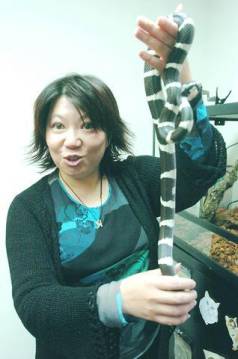
Media Monitor Alliance Secretary-General Connie Lin handles a poisonous snake during an interview with a `Taipei Times' reporter last week.
-----------------------------------------
On May 3, 2004 ……
Okazaki dissects cross-strait issue
`TAKE YOUR TIME': The former Japanese diplomat cautioned Taiwan against moving too hurriedly along the road to independence, saying patience is the key
By Stephanie Wen, STAFF REPORTER , IN TAINAN
Despite the continuing resistance to President Chen Shui-bian's re-election victory, which caused extreme social divisions within Taiwan, the March 20 election has been one which Taiwan and Asia's fate depended on, said former Japanese ambassador to Thailand and director of the Okazaki Institute, Hisahiko Okazaki.
Okazaki made the remark yesterday in a speech entitled A bright future for Taiwan at a Taiwan Advocates' seminar in Tainan.
"The election has prevented any possibility of cross-strait unification," Okazaki said to his audience, which filled the hall of the Tainan Municipal Cultural Center, with hundreds more sitting on stools outside the building.
"A fact shown by election trends is that in the future, whether Taiwan's diplomatic policy continues to maintain the status quo or moves toward independence, thereby standing up to China, it will be impossible for any unificationist party to take over the government.
"This means that China is left with the option of military aggression to attain its unification goal, but this would mean confrontation with the US," he said.
Okazaki thinks that for Asia's long-term stability and the Chinese people's peace and prosperity, China should give up on ideas of unification with Taiwan.
"Today the only existing empire is that of China, and if China fails to maintain its empire while seizing Taiwan, it will also lose the inner-Mongolian region and Xinjiang.
"Amidst the upsurge of Taiwanese identity today, China has lost its chance to play a manipulation policy," he said.
In the future, perhaps China could still assist Taiwan in gaining entry into the UN, in exchange for Taiwan bowing to an abstract "One China." But in this process, regardless of whether Taiwan admits to a "One China" or not, China may give what is the equivalent of consent to Taiwan's bid to enter the UN, Okazaki said.
He said he strongly opposes the
attitude taken by the US administration during the Clinton era, ie, if Taiwan
unilaterally announces independence or provokes China, the US will not assist
Taiwan.
"Not only will the US media and its congress intervene," should China attack Taiwan after a democratically-induced declaration of independence, "such a stance is equivalent to the US cheating China into war," Okazaki said.
"The Korean war is a good example. The question is whether the US will repeat its mistake," he said.
Okazaki said there are two things important to Taiwan. The first is to maintain a state of military alertness to prevent an unexpected attack by China from succeeding.
The second is to continue making diplomatic efforts to pave the way for Taiwan toward the day it intends to move towards independence and counter objections by the US, Okazaki said.
Okazaki is optimistic that pan-green legislators will win more than 50 percent of the seats at the year-end legislature election, "as long as the current 50 percent support can be maintained. It is likely that the Chinese Nationalist party (KMT) may have changes within the party before the election.
"From the medium to long-term perspective, the pro-independence force will become stronger and shape up. Even pro-status-quo groups will overlook the value of maintaining the status quo, but will try to find a safe strategy by second-guessing the US and China's stance. I think that Taiwan is likely to become independent in the medium to long run," Okazaki said.
"After several rounds of legislative and presidential elections, the fact that the Taiwanese people would want independence could not be ignored any longer," he said.
Okazaki predicts that the US may amend its Taiwan Relations Act in Congress and discuss the proposals of assigning ambassadors to Taiwan and supporting the country's bid to enter the UN.
"Although the US administration may exercise its veto right and the US Constitution bestows the US president with diplomatic authority, the US is still a country that values public opinion. If the majority of the public supports Taiwan, the US government can only tag along to their wishes," he said.
What stance will Japan take?
"It is hard to imagine that Japan would act before seeing a decision by the US. But a possible logical theory is that, as the Japanese prime minister has no veto right according to the Constitution, as long as both political parties pass the legislative proposal in the congress, the process will be easier than in the US," Okazaki said.
Okazaki concluded his speech with a word of caution.
"The developments in Taiwan will not be reversed, so there is no need to proceed hastily from now on. It would work against Taiwan if it gives the US the impression of acting with too much haste.
"All in all, under the circumstances that Taiwan could be swallowed up by its huge Chinese neighbor, protecting and maintaining democratic freedom is a life-and-death survival pre-requisite. Continuing the development of democracy in Taiwan is the best route to freedom," Okazaki said.
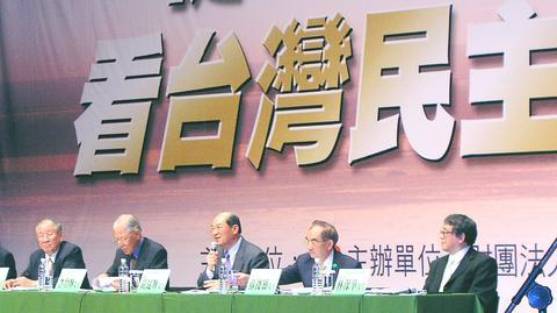
Political commentator Yang Hsien-hung, left, former president Lee Teng-hui, second left, Grand Justice Su Chun-hsiung, second right, and political commentator Paul Lin, right, yesterday listen as National Policy Advisor Ng Chiau-tong speaks during a Taiwan Advocates seminar discussing the implications of the presidential election.
-----------------------------------------
On May 3, 2004 ……
It's about identity, Lee tells blue camp
LOVING TAIWAN: The former president said the pan-blue camp's efforts to broaden its appeal will fail unless it comes to terms with the mainstream Taiwanese identity
By Stephanie Wen, STAFF REPORTER , IN TAINAN
The presidential election marked the start of another stage in the development of a Taiwanese identity, former president Lee Teng-hui said yesterday at a seminar by Taiwan Advocates in Tainan.
Thousands of people from southern Taiwan flocked to the Tainan Municipal Cultural Center for the event, and thousands more sat outside in 32?C heat. The meeting was the second of three seminars examining the impact of the presidential election on the development of the nation's democracy and rule of law.
Lee said that, although the March 20 presidential election was seen as a victory for mainstream Taiwanese identity, "it is only the beginning of the rise of Taiwanese awareness."
He said the country still faces many tests such as the year-end legislative elections, reforming the electoral system, generating a consensus on the need to create a new constitution and the challenges coming from China.
"All these changes need the backing of the mainstream Taiwanese identity," he said.
Lee lambasted the pan-blue camp's efforts to trample the democracy and rule of law that Taiwanese have worked so hard to build.
"Not only did pan-blue resistance cause social instability, it hurt Taiwan's international reputation. It is hard to approve of putting personal power and party benefits ahead of social concerns and national image."
Lee said the blue camp has failed to examine itself critically, risking the future of its parties' development and any role they might play in balancing the nation's democracy.
Lee said that rather than nurturing a new generation or staging a revolution within the blue camp, establishing a mainstream identity should be the alliance's priority.
He added that loving Taiwan is a path that must be followed.
"It is not an election slogan," he said, but a national consensus needed for the country's development.
Loving Taiwan reflects where people stand on sovereignty, the languages and cultures of the country and where the nation's development is prioritized, Lee said, adding that these considerations are independent of ethnicity.
Narrowing Taiwanese identity to the issue of ethnicity shows either a lack of understanding of the issue or an intentional change of focus, he said.
Lee said Taiwan has yet to become a normal democratic country.
"Taiwan's democracy and rule of law still require care and consolidation," he said. "Both the mainstream Taiwanese identity and the spirit of loving Taiwan need to be enhanced."
Former judge Su Chun-hsiung said the blue camp's commitment to democracy must be examined.
"Only if the spirit of democracy develops can Taiwan become a democratic and peaceful society," Su said.
According to Su, the blue camp keeps saying it wants justice, but can't look at things rationally, doesn't want to accept recommendations by experts and doesn't understand the sprit of democracy.
Su referred to the contentious 2000 US presidential election between Al Gore and George W. Bush and called on the coalition to follow Gore's lead by respecting the rule of law and valuing social peace.
"Even though everyone has a right to his or her opinions, we should exercise rationality," Su said.
Political commentator Paul Lin said China was obviously unhappy with President Chen Shui-bian's re-election.
"China has ceased interaction with Taiwan, but isn't that a good thing?" he said.
Lin said China's interaction has one purpose: to further its sovereignty claims over Taiwan. By next year Beijing will find excuses to ease the tension, he added.
Lin said Taiwan shouldn't let down its guard over China's military threat, but added that the likelihood of China invading is low.
Lin said the US would be mistaken if it were to believe China is a normal country.
"But China is not a normal country. It is abnormal and a bully," he said.
Lin urged Chen to act with wisdom in countering China and to avoid acting hastily.
He added that people should beware of slanted media coverage.
"Even the most anti-China media in Hong Kong are pro-blue. I hope people in Taiwan can work toward boycotting such biased media propaganda," he said.
-----------------------------------------
On May 3, 2004 ……
`The 7-day coup d'etat' and its real meanings
By Chin Heng-wei
The "seven-day coup d'etat"
that lasted from March 20 through March 27 is a major incident in Taiwanese
history.
The first reason it is so important is that the party-state system of the Chinese Nationalist Party (KMT) boldly attempted to alter the results of a democratic election with this "coup," failing by a hair's breadth, and thereby signalling the end of the party-state.
The other reason is that the
consolidation of Taiwan's democracy is no longer in doubt, and from now on we
can work on deepening it.
Future historians are sure to add
their bit to this incident, perhaps even in the style of the historian Jonathan
Spence.
Spence might have written about the former chairman of the Democratic Progressive Party, Hsu Hsin-liang announcing at the scene of the coup "I declare Lien Chan and James Soong as the 11th president and vice-president, according to the wishes of the Taiwanese people." Such an account certainly would spotlight the absurdities of Lien, Soong and the pan-blue camp.
This attempted "coup" is
neither a fabrication nor an unfounded accusation, and it is not hard to see
why both former president Lee Teng-hui and President Chen Shui-bian brought it
up.
Chen actually said: "It has been
said that there was an abortive coup d'etat between March 21 and 27."
Notice the judicious use of the words
"It has been said that." To put it more finely, Chen approached the
"seven-day coup d'etat" with a political solution in mind.
The pan-blues apparently became livid upon hearing these comments. The People First Party demanded an apology from Lee and Chen within 24 hours, and the KMT asked for evidence to justify use of the coup label.
It's possible that neither man has
substantial evidence to offer, but it could also be that they are just not
willing to reveal it.
If they do, in fact, have such evidence, and wanted to do something about it, they could throw Taiwan into turmoil. This would be of no obvious advantage to the authorities, and they may well be keeping mum about it for this reason, preferring not to take it any further.
Do I have any basis for saying this?
Yes, I do, in the infamous Watergate scandal.
This scandal started when US president Richard Nixon was campaigning for re-election in 1972, and people working for him broke into Democratic Party offices in the Watergate Hotel.
It appears that during his 1968 campaign Nixon had used his "secret emissary" Anna Chennault to persuade South Vietnamese president Nguyen Van Thieu not to attend the Paris Peace Talks with North Vietnam.
This effectively crippled then US
president Lyndon Johnson's foreign policies. Nixon's intention was to
demonstrate Johnson's inability to end the war in Vietnam. In return, Nixon
promised to help the South unite Vietnam after he was elected. Johnson kept
quiet about Nixon's treasonous behavior, even keeping it under wraps when Nixon
won the election. He did, however, force Nixon to stop the US war in return for
his silence.
In 1972 Nixon sought re-election, and
put his neck on the line with the Watergate burglary to find out whether the
Democrats were planning to use the stick of his past deeds to beat him with.
Nixon's behavior was in fact treasonous, but Johnson kept it under wraps for the good of the country. Is this the situation facing Chen?
Chin Heng-wei is editor in chief of Contemporary Monthly.
-----------------------------------------
On May 3, 2004 ……
-----------------------------------------