20040505
=======
NTU on May 5, 2004 ……
NTU medical students back nation's latest WHO bid
CNA , TAIPEI
Students from National Taiwan University College of Medicine met yesterday at a news conference to push for Taiwan's accession to the World Health Organi-zation (WHO).
Taiwan, a full-fledged democracy where people enjoy fair, advanced and convenient medical care, should not be left out of the WHO and its activities simply based on a concept of global management, said Shen Rong-ching, a leader of the college's Student Council.
Members of the student council said that WHO membership would not only allow Taiwan access to the global medical system but it will also help the nation's medical professionals to better globalize.
The council is scheduled to launch a series of activities on campus on Monday to introduce the WHO's organization, operations and stress how imperative it is that Taiwan is admitted.
Presidential advisor Chen Lung-chu, who is the head of the Taiwan UN Alliance and former Department of Health director general Twu Shiing-jer also held a press conference yesterday to back efforts to push for Taiwan's entry to the WHA.
Meanwhile, six other medicine and health organizations are scheduled to hold a joint news conference in Taipei today to formally demand the international community squarely face the issue concerning the health rights of the 23 million people in Taiwan.
In related news, Department of Health Director General Chen Chien-jen is scheduled to lead a mission for Geneva before May 17 to lobby for international support for the nation's bid to become an observer of the World Health Assembly (WHA), the WHO's decision-making body.
Chen's official delegation, as well as more than 100 people from several Taiwanese groups, will be in Geneva to enhance the lobby drive during the 57th annual conference of the WHA.
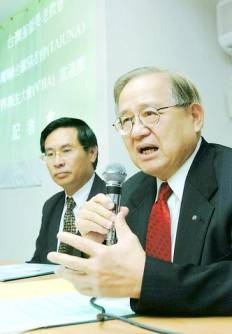
Presidential advisor Chen Lung-chu, right -- head of the Taiwan UN Alliance -- and Twu Shiing-jer, the former director-general of the Department of Health, hold a press conference to push for Taiwan's entry to the World Health Assembly.
-----------------------------------------
On May 5, 2004 ……
Ma criticized for an op-ed piece
COMMEMORATION: The mayor wrote a newspaper article to celebrate the May Fourth Movement in which he attacked the DPP's campaign strategies
By Jewel Huang, STAFF REPORTER
Taipei Mayor Ma Ying-jeou yesterday accused Democratic Progressive Party (DPP) of abusing democratic systems and engaging in populism during the presidential election in an op-ed piece in a Chinese-language newspaper. Analysts said it showed that Ma is weak on political discourse and lacks reflection.
Ma's article was published yesterday for the 85th anniversary of the May Fourth Movement, a movement launched in China in 1919 in which intellectuals and students staged demonstrations against the feudal and traditional Chinese culture, spurred on by the allocation of German concessions in China to Japan as part of the Treaty of Versailles. The movement is considered the beginning of China's modernization.
Ma has published newspaper articles commemorating the May Fourth Movement for several years. This year he used the words of a key figure in the May Fourth Movement, philosopher and essayist Hu Shih, as his article's title: "Democracy is a lifestyle of reason and tolerance."
Ma stressed in his article that the presidential election showed many of the negative sides of democracy, such as social unease and rifts and confrontation between ethnic groups, which he attributed to the DPP's agitation and vilification of its opponents during the campaign trail.
"This presidential election was an ominous omen for Taiwan. The ruling party repeatedly told people that holding referendums and writing a constitution is a universal human right and a means of supporting democracy and loving Taiwan," Ma wrote. "The DPP's campaign appeals rapidly eroded political diversification and tolerance in democratic politics, through populism."
He blamed the DPP for developing a "new holy trinity" combining the promotion of referendums, writing a new constitution and Taiwan's independence as the party's "endless extension of power."
On the other hand, Ma said the Chinese Nationalist Party (KMT) should be credited for facilitating the transfer of power in 2000, and it also abandoned negative campaigning in this election.
On March 12, the KMT sponsored five full-page newspaper advertisements in which Adolf Hitler's photograph featured prominently, while calling on voters to end President Chen Shui-bian's "dictatorship" on election day.
Ma said that he put forth his ideas clearly and did not make any unwarranted accusations in his article.
"People who delve into my article will realize what I'm talking about. I don't have to explain more," Ma told reporters yesterday.
Hsu Yung-ming, a researcher at the Institute of Social Sciences at Academia Sinica said Ma's article showed that the KMT has not developed a strong political discourse which could rival the DPP's.
"What Ma criticized was the form of democracy, rather than the substance of democracy," Hsu said.
"I think Ma could focus more on the KMT's reform and hammer out a new political discourse for his party, instead of continuing the thinking advocated on March 13 Rally , which was anti-Chen," Hsu said.
Hsu added that Ma's words were too intellectual for the public to understand and it was also untenable to accuse the DPP of populism just because the DPP used a language that was more familiar to people.
"It will expose the KMT shortcoming of being so remote from public opinion," said Hsu.
DPP Legislator Gao Jyh-peng said that it was the KMT and People First Party that called on people to continue protesting over the past month who were the real demagogues, and were the ringleaders in causing social unease and tension.
-----------------------------------------
On May 5, 2004 ……
Poking the US and the Chinese beast
Doug Bandow, a senior fellow at the Cato Institute, was a special assistant to former US president Ronald Reagan. During a visit to Taiwan this week, he talked to 'Taipei Times' staff reporter Stephanie Wen about cross-strait relations, the importance of better communication with the US and tensions following the presidential election.
Taipei Times: What is the Bush
administration's view of President Chen Shui-bian's re-election?
Doug Bandow: I am sure that from the simple point of stability, the administration doesn't want trouble. So I suspect most people in the administration would have preferred a Chinese Nationalist Party (KMT) victory, just on the theory that it [would have been] less troublesome -- not on substance of argument, not on the merit. They have a lot on their plate. Iraq is a complete disaster; the North Korean problem is not solved. They don't need any problems in the Taiwan Strait.
Now the perception in Washington is that if Chen steps out of place and pokes the China beast, then ... who needs this? This is understandable. Washington feels it has handed out a security guarantee -- and the country then uses that security guarantee and surprises them.
But I do think that there are some disagreements in the administration. There had been a reservoir of goodwill toward Taiwan, and it's just been that in the last few years that reservoir is running a bit dry, because they've been so focused on other things. And they really perceive that they need China. They don't want a veto of UN resolutions. They are very concerned about Korea -- they correctly perceive that China has the most leverage against North Korea. It may not be enough to solve the issue, but if you are looking within the region, probably Beijing has the most [influence]. So I think it will be [helpful for the] US that the China-Taiwan relationship remain smooth, and that Taiwan be very low key. Then they can cooperate with you on other issues.
TT: If Democrat presidential hopeful John Kerry is elected, what do you think the administration's approach to Taiwan will be?
Bandow: I think a starting point for policy with Kerry is [former US president Bill] Clinton. I don't think Kerry has ever thought deeply about Taiwan. He has thought about China, I am sure, because it is hard not to think about China. It is interesting because his current anti-China campaign and rhetoric in some sense should be helpful to Taiwan. But again I look at the Clinton experience, which was that the moment Clinton was elected, everything changed around. I think Kerry would be more difficult for Taiwan. People perceive that China is relatively more important. And to some degree it will depend on Congress. They will uphold policy that will uphold the Taiwan Relations Act, but you won't have the same level of affinity, and there will be probably more rhetoric, more distance from the administration in Taiwan, and there will be more pressure on the referendum and constitutional amendments.
TT: Do you have advice for Chen?
Bandow: If Chen can communicate clearly to the administration that he recognizes Washington's concerns and that he understands the need for stability, then this would make Washington feel better, [knowing] that Chen really understands the concerns of Washington. And then there's the extent to which Chen can indicate that he is willing to change policy -- that you'll still hold a referendum but be willing to change the wording of the referendum.
I think the emphasis is on constitutional change. The fear clearly is constitutional change, at some point. It means you have to define what Taiwan is, what the community is, the issues of name and flag. But if you communicate to Washington that constitutional changes will be carried out [within a] narrow framework, then we won't raise all these other issues. Right now, Washington needs to perceive that it has been heard.
There's criticism of Taiwan even by conservative activists who were previously pro-Taiwan. This is significant, because this is the Taiwan base in American politics, and you are getting criticism there. You sure are getting some distance from people who ought to be your friends. So you should want to reassure them.
The second thing is the notion of trying to demonstrate to Washington that Taiwan is an asset. I think [the argument] could be humanitarian or it could be other things. It could be the notion that the US wants democracy around the world. Taiwan shows how a country can move to democracy: Within 20 years, Taiwan has moved from martial law and end of a dictatorship into elections, and the opposition wins, and you can weather all kinds of controversy.
Washington can use symbols of democratic change and Taiwan is a role model for that. China matters a lot -- the UN veto, North Korea and economic interaction -- and Taiwan doesn't have that same [leverage]. At the moment the US is desperate for better relations with China, and in that context Taiwan is in danger. Taiwan is in danger of being marginalized.
You've got to realize that this administration has a very short attention span, and right now it is in a lot of trouble with Iraq, and the Bush administration wants to be re-elected. When they look at Taiwan they look at it very superficially.
That is why it is critical for Chen to communicate to Washington, "I heard you." And small things are very symbolic. Like the Washington Post interview with Chen and Chen's administration putting out statements. [Washington has] the perception that Chen, poking at the China beast, seems to be a bit reckless, so everything is interpreted in that framework.
TT: How do you think the
international community perceives post-election opposition to the election
result?
Bandow: For the international community, what is important is that there is the perception of a fair process. So there is a perception that the charges are being investigated. I do think that there is enough legitimacy there -- there is a court-ordered recount and an investigation into the shooting. But the tough question is the KMT, and whether they can accept an adverse result after the recount and the investigation into the shooting.
If they don't, I worry that the other countries will worry not about the fairness of the procedure but the stability of the country. I've talked to a lot of Americans who think that the shooting looks pretty weird, but I am yet to find an American who thought that if he was to stage a shooting he would stage it on a moving vehicle. But the perception of the process is more important than the result.
TT: To what extent has democracy and
the rule of law been tarnished by the ongoing dispute?
Bandow: I think what is critical is an acceptance of the result. That what happened after the election, in terms of the huge rhetoric, violence or what have you, is forgotten by the inauguration if a recount is held. If Chen won and the investigation bears it out, then the opposition has to accept that. What happened in the US in the end is that the Democrats accepted that the process works. President George W Bush -- they may not like him, but he is inaugurated, he is president, he is legal, no one is filing law suits saying he can't sign laws.
Yet the KMT does not accept the result. There are continuing controversies and protests. I hope that the KMT does think about the stability of Taiwan's political system, and that it is not in Taiwan's interest to continue delegitimizing the system, especially where a potentially hostile China is right across the Strait.
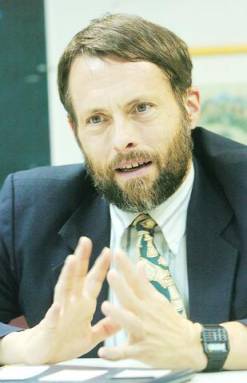
Doug Bandow says Taiwan needs to pay more attention to the quality of its communication with the US.
-----------------------------------------
On May 5, 2004 ……
It's not fair
By Judy Wu, Nantou
If Taiwan had truly developed from a dictatorial regime into a mature democracy, the opposition would have accepted its defeat in the recent presidential election gracefully for the good of the country. Thus society would have continued to run smoothly after the election. In a democracy, the losing side concedes defeat and congratulates the winner in a spirit of sportsmanship -- no matter how close the vote. Instead, we descended into chaos.
Why? Because Chinese Nationalist Party (KMT) Chairman Lien Chan and People First Party Chairman James Soong and their underlings are still stuck in the dictatorial past, when the KMT had absolute political domination.
Rather than contributing to our growing democracy, the irrationally stubborn leaders of the KMT and the PFP provoked the disruption of society with post-election turmoil in a desperate ploy to seize the power they lost in the 2000 election.
With their incendiary speeches, rumors that President Chen Shui-bian staged an assassination attempt to gain votes, and baseless charges of vote fixing, these candidates misled the people about the Democratic Progressive Party (DPP) and urged their followers onward to attempt a kind of coup in which they condoned if not advocated violent acts and demanded Chen step down.
Even criminals were unleashed to compound the mayhem while the nation stood aghast and we were made a target of ridicule in the eyes of the world.
With their venomous language, Lien and Soong revealed to all their true natures -- unrepentant totalitarian rulers willing to regain their positions of power at any cost.
We can only hope that now that things have settled down, they will concede the election so that Taiwan can have a peaceful inauguration. We do not need another ruckus that wastes taxpayers' money controlling unruly crowds and that disturbs schools, hospitals and libraries, causes traffic jams and generally upsets the tranquility of society.
For the past four years, the pan-blue camp has undercut Chen's efforts to establish relations with China. Like dinosaurs that have outlived their era, Lien and Soong continue to advocate an outmoded policy toward China that does not respect Taiwanese identity and has not adapted to the political changes of the past decade.
For its part, the US needs to discard its antiquated policies toward Taiwan and adopt new strategies based on the facts rather than remain frozen in the past when Taiwan was a totalitarian regime under Chiang Kai-shek and the KMT. The new reality is that over the past decade Taiwan has abandoned the KMT ideology in favor of being an autonomous state that wishes to live in peace with China -- but as a separate political entity, not on the basis of Taiwan being considered a province of a communist regime.
I might add, not incidentally, that as a native Formosan of the Bunun tribe, I and hundreds of thousands of other Aborigines have never had any connection whatsoever with China. Aborigines are also a vital part of the new Taiwanese identity. Why should we be held hostage to obsolete US political policies and a communist regime's demands? This is what the world's misinformed nations seem to expect, despite the fact that these nations claim to support the democratic aspirations of peoples everywhere, and specifically to support the rights of indigenous groups.
US Vice President Dick Cheney recently said that if Taiwan declares independence, the US will not protect it from Chinese aggression. This is not fair! Many countries in the world have wanted to be free and the international community has helped them become independent and develop democratic governments. -- East Timor, the Balkans, the countries of Eastern Europe.
Why is Taiwan treated so differently? Even the thought of Taiwan declaring independence seems to provoke panic.
The problem is the "one China" policy. Neither former KMT government nor the PRC ever consulted the people of Taiwan, but made their claims by proclamation. Taiwan no longer has this kind of government nor does it have such aspirations, yet the US does not recognize the transformation Taiwan has undergone. Does Taiwan not have the right to determine its own destiny without being bullied and disrespected by the nations of the world?
Taiwan is already a free country. No one has to go to war to make us independent; no soldiers or civilians have to die for our freedom. Not one penny has to be spent to remove us from suppression by a dictator.
Yet when a communist nation demands that Taiwan be considered a province under its dominion, the whole world caters to the wishes of this authoritarian regime. Has the world gone crazy?
-----------------------------------------
On May 5, 2004 ……
Ma's muddled thinking bewildering
Contrary to his image as a humble and gentle politician, Taipei Mayor Ma Ying-jeou has made some unbelievably absurd comments since the presidential election. Could they be related to the pan-blue's election failure? After all, Ma served as the campaign chief for the Chinese Nationalist Party (KMT)-People First Party (PFP) alliance. How else could these remarks be explained?
In a city government meeting on
disaster relief on Monday, Ma reminded city officials and military personnel to
prepare for a Chinese military invasion. He seems to believe that tensions
across the Taiwan Strait still exist and that Taipei, especially the Chungchen
and Hsinyi districts, would be the primary targets of a Chinese attack in case
of war.
Then, in a newspaper article published yesterday, Ma wrote that he had opposed the central government telling the public that holding a referendum and enacting a new constitution are universal values, as well as ways to love Taiwan and support democracy. In his article, Ma stressed that "Taiwan independence, referendums and writing a new constitution" have gradually evolved into a new holy trinity -- an infallible moral cult that cannot be challenged.
Why did Ma only mentioned the Chungcheng and Hsinyi districts while leaving out the Ta-an District, where many government officials reside? He also omitted other military districts that are equipped with the ability to counter a Chinese attack.
Moreover, aren't referendums and writing a new constitution universal values endorsed by democratic societies? Why are these two necessarily jointed with Taiwan independence? While Ma reproached the green camp for labeling others at will, he should not couple Taiwan independence -- a unique political ideal -- with the universal values of referendum and writing a new constitution. If the new holy trinity was really an infallible moral cult, as Ma has claimed, how could he question it himself?
Ma's argument reflects that many blue-camp leaders have yet to overcome the frustration of losing the election; they appear dazed and confused. They are still threatening Taipei residents by claiming that China may attack Taiwan by force if the green camp continues to rule. They cannot see the potential crises that may occur during the inauguration.
Not only have some people publicly vowed to assassinate President Chen Shui-bian, but several PFP members have threatened to turn the inauguration into a "national mourning ceremony." The ambassadors from our Latin American allies were warned against attending the inauguration. Did Ma condemn such words and deeds that seriously violate the law? No; instead he worried that the inauguration might affect the flow of traffic. As the mayor, is this really what he should say?
Looking at the logic Ma has used, it is clear that he's still looking back at those unpleasant days in the past, and has forgotten about protecting the important national event in front of him. Democratic rule of law is the basis for this nation to survive. It surpasses the interest of any one political party. If the presidential inauguration is ruined, Ma's political career will also be ruined. Is this want he wants?
-----------------------------------------
On May 5, 2004 ……
-----------------------------------------