20040507
=======
Mutual understanding is the key on May 7, 2004 ……
Mutual understanding is the key
`There will be some tough challenges.
How will a provocation be identified and by whom?'
By Nat Bellocchi
The testimony given to the US House International Affairs Committee on April 21 by Assistant Secretary of State for East Asia James Kelly covered a broad range of issues in the US-Taiwan relationship. It seemed to reflect as close to what could be a consensus within the US government on the relationship as one could expect. It made some clear statements on US policy toward some issues, but reverted to ambiguity on others. China, Taiwan, the US Congress, political liberals and political conservatives -- all can find something good and something bad in it, and think tanks can fashion an infinite number of seminars from it. But it will bring new challenges to the US-Taiwan relationship and the need for the right kind of people to address them.
Though it headed in a very different direction, the testimony reminds me very much of that made by John Holdridge, a former assistant secretary of state for East Asia and the Pacific, when explaining the August 1982 US-China Communique. Buried in various parts of the testimony was what has come to be known as the "six assurances." Like Kelly's, the testimony was written not only to inform, but also to satisfy a broad readership. Subsequently, the "six assurances," which were not a part of the communique, became stronger -- thanks in large measure to congressional interest -- while expectations for arms sales were eroded by the way statements in the communique were interpreted.
In Kelly's testimony, as one would expect, the "one China policy," defined by the Bush administration as an amalgam of the three communiques and the Taiwan Relations Act, was affirmed. There was an offer to Taiwan to explore how the US could cooperate in spreading Taiwan's democratic experience to other countries, including China. There was also an insistence on peaceful resolution of cross-strait tensions and a reiteration of US commitments should this not be observed. The "six assurances" were again publicly mentioned by the US government and a strong, public statement on support for a bilateral dialogue between China and Taiwan, as soon as possible and "without preconditions," was included.
Of special interest was a separate paragraph about the Dec. 9 meeting between US President George W. Bush and Chinese Premier Wen Jiabao). It was meant to make clear that Bush had told Wen the US opposed any change in the status quo by either China or Taiwan. Kelly also added in that paragraph that the commitment made under the Taiwan Relations Act to help defend Taiwan would be fulfilled, but he worried that efforts at deterring Chinese coercion might fail if Beijing was convinced Taiwan would embark on a course toward independence.
The testimony was long and covered economic, military and political issues. The statements in the testimony were for the most part positive for Taiwan, and for those that were not, they were at least frank and clear. There were a few omissions in the testimony -- no reference to the issue of sovereignty, Taiwan's need for international participation or an affirmation of the need for the consent of Taiwanese to change the status quo. The latter is supported by the US, but if advocated using the term "referendum," which means the same thing, it becomes a delicate issue.
On political issues, there was also considerable ambiguity. It is becoming obvious that recent cross-strait issues leading to tensions between the three parties have no clear solutions. The US will increasingly find itself involved in Taiwan's domestic problems -- making judgments on the relative merits of a specific democratic reform versus the potential for military action, for example. This is getting into very delicate and complex matters that the US would normally avoid.
There will be some tough challenges. How will a provocation be identified and by whom? Right now it is China that never accepts compromise even when it cannot avoid change. The US seems to accept this, while Taiwan takes some risks in working around it. A balanced solution under these circumstances is not likely.
What does a "move in the direction of independence" mean? Any democratically determined reforms that strengthen governance of Taiwan can be charged with moving in this direction simply because the people's will has been empowered. Reform of the Legislative Yuan, the government and an education system that goes on to place greater emphasis on Taiwanese history has the same effect. Are these "moves in the direction of independence," and therefore to be opposed?
According to the testimony, Taiwan is expected to be prudent in managing cross-strait relations lest it lose US support. But "prudent behavior" remains a difficult thing to define.
Another question is this: Does "no change in the status quo" give one side an advantage over the other? There is, for example, an argument among some in the think-tank community that efforts by Taiwan to make unification more difficult constitutes a "move toward independence" and should therefore be opposed. At the same time, similar efforts by China obstructing independence, such as blocking participation in the international community, are not meeting opposition. If this situation was carried to its practical conclusion, the US position would be that Taiwan cannot be independent but can only become a part of China when it is acceptable to the US. It is highly unlikely that the US would actually take this position, but a move in this direction is no less possible than creeping moves toward independence.
With these problems still undefined, and their resolutions even less clear, the testimony shows nonetheless that the US-Taiwan relationship remains close. In this new environment, there will be much to explore in how democracies can work with one another in a global environment that is hostile to democracy.
To do this, the US and Taiwan will need to become even more involved with one another. The US will need more Taiwan experts, as opposed to China experts with scraps of Taiwan knowledge, and Taiwan will need more US experts with more than a faint understanding of Taiwan's new politics.
Nat Bellocchi is the former chairman of the American Institute in Taiwan and is now a special advisor to the Liberty Times Group.
-----------------------------------------
On May 7, 2004 ……
WHO is sick
By Danielle Hagmann, Center for Global Health Analysis, Geneva,
Switzerland
How did China treat SARS and the WHO ("Poisoned words provoke changes," May 3, Page 8)? The World Health Organization (WHO) is the only world health authority responsible for promoting the highest standard of health for all people everywhere. Since the infection of political interference continually threatens the work of the organization, the role of its head should be to continually strengthen its immune system and defend its independence. Unfortunately, Director-General Lee Jong-wook seems to have abdicated that responsibility.
Lee recently visited Beijing for his first trip to the world's most populous country. He should have been able to work to secure improved transparency and cooperation from the Chinese health authorities, who fooled the global health community by covering up the SARS outbreaks last year, causing enormous loss of life and a huge financial impact throughout the Asia-Pacific region. However, not only did he fail to do so, he also failed even to obtain a clear list of laboratories in China stocking SARS viruses. Two days after Lee finished his kowtow, China's health authorities notified the WHO Beijing office of two cases of SARS, the first since January. These quickly expanded into 10 cases, at least one death in Anhui Province, and thousands of contacts with index cases in the region. These SARS cases originated from a mismanaged laboratory across town where Lee was feted by Chinese President Hu Jintao and Chinese Vice Health Minister Gao Qiang, and expressed his fealty to China's mission to prevent Taiwan from participation, even as an observer, in the WHO. The only message Lee carried in his trip was "there is no room for Taiwan to get into WHO as an observer or a member."
Of course, this political statement earned him warm smiles from the Chinese government. In fact, the new batch of SARS emanating from China's Center of Disease Control were already spreading from the capital to Anhui province before and while Lee was there. What we do not know is, did Beijing deliberately cover up the outbreak until after Lee had delivered his political commitments, then released the health threat news on its planned schedule? It is time for the WHO and Lee to diagnose this health question.
-----------------------------------------
On May 7, 2004 ……
Keep on moving
By Yang Ji-charng, USA
While there are many overt and covert suggestions about what President Chen Shui-bian should and will say in his May 20 inauguration speech, the truth is that no one knows.
Needless to say, as the re-elected president of Taiwan, he should keep the interests of Taiwan first in his mind when he is preparing this important speech.
Obviously, topping the list of Taiwan's interests are its sovereignty, security, prosperity and democracy. And China, with its nationalistic call to annex Taiwan, is a threat to all these interests.
Chen's conciliatory tone in the last four years proved to be only futile when it came to the diehard Beijing leadership.
Therefore, Chen should refrain from reiterating the futile and humiliating "five noes" policy again. Instead he should call for the respect of democracy. And no one should put a straightjacket on Taiwan or stop its practice of democracy.
Taiwan's democracy is a dagger threatening the heart of Chinese communist rule. And it is a recipe to win American hearts and support.
In the aftermath of the March 20 election, Taiwanese people have shown their wisdom and maturity to protect and nature their democracy. No countries or individuals should continue to ignore the choices and conciousness of these people.
The times have changed. Taiwan has made its choice and moved forward. Will others do the same?
-----------------------------------------
On May 7, 2004 ……
End the disingenuous demagoguery
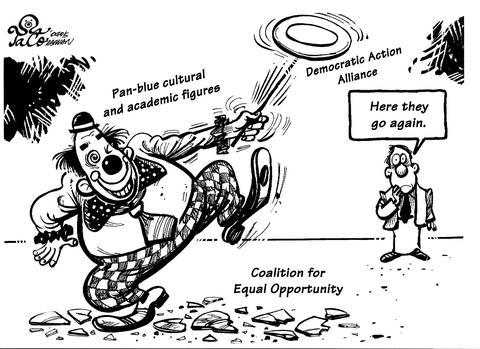
The swearing in of a new president is a national ceremony that should be wreathed in joy, but on the eve of the May 20 inauguration ceremony, the nation is filled with doubt and unease. Although President Chen Shui-bian and Vice President Annette Lu won with a minuscule margin, the announcement by the Central Election Commission was followed by the pan-blue alliance filing several lawsuits in an attempt to reverse the situation through judicial means. If the recount verifies the election of Chen, the legitimacy of his victory can no longer be questioned.
We have seen, however, several worrying signals, including the formation of a revolutionary group publicly calling for the murder of both former president Lee Teng-hui and Chen, rumors that remotely controlled model planes will break through security arrangements around the Presidential Office and bring destruction, warnings to foreign ambassadors to stay away from the ceremony and pan-blue supporters saying that they will attack pan-green supporters. As a result, the political situation continues to be unstable.
The problem is not, in fact, that the election result was so close. The real problem is the lack of faith in democracy and distrust of the nation's legal system. The pan-blues, not wanting to concede the election, have instigated street demonstrations, filed lawsuits and tried to overturn the election results through extra-legal means.
Blue-camp politicians and media have also made constant provocations to stir up public dissatisfaction with the president. This confused some radicals to the point where they say they are willing to assassinate the president and "die a martyr's death" if necessary. Not only have the blue camp's unlimited protests endangered core democratic values, but they have also generated an outrageous idea among its supporters, who would rather destroy both their enemies and themselves than concede defeat.
The Taiwan High Court's recount of the ballots will begin on Monday. But the blue camp has never promised to accept the results, because the recount is merely an excuse. If they lose the recount, they will only have lost one lawsuit invalidating Chen's election. They can still continue their second lawsuit to have the whole election invalidated and try to launch constant public protests until the year-end legislative election. This is certainly in the interest of Chinese Nationalist Party (KMT) Chairman Lien Chan and People First Party (PFP) Chairman James Soong. Perhaps such a ploy is also beneficial to the PFP, but it's not necessarily good for the KMT. For Taiwan, it means that almost a full, precious year will be wasted, as everything will go up in smoke in the political war of words. Taiwan's international image and democracy will be damaged. It will even give China a good excuse to not respect Taiwan's democracy, not strengthen Hong Kong's democracy and not tolerate domestic democracy. For the sake of Taiwan's future, let the election dispute end with the judicial recount.
The inauguration will get the attention of the international community. Thousands of citizens, heads of state, and VIP guests will attend the ceremony. If anyone attempts to create commotion and ruin the ceremony, Chen and Lu will not be the only ones insulted -- all of Taiwan will be tarnished. If politicians or parties fail to understand the overall picture and ignore the national interest, they will be despised by the majority of people.
-----------------------------------------
-----------------------------------------