20040512
=======
Evil-blue on May 12, 2004 ……
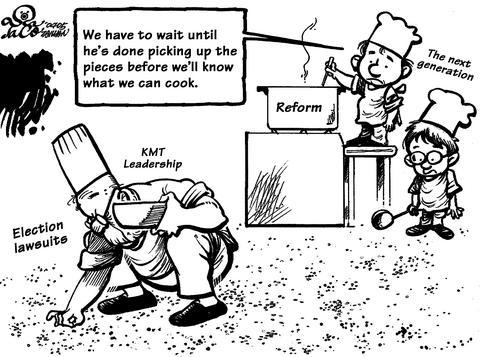
Recount is not a game to lawyers
` I also hope that society will refrain from equating the behavior of lawyers performing their professional duties with the political stance of the party they are working for.'
By Shirley Lin
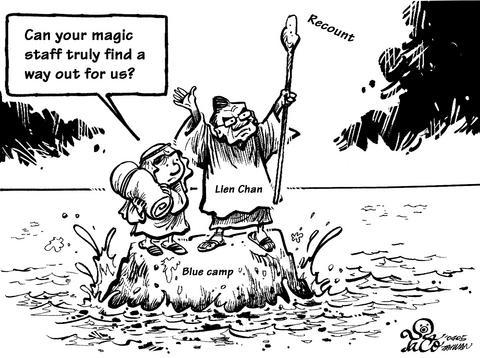
Advertising On Monday, district courts began recounting all ballots cast in the presidential election. This great project is of extreme importance to both President Chen Shui-bian and Chinese Nationalist Party (KMT) Chairman Lien Chan, and it is an unprecedented challenge for the judicial authorities.
How does one recount more than 13 million ballots? Who should carry out the recount? Could it be done quickly? How should disputes be dealt with? Just how difficult these questions really are was implied when the Taiwan High Court on May 3 gathered representatives of all the nation's district court judges and registrars -- there were constant arguments and discussion.
The court has decided that each recount team shall consist of a judge, a court registrar, one representative from each party, and two election workers to assist with the recount; that the Central Election Commission's regulations for valid ballots declared prior to the election shall remain in place; and that disputed ballots shall be copied, sealed and sent to the High Court together with a written record for verification. Despite these measures, the success of the endeavor will still depend on the court's wisdom and efficacy.
A total, simultaneous recount is without question also a challenge to the two parties' legal teams. Due to doubts concerning the acceptability of party workers or members of the public participating in the recount, the Taiwan High Court demanded that both parties should appoint qualified lawyers or intern lawyers to participate in the recount. This was turned into an unexpected extraordinary mobilization of lawyers, with each of the two parties gathering over 600 lawyers, an astonishing number.
During this period, I heard of lawyers who were unwilling to participate in the recount because they don't want to be labeled "green" or "blue." There were also lawyers who first signed up with the green lawyers' team, only to switch to the blue team when they found that their compensation was higher. As a lawyer myself, I fully respect the choices made by my fellow lawyers, and I also hope that society will refrain from equating the behavior of lawyers performing their professional duties with the political stance of the party they are working for in the recount.
A bit more worrying is the blue camp's recount instructions, which were recently revealed to the public. One sentence in the manual required that lawyers participating in the recount should "have the courage to voice disagreement and must split hairs trying to find faults." It caused a strong reaction from the green camp's team of lawyers, who said they would act in the same way. This would result in a high number of disputed ballots that would all have to be sent to the Taiwan High Court, where they would have to be dealt with one by one. If this really will be the case, it will not run counter to the original intent of the Taiwan High Court's demand that lawyers or intern lawyers participate in the recount, but I am afraid that it will lead to further social unease.
I hope that all participating lawyers will think carefully. The Taiwan High Court held negotiations with lawyers from both sides on May 4, reaching consensus that if a dispute over ballots arises, the two sides must state their opinions clearly and substantively, and not engage in sweeping, abstract disputes. If they do, judges will be allowed to immediately order lawyers disregarding the rules to desist from further participation in the recount.
In addition, the Attorney Regulation Act and the Ethical Rules for Attorneys state that lawyers must treat their legal duties as public duties, and when carrying out their duties, they should consider the legal rights and public interests of the defendant. These regulations also state that lawyers must not handle matters entrusted to them in an inappropriate manner, and that they may not represent a defendant in baseless lawsuits, appeals or complaints. In other words, if lawyers participating in the recount should arbitrarily voice their disagreement, they would be in violation of professional ethical regulations. I also want to alert my fellow lawyers to the fact that, in case of graver violations, they may even be disciplined in accordance with Article 39 of the Attorney Regulation Act.
Both legal staff in the courts and the participating lawyers are writing history in Taiwan's first-ever lawsuit demanding the invalidation of the election of the president and the vice president and a full ballot recount. I sincerely hope that this will offer an opportunity to increase the dignity of the judiciary and of lawyers.
I also call on the government, opposition and the general public to maintain their reason and their respect for the judiciary, so that the high social cost resulting from this election will also include a lesson in democracy and the rule of law.
Shirley Lin is executive general of the Judicial Reform Foundation.
-----------------------------------------
On May 12, 2004 ……
Redundant recount
By Liu Ching-Ming
The result of the presidential vote recount is already clear. A recount of ballots cast in the election started on Monday. More than 2,000 judges and court clerks, and more than 1,500 lawyers have been assigned to this taskforce.
Team members of the pan-blue camp have certainly assumed the responsibility for winning a lost presidential election. However, the game is over.
The teams taking part in the recount must contain at least two lawyers, representing both parties, a judge, a court clerk and two Central Election Commission employees. Whenever a controversial ballot is discovered, it will be presented to the High Court for a final ruling. An unprecedented event in Taiwan's political history, the recount is part of the progressive and gradual evolution of democracy.
Although the result of this presidential vote recount will be a redundant, both the People First Party-Chinese Nationalist Party (KMT) alliance and the Democratic Progressive Party need to respect the results of the recount. The legitimacy of the presidential election could face some uncertainty due to different opinions before the recount. Fair and public judgment through a transparent process could counter the uncertainty in this turbulent stage following the March 20 election.
This is the end of the dispute and contradictory issues and opinions. New collaboration and cooperation, coordinated movement and action could evolve and begin the new era of the democratic stage of Taiwan's history.
Liu Ching-Ming, Taipei
-----------------------------------------
-----------------------------------------
On May 12, 2004 ……
Lien, Soong to boycott inauguration
"The president-elect lacks a
proper legal basis. Lien, therefore, will not take part in the presidential
inauguration ceremony." --- Kuo Su-chun, KMT
spokeswoman
By Huang Tai-lin, STAFF REPORTER
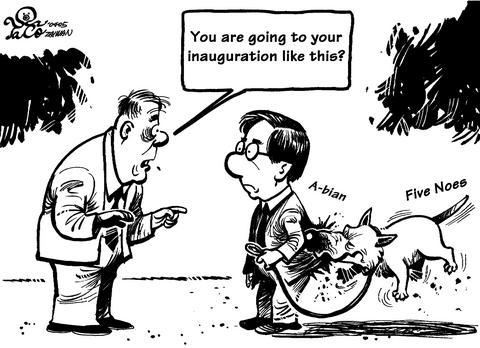
Chinese Nationalist Party (KMT) Chairman Lien Chan and People First Party (PFP) Chairman James Soong will not participate in President Chen Shui-bian's inauguration ceremony on May 20, according to Lien and Soong's top aides.
"The president-elect lacks a proper legal basis. Lien, therefore, will not take part in the presidential inauguration ceremony," KMT spokeswoman Kuo Su-chun said yesterday.
Kuo confirmed that Lien's office received an invitation yesterday to attend the ceremony from the Presidential Office.
Chen defeated the joint ticket of Lien and Soong in the March 20 presidential election by less than 30,000 votes. Lien, refusing to concede defeat, is contesting the result.
PFP spokesman Hsieh Kong-ping said yesterday that Soong had received an invitation for the ceremony but would not attend.
"The election dispute is unresolved," Hsieh said. "No truth, no president."
Neither Lien nor Soong attended Chen's inauguration four years ago, choosing instead to be out of the country for the occasion.
"Neither KMT headquarters nor the KMT legislative caucus have felt a sense of sincerity" from the DPP administration, KMT spokesman Justin Chou said. "We already have an event planned for May 20."
The KMT-PFP alliance plans to hold a protest rally that day in Taipei City "to highlight how the president is being inaugurated under controversial circumstances," Chou said.
He said the alliance will not deliberately mobilize people to attend the protest, but hopes the demonstration would still attract participants.
The location of the demonstration has yet to be determined. On Monday Kuo said the alliance was considering holding the event at the Sun Yat-sen Memorial Hall, the Taipei Municipal Stadium or the Da-An Forest Park.
Officials for the memorial hall issued a press release yesterday saying the hall was not an option for the rally.
"The memorial hall is an educational facility ... and events taking place on the premises would have to be related to either culture or education," the release said.
As May 20 is a Thursday and thus a regular working and school day, officials for the memorial hall said holding a protest at the site would disturb students at nearby Kuangfu Elementary School.
Saying that an application for use of the hall needs to be received one month in advance, the press release added that the memorial hall has not received an application from the alliance.
-----------------------------------------
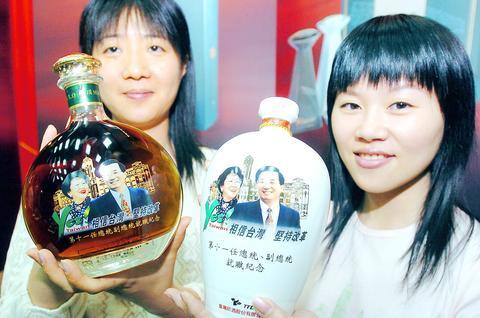
Taiwan Tobacco and Liquor yesterday released five kinds of liquor to mark the nation's 11th presidential inauguration, but Chinese Nationalist Party Chairman Lien Chan and People First Party Chairman James Soong are not likely to partake in the beverages.
-----------------------------------------
-----------------------------------------
-----------------------------------------
On May 10, 2004 ……
Taiwan must make it to the global stage
By Y.T. Hung
US Assistant Secretary of State James Kelly's congressional testimony well outlined the present policy of the US towards China and Taiwan. He pointed out that the Taiwan Relation Act is the foundation for the US to maintain peace and stability in the region and emphasized maintenance of the status quo as the best way to preserve stability.
He also made clear that it is irresponsible of leaders of both the US and Taiwan to treat China's military threats as meaningless. Taiwan should share the US's concern and should refrain from acts or rhetorical statements that may be misinterpreted. The US should also send a clear and unequivocal message to China that it views "any use of force against Taiwan with grave concern [and] will maintain the capacity of the United States to resist any resort to force or other forms of coercion against Taiwan." To alleviate tension, the US "continues to urge Beijing and Taipei to pursue dialogue as soon as possible through any available channels, without preconditions."
Meanwhile, the US commits itself to "explore with our friends in Taiwan" how to promote "Taiwan's successful story for democracy in Asia and around the world ... to a global audience, and how we [the United States] can help to make Taiwan's instructive example available to all countries that are attempting to institute democratic reform."
The plight of Taiwan is not the question of whether it is an independent country or whether it is generally recognized as a member of the international community. The US recognized Taiwan as a sovereign country until formal diplomatic relations was severed on Jan. 1, 1979. In so doing, instability was introduced into cross-strait relations.
Over the past 25 years, while democracy progressed in Taiwan and China's threats intensified, tension between the US, Taiwan and China has escalated. Circumstances have dramatically changed, particularly in Taiwan. Since the Shanghai Communique was entered into in 1978, Taiwan transformed itself from a dictatorship. Martial law was abolished; general elections were adapted for the election of members of parliament and the president. A constitution is to be made according to the free will of the people of Taiwan.
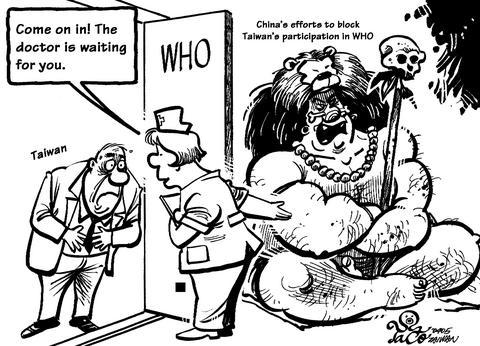
Twenty-five years ago, the US adapted its "one China " policy because the governments on both sides of the strait claimed their China was the real one. Now the "one China" policy obviously becomes the root of problem. It is time for the US to re-examine and update its policy toward Taiwan. The burden of using military force to deter China's "grave actions" against Taiwan rests almost entirely on the US. The US should shift part of this burden to the international community by allowing Taiwan to join international organizations as an international entity, if not a country.
Taiwan's success as a democracy and economic force certainly should not be overlooked by the international community.
The US should bring proof of Taiwan's governmental and economic success to the world's attention so that Taiwan's existence will be recognized, and the security of the western Pacific be supported by the international community and protected by the rule of law.
It is laudable that "the United States continues to be a strong supporter of Taiwan's participation in international organizations." To implement this goal, the US must take the initiative. The effort of the US to attain these goals, based on past history, lacked initiative. The US efforts appeared to be at China's behest.
The US must be able to break through the barrier of appeasing China. Taiwan's participation in international organizations is as important as arms sales for maintaining peace and stability in the region.
International organizations are also a forum for Beijing and Taipei to pursue dialogue.
Y.T. Hung is a lawyer practicing in Virginia.
-----------------------------------------
 -----------------------------------------
On May 8, 2004 ……
Taiwan deserves more respect
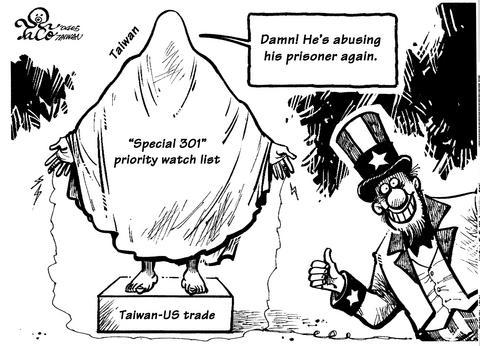
As the presidential inauguration approaches, the whole world, especially the US and China, is carefully watching to see what messages President Chen Shui-bian will deliver in his inaugural speech that might affect Taipei-Washington-Beijing relations.
Washington is not simply waiting around for Chen to elaborate on his agenda for a new constitution by 2006. The Bush administration is making a tremendous effort to exert its influence -- through diplomatic pressure as well as through the media -- to redirect Chen's cross-strait policy.
At the heart of US concerns is how Chen will manage cross-strait relations while rewriting the Constitution, but without giving the impression that he is unilaterally changing the status quo.
The Bush administration has so far found Chen's rationale for implementing constitutional revision through referendums unconvincing. There are clearly limits to what the US will support when it comes to constitutional reform. US Assistant Secretary of State for East Asian and Pacific Affairs James Kelly told a hearing on Capitol Hill that "the US does not support independence for Taiwan or unilateral moves that would change the status quo as we define it." In other words, the US will watch every step Chen makes, and will feel free to comment whenever it feels he is crossing the line.
But can the status quo be solely judged by what Taiwan can and cannot do? What about the authoritarian regime across the Taiwan Strait that has never renounced the use of force against this nation? The "status quo" is a growing number of missiles deployed along China's southeastern coast targeting Taiwan. The status quo is Beijing's relentless effort to sabotage Taiwan's sovereignty by promoting its ideas of "one China" and "one country, two systems."
It is China's relentless saber-rattling and diplomatic squeezing that has lead to a growing anti-China sentiment and the rise of Taiwanese consciousness. This is the origin of potential changes to the status quo in the Taiwan Strait.
Washington may ignore the danger inherent in Beijing's efforts to restrain Taiwan, but it should not portray Chen's efforts to consolidate democracy as an attempt to pursue independence. Chen reiterated during the recent election campaign that a new constitution would not change the status quo or the name and territory of the Republic of China. Washington should trust Taiwan and show it more respect if Chen incorporates such a pledge in his May 20 speech.
The Bush administration has long argued that Beijing is a lot more uncontrollable than Taiwan and therefore Taipei should refrain from rocking the boat. This notion is neither persuasive nor respectful of Taiwan's democratization. The double standards of the US are clear: it treats Taiwan's democratically elected president as a reckless troublemaker while sycophantically hosting China's leaders. It should apologize to the people of Taiwan for trying to deprive them of their right to say no to China.
Taipei and Washington should work on strengthening bilateral communication over the next four years. The Bush administration must also contemplate the extent to which the US could strike a balance between safeguarding its national interests and those of democratic Taiwan while trying to build constructive and candid relations with China.
-----------------------------------------
-----------------------------------------
On May 8, 2004 ……
Hold your horses, please
Since the presidential election campaign began, Taiwan's visibility in international news reports has increased. Hundreds of journalists from around the world gathered here to witness the election's outcome.
Despite the post-election social and political turmoil, the political situation has cooled down in recent weeks, and so has Taiwan's profile in the international media.
The issues that the global media were most interested in covering were President Chen Shui-bian's policy toward China and his controversial defensive referendum.
Suffice it to say that A-bian failed to achieve his referendum agenda, yet that failure effectively clarified Taiwan's security issues for the world at large. Perhaps making this point was what he actually intended to accomplish, rather than the passage of the referendum.
A-bian has thus far elevated the level of global awareness of China's tyrannical policies, particularly of the hundreds of missiles aimed at Taiwan.
Nowadays when I talk with someone in Canada who might not even know where Taiwan is, chances are she or he knows that Taiwan has a serious problem with its neighbor China. Based on that fact alone, A-bian deserves 100 percent credit for sending out this message so effectively.
However, a more serious problem confronting Taiwan's security is not its inability to further publicize China's military threat. It is rather the post-facto clean-up resolution with the US, Taiwan's most significant ally, which also serves this nation as its weapons manufacturing powerhouse and as a cross-strait balancing element.
By clean-up resolution, I do not mean any voluntary submission by Taiwan to US-imposed policy alternatives. Instead, Taiwan should restrain itself from further provoking the Americans, and especially the Chinese tyrants.
To be more specific, the proposed
2006 Constitutional reform ought to be put into the freezer until the heat wave
outside cools down. Its reintroduction, or any fundamental change in the
current cross-strait status quo, will undoubtedly be interpreted as posing a
serious threat to the US' national interest, as well as to China's.
Washington's fundamental interest is that Taiwan remain a semi-independent country, to be sold as many expensive weapons as possible, for as long as China maintains its missiles and other military threats against Taiwan.
As for China, as long as its dream of unification remains it can be metaphorically said to be a big baby crying for milk; once he is fed, he will quiet down.
As for Taiwan, A-bian should lead the nation quietly and discreetly toward a new position within the trilateral framework, toning down the independence rhetoric but significantly upgrading national military capabilities.
Taiwan should be the fisherman sitting idly waiting for the fish to come in, not the other way around. Let the big boys fight each other!
Lee Chia-le, Canada
-----------------------------------------