20040513
=======
On May 14, 2004 ……
Pan-blue camp threatens criminal charges on vote
By Jewel Huang
Chinese Nationalist Party (KMT) Secretary-General Lin Fong-cheng yesterday threatened that the pan-blue camp might file criminal charges against civil servants involved in administering the presidential election.
In a news conference held at the KMT's headquarters yesterday, Lin said that lawyers working for the KMT-People First Party (PFP) alliance have found many "doubtful points" in voter registration rolls and said that the number of ballots has increased "abnormally" in the vote recount, leading the lawyers to believe that there must have been fraud in the election.
"If we do find cases of fraud during the recount, our lawyers will file a criminal suit against the people responsible for the fraudulent actions," Lin said.
"We have also urged prosecutors to investigate such fraud vigorously," Lin said.
Lin said that, judging from preliminary results of the recount, he was confident that the KMT-PFP alliance had an excellent chance of winning the suit it has filed with the Taiwan High Court asking that the presidential election be declared void.
"If we win the lawsuit, it is very likely that the presidential election will be held again. At that time, KMT Chairman Lien Chan will continue to encourage our supporters," Lin said.
Maintaining that "the election has not yet ended," Lin said that Lien will travel this weekend to Tainan and Kaohsiung to thank and encourage the lawyers and party members who have been working on the recount.
This will mark the first time since the election that Lien will have left Taipei to meet with rank-and-file party members working in other cities and counties.
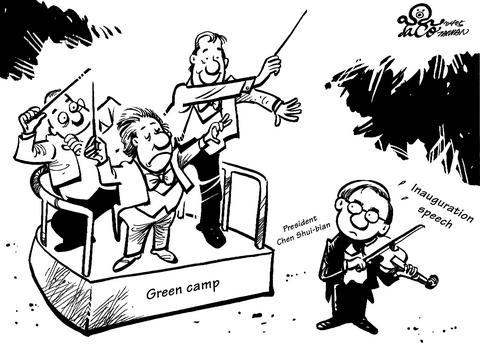
Meanwhile, PFP Chairman James Soong yesterday confirmed that he would not attend President Chen Shui-bian's May 20 inauguration ceremony because "so much systematic and intentional fraud has been found during the vote recount."
"I would be crazy if I attended Chen's inauguration under such circumstances," Soong said.
Soong also said that the KMT-PFP alliance would call on its supporters to renew their protests on Ketagalan Boulevard in front of the Presidential Office if the Democratic Progressive Party (DPP) "continues to pressure" the management of Sun Yat-sen Memorial Hall not to allow the pan-blue camp to use the space.
Chang Hsien-yao, director of the PFP's Center for Policy Research, said that bringing the pan-blue camp's supporters back to Ketagalan Boulevard would be a joint decision of the KMT-PFP alliance's members.
"If the DPP continues its maneuvering to obstruct our rally at Sun Yat-sen Memorial Hall, we will have no choice but to go back to Ketagalan Boulevard," Chang said.
The management office of Sun Yat-sen Memorial Hall said in a press release yesterday that rally permits for the space must be obtained a month ahead of time and that the proposed pan-blue rally does not fit in with the sorts of activities that the facility usually hosts.
KMT Vice Chairman and Taipei Mayor Ma Ying-jeou said yesterday that he was not concerned about possible protests because he expected city police to do what the law requires them to do.
-----------------------------------------
On May 13, 2004 ……
Blue-camp bullies behaving badly
`The two have acted arbitrarily and irresponsibly for the sake of personal benefit, and they can only be described as villains of Asian democracy.'
By Holmes Liao
This year could be called the Year of Asian Democracy. It is difficult to keep up with all the elections in East and Southeast Asia: the presidential election in Taiwan, the parliamentary elections in Malaysia in March, parliamentary elections in South Korea and Indonesia last month, the elections to Japan's upper house in July, and the presidential elections in the Philippines on Monday and Indonesia in July. Although the economic and educational standards of most of these countries fall behind those of Taiwan, Taiwan has, through the behavior of Chinese Nationalist Party (KMT) Chairman Lien Chan and People First Party (PFP) Chairman James Soong, provided one of the worst examples of democracy in Asia.
The two have acted arbitrarily and irresponsibly for the sake of personal benefit, and they can only be described as villains of Asian democracy.
First, their behavior has had a great influence on China. People in China working hard for the country's democratization have all along used Taiwan as a reference. However, Lien and Soong have disregarded Taiwan's tradition of letting the ballot decide the winner, and, without a shred of proof of the election having been rigged, mobilized the public for illegal protests. This has had a great impact on the Chinese people's confidence in democracy, and made them see democracy as a source of chaos.
The democratization of China would
further peace and stability in Asia, but Lien and Soong's behavior has clearly
damaged its development.
Second, demands in Hong Kong for the direct election of their chief executive and democratization have been dealt a blow thanks to Lien and Soong.
The past two months have shown that
we still have a long way to go before achieving true democracy, and it has made
it impossible for democracy in Taiwan to serve as a beacon for those in Hong
Kong and China. It has also given Beijing an excuse to block liberalization in
Hong Kong.
Lien and Soong have also disregarded the capability of the democratic mechanism to resolve disputes, instead relying on extralegal means to threaten the president and bring unsubstantiated complaints to the international press. This has created an image of Taiwan as incapable of democratic self-management and in need of foreign assistance to maintain social stability.
Because the pan-blue leaders have been bringing their complaints directly to the international community, they have caused the US role to become highly politicized. Not only that -- the outside world's questioning of Washington's involvement in Taiwan's domestic affairs has offered Beijing an opportunity to interfere in the workings of Taiwan's democracy, with China's Taiwan Affairs Office issuing strongly worded statements on the election.
Taiwan's democracy no longer shines brightly in the eyes of the international community, and the country's international image has been ruined.
Although most governments have given in to pressure from China to different degrees, public opinion in these countries is still supportive of Taiwan's democratic achievements. Public pressure has often led to other parliaments supporting Taiwan.
Refusing to concede defeat, Lien and Soong have used irregular means to challenge the election -- a judicial ballot recount, making statements to the international media about vote-rigging and suggesting the March 19 assassination attempt on President Chen Shui-bian and Vice President Annette Lu was staged.
The international community is largely unaware of the true situation and unable to verify these statements. Some friends of Taiwan, unwilling and unable to gain a deeper understanding, have come to the mistaken conclusion that the statements are true.
Understanding that elections are about counting heads and not about breaking them allows for the peaceful transfer of power without the need for military force to decide the winner. This wisdom is the result of thousands of years of political development.
Because the result of the presidential election did not suit the taste of Lien and Soong, however, they have resorted to savagery in order to destroy this wisdom. Lacking support from a majority of the public, and with the international media not buying their explanations, their strategy of using the international community to reach their goals has failed.
Yet the March 26 attack on Central Election Commission offices and the violent scenes in front of the Presidential Office on April 10 received widespread international coverage, which lead to global disappointment with Taiwan, a nation that calls itself a democratic model. For Taiwan, the broken glass outside the commission is symbolic of the country's broken dream of democracy.
Holmes Liao is an adviser to the Ministry of Foreign Affairs.
-----------------------------------------
On May 15, 2004 ……
An updatedconstitution nothing to be afraid of
By Hsiao Bi-khim
Since its founding in 1949, China has promulgated four different constitutions. The last, enacted in 1982, has undergone four sets of amendments. Regardless of how many times China changes its constitution, it is still the same country -- the People's Republic of China.
Likewise, plans to reform Taiwan's constitution should not be considered an attempt to change Taiwan's status quo as an independent, sovereign country.
In fact, Taiwan's Constitution has already been amended six times -- the most significant amendments allowed for the direct election of the legislature and president. Other new provisions attempted to streamline the government's structure but proved to be largely unsatisfactory. Constitutional reformers were working with a Constitution that had originally been designed and promulgated back in 1947 for a government that ruled over China, not Taiwan. A sound constitutional structure forms the basis for the normal functioning of any country.
Taiwan's Constitution requires reform in three main areas:
-- Governance structure. In this area, the main question is whether Taiwan should have a presidential or Cabinet system of government, neither of which can describe Taiwan's current hodgepodge of governance structures. Under the present constitution, government is divided into three tiers and separated into five branches. The result is an unwieldy system that fails to clearly define political powers and duties.
The gravity of this problem was illustrated in 2000, when power struggles threatened to dismantle the six-month-old presidency. The opposition parties, which together still held a legislative majority, threatened to recall President Chen Shui-bian in response to the premier's decision to terminate construction of a controversial nuclear power plant. They could have initiated a no-confidence vote against the premier, but then the president would remain in office and disband the legislature accordingly, leaving the opposition parties with the challenge of a new election. Under a Cabinet system, the premier would have dissolved the legislature, whereas under a presidential system the president would have veto power to resolve the controversy.
Clearly, a more stable system of governance is in order. The type of government also determines parliamentary design and electoral procedures.
-- Citizen's rights. Taiwanese can't vote until they are 20, one of the highest voting ages in the world. In order to extend the right to vote to 18-year-olds -- as 162 other countries have done -- a constitutional amendment is needed. In addition, the Constitution's guarantee of basic human rights could be expanded to include Aboriginal rights of self-determination.
-- Economic principles. The Constitution outlines a socialist organization of the economy, including the restriction of private capital and the equalization of land ownership. Although Taiwan has developed a vibrant capitalist economy, certain constitutional provisions -- such as an unusual incremental land-value tax scheme -- impede the effective use of resources and hinder overall competitiveness.
Why is constitutional reform necessary when Taiwan has already lived with such a cumbersome document for more than 50 years? The KMT's one-party control over all aspects of government also meant that the problems of an awkward governance structure due to an ill-designed Constitution were not apparent. Just as laws are amended and created to fit the changing needs of society, Taiwan needs a constitution that will be a workable foundation for its maturing democracy.
Hsiao Bi-khim is a legislator and the director of inter-national
affairs for the Democratic Progressive Party.
-----------------------------------------
-----------------------------------------