20040514
=======
Five noes on May 14, 2004 ……
Activists warn against `five noes'
STAY AWAY!: A pro-independence group yesterday said President Chen Shui-bian should not reiterate his `five noes' pledge in his inauguration speech, or face reprisals
By Chang Yun-ping, STAFF REPORTER
Members of the pro-independence Taiwan Association of University Professors (TAUP) yesterday warned President Chen Shui-bian not to reiterate his "five noes" pledge in his inauguration speech, or face counter attacks as a consequence.
TAUP Chairman Wang To-far, an economics professor at National Taipei University, yesterday said Chen should not bow to US pressure to repeat his "five noes" pledge, which would undermine the goal to build Taiwan into a normal and independent country.
"Presidential advisor Koo Kuan-min told Chen that he would leave the inauguration ceremony immediately if he hears Chen mention the `five noes' pledge. The TAUP will organize an emergency group to monitor Chen's inauguration speech. If we also hear Chen speak of it on May 20, we will decide on our counter measures," Wang told a press conference.
At his swearing-in ceremony four years ago, Chen made five promises, including that he would not declare independence or change the nation's title.
The US has been hinting that Chen should reaffirm the five promises after winning the March 20 presidential election. US Deputy Secretary of State Richard Armitage said last month that Washington wanted Chen to restate his "five noes" pledge in his May 20 speech.
Wang yesterday said that "Taiwan is not a state of the US, and the US can't prescribe what Taiwan should do. Taiwan should take care of its own national interests."
Wang said Chen is a president elected by the 23 million people of Taiwan and he should not dictate the people's will by unilaterally deciding that he won't push for independence.
"Chen's victory in the March 20 presidential election represents the consolidation of Taiwan's national identity. Chen's re-election happened not because Chen did well with his four-year administration; rather, it was because of the development of a Taiwan-centered awareness," Wang said.
Examination Yuan member Chang Cheng-shuh, also a member of TAUP, said Chen should not bind himself to the "five noes" pledge, which has contradicted Chen's theory that China and Taiwan are "one country on each side of the Taiwan Strait."
Chang said Chen should live up to his campaign promises to rewrite the Constitution by 2006 and further reforms to ensure Taiwan's status as an independent sovereign country.
"We urge Chen not to speak of `five noes' pledges again, because it might cause legal problems; that is, if Chen fails to deliver on his campaign promises, he would have to face the consequences of political responsibility, which could mean impeachment," Chang said.
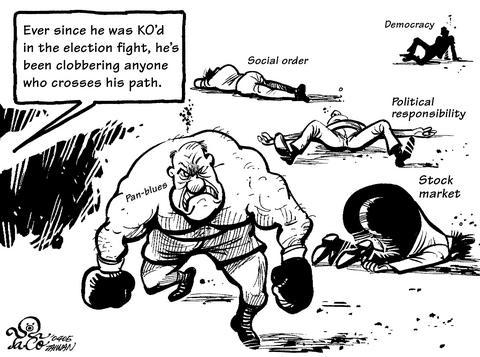
"Such an impeachment won't come from his pan-blue rivals but from Chen's own staunch pan-green supporters," he said.
The TAUP was not the only group warning Chen. In recent days, many pro-independence heavyweights expressed similar concerns and urged Chen to avoid the "five noes" promises in his inaugural speech.
Senior presidential adviser Koo Kuan-min visited Chen on Wednesday to make the same appeal. He said the "five noes" pledge overrides Chen's authority as a president and hinders Taiwan's democratic development and the process of becoming a "normal" country.
Koo said Chen is still considering whether to mention the "five noes" pledge in his speech. He predicted that Chen will not speak of it at the inauguration ceremony.
Chairman of World United Formosans for Independence Ng Chiau-tong, presidential advisor Chen Lung-chu and Democratic Progressive Party Legislator Trong Chai also urged Chen to drop the "five noes" pledge and, in the meantime, asked the US to adjust its "one China" policy and to not excessively interfere with Taiwan's internal affairs.
-----------------------------------------
On May 14, 2004 ……
Unification `law' draws guarded response from US
By Charles Snyder, STAFF REPORTER IN WASHINGTON
Reacting to reports that China is considering a law requiring Taiwan's unification, the US on Wednesday reminded Beijing of its policy favoring a peaceful resolution of cross-strait issues.
US State Department spokesman Richard Boucher, however, declined to make substantial comment on the possibility of such a law, saying it "will depend on what they say."
Boucher was speaking at his regular midday news conference hours after a spokesman for China's Taiwan Affairs Office, Li Weiyi, confirmed that Beijing authorities were considering such a law.
The law, as variously mentioned by Chinese officials and analysts, would mandate that Taiwan unify with China and would, by extension, legally bind the People's Liberation Army to attack Taiwan if it declared independence.
"China will seriously consider all suggestions for unification, including by legal means," Li said at his own regular press briefing on Wednesday, the semi-official China Daily reported.
If a unification law was proposed, "we will seriously consider it and adopt it," he said.
Boucher said the US was "certainly aware" of the discussions in Beijing about a possible law.
"We've seen the statements and the reports that they might want to use legislation to promote reunification with Taiwan," he said.
"I would remind people our policy remains that issues between Taiwan and the mainland need to be settled through peaceful dialogue," he said.
The idea of a mandatory unification law arose during a meeting between Chinese Premier Wen Jiabao and ethnic Chinese in London on Monday, according to the China News Service. The report, which was given prominence in official Chinese media, said the idea, raised by a 76-year-old Chinese man, was that "the National People's Congress should draft and adopt a reunification law to prevent Taiwan from edging toward independence."
Wen reacted by saying, "Your view on reunification of the motherland is very important, very important. We will seriously consider it."
Wen spoke of unification as "a historical inevitability that cannot be blocked by any force," but did not elaborate, the China News Service said.
The report also quoted Zhu Xianlong, a Taiwan expert at Beijing Union University, as saying, "This will be legally binding. The use of force will be an important, but our last, resort."
The move toward a unification law comes a month after Beijing essentially quashed any medium-term hopes for greater democracy in Hong Kong, ruling that only Beijing would decide if the chief executive or the Legislative Council (LegCo) could be elected.
That decision is seen as removing any possibility that a successor to Chief Executive Tung Chee-hwa will be elected by the people of Hong Kong when his term ends in 2007, or any possibility that LegCo's 2008 election will be fully democratic.
-----------------------------------------
On May 14, 2004 ……
`Rummie' heads into eye of storm
REUTERS , BAGHDAD
US Defense Secretary Donald Rumsfeld made a surprise visit to Baghdad yesterday, flying into the eye of the storm over Americans torturing prisoners that has sapped Washington's credibility in Iraq.
Hours after US lawmakers viewed "sadistic" new photographs of US troops torturing Iraqis, the embattled secretary met Lieutenant General Ricardo Sanchez, the US commander in Iraq, and Major General Geoffrey Miller, the new head of US prisons there.
It was not clear whether he would visit the nearby Abu Ghraib jail itself, where seven military police reservists are charged with sexually and physically tormenting detainees.
His trip looked like a robust answer to critics who say Rumsfeld, one of the architects of the Iraq war, should resign, six months before US President George W Bush seeks re-election.
As international anger at US conduct in Iraq -- and at its Guantanamo Bay prison on Cuba -- mounts, General Richard Myers, the chairman of the joint chiefs of staff who visited with Rumsfeld, said: "We absolutely have the high moral ground."
Once notorious as Saddam Hussein's torture chamber, Abu Ghraib has become a symbol of the US failure to win over many Iraqis despite ridding them of Saddam a year ago. With just seven weeks to go until Washington hands sovereignty back to an Iraqi government, that is a serious problem for Rumsfeld.
Efforts by the Bush administration to contain the damage to the seven soldiers charged have been buffeted by reports from the Red Cross and other groups saying that Washington was warned about systematic and widespread torture many months ago.
Not only are Arabs dismayed at evidence that the troops who overthrew Saddam's dictatorship were inflicting torments themselves on thousands of Iraqis but US allies, many of whom opposed the war, are also becoming more vocal in criticism.
"It all gives the impression of a total lack of direction," French Foreign Minister Michel Barnier told Le Monde newspaper in unusually tough comments about Iraq under US occupation.
Prisoner abuses and persistent violence showed the country and region were spinning out of control, Barnier said.
In the holy cities of Najaf and Kerbala, where US troops are facing an uprising by a Shiite Muslim militia loyal to radical cleric Moqtada al-Sadr, there was renewed fighting.
Al-Sadr's Mahdi Army fighters stormed the main police station in Najaf overnight and emptied the weapons store, police said, before they were driven off by US tanks.
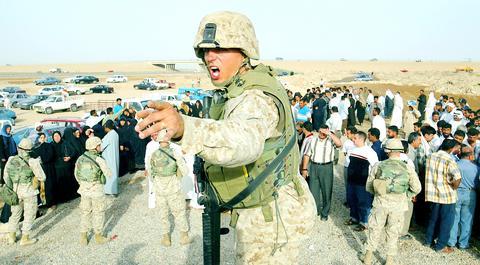
US Marine Sergeant William Hamby shouts to fellow Marines at the
entrance of the Abu Ghraib Prison on the outskirts of Baghdad, Iraq on
Wednesday. He and his comrades from Kilo Company of the 3rd Battalion 24th
Marines, who control the front gate of the prison, arrived to Abu Ghraib
earlier this year and are not implicated in the prisoner abuse seen in photos
from late last year. US Secretary of Defense Donald Rumsfeld made a surprise
visit to Iraq yesterday amid increasing calls for his resignation over the
scandal.
-----------------------------------------
-----------------------------------------
On May 14, 2004 ……
Ask the people about unification
By Edward Chen
Taiwan is in trouble with the US, whose support is absolutely essential to the survival of the nation.
The first sign of trouble came last December when US President George W. Bush, after meeting with Chinese Premier Wen Jiabao, criticized President Chen Shui-bian for seeking to unilaterally change the status quo. This is the same US president who only two years ago declared that he would do "whatever it takes" to help defend Taiwan.
In a recent congressional hearing, US Assistant Secretary of State James Kelly was even more blunt, warning that Taiwan risked losing US support if Chen changed the status quo through amending the Constitution. In Taiwan, David Keegan, deputy director of the American Institute in Taiwan, called on A-bian to resume dialogue with China as quickly as possible, insisting that the US' pledge to help defend Taiwan should not be thought of as a blank check. China must have been delighted by all these developments.
Is Washington conspiring with Beijing to force Taiwan into compliance with the "one China" formula in the name of preserving the "status quo?" Perhaps not. But one thing is certain: China has succeeded in weakening the US' resolve to protect Taiwan by taking advantage of the US' preoccupation with wars in Afghanistan and Iraq and the fight against international terrorism. The US needs China's assistance in reigning in North Korea's nuclear ambitions. The US must also remain mindful of its booming trade with and investment in China, on which US consumers and corporations heavily depend. Those factors are reason enough for the Bush administration to want to accommodate China on Taiwan.
How can the A-bian administration keep Taiwan from one day finding itself with no choice but to begin negotiating with Beijing on the basis of "one China" or a variation of it?
A-bian should hold a referendum as soon as possible and ask his people a simple and straightforward question: Do you favor the unification of Taiwan with China?
Such a referendum should proceed with or without the US' support. In fact, the US has no reason to object to it, because it is not designed to change the status quo. On the contrary, if a large majority of Taiwanese should reject unification, as is expected, the referendum would reinforce the status quo. While China uses the status quo to prevent Taiwan from drifting toward independence, Taiwan can use the same status quo to dissuade China from using force. Additionally, a resounding vote against unification would send a powerful message to the world that unification is not an option for Taiwanese people.
Such a referendum would provide A-bian with a strong mandate to undertake the constitutional overhaul he has promised. The small margin by which he won re-election hardly constitutes a mandate for carrying out a revision of the fundamental law of the land.
The March 20 referendums failed because the two items on which the people were asked to vote (missile defense and negotiation with China) clearly fall within the domain of executive decisions.
This allowed the pan-blue camp to label the referendums an "election gambit." In contrast, voting for or against unification is a question of fundamental concern to all the people of Taiwan, regardless of their political inclinations or ethnic affiliations. If skillfully handled, the referendum could pave the way for ethnic harmony by providing people with political common ground.
Finally, by carrying out such a referendum, A-bian could help Taiwanese realize their century-old dream of self-determination.
In the past 110 years, decisions have been made on several occasions which affected the sovereignty of Taiwan: the Treaty of Shimonoseki (1895), the Cairo Declaration (1943), the San Francisco Peace Treaty (1951), the Shanghai Communique (1972) and the US' recognition of the People's Republic of China (1979). Not in a single instance were the Taiwanese people ever consulted.
Today, Taiwanese control their own government. It is up to the A-bian administration to give the people a chance to exercise their right of self-determination. Let them clearly say yes or no to unification.
For Taiwan to continue to survive as a free, democratic and prosperous society, it has to break the "one-China" spell cast by Beijing and subscribed to by Washington.
But before Taiwan can ask the US to change its stance, Taiwan must demonstrate that good reasons for change exist. An overwhelming vote against unification could be a first step toward a review of the US's "one China" policy.
Caveat: For such a referendum to be effective, 65 percent to 75 percent of eligible voters must vote against unification. To achieve this result, careful preparation and skillful communication with all political groups are essential. Enlisting the support of those working for the rectification of Taiwan's name -- a movement led by former president Lee Teng-hui -- is equally essential.
Edward Chen is professor emeritus of history residing in Edinboro,
Pennsylvania. E-mail: edchen@velocity.net
-----------------------------------------
On May 15, 2004 ……
Another poll to worry about
Philip Wallbridge, Taipei
Taiwan took a further step towards democracy and freedom with the re-election of President Chen Shui-bian. He now has the mandate of the people to progress these, but how effectively this can be achieved may be dependant on another election -- in the US in November. The re-election of President George W. Bush may leave Taiwan in a precarious position.
Bush and his administration have claimed to support freedom and equality in the world, but these admirable principles have at best been applied inconsistently. Pulling out of the Kyoto agreement, supporting unilateral action by Israel but opposing such an approach by Taiwan and the war in Iraq have left much of the world deeply suspicious of American foreign policy.
Chen would be in a difficult position should Bush be re-elected. With China trying to drive a wedge between America and Europe, it is unclear where support for his dream of Taiwan being given a fair chance of true democracy that these countries enjoy would come from.
The one thing that is clear though is that Bush is not a man to be trusted, and here is one who is desperately hoping Senator John Kerry is also given a chance -- a chance to really practice what the Bush administration have preached.
-----------------------------------------
On May 15, 2004 ……
Ethics needed
Liu Ching-ming, Taipei
A recount of ballots cast in the presidential election has begun. It is the largest vote recount in Taiwan's political history. Given the way some people, groups and members of the media abusing their freedom of speech to spread rumors and unconfirmed information, the endless aggressive interaction between the pan-blue and green camps seemed inevitable.
People tend to suspect everything and began to distrust everyone, suffering from the ever increasing rumor or political "reasons" being offered. As long as the "truth" is not found or revealed in public, people might still get involved in this endless aggressive behavior.
The ethics and profession of politics need to be revamped. The professionalism and ethical issues should be a core value of any society in the modern world. We should respect them by way of implementing them.
I believe that President Chen would acknowledge the essentials of ethics and professionalism, as well as the value of politics.
Honesty is the best policy. The "truth" must always be revealed, otherwise people will not believe or trust their government. That may be quite a large tragedy in this democratic country -- Taiwan.
-----------------------------------------
On May 15, 2004 ……
UN's cowardice apparent
Lee Long-hwa, United States
Once again, the UN has shown that it is nothing more than a political club, despite its charter and high-minded opinions of itself. Secretary General Kofi Annan has always acted as a Communist Chinese parrot, and many member nations have behaved like dung beetles, devouring the remnants of whatever putrid lies are spewed forth by the Communist Chinese administration, particularly about Taiwan.
In its latest inhumane act of appeasement (and complacency and conspiracy), the World Health Organization (WHO) denied the Taiwanese press, en masse, the right to cover the agency's new proceedings. Did I hear right? The UN has denied a nation of 23 million people freedom of the press? Yes, exactly. How shameful.
The supposed international organ of freedom and dignity for all peoples is now nothing more than the lackey of China. Woe to the Tibetans, woe to the Taiwanese, woe to the Mongolians and Hong Kong's democrats, and woe to the hundreds of millions of Chinese citizens who aren't even allowed to know how truly awful and cowardly their leaders are.
Woe to the scores of coward nations who have betrayed Taiwan, democracy and freedom. All of their statements and protestations to the contrary, they are cowards of principle.
-----------------------------------------
On May 15, 2004 ……
TSU legislators fault ministry over WHA
By Debby Wu, STAFF REPORTER
The Taiwan Solidarity Union (TSU) legislative caucus yesterday condemned China for suppressing Taiwan and obstructing Taiwanese media coverage of this year's World Health Assembly (WHA), and criticized the Ministry of Foreign Affairs for not making a great enough effort to protect Taiwan's rights and dignity.
The WHA is slated to convene on Monday.
This week the WHA said that it had transferred authority for press accreditation to the UN due to security concerns. The UN declared that journalists holding Taiwanese passports would not be permitted to enter the assembly building because Taiwan is not a UN member.
It has been rumored that China engineered this arrangement.
The TSU yesterday invited the ministry and Government Information Office (GIO) to elaborate on the situation.
The TSU legislators demanded that the government stick up for the nation's media -- and criticized China's actions.
"If we look at China's health record, China should be the one isolated from the global health network -- yet due to human rights concerns, China is still included. So China really should not oppress Taiwan," TSU Legislator Chien Lin Whei-jun said.
Meanwhile, the ministry and GIO officials said that they had contacted several international press clubs and requested the support of international reporters.
"We feel angry about this. Press freedom is a universal value and we urge China to respect that freedom," said David Lee, the GIO's director of the Department of International Information Services.
"We have also contacted the WHO secretariat in Geneva and we have been negotiating with them on the issue," said Jieh Wen-chieh, the ministry's deputy director-general of the Department of International Organizations.
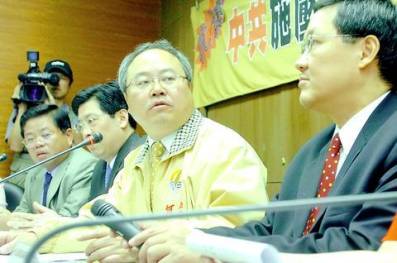
TSU Legislator Ho Min-hao, center, and his colleagues call on the Ministry of Foreign Affairs to adopt a tougher stance regarding the WHA's refusal to allow Taiwanese reporters to cover the group's upcoming annual meeting, yesterday.
-----------------------------------------