20040517
=======
For Taiwan election on May 17, 2004 ……
Chinese culture and freedom
By Samuel Yang, Ming T. Chang, Chi T. Su and Thomas Tsai
The recent presidential election has clearly exposed the incompatibility of Chinese culture and democracy. It is saddening to witness the unrestrained lawlessness of the opposition parties during the election process. They have openly accused the legitimately elected President Chen Shui-bian of being the same as Adolf Hitler, Saddam Hussein and Osama bin Laden. They have conducted violent protests after losing a highly transparent election that was closely scrutinized by the international observers and even by their own well-organized followers.
These opposition party members and followers take great pride in their higher educations and inheritance of the great Chinese culture. Such egos reject Taiwanese contributions, which are blemished by foreign influences. They consider the Taiwanese democracy advocates as traitors to the Chinese nation. Despite their love of Taiwan and democracy, the same Chinese opposition parties prefer to unite Taiwan with a totalitarian communist China, which does not understand democracy and has a long list of human rights violations.
Chinese civilization does have a very rich culture and all Chinese take pride in being Chinese. The great teaching of Confucius, which advocates societal harmony through moral conduct in all relations, has been accepted by most Chinese for centuries. Then why is it that China has en-dured endless cycles of tyrannic rulers, rampant corruption and violent mass upheavals?
The main culprit, we believe, is the tradition of the Chinese educational system. Since ancient times, Chinese intellectuals have educated themselves primarily to gain positions in a feudal system. Other professions have not been considered prestigious. Such a mentality has influenced intellectuals to become gratified by just being members of the ruling parties. They are incapable of understanding self-governance or democracy. The remaining civilians have been indoctrinated or terrorized by violence to blindly follow the rulers, regardless of their legitimacy.
Even now, almost all Chinese also believe in a ruler's right to rewrite history to his own liking, and all opposition members are subject to liquidation. Therefore it is no coincidence that the Chinese Nationalist Party in Taiwan and the communists in China, regardless of their ideological differences, both seized power with violence, and with the cooperation of intellectuals who were interested in personal prestige and fortune. The same groups continue to practice violence and illegitimate tactics in the 21st century, though such tactics are now despised by civilized nations.
Taiwan's democracy should survive, despite the missile threat and political persecution by China, and despite sabotage from within by the opposition Chinese parties. Moreover, for the sake of regional stability, Taiwan should become the Switzerland of Asia. Taiwanese have shown their genuine love of democracy and their capacity for tolerance even of the people who tormented them for decades. They are capable of becoming the force of peace in the region.
Let democracy blossom, and let Taiwan safeguard the regional peace. Then one day all Chinese will eventually understand the blessing of life under democracy. When such a day comes, all Chinese will enjoy the peaceful world of brotherhood. The United States and the other nations will never be dragged into the cycles of Chinese violence again.
Samuel Yang, Ming T. Chang, Chi T. Su, Thomas Tsai, United States
-----------------------------------------
On May 17, 2004 ……
Are parties for loyalty or for victory?
Currently the Chinese Nationalist Party (KMT) resembles nothing so much as two men in a pantomime donkey suit kicking each other.
On the one hand we have party Chairman Lien Chan, vowing mass rallies for Wednesday and Thursday to protest the presidential inauguration, saying that the recount is only the first move in the KMT's plan to change the election result, and telling members who think the election should be properly conceded to quit the party.
On the other hand we have KMT members wondering whether "Chinese" and even "Nationalist" should be dropped from the KMT's name. While we are puzzled as to what that might leave -- the Party sounds Orwellian in the extreme, but maybe even we could vote for the Party -- it is a reflection that not everyone in the KMT is an intellectual basket case.
The problem is that changing the name of the KMT doesn't make sense unless you have some idea of what the party stands for. Currently there is no consensus on this.
For too many senior figures like Lien, the KMT stands for their divine right to rule without subjecting themselves to anything as demeaning as the approval of the hoi polloi at the polls. Lien can't get over the fact that elections aren't formalities endorsing his greatness.
A younger KMT generation, one that came of age in a political environment where elections are real and power comes via the ballot box, is realistically asking how the KMT can be made more attractive at the polls. To see that this is possible, one only has to look at the electoral success of the post-communists in Eastern Europe to see that a less-than-appealing history does not doom a party forever at the polls. It might pay the KMT's reformers to look seriously in Eastern Europe's direction not so much for inspiration as to how to rebrand itself, but for mechanisms by which this rebranding might be achieved.
The most important thing that the KMT needs, though members can't openly discuss this, is a mechanism by which its leader can be removed. That it does not have this is a sign of political immaturity and the KMT's origins in strongman rule.
The KMT has always valued loyalty over ability or, in fact, anything else. What it is not able to grasp is that loyalty to a party goes beyond loyalty to a particular leader.
Successful political parties tend to be those that, within an atmosphere in which party loyalty is cultivated, nevertheless are ruthless in getting rid of leaders who have become liabilities -- the British Conservatives' removal of former prime minister Margaret Thatcher is a memorable example.
The purpose of a party is to win power through election victories. Anything that interferes with that goal has to be jettisoned. To deny your party the power that is its reason for being because of loyalty to any particular leader is a plainly suicidal course.
Lien is a three-time loser now; he has lost two presidential elections and led his party to its worst-ever drubbing in legislative elections in 2001. There is no reason to suppose that the KMT's performance will be any better given its antics in the last couple of months.
In response to Lien's temper tantrum that those who would concede the election should leave the party, he deserves an ultimatum: If the recount goes against the KMT, he must go -- or else face the mass resignation of his party's brightest and best.
Toward someone as vain as Lien, this will be a risky challenge. But it has to be done.
-----------------------------------------
On May 17, 2004 ……
Taiwan's political maturity seen in poll
By Tien C. Cheng
Finally the chaos of Taiwan's presidential election has settled down. The question of the shooting of President Chen Shui-bian was cleared by Henry Lee, an internationally known US criminologist. The world has been reassured that democracy works in Taiwan.
Taiwan was ruled by Japan for 50 years before being occupied by the Chinese Nationalist Party (KMT) regime for the next 50 years. Generalissimo Chiang Kai-shek and his son ruled the island with an iron hand. The people were forbidden to speak their native language, and their education was forced to revolve around the teachings of China. The people were told that one day the communist regime, which defeated the nationalists in civil war in China, would be overthrown and the nationalists would regain power throughout China.
Due to these outside rulers, the Taiwanese, who comprised 85 percent of the population, were deprived of their own cultural heritage, which created an identity crisis. The people of Taiwan have only had 12 years in which they could elect their president. Their identity became important when the people had to choose between a Chinese Nationalist presidential candidate and Chen, a native-born Taiwanese.
Chen was portrayed as a warmonger by his opponents. He wishes to avoid a confrontation with China but insists on independence for Taiwan.
More than 80 percent of Taiwanese voters cast ballots, with Chen winning by a margin of only 0.2 percent. The election was so hotly contested that almost every person in Taiwan was motivated to participate in the decision of who would lead the country.
I give a lot of credit to the people of Taiwan. With only 12 years of democracy, they were able to overcome all the difficulties and make the right decision. Chen represents the Democratic Progressive Party. In his four years as president he has cleared up bad bank loans, put an end to many white-collar crimes, and has brought discipline to the government. He has improved mass transportation, but most importantly he has brought Silicon Valley ideas to Taiwan and has made it the world's leading high-tech country.
Taiwan is not recognized by the UN, and has been isolated because the world goes along with China's request not to accept Taiwan as a legitimate country. China has always proclaimed that Taiwan is a renegade province, even though they have never set foot in Taiwan.
Chen has offered to sit down with the Chinese government many times. However, China wants the Taiwan government to accept one condition: China's legal right to govern Taiwan. The people of Taiwan have voiced very clearly their strong opposition to that demand.
Taiwan has been a strong ally of the US. When the US recognized China during the presidency of Jimmy Carter, Congress passed the Taiwan Relations Act to ensure that Taiwan would not be taken over by force by China.
Taiwan has done wonders in helping many underdeveloped countries in Africa and Central America. This help has come in the form of economic aid to build hospitals and bridges and to develop rural resources via technical assistance for farmers.
Taiwan has supported US policies and has maintained friendly relations. The people of Taiwan share the values of democracy, human rights and peace.
A strong and democratic Taiwan will bring peace, stability and economic progress to the Pacific basin. Taiwan's democracy needs the US. It is certain that the US will support any free country, as it has during the war in Iraq, for the sake of permanent safety of the free world.
Tien C. Cheng is a member of the Overseas Chinese Affairs Commission.
-----------------------------------------
On May 18, 2004 ……
Take no notice, Mr. President
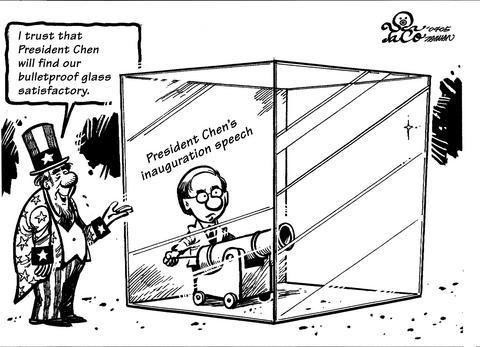
The Office of Taiwan Affairs under the Central Committee of the Communist Party of China and the State Council's Taiwan Affairs Office issued a statement early yesterday morning, rushing to set the tone before President Chen Shui-bian's inauguration speech on May 20. The statement raises the bar a lot higher in terms of talking peace. Chen's speech, therefore, can only aim to maintain stability by defending the status quo.
Its content is numbingly familiar. It slams Chen's "five noes" and trumpets its "seven lines," leaving itself pinned to a "one China" framework. China's resolve to "never sit idly by" at the prospect of Taiwanese independence and its military chest-beating will appeal neither to the Taiwanese nor the international ear.
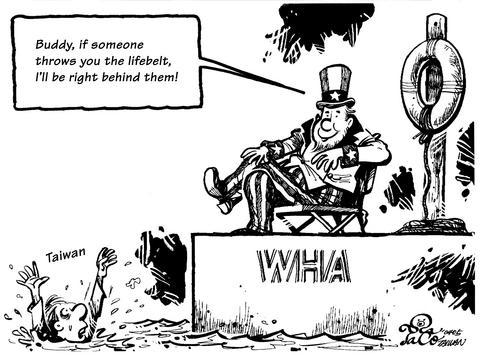
The statement does, however, bring Chinese intentions into sharper relief. Its release on the eve of the World Health Assembly's Geneva meeting, where Taiwan's push for observer status is again a cause for embarrassment, is meant to head off anger after the likely veto of the bid. Repeating its warning that only by accepting the "one China" principle will negotiations commence on "the issue of international living space of the Taiwan region," the Chinese added it would do its utmost to block any diplomatic step forward Taiwan takes.
The timing also reveals a degree of haste by addressing cross-strait relations in advance of Chen's speech. China now seems to have no faith in Chen's "five noes," if it ever did. On the other hand, China equates the plan to write a new constitution by 2006 with the push for Taiwanese independence as a whole. This warning is simply a clumsy attempt to influence the drafting of the speech.
There was a token mention of Chen's
proposals, such as establishing a mechanism for mutual trust in military
affairs and constructing a framework for peace and stability, but the statement
cannot redeem the browbeating line that as long as China unifies with or
annexes Taiwan, everything will be just fine. Beijing still expects this
country to renounce every right that it is entitled to as a state in exchange
for a promise that the People's Liberation Army will keep its distance and that
some participation in the international community will be tolerated.
As Hong Kong has shown us, reunification with China amounts to the implementation of "one China" policies and the bankruptcy of the "two systems" promise, sweetened by the retention of a limited democracy. The Hong Kong model does not appeal to Taiwanese people.
China's statement is a predictable but insubstantial warning to the Taiwanese people and the Chen administration. It offers no solutions for the cross-strait impasse. Taiwan, therefore, need not be overly concerned about the statement's repetitions and unfriendliness.
China's economy is a much more pressing crisis. Cross-strait tension, in comparison, is a longstanding issue that requires some attention but which will not be resolved overnight.
China has showed its cards -- prematurely. There is no need for Chen to respond to the statement. If he does, it would seem Pavlovian rather than strategically sound. Chen should instead outline a framework under which cross-strait peace could be achieved. This is the real challenge for his next term.
-----------------------------------------
-----------------------------------------
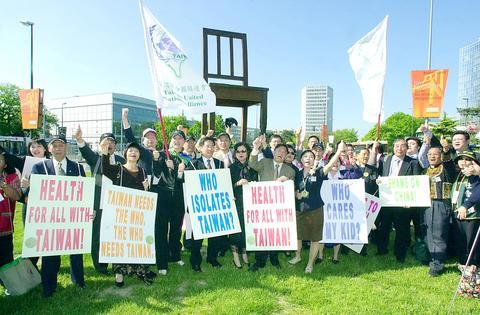
Activists from Taiwan hold banners and chant slogans at a square outside the World Health Assembly in Geneva yesterday demanding Taiwan's accession to the World Health Organization.
-----------------------------------------
-----------------------------------------