20040519
=======
Pro-independence activist on May 19, 2004 ……
Pro-independence activist to head mission in Japan
By Lin Chieh-yu and Ko Shu-ling, STAFF REPORTERS
Independence activist Koh Se-kai will succeed Lo Fu-cheng as Taiwan's top diplomat in Japan, Minister of Foreign Affairs Mark Chen said yesterday.
Koh met yesterday with former Tokyo mayor Shintaro Ishihara, who is leading a delegation to attend President Chen Shui-bian's inauguration.
Koh, a law and political science professor at Formosa University, has also been invited by Vice President Annette Lu to join the Presidential Office's human rights task force.
Mark Chen disclosed the upcoming appointment when receiving foreign guests at the CKS Airport yesterday for Chen Shui-bian's upcoming inauguration.
Koh was born in 1934 and earned a doctorate at Tokyo University.
A senior leader of the nation's independence movement, he was elected chairman of the World United Formosans for Independence in 1987 and chairman of the Taiwan Independence Party in 1998.
"Koh, Lo and Minister Chen are all comrades in fighting for Taiwan's democracy. They were all members of Formosans for Independence," said Ng Chiau-tong, the current chairman of the group.
"I think that Koh's priority is to realize a public meeting of high-ranking Taiwanese and Japanese officials as soon as possible," Ng said.
Meanwhile, the Cabinet said yesterday that outgoing minister of economic affairs Lin Yi-fu accepted an offer to take up the vacancy for the last of the Cabinet's seven ministers without portfolio. Lin will be in charge of reviewing bills and projects related to finance and economics.
The managing director of the Cabinet's Aviation Safety Council, Yong Kay, will be appointed to chair the proposed National Communications Commission (NCC).
Once the legislature gives the establishment of the NCC the go-ahead, the long-anticipated agency will be established under the Executive Yuan as an independent entity to supervise the nation's telecommunications and media industries.
Currently, the media industry is regulated by the Government Information Office (GIO), while the telecommunications industry falls under the jurisdiction of the Ministry of Transportation and Communications and the Ministry of National Defense.
In appointments of No. 2 positions at Cabinet agencies, Lee Ruey-tsang, director-general of the National Property Bureau under the Ministry of Finance, will become the administrative vice minister.
Thomas Yeh, director of the Cabinet's fourth division in charge of finance and economics, will be promoted to vice chairman of the Council of Economic Planning and Development (CEPD). Yeh used to serve as the secretary-general of the CEPD.
Ting-kuei, vice chairman of the Research, Development and Evaluation Commission, will take up the position of deputy administrator of the Environmental Protection Administration (EPA).
Yang Tzu-pao, secretary-general of the International Cooperation and Development Fund under the Ministry of Foreign Affairs, will become the vice chairman of the Overseas Chinese Affairs Commission.
-----------------------------------------
On May 19, 2004 ……
228 human chain rally commemorated in book, VCD
By Chang Yun-ping, STAFF REPORTER
The organizers of the 228 Hand-in-Hand Rally yesterday launched a book and VCD documenting the spectacle of the world's longest human chain, which attracted nearly 2 million people across the country in protest against China's missile threat.
The book Hand-in-Hand to Protect Taiwan was launched yesterday as a record of the historic event held on Feb. 28 to mark the country's displeasure at the nearly 500 missiles deployed against the nation.
Ruan Ming, a political commentator, visiting professor at Tamkang University and a former special assistant to late general secretary of the Chinese Communist Party of China Hu Yaoban, said the human-chain rally captured the historic moment at which the Taiwanese people chose to reject Chinese intimidation.
The rally, he said, was also the cornerstone for President Chen Shui-bian's victory in the March 20 election.
Ruan said the rally not only demonstrated a rejection of the "one China" principle, but also prevented the Chinese Nationalist Party (KMT)-People First Party alliance, which identifies with the "one China" principle, from gaining power.
Poet Lee Ming-yung said the 228 Hand-in-Hand Rally was an artful demonstration which encapsulated the passion of Taiwanese people.
The rally, which took its name from the infamous 228 Incident in 1947 in which tens of thousands of Taiwanese were slaughtered by KMT forces, represented the transformation of sorrow from the 228 Incident into the courage to recognize this part of history, Lee said.
"For a very long time during KMT rule, the Taiwanese people were told to forget history out of political considerations. The success of the 228 human-chain rally symbolizes the people's courage in seeking and confirming the importance of history," Lee said.
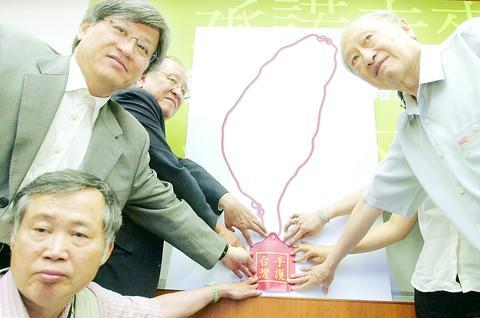
Peter Wang, deputy executive director of the Hand-in-Hand Taiwan Alliance, bottom left, Lee Ming-yung, second left, Ng Chiau-tong, chief organizer of the 228 Hand-in-Hand Rally, top left, and Ruan Ming, a professor at Tamkang University, right, introduce a book and VCD documenting the world's longest human chain yesterday.
-----------------------------------------
On May 19, 2004 ……
Politicians abuse role of discourse
By Ku Er-teh
The most moving political action following the shooting attack on President Chen Shui-bian and Vice President Annette Lu on March 19 is this: young politicians from the Democratic Progressive Party (DPP), the Chinese Nationalist Party (KMT) and the People First Party (PFP) plan to propose a New Culture discourse aimed at resolving ethnic confrontation in Taiwan. This has been one of the few constructive things that politicians have wanted to do in this atmosphere of political and ethnic hatred. But how effective will it be? I have my doubts.
I don't doubt the importance of a new discourse. "Discourse" seems to be such a powerful academic word, yet it is something we all engage in in our daily lives. It's a way of communicating and engaging in rational debate in order to arrive at some degree of consensus on a certain issue. Although rationality is not the only component of human society, society would not function if we denied the possibility of rational consensuses and norms.
Nor do I doubt the sincerity and good intentions of the pan-blue and pan-green politicians involved in the construction of this new discourse. Their capacity for rationality is above that of the average politician. The New Society Declaration, for example, drafted 15 or 16 years ago by one of the participants in the New Culture discourse, Julian Kuo, became the focus of debate for students and social activists of the day.
What I do doubt, however, is whether many people will accept having politicians direct the formation of a discourse.
Quite a number of important new discourses have appeared over the past dozen years -- the Rising People discourse, the New Central Plains Culture discourse, the New Taiwanese discourse, the state-to-state discourse, the Alien Regime discourse, and so on. Some of these discourses have been more reminiscent of slogans, but many are the result of rational argumentation. Most of them have been proposed by advisors to politicians, and have then trickled down through society via politics.
All of these discourses were at one stage or another given wide coverage by the media, and they were once on the lips of every politician and common man. They have influenced the way people think. The state-to-state model, for example, created an uproar when it was first proposed, but in the past two or three years many people have come to accept the idea of one country on each side of the Taiwan Strait.
But why did former DPP chairman Hsu Hsin-liang, who proposed the Rising People discourse from a DPP point of view, end up in direct opposition to Chen during the recent presidential election? And why does Taipei Mayor Ma Ying-jeou, who relied on former president Lee Teng-hui's New Taiwanese discourse to win his election, no longer seem to live in the same country as Lee?
Because politicians don't care about the process of a discourse. All they ask is whether a discourse meets their political interests. If it does, they use it. The majority of the public are even less engaged in the discourse process, and are only aware of a discourse's results.
It is very difficult to imagine a cultural discourse emerging from the political arena. But how about the world outside politics? It has been said that religion is good medicine in times of chaos, so how about Taiwan's religious leaders? After March 19, when they have been most needed by society, they have only been willing to issue uncontroversial press releases.
Only Cardinal Paul Shanand Master Sheng Yen have been willing to stand up and make some further statements, and it is still not an area open to social dialogue. Master Hsing Yun showed an interest in the election only when things had calmed down slightly, and the Presbyterian Church had a lot of misgivings about making a donation for the recount.
How about cultural circles then? Lately, cultural groups seem to have been more interested in issuing declarations than in engaging in dialogue. A step down on the ladder, the mass media orators are spreading doubt lacking any rational foundation on daily TV talk shows. Imagine the following scene: a member of the public is sitting in a taxi reading an article about how Chinese culture is an important part of Taiwanese culture, or one about how Taiwanese culture is a branch of Chinese culture, while a voice on the radio says that "although forensic scientist Henry Lee says Chen didn't fire the bullets himself, these two bullets are still mired in doubt." Would you still have any interest in considering the Chinese or Taiwanese culture issue?
The formation of social and cultural discourses requires sincere dialogue. With society unwilling to engage in dialogue, it will be even less probable that politicians will give up their dialogue ruled by the logic of power. Maybe political circles should pay more attention to minimizing social confrontation from a policy, systemic and even personnel point of view.
The political scientist Lin Jih-wen, for example, has considered the question of how to reduce the polarization during election campaigns from the perspective of the electoral system. And why hasn't the Cabinet reshuffle included any actual personnel arrangements aimed at putting the spotlight on ethnic reconciliation? Would these issues be more difficult to achieve than the formation of a New Culture discourse?
Ku Er-teh is a freelance writer.
-----------------------------------------
On May 19, 2004 ……
Four fundamentals for the future
By Frank Wu
Taiwan's geographical position was instrumental in putting it on the world stage during the great ocean-going age of the 16th century. It was because of this that the island became home to many different ethnic groups, and this ethnic diversity naturally led to the multicultural society we now have in Taiwan.
Ethnic and cultural diversity can easily cause ethnic and cultural conflict. If such differences are dealt with skillfully on a political level, however, this very diversity can be turned into a valuable asset for Taiwan.
In other words, if one does everything to avoid discord, remains broad-minded and designs a model in which all groups can be governed together, then this ethnic diversity will guarantee a wealth of talent. If one avoids discrimination and elitism and promotes a multicultural system, cultural diversity will ensure a blossoming culture. This is the first fundamental principle in planning for the future of Taiwan.
Complex historical factors have forced minority rule, colonialism and dictatorship on Taiwan throughout the past 400 years. This ended in 1996 when the Taiwanese people elected their president, ushering in a new era. This did not mean that Tai-wan was free of its pre-1996 historical baggage, and even now it is yet to break free of a triangle including the US and China.
The political reverberations left over from the end of World War II and the civil war fought between the Nationalists and Communists in China are still being felt today. The fallout has made Taiwan captive to the US and a renegade province that China stakes its claim to liberate.
Although Taiwan now meets all the criteria of a nation, it has yet to secure international recognition of its legitimate and full nationhood.
The US is a powerful nation quite capable of protecting its interests in Taiwan. That is not to say, however, that Taiwan has nothing bargain with. China is calling for unification, and if the Taiwanese want China to understand and respect their desire for autonomy, then they will also have to understand and respect why China has no alternative but to call for unification. Only then can the two sides move together in the same direction. It is far wiser to be positive than negative, and this would be a very important principle to follow.
American interests are not absolutely identical to those of China, and it would not be too difficult for Taiwan to secure benefit from both sides. What's more, globalization of the economy is inevitable, and this will significantly change international relations; even the concepts of national boundaries and arms need to be redefined. If we can deal with these changes well, we can reverse our current isolation. This is the second fundamental principle for planning for the future.
Taiwan's importance has always been the economic value of its productive output; this economic value has consistently assured its survival. Taiwan consequently needs to produce new ways of making money.
Taiwan has relied on different products at different times. In the past it has produced deer skins, camphor, tea, sugar, rice, clothes, jewelry, plastics and electronics. In the short term we can expect this role to be taken by bio-tech, but in the longer term the nation is likely to rely on its cultural and tourist industries. Why has no one in government sought to consolidate the various European, Chinese, Japanese, American and Aboriginal cultural resources that we have here? Could it be that no one up there has realized that the Pacific coast along Taitung is the nearest stretch of tropical coastline for the several hundred million tourists north of the Pashi Channel?
If these tourists were enticed to spend a few days each visiting Taiwan, and to spend NT$30,000 on Taiwan's cultural and tourism resources, this would become Taiwan's largest and most sustained source of economic interest. This idea needs to be seized and put into practice. Creating the conditions for cultural and tourist facilities of an international standard is the third fundamental principle.
The most important principle, however, needs to be recognized by the government, the opposition and the people. The present-day state of Taiwanese politics was not achieved through bloody revolution, but through a peaceful and gradual process. There is a huge difference between these two paths.
If there had been a revolution, the old system would have been overthrown and replaced by a new one overnight, and the differences between respective systems would have been stark. The non-violent route evades the tragic cost, but demands a kind of "payment in installments" from politicians and the people to offset the price of revolution. This installment plan entails its own kind of anguish, and changes in power and authority need to be borne with patience, tact, compromise and mutual consideration. This is the fourth fundamental principle in planning for the future.
Frank Wu is the chairman of the Public Television Service Foundation.
-----------------------------------------
On May 19, 2004 ……
-----------------------------------------
On May 19, 2004 ……
China needs a history lesson
On Monday, Taiwan's eighth bid to join the World Health Assembly (WHA) was ended by a vote of 133 to 25. But both the US and Japan, after many years of silence, finally spoke out for Taiwan, urging the WHA to exclude political considerations and accept Taiwan as an observer without voting rights on the principle that medical issues transcend national boundaries.
The SARS epidemic hurt Taiwan deeply last year. Although the nation paid considerable social costs in the process of dealing with the disease, its outstanding performance attracted worldwide attention. Taiwan's medical care standards and public health defenses are much better than those of China, which ranks 144th among the 191 WHA member states.
Beijing has been the source of two SARS outbreaks that sent the entire world into a panic. Yet it shamelessly claims that it has provided medical assistance or earthquake emergency aid to Taiwan as a Chinese province.
Is this for real? If the Chinese regime really cherishes the life and property of the Taiwanese people, why would it deploy 500 missiles along its coastline aimed? How is it possible that a country so poor by sanitary and medical standards can offer assistance to a country with relatively better conditions?
History reveals China's claims to be lies. Prior to any Chinese settlement in Taiwan, Portuguese commercial boats arrived in nearby waters. Ever since then, the island, which was originally inhabited by Aboriginal people, has been tangled in world politics. The Dutch landed and started developing Tainan in 1624. The Spanish later occupied the north with an official ceremony on today's Hoping Island in Keelung.
China's political influence did not
reach Taiwan until 1661, when Koxinga, a loyalist to the fallen Ming dynasty,
defeated the Dutch after his retreat to Taiwan. Then, in 1683, the Qing took
over Taiwan. Ceded to Japan in 1895, the island was Japanese territory for half
a century. Taiwan was taken over by the refugee regime led by late president
Chiang Kai-shek in 1945, following Japan's defeat in World War II.
As these historical facts demonstrate, Taiwan has never been an inherent part of China's territory. Instead, it is an island that other powers have fought over since the 17th century. When the People's Republic of China was founded on Oct. 1, 1949, the Republic of China set up its central government in Taiwan separate from China's. One capital was in Beijing, the other in Taipei. The long standoff has produced "one country on each side" of the Taiwan Strait. It's absurd to claim Taiwan to be part of China's integral territory or as a breakaway province.
Beijing keeps pressing the international community to accept its twisted logic and historical claims, most recently in forcing Taiwan to be excluded once again from the WHA's list of observers. Such Chinese suppression will only further irritate the Taiwanese and will block this nation from contributing its medical aid and lending its experience to needy countries.
Although Taiwan's national dignity was damaged again, those who will suffer the most from this exclusion may be poor countries in need of medical aid, along with the principle of fair distribution of medical resources, which the WHA is supposed to uphold.
-----------------------------------------