20040521
=======
Chen’s statement on May 21, 2004 ……
Chen to continue middle way
INAUGURATION SPEECH: The president said he would still seek changes to the Constitution, but took steps to ensure his next four years in office did not alienate the US or do too much to antagonize China
By Lin Chieh-yu, STAFF REPORTER
President Chen Shui-bian pledged in his inauguration speech yesterday to pursue constitutional reform in his second term, but said he would not address the thorny issues of national sovereignty, territory or independence.
"By the time I complete my presidency in 2008, I hope to hand to the people of Taiwan and to our country a new version of our Constitution -- one that is timely, relevant and viable. This is my historic responsibility and my commitment to the people," Chen said.
"I am fully aware that consensus has yet to be reached on issues related to national sovereignty, territory and the subject of unification/independence; therefore, let me explicitly propose that these particular issues be excluded from the present constitutional re-engineering project," he said.
The inauguration ceremony began in rainy weather at 9am at the Presidential Office.
Supervised by Judicial Yuan President Weng Yueh-sheng, Chen and Annette Lu took their oaths to be sworn in for their second term. Legislative Speaker Wang Jin-pyng presented the state seals to Chen and Lu.
After signing the official documents appointing Premier Yu Shyi-kun, Presidential Office Secretary-General Su Tseng-chang and National Security Council Secretary-General Chiou I-jen, Chen received foreign delegations and accepted their congratulations.
In his inaugural speech, "Paving the Way for a Sustainable Taiwan," Chen sought to reduce tensions with China and to reassure the US that his plans for a new constitution would not stir up trouble.
Chen said the first step is to have the legislature pass a constitutional amendment, something he said during the election campaign he wouldn't do.
"Accordingly, after the passage by the legislature, members of the first and also the last Ad Hoc National Assembly will be elected and charged with the task of adopting the constitutional reform proposal as passed by the legislature, abolishing the National Assembly, and incorporating into the Constitution the people's right to referendum on constitutional revision," Chen said.
As to the future of cross-strait relations, Chen expressed "understanding" toward Beijing's "one China" principle -- something the Democratic Progressive Party (DPP) government has never done -- and said an environment of peaceful development and freedom of choice would allow the two sides to seek to establish relations in any form.
"We can understand why the government on the other side of the Strait, in light of historical complexities and ethnic sentiments, cannot relinquish the insistence on the `one China' principle," Chen said. "By the same token, the Beijing authorities must understand the deep conviction held by the people of Taiwan to strive for democracy, to love peace, to pursue their dreams free from threat, and, to embrace progress," he said.
Noting that Taiwan is a free and democratic society, Chen said neither an individual nor a political party alone can make the ultimate choice for the people.
"We should not exclude any possibilities, so long as there is the consent of the 23 million people of Taiwan," Chen said.
He urged both sides to establish a dynamic "peace and stability framework" for interactions.
To express his goodwill to maintain stability in cross-strait affairs, Chen, while not directly reiterating the "five noes" made in his 2000 inauguration speech, said he would follow the promises and principles set forth in 2000.
"Those commitments have been honored -- they have not changed over the past four years, nor will they change in the next four years," Chen said.
He also reaffirmed his resolution to establish a committee that would gather input from all parties and the public to draft guidelines for cross-strait peace and development.
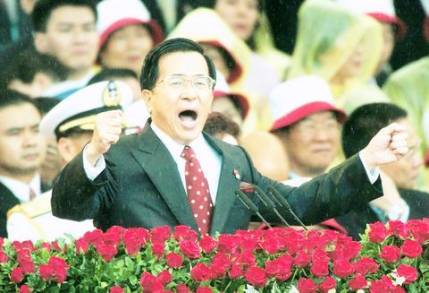
President Chen Shui-bian gestures during his inauguration speech yesterday in front of the Presidential Office in Taipei.
-----------------------------------------
On May 21, 2004 ……
Chen's speech was constructive: Leach
"I think the president has taken
our views into account as he has taken the views of the people in Taiwan into
account." --- James Leach, US congressman and head of the US
delegation to the presidential inauguration
US PERSPECTIVE: The head of the US delegation said he was impressed with the tone and substance of Chen's speech, particularly his flexibility toward the Constitution
By Melody Chen, STAFF REPORTER
President Chen Shui-bian's inaugural speech was "constructive and helpful" for trilateral relations between Taiwan, the US and China, US Congressman James Leach, leader of the American delegation to Chen's swearing-in ceremony, said yesterday.
After the ceremony, the US delegation met Chen in the Presidential Office and Leach delivered a letter to Chen from US President George W. Bush. Details of the letter were not available.
Commenting on Chen's explanation of his plans for constitutional reform, an issue that has sparked concern in Washington and Beijing, Leach praised the president for "very wisely taking a tack of seeking to amend the Constitution rather than seeking a new constitutional convention."
In his speech, the president called for a "project of constitutional re-engineering" rather than an entirely new version of the document.
"This is a methodology that is possibly more important than the end results. Sometimes process can be as important as substance," the congressman said.
"I think the president made it clear he wanted the process of seeking consensus in Taiwanese society for how the government should be structured. He also made it clear he wants to start some kind of discussion about how to make relations with the mainland more credible," Leach said.
Leach made the remarks ahead of a closed-door meeting with Kaohsiung Mayor Frank Hsieh in Taipei's Grand Formosa Regent Hotel yesterday afternoon. Leach and Hsieh have been friends for years.
Chen handled the constitutional reform issue "in a very decent way," said Leach, adding: "He is seeking to make it clear he is not imposing. He is attempting to bring the whole of the society together."
Declining to say whether the US was satisfied with Chen's speech, Leach restated that the US was very cautious at this time.
"We have certainly advocated great caution. I think the president has taken our views into account as he has taken the views of the people in Taiwan into account," Leach said.
Warning that Taiwanese stability and democracy could be upset through accidents and belligerency, the congressman said that now was the time everyone should work together.
"We were cautioning the mainland as we are cautioning people here in Taiwan," he said.
The promotion of constitutional re-engineering and the re-establishment of the constitutional order are tasks that correspond with the expectations of the people and are in accordance with the consensus shared by all political parties, Chen said.
Describing constitutional reform as his "historic responsibility and commitment to the people," Chen promised that issues related to "national sovereignty, territory and the subject of unification/independence" would be excluded from the constitutional re-engineering project.
"Clearly he is seeking consensus of the Taiwanese people and just as clearly he is seeking not to be too confrontational with the mainland," Leach said.
Asked whether the president's speech would help cross-strait relations, Leach said: "I think the president has said what he needed to say. It is not for me to be critical."
Sharing his thoughts about the overall speech, the congressman said that Chen had made "an extraordinary personal statement of moderation" and that the president's "call for a middle way was very impressive."
"I thought he artfully made a very profound statement. In fact, my sense was that it was one of the most quality statements a head of government has made in recent times," Leach said.
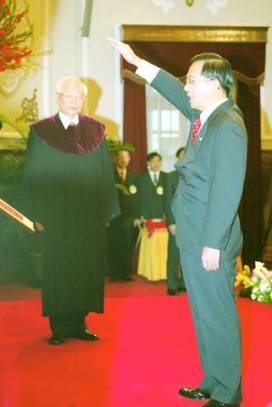
FINAL OATH
President Chen Shui-bian is sworn in while Judicial Yuan President Weng Yueh-sheng looks on at the Presidential Office yesterday.
-----------------------------------------
On May 21, 2004 ……
A missed opportunity
Prior to President Chen Shui-bian's inauguration there was considerable speculation as to what he might say in his speech. There needn't have been. Yesterday's speech, reprinted on these pages, was almost entirely predictable, given the pressure on Chen from internal forces, the Americans and China. These demands amounted to gestures toward reconciliation across the political and ethnic groupings sundered by the election, reassurance as to the substance and the method of future constitutional change and some kind of overture concerning peace in the Taiwan Strait. The demands and the exigencies of the current political situation put Chen in a straightjacket in which grand gestures were simply not possible.
That does not mean there weren't things worth noting. For example, in the area that has worried the US the most, that of constitutional reform, Chen presented a laundry list of anodyne issues that few except constitutional scholars could make conversation about. Once again what was noticeable was what was excluded. Chen specifically said that since there was no consensus on issues relating to national sovereignty, territory and independence/unification, these issues would not be part of the constitutional re-engineering, thus making the US happy and disappointing the most hardline elements of the pan-green camp.
It is also worth noticing that Chen said that the constitutional revision process would proceed according to the system laid down in the Constitution. That may hardly seem remarkable, but there was talk of throwing out the set process for revision and having a new constitution endorsed by referendum. We have criticized such maneuvering before as far too closely resembling a Latin-American-style populist coup. That Chen has abandoned the reform-through-referendum plan should reassure those who fear what, after the last election campaign, he might do with the Referendum Law.
But what people were really looking for in Chen's speech was some indication of his attitude to China and here we think a chance was missed. Chen did not repeat his "five noes" pledge made at his last inauguration. The "five noes," in which Chen volunteered not to implement a number of measures to which China objected, were designed to keep Taiwan's international status in the limbo from which China has benefited so much. That Chen did not reiterate the "five noes" is good. What is not so good is the evidence that the kind of thinking that motivated the pledge, that China would respond to "goodwill gestures" -- and we remind our readers that it never has -- is still in play. We would caution the president that his first term showed that goodwill gestures toward China are invariably interpreted as gestures of weakness by Beijing.
The low point of Chen's speech came two-thirds of the way through when he said that "we can understand why the government on the other side of the Taiwan Strait ... cannot relinquish insistence on the `one China principle.'" Actually, no we can't. To say such a thing is to suggest that Beijing's territorial demands have justification -- which, under any interpretation of international law, they don't.
What should have been said about the "one China" principal was not that Taiwan understands it, but that Taiwan would like to enter into talks if only Beijing would drop such an unreasonable demand, thereby throwing the blame for the impasse in cross-strait relations where it belongs -- on China's absurd preconditions.
Chen did make the customary remarks about the aspirations of Taiwan's 23 million people, but then Beijing talks at length about what the 1.3 billion Chinese will and will not put up with. Chen talked about being just the servant of the people. And he also said that any solution to the China-Taiwan impasse needed the endorsement of the Taiwanese. But we think a serious opportunity was lost here, an opportunity to present a compelling case for Taiwan's current stance, an opportunity to impress upon the world that the Taiwanese people's endorsement is not a rhetorical figure of speech but refers to a very practical process: Taiwanese saying "yes" or "no" to any proposed settlement via the ballot box.
It is true that all the elements of just such a message were in his speech. It is regrettable therefore that they were not presented in a cogent and compelling argument that would make leaders in China, Washington and elsewhere sit up and think. Taiwan will resist to the utmost the shotgun wedding that is the only relationship Beijing has on offer. If Beijing wants Taiwan, it has to woo it to win it, and the voters of Taiwan are the only arbiters of whether it has succeeded in its attempt. It is not provocative to say this, though it might force a number of people on both sides of the Pacific currently in denial to confront reality. Foreign powers that want to see better cross-strait relations need to take note of this and put pressure on China to change its ways, not on Taiwan to zip its lip. Chen could have pointed this out with far more force yesterday. What a shame he didn't.
-----------------------------------------