20040522
=======
ROC flag in May 22, 2004 ……
Lawmakers debate whether ROC flag is like a used condom
AP , TAIPEI
An opposition lawmaker sparked a heated debate in the legislature yesterday, saying that supporters of President Chen Shui-bian treated the country's red and blue flag like it was toilet paper or a used condom.
Chinese Nationalist Party legislator Chang Yi-wen noted in an impassioned speech in Parliament that many of Chen's supporters were given mini flags to wave during Thursday's presidential inauguration ceremony.
After the event, many of the flags were thrown on the ground. Chang said this reflected the president's disrespect for the flag. Some in the president's Democratic Progressive Party have supported adopting a new flag.
"He treats the flag like toilet paper," she said. "Once he uses it, he throws it away."
Referring to Chen by his nickname, the lawmaker added, "Yesterday, I went back to the south and people told me that President Abian treats the flag like a condom. After he uses it, he just tosses it away."
Democratic Progressive Party lawmaker Lee Ming-hsien took over the podium and accused Chang of disrespecting the flag by using a crude metaphor to describe it.
"Why would such a beautiful women say such unpleasant things?" Lee said.
"How could you use a condom as a metaphor for the national flag?" he asked. "Is this appropriate? Is this respecting the flag?"
Lee said that during violent street protests after the March 20 presidential election, some opposition supporters disrespected the flag by using flag poles to clobber police who were trying to control the crowd.
Another ruling party lawmaker, Lin Chung-mo, approved of Chang's metaphor because he said that condoms were important things that protected people from life-threatening diseases.
"Using a condom as a metaphor for the flag sounds good to me," said Lin, who has a reputation for outrageous comments. "Condoms are really useful."
-----------------------------------------
On May 22, 2004 ……
Chinese media froth at the mouth
AGENCIES , BEIJING
As Beijing turned to the US for sympathy, Chinese state media yesterday slammed President Chen Shui-bian as a "slippery politician" bent on pushing the nation toward formal independence, despite the conciliatory tone of his inauguration speech.
Beijing issued no direct response to Chen's speech on Thursday, but a statement issued by China's Foreign Ministry hours after he was sworn in called him the "biggest threat" to regional peace.
Late yesterday, China then urged the US not to be fooled by the "deceptive manner" of the Taiwan authorities after Washington praised the speech.
"We again urge the United States to see through the deceptive manner of the Taiwan authorities," ministry spokesman Liu Jianchao said in a statement posted on the ministry's Web site.
Major newspapers, meanwhile, focused on anti-Chen protests and quoted Chinese academics who denounced his motives.
"Chen Shui-bian's speech cannot cover up true intent of Taiwan independence," read a headline in the Beijing News, which had a photo of an anti-Chen protester.
Chen "painstakingly dodged the one-China question and it was impossible to see any sincerity toward improving relations across the Taiwan Strait," it said. "Rather, it used flowery language and played word games, concealing his `Taiwan independence' splittist position. Cross-strait relations in the next four years will remain in crisis."
An editorial in the China Daily proclaimed: "Chen Shui-bian's latest offer of `goodwill' turns out to be another sham."
Chen's speech appeared to be an attempt to smooth things over with Beijing and assure the US he wasn't trying to start a war with China. But the Chinese press disagreed.
"His latest inaugural address is once again gaudily decorated with such `universal human values' as `public welfare,' `freedom and democracy' as well as `peace and goodwill,'" the China Daily said. "Chen's promise not to constitutionalize the `two states' theory has never prevented him from treating Taiwan and the mainland as two sovereign entities, including in yesterday's speech.
"Many wonder whether his domestic audience was the main target of Chen's speech. What most of the overseas audience heard, however, were the very latest and the most beguiling words of a slippery politician," it concluded.
A Chinese ministry official who refused to give his name said the ministry's statement was a response to US criticism of Beijing's warning on Monday that it would crush any moves toward Taiwan independence.
Chinese academics quoted yesterday by Chinese media expressed skepticism about Chen's motives.
Fan Xizhou, a professor at the Taiwan Research Institute of Xiamen University, said in the China Daily that Chen's "pro-independence stance can be sensed everywhere within his 5,000-word inauguration address.
"Behind all the soft words is his hard will to cling to a separatist stance and forge ahead with his pro-independence agenda," he said.
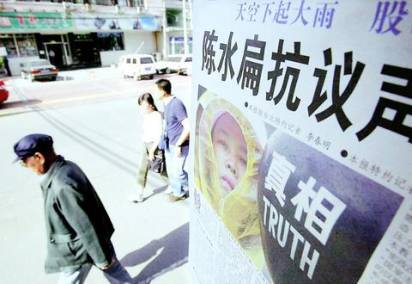
Beijing residents walk past a newsstand where a headline reads, ``Chen Shui-bian sworn in amid protests'' in Beijing yesterday.
-----------------------------------------
On May 22, 2004 ……
Advice to Chen: steady as she goes
By Michael Danby
Sworn in for his second term, President Chen Shui-bian is the head of state of the Republic of China (ROC), but most who live there don't really call it that. They call it Taiwan. This ambiguity has been fostered by Chen since he became president in 2000. His Democratic Progressive Party (DPP) was founded to support the cause of Taiwanese democracy, and this democracy has inevitably come to question the nation's status.
Chen, however, is too cautious and too mindful of the strong advice from Taiwan's closest ally, the US, to move openly toward independence. Instead, he has inched crabwise in this direction, gradually dropping references to the ROC and allowing Taiwan to appropriate all the trappings of an independent state.
China is not having any of this. Its position is that Taiwan is a province of China, and that neither Chen nor the Taiwanese people have any right to change this: they're not very big on democratic theory in Beijing. Although China often accused former president Lee Teng-hui of favoring Taiwanese independence, China still prefers its old enemy, the Chinese Nationalist Party (KMT), to the DPP. Chen's victory in this year's election greatly annoyed Beijing.
For his second term, Chen has set
himself the ambitious task of revising the Constitution. This will be an
exercise fraught with danger. If a new constitution abandons the name ROC and defines
the national territory as the island of Taiwan, this will be a declaration of
independence, as China understands perfectly well.
In the run-up to the inauguration, China deployed its usual mixture of threats and inducements to influence public opinion in Taiwan. If Taiwan's leaders should move towards independence, Beijing said last week, "the Chinese people will crush their schemes firmly and thoroughly at any cost." Since China has over 500 missiles targeting Taiwan, this is not an idle threat.
On the other hand, Beijing says, if Taiwan will only acknowledge that "there is only one China in the world" and that "both the mainland and Taiwan belong to one and the same China," then all sorts of concessions might be possible. These could include "formal ending of the state of hostility through equal-footed consultations, establishing a mechanism of mutual trust in the military field and jointly building a framework for peaceful, stable and growing cross-strait relations."
There are three problems with these honeyed words. The first is that, in the 55 years since the People's Republic of China was founded, the people of Taiwan have grown less Chinese and more Taiwanese. There was always a separatist strain in Taiwan, but since the establishment of democracy the feeling of difference has grown greater. The people mostly speak Hoklo (commonly known as Taiwanese), not Mandarin, and even the children of the refugees who came from China in 1949 think of themselves as Taiwanese. They are less and less interested in unification with China.
The second problem is that Taiwan is no longer the country the Beijing leadership thinks it is. The most striking feature of this year's presidential election was that, despite the acrimony over the close result, the issue was referred to the High Court, where it is close to being settled. This shows that Taiwan is not just a democracy but a mature democracy that accepts the rule of law. This culture is alien to the corrupt authoritarianism of China, a country which, for all its economic advances, is still basically ruled by force and fear.
The third problem is that China has a proven record of bad faith. Before the British withdrawal from Hong Kong, China made the same sort of promises it is now making to Taiwan, under the slogan "one country, two systems." But since the handover, China has imposed authoritarian rule in Hong Kong by the same tactics that the communists used to take over Poland and Hungary after World War II. China has broken its promise, enshrined in the Basic Law, to allow the people to elect a fully democratic legislature and to choose their own head of government.
All these circumstances make it unlikely that the Taiwanese will ever agree to unify with China on any terms, and certainly not on the terms of Beijing's one-party regime. The democratic parties in Taiwan might move onto the front foot by advising their would-be overlords that while there will not be any overt moves toward independence, international and Taiwanese concerns would be eased if China adopted less hard-line attitudes toward Tibet and Hong Kong, ceased its rapid military growth that especially targets the Taiwan Strait, and released millions of prisoners from the laogai (the Chinese gulag).
Taiwan cannot become a globally recognized sovereign state despite having one of the world's leading economies. Led by the US, the international community, including Australia, does not want a fight with Beijing over an issue close to the hearts of nationalists at a time when the West is involved in Iraq and the war against terrorism.
This is why the US has been forcefully advising Chen not to declare Taiwan's independence -- not that he has any immediate intention to do so -- and also advising him not to include any wording in the new constitution that could be seen to be implying a declaration of independence. It is also useful advice at a time of economic revival that Taiwan buy defense technology such as advanced anti-missile radar and jet fighters.
With its third free presidential election, there is increasing goodwill toward Taiwan, which has proved that democracy is not inconsistent with a Chinese republic. Taiwan would be well-advised to cool it for the moment, while it continues to build up international goodwill.
Michael Danby is a Labor member of the Australian House of Representatives. He was part of an Australian delegation that attended Chen's inauguration on Thursday.
-----------------------------------------
On May 22, 2004 ……
Meeting threats with candy floss
China has been escalating its anti-Taiwan, anti-Chen Shui-bian rhetoric yet again.
First we had the Taiwan Affairs Office saying on Sunday that it would crush any attempt to seek Taiwan independence "at any cost." After Washington rightly called such remarks unhelpful, it was the turn Thursday of the Foreign Ministry to tell Taiwan not to "gamble on the mainland's tolerance" and to call Chen the "biggest threat" to regional peace.
We might hurt ourselves laughing if the situation was not so grave. Taiwan, a small island with defensive military forces only, whose only wish is to be left alone, is the biggest threat to regional peace?
We are gobsmacked by the audacity. This accusation comes from a power that regularly threatens Taiwan with attack -- and regularly has its military practice mock attacks on Taiwan. The same power gave Pakistan the technology and know-how to build nuclear weapons, has played a murky unclear role in its client state North Korea's nuclear program and has been the supplier of choice to a number of unpleasant regimes' chemical weapons programs.
We are immensely gratified therefore by the US House of Representatives' passage on Thursday of legislation to broaden military contacts with Taiwan. We can only hope that the Senate version of the bill also passes and that the White House has the wisdom to sign the measure into law.
What we particularly like about the bill is its frankness, namely that it seeks "to improve the defenses of Taiwan against attack by the People's Liberation Army." Of course that is exactly what the defense of Taiwan is all about, but it is refreshing to see the likely aggressor named.
The US action is, we understand, a Defense Department-inspired measure brought about by concerns that Taiwan's armed forces have declined in recent years in their ability to fend off an attack by China. It is not just the Defense Department that thinks this; it has become received wisdom overseas while being curiously little talked about here.
Of course it might be that the vastly increased cooperation between Taiwan and the US military that has already occurred during the George W. Bush administration has simply revealed Taiwan's forces to be by no means as good as the Americans had previously thought them to be. But US concerns are also cause for our concern.
Part of the problem is political. Weapons budgets need legislative approval, and the legislature is dominated by parties allied to China who have every interest in ensuring Taiwan's defenses remain weak. Another part is financial; Taiwan is an undertaxed country, the treasury of which has increasingly resembled Old Mother Hubbard's cupboard, as all parties have voted money for electorate-pleasing social programs without paying too much attention to where the money to pay for them should come from. The pan-blues' attempt to lower National Health Insurance contributions, irrespective of the fact that the program was facing imminent bankruptcy, was a typical example of this.
The president's inaugural address was full of good news but lacked substance on real problems. It's all very well to waffle about "23 million warm smiles descended from an ethnic rainbow," but it would have been nice if we had heard something about how the government's financial plight is to be addressed and about a determination to strengthen Taiwan's defenses.
Chen's address was about "paving the way for a sustainable Taiwan," but to be sustainable Taiwan has to be able to defend itself from its enemies, or rather enemy, since really there is only one. If Chen wants to talk about sustainability he has to face the unpleasant fact that Taiwan, like anywhere else, has to make the choice between guns and (more) butter.
-----------------------------------------
On May 22, 2004 ……
-----------------------------------------
On May 22, 2004 ……
Ten ways to tweak Beijing
By Bei Dawei, Hsinchu
In order to focus international attention on the cross-strait situation, Taiwan needs to find ways of challenging China without seeming to "step over the line," ie, giving China a casus belli. Here are some suggestions for building a Taiwanese identity and improving its diplomatic situation. Any of these would get attention; several at once would give Beijing a fit.
One, abandon the Minguo (Republican)
calendar. Besides Taiwan, only North Korea thinks that this is the year 93, and
not 2004. And China can't very well complain about the switch, because they
already use the Western calendar.
Two, change the name of the Chiang
Kai-shek Memorial Hall to the "Chiang Kai-Shek Victims Memorial
Hall." A minimum of renovation would be needed, such as replacing quotes
from the generalissimo with the names of those murdered, imprisoned and/or
tortured by his agents.
Three, promise unification talks as soon as Hong Kong has full democracy, and Tibet and Xinjiang are made into a Special Autonomous Regions. This would serve to deflect political pressure from Taiwan, onto hardline factions within China.
Four, invite China to submit any resolution it likes to a popular referendum in Taiwan. If they refuse, it will be something of an embarrassment for them, since it will constitute a tacit admission that the ordinary people of Taiwan do not support them.
Five, allow the Chinese Communist
Party full freedom to operate in Taiwan -- running for elections and so on --
in return for granting similar privileges to Taiwan-based political parties
desiring to contest Chinese elections.
Six, promote an alphabetic (not character-based) script for Taiwanese. If the Zhiyin Fuhao ("bo po mo fo") system could somehow be adapted to this purpose, this would be ideal, as it is both widely-recognized and distinctive from other scripts. (Such a writing system need not displace any others, but might be used in a ceremonial way, as is Maori in New Zealand.)
Seven, promote a multicultural identity for Taiwan in which the Chinese component is seen as merely the largest among many. The model for this would be Singapore. To this end, Taiwan should take steps to encourage non-Chinese to seek citizenship here (for example by eliminating the requirement that foreigners renounce their previous citizenships before seeking ROC citizenship).
Eight, establish a "National
Guard" system in which ROC civilians -- particularly those with previous
military experience -- are encouraged to keep rifles and participate in weekend
military exercises.
Nine, adopt a Taiwanese flag to be
used in addition to the ROC flag. Later the ROC flag could be gradually
abandoned, as circumstances permit. For this purpose I recommend the 1895
"Republic of Taiwan" or "Yellow Tiger" flag, which has the
important vexillological virtues of being beautiful, historic and an excellent
symbol for Taiwan (an "Asian tiger").
Ten, even the name issue could perhaps be finessed, with something like Taiwan Chunghwa Mingguo ("Chinese Republic of Taiwan"), which could be argued isn't that much of a change.
-----------------------------------------
On May 22, 2004 ……
Taiwan deserves statehood
By Rao-kok-sian, Boston
I would like to respond to your article about seeking independence for Taiwan as a country ("Activists warn against `five noes,'" May 14, page 3). There are those who are worried that President Chen Shui-bian's "five noes" pledge from 2000 could undermine Taiwan's prospects as an independent country.
But Taiwan is already an independent country. I believe her statehood is questionable, therefore, Taiwan should seek statehood, not independence, which is what your article would like the readers to believe.
Recently, people have talked about the ROC and Taiwan being one and the same. I do not know if I agree. However, Taiwanese people have accepted the ROC, which was kicked out of China in 1945. The Taiwanese have repaired it and are trying to make it suitable to local conditions. Therefore, it is now the Taiwanese Republic of China.
The "Taiwanese ROC" is different from the "ROC in Taiwan" proposed by former president Lee Teng-hui and used officially by Chen's administration. "ROC in Taiwan" is wrong, because it represents the occupation of Taiwan by China, who allows the KMT to use it for this reason.
"Taiwanese ROC" puts Taiwan at the front and represents Taiwan has the ROC, not China. After all, China rejected her some 60 years ago, so the People's Republic should have no say about the ROC anymore. I would strongly suggest that the media urge A-bian's administration to use "Taiwanese Republic of China."
-----------------------------------------