20040523
=======
Spit on May 23, 2004 ……
Spit on the pan-blue leaders, Lee says
"Some people still refuse to
accept the results of the recount and even blame the national security
mechanism for their loss ... The people should really spit on them for their
behavior." --- Lee Teng-hui, former president
EXPECTORATION: The former president believes that the Lien-Soong cabal has made such a nuisance of itself through its poor sportsmanship and by going into denial over the election that it deserves derision of the liquid variety
By Chang Yun-ping, STAFF REPORTER
Former president Lee Teng-hui said yesterday that the people of Taiwan should spit on pan-blue leaders who refuse to recognize that the presidential election is over and who insist on blaming the government for their loss.
Lee said that although President Chen Shui-bian has been sworn into office for his second term and disputes surrounding the election are coming to an end through the recounting of votes, the opposition parties' leaders, still unwilling to admit that the election is over, keep blaming their problems on the election-eve activation of the national security mechanism.
"Some people still refuse to accept the results of the recount and even blame the national security mechanism for their loss. If they insist on casting blame like that, the election disputes probably won't be settled even in another four years. The people should really spit on them for their behavior," Lee said yesterday while addressing hundreds of students at the Lee Teng-hui School.
Lee said that the most important thing for the people and the administration now is to redouble their efforts, carry out reforms and push ahead with administrative affairs and legislative operations.
Analyzing the pan-blue camp's loss in the election, the former president said that the pan-blue alliance's defeat resulted from Chinese Nationalist Party (KMT) Chairman Lien Chan and People First Party (PFP) Chairman James Soong neglecting to appreciate the growth of Taiwan-centered consciousness. Lee said this failure led to the collapse of the KMT's party-state system and to the break-up of the KMT's control over its own network of supporters.
Lee said that efforts by many private social groups to promote Taiwanese national identity have helped bring about a situation in which 57 percent of the people in Taiwan, according to opinion polls, say that they identify with the notion of Taiwanese consciousness. However, Lee said that the goal is to boost that number to 75 percent within four years.
"Candidates in the next presidential election should endeavor to win at least 55 percent of the vote," Lee said.
Urging Hoklo (more commonly known as Taiwanese) members of the KMT to realize that their party is under the control of politicians who are outside the social mainstream, Lee said that ethnic Taiwanese people have remained a part of the KMT only because they have come to rely on certain benefits that they have received as a result of Mainlander leadership.
Lee said that the KMT's leaders have too much in common with the Beijing authorities and that they don't mind seeing Taiwan harmed if it suits their political interests.
Commenting on a plan that would lead to a merger between the KMT and the PFP, Lee said the plan is riddled with trickery and conspiracy and that it would silence the voices of pro-localization party members, many of whom are leery of the proposal.
Meanwhile, Lee yesterday repeated his dismissal of China's recent threats to "crush" moves toward Taiwan's independence "at any cost," saying the bellicose statements were only bluffing on China's part.
"Some reporters asked me whether I was afraid of the threats. I said there is nothing to fear because barking dogs don't bite. Those were just deceptive tricks by the Chinese," Lee said.
"Furthermore, the guidelines they issued on cross-strait relations were only issued by the very low-ranking Taiwan Affairs Office. If the threats really did come from [Chinese President] Hu Jintao, we would have to seriously wonder if the threats had to be taken seriously. But even if there were any substance to the threats, there is nothing to be afraid of if they want to attack," Lee said.
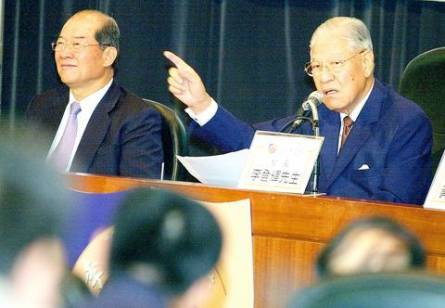
Former president Lee Teng-hui, right, with Huang Kun-hui, the dean of study for the Lee Teng-hui Leadership School, speak in Taipei yesterday at the opening ceremony for the first term of an agricultural economics class at the school and the second term of a class for young leaders. Lee said Taiwan does not have an ethnic problem, but does have problems with national identification.
-----------------------------------------
On May 23, 2004 ……
Good appointments, good politics: analysts
By Lin Chieh-yu, STAFF REPORTER
Compared to the pan-blue alliance, which is engaged in an internal struggle over transferring power to a younger generation, President Chen Shui-bian has performed extraordinarily well in putting talented people in appropriate positions for his second term, in accordance with his goal of developing prospective candidates for major electoral races over the next four years.
Having won a second term, Chen is displaying self-confidence and improving upon his formerly closed style of policy-making in order to incorporate power-sharing, factional balance and the cultivation of talent into his new administration.
With Chen's new Cabinet and a network of officials now established in the national security system and in the diplomatic corps, the Democratic Progressive Party (DPP) is establishing a basis from which it could establish itself as the permanent ruling party, said senior DPP Legislator Hung Chi-chang.
Compared to four years ago, when Chen was confronted with a lack of governmental talent within the DPP and had to select a number of figures from outside his party, the new government is now a veritable cornucopia of talent in a wide range of fields -- including people recommended by former president Lee Teng-hui, senior Chinese Nationalist Party (KMT) experts, bureaucrats and senior figures from the worlds of business and academia.
"When A-bian started out, he really had no standard by which to promote people and, as a result, his Cabinet didn't gel. People found it difficult to work together, causing an unstable personnel situation until the third year of his first term, when he was finally able to judge the mettle of his appointments," Hong said.
Hong says that following this year's presidential election, Chen has promoted people on the basis of experience, taking into account the esteem in which the appointees are held both within the party and outside it.
"Chen no longer needs to rely on outside forces. Those who were promoted before their time have reached maturity and, in his appointments this time around, Chen is looking confidently ahead toward four years -- perhaps even eight years -- of stable government," Hong said.
Another observer says that Chen has done a good job of developing future DPP presidential candidates. The DPP's "four stars" -- Taipei County Commissioner Su Tseng-chang, Premier Yu Shyi-kun, Vice President Annette Lu and Kaoshiung City Mayor Frank Hsieh -- are all plausible choices as presidential candidates in 2008, and all have been advanced by Chen.
Mutual trust
"Su's appointment as secretary-general of the Presidential Office brings him to the very center of power and policy-making, and this was done in order to develop his experience in running the country. If he is successful as secretary-general, he will be the next premier," said Chen Sung-shan, civil service commissioner and the man who served as director of Chen's legislative office when Chen was a legislator.
"In addition, A-bian has taken pains to relinquish some power and give it to Yu, enabling Yu, in the process of reshuffling the Cabinet, to allocate posts in such a way that the Cabinet will become his own base of support. At the same time, in the organization of national security, cross-strait affairs and diplomatic staff, Chen has accepted Lu's favorite candidates, allowing a team to emerge that has been forged by the exercise of mutual trust between the president and vice-president," Chen Sung-shan said.
As for Hsieh -- who is less than halfway through his second term as mayor of Kaohsiung -- Chen cannot yet appoint this political giant to any post. Chen Sung-shan says that Hsieh is regarded as the "possessor of the greatest intellect in the party."
Chen has therefore appointed DPP Legislator Cho Jung-tai, an emerging star and one very close to Hsieh, as deputy secretary-general of the Presidential Office, which should enable Hsieh to participate in national affairs through his close friend.
"Chen has allowed the four eligible presidential candidates to take up battle stations in order to give them every opportunity to compete, as well as to provide an equal balance of power, preventing any one of them from being dominant at the outset and turning Chen Shui-bian into a lame duck president too early on," Chen Song-shan said.
Regarding the 2006 Taipei and Kaohsiung mayoral elections, Chen Shui-bian has clearly sought to cultivate Taipei City Legislator Luo Wen-chia and Kaohsiung City Legislator Chen Chi-mai as candidates, bringing both of them into the Cabinet not only to bolster the government's experience but also to provide the two with political experience.
"Luo-Wen-chia's appointment as Chairman of the Hakka Affairs Commission -- and Chen Chi-mai's as Cabinet spokesman and minister without portfolio -- will give each of them a lot of leadership experience, raise their profiles and enable them to promote and train their staff and aides in the best possible way," said political columnist Hu Wen-huei.
"They only need to do a good job and they will be the best possible DPP candidates for the 2006 Taipei and Kaohsiung mayoral elections," Hu said
The reshuffling of the Presidential Office's staff also deserves attention. Chen has appointed his most trusted senior aide, Chiou I-jen, to return to the post of secretary-general of the National Security Council (NSC) in order to strengthen that department's capacity for "special combat," especially in terms of foreign relations and policy integration, enabling Chen Shui-bian himself to focus more intensively on other priorities.
The president chose close aide Lin Chin-chang, who led the team responsible for the text of Chen's Thursday speech and who coordinates the president's schedule, as a senior adviser at the NSC. Lin will liaise between the president's closest aides and the NSC.
"As in the US White House, important presidential speeches and policy must be looked at by the NSC," said an important aide to the president.
"Lin should be able to steer the operations of the NSC in the direction of those of its US counterpart," the aide said.
Taiwanese awareness
As far as "the political resources" of the Presidential Office are concerned, including posts as national policy advisers and senior adviser to the president, these posts were seen in the past as "serving as a reward for services rendered and as a way to win people over by any means, even in opposition to the party," but the personnel occupying the posts were not actually entrusted with providing advice to the president.
However, the list of names announced by the president on Thursday includes talented figures from the world of business -- replacing the former captains of industry who contrived to steer Chen towards the pan-blue camp -- as well as a good number of people steeped in knowledge of the Taiwan independence issue.
Of 30 senior-adviser posts, 15 receive pay (with salaries along the same lines as those of the presidents of the government's five branches) and 15 serve without pay.
Of 90 policy-adviser posts, 30 serve with pay (with salaries equivalent to those of ministers) and 60 serve without pay.
Evergreen Group founder Chang Jung-fa, who for two decades has been regarded as Chen Shui-bian's biggest supporter, but who during the campaign hinted at endorsing the pan-blue camp, was not included on the new list of senior advisers to the president.
Meanwhile, Wu Li-pei, chairman of the Global A-bian Family and a very successful businessman in the US, was invited to take up a post.
"Some senior leaders of groups that favor independence, and academic elites with strong Taiwanese awareness, such as Chin Heng-wei, Ng Chiau-tong, and Ruan Ming -- respectively, a political commentator, a visiting professor at Tamkang University and a former special assistant to late general-secretary of the Chinese Communist Party of China Hu Yaoban -- have all been invited to serve as national policy advisers to Chen Shui-bian, displaying not only that Chen appreciates their solid support during the presidential campaign, but also that Chen is still an advocate of Taiwan's independence," Hu said.
"At the same time, choosing them is intended to conciliate the pro-independence veterans, to keep them from feeling bitter about the goodwill shown toward China and the backing down from the US in the inauguration speech," Hu said.
-----------------------------------------
On May 23, 2004 ……
DPP: Constitution still requires the people's approval
UNCHANGED GOAL: The president refused to talk about a new constitution in terms of a referendum, but some are not so shy
CNA , TAIPEI
Giving the people the final say in enacting a new constitution is the eventual goal of the ruling Democratic Progressive Party (DPP), and that goal won't be abandoned despite President Chen Shui-bian's decision not to mention it in his inauguration speech, a DPP lawmaker said yesterday.
Tsai Huang-liang, DPP whip in the Legislative Yuan, said that it is his party's long-term goal to give people the right to approve a new constitution and that the party won't lose sight of this goal.
In his speech Thursday, Chen said he would push for constitutional reform through the steps provided for in the existing Republic of China Constitution, including the election of an ad hoc National Assembly.
In a related development yesterday, the Chinese Nationalist Party (KMT) said it wouldn't budge from its proposal to amend the ROC Constitution to extend lawmakers' terms from three years to four years and to cut the size of the 225-seat Legislative Yuan by half, with more than 30 percent of the seats reserved for female lawmakers.
Liao Feng-teh, KMT whip in the Legislative Yuan, said his party is ready to force a showdown with the DPP in a vote in the Legislature, even though the KMT might not prevail in light of the fact that it holds only 65 seats.
-----------------------------------------
On May 23, 2004 ……
Intellectuals hide behind pretense of democracy
By Hsu Yung-ming
Many intellectuals recently voiced their concern that Taiwan's democratic development is moving toward populism. To them, the election was full of political manipulation. Voters' rational judgment was impaired by such decisions as holding a referendum on the day of the presidential election and the shooting incident that occurred on the eve of the election.
They argued that older voters with a lower education level in the south supporting Democratic Progressive Party (DPP) President Chen Shui-bian and Vice President Annette Lu were the ones most likely to be influenced. Therefore, they mistrusted the election results and even contended that the idea of pushing forward localization was nothing but obscurantism.
These discourses are interwoven with prejudices -- first, that intellectuals are more sensible than ordinary people and that they are responsible for educating the public; and second, that people can be easily manipulated, especially by the electoral process, which tends to obscure truths. So they believe that voters will make wrong decisions and that the entire process is a matter of populistic manipulation.
Such an assessment contradicts the democratic principle that every vote has the same value. The rationale behind anonymous voting is to respect each voter's decision regardless of financial conditions or intellectual capability.
The difference between intellectuals and ordinary people does not lie in the value of their votes, but in the discourse resources accessible to the former.
Ignoring the value of people making their own decisions, these intellectuals are being arrogant. The new democracy they uphold is in fact elitism, a practice that violates the equality of human rights. If decisions made by voters are judged by external criteria, such as their academic achievements, place of residence or their social or economic status, then what these intellectuals are pursuing is pseudo-democracy.
With pseudo-democracy comes pseudo-science. Typical of pseudo-science is a recent argument stating that the number of invalid votes cast in the presidential election proves vote-rigging. It embodies the arrogance and anti-intellectualism of the intellectuals.
The intellectuals' arrogance was made evident by their efforts to dress their underlying prejudices in a scientific disguise of numbers, statistics and technical terms. Totally ignoring the practical operation of electoral affairs, they simply use their "academic point of view" to accuse tens of thousands of electoral personnel of vote-rigging, which is practically no different from the Inquisition during the Middle Ages.
The intellectuals' anti-intellectualism is made evident by their attempts to cover their political prejudices behind an academic appearance, which is even used to justify their political preferences. Surprisingly, this is the norm in academic circles. Especially for Taiwanese scholars, who are faced with specialist division of labor and whose academic survival is based on churning out papers, there is a difference between the production of academic articles and the ideal of seeking the truth. Instead we find that their academic skills have become effective tools for producing "truths" -- even with faulty logic behind it, academic discovery is always valued higher.
As a matter of fact, the controversies following the presidential election serve as a monster-revealing mirror. It shows us how many practitioners of pseudo-democracy and pseudo-science are hidden under the high hat of true democracy and science.
Hsu Yung-ming is an assistant research fellow at the Sun Yat-sen Institute for Social Sciences and Philosophy at the Academia Sinica. Translated by Jennie Shih
-----------------------------------------
On May 23, 2004 ……
Lien using merger as a lifeline
During a meeting with Chinese Nationalist Party (KMT) Chairman Lien Chan on Friday, KMT lawmakers openly questioned Lien about the purpose and meaning of a merger with the People First Party (PFP). This is a move that has rarely been seen in the highly conservative KMT culture, in which the party chairman continues to be exalted in a feudal manner.
In reality, after Lien announced a plan to push for the merger, skepticism and resentment within the party, especially from the nativist factions, have been loud and prevalent. After all, the merger is practically suicidal for the KMT as a party, although a small group of people have much to gain -- namely Lien and his loyal supporters.
The merger efforts can be interpreted as the latest counter-strike by Lien's group against pressure for generational succession by Vice Chairman Wang Jin-pyng and Taipei Mayor Ma Ying-jeou, as well as the adoption of a moderate and nativist path by the party.
Obviously, once the KMT undertakes this enormous merger project, Lien and his gang would have new reasons to stay on and delay generational succession, claiming that they must finish what they started. This excuse comes in handy, because the legitimacy of their previous lifeline -- that they must stay to deal with the controversies surrounding the presidential election -- has been fading while the possibility that the recount will overturn the result of the election becomes more and more remote.
Bringing back PFP members to the KMT -- people who had left the KMT mostly due to their inability to identify with the nativist path previously embraced by the party during former chairman Lee Teng-hui's reign -- will turn the tide in the current debate regarding the future direction of the party even further against nativization. In a way, this will also delay and possibly eliminate all possibility of Wang and Ma taking over the leadership. After all, if the party is to align toward the middle and Taiwanese consciousness, Wang and Ma would serve as much better leaders than Lien and PFP Chairman James Soong.
Interestingly, of the six vice chairmen of the KMT, Vincent Siew was the only one absent from the meeting of the party's Central Standing Committee on Wednesday in which the plan to push for a merger was unanimously approved.
It was only earlier this month that the policy and strategy committee headed by Siew had announced the plan to search for a "nativist discourse" as the basis of the party's values, and that Siew had openly called for generational succession within the party. Consequently, it is not hard to guess the reason for Siew's absence. As for the other five vice chairmen who attended the meeting and endorsed the approval, one can only ponder what has happened to their moral courage.
The merger with the PFP, which is considered a radical anti-nativization party, will cause the KMT to relinquish the support of the pro-nativization voters -- which is the biggest voting segment -- leaving the Democratic Progressive Party and the Taiwan Solidarity Union with no competition for that market. That was why the Lien-Soong ticket lost the presidential election. But Lien still seems unable to figure out this simple logic.
As for KMT lawmakers of the nativist faction, they face a serious dilemma: They need the nomination and the campaign resources of the party for the upcoming legislative election, and therefore they do not yet dare to openly revolt against Lien. However, they know only too well that the merger would be bad for their re-election, so their last hope is to at least delay the merger until after the election. But it is unlikely that their voice would be heard by Lien, who is looking increasingly like a party dictator these days.
-----------------------------------------
On May 23, 2004 ……
Leading Taiwan toward normalcy
By the Liberty Times editorial
President Chen Shui-bian and Vice President Annette Lu have officially taken office as the nation's 11th president and vice president. In his inaugural speech, "Paving the Way for a Sustainable Taiwan," Chen sketched the policy-implementation blueprint for the next four years and indicated the direction his policies on various major issues would take.
On the issues of constitutional reforms and cross-strait relationship -- about which there is much concern, both within the country and overseas -- Chen's remarks suggested compromises on his part to live up to expectations from all sides. Generally speaking, the inaugural speech accomplished the effect of being "safe and steady," especially after the pan-blue camp's mass protests and lawsuits seeking to declare the election null and void.
The relationship between the opposition and ruling camps has reached an all-time low and society as a whole is riddled with restless sentiment. The president's inaugural speech especially addressed this point, reminding people that "various ethnic groups, because of their disparate history and distinctive subcultures, understandably hold divergent views and values. Recognizing such inherent differences, we should embrace one another with more tolerance and understanding."
"Regardless of whether an individual identifies with Taiwan or with the Republic of China, a common destiny has bequeathed upon all of us the same parity and dignity. Let us therefore relinquish differentiations between `native' and `foreign' and between `minority' and `majority,' for the most complimentary and accurate depiction of present-day Taiwan is of a people `ethnically diverse, but one as a nation,'" Chen said.
He pointed out that unifying Taiwan, stabilizing the cross-strait relationship as well as domestic society, and having a prosperous economy are the heart-felt expectations of the people, and therefore the top priorities for the government's future policy implementation.
Regarding the issue of constitutional reform, Chen indicated that his reforms will be geared toward better management of the government, improved government efficiency, confirming the roots of the democratic rule of law, and sustainable governance and security of the country. On the substantive level, he plans to organize a Constitutional Reform Committee to identify common ground within society for the scope and procedures of the constitutional reforms, and to accommodate the monitoring of the public as well as commentators.
Chen emphasized that "the Republic of China now exists in Taiwan, Penghu, Kinmen and Matsu. This is a fact. Taiwan's existence as a member of international society is also a fact. Such realities cannot be negated by anyone for any reason -- for therein lies the collective will of the people of Taiwan."
He said that if both sides are willing, on the basis of goodwill, to create an environment built upon "peaceful development and freedom of choice," then the Republic of China and the People's Republic of China -- or Taiwan and China -- "can seek to establish relations in any form they desire. We would not exclude any possibility, as long as the consent of Taiwan's 23 million people is gained."
Middle way
Chen also reiterated the promises and principles set forth in his inaugural speech in 2000. "Those commitments have been honored -- they have not changed over the past four years, nor will they change in the next four years," he said, adding that he would establish a Committee for Cross-Strait Peace and Development to draft the guidelines for cross-strait peace and development. These statements demonstrate his alignment toward the "middle way." The US, China and all camps within and outside of Taiwan should find them generally acceptable.
Whether Chen's concessions will be reciprocated by China remains to be seen, especially after Beijing on May 17 issued a harshly-worded declaration, making threats and criticisms about Taiwan's move to strengthen its sovereignty, as if Taiwan has no choice but to succumb. Beijing's statement was obviously intended to influence Chen's inaugural speech, and anyone who reads the speech can discover the shadows cast by China.
The president needs to seek domestic and international consensus on major issues and should of course exercise caution in his leadership of the country. In this respect, the inaugural speech indeed sought to accomplish a highly challenging task.
However, Beijing continues to claim that Taiwan is part of China, and it keeps escalating its military threats. If we allow them to believe that intensifying the pressure on Taiwan can get them what they want, then Chen's endeavors to consider the overall good will convey a message to China that it can keep pushing us around. Against a backdrop of continued Chinese hostility, hastily expanding and enlarging cross-strait exchanges in journalism, information, education, culture, trade and economy, as well as pushing for direct links, can only increase the likeliness that China will step up its unification propaganda while continuing to hollow out Taiwan's economy.
For Taiwan, the evolution of democratic reforms have reached the point where a new constitution is required. This is supported by the fact that Chen's campaign proposal to draft a new constitution helped him win over the hearts of the people. But in his inaugural speech "drafting a new constitution" has been replaced by a "constitutional re-engineering project," suggesting that issues involving sovereignty, territory and unification versus independence should not be included in the scope of the project.
Moreover, in terms of the procedure of the constitutional reform, the first and also the last ad hoc National Assembly will be elected by the Legislative Yuan according to the existing Constitution and charged with the task of adopting the constitutional reform proposal as passed by the legislature. Abolishing the National Assembly, incorporating the people's right to hold referendums into the Constitution and reforming the Constitution itself will all be accomplished in this way.
Chen said that the last six constitutional amendments over the past 10 years had been spearheaded by one man and one party. He went on to state that in the future, the Constitutional Reform Committee would seek the greatest social commonality in terms of the scope and procedure of the constitutional reform, despite the fact that he had himself already determined the fundamental elements of the reforms. This would seem to contradict fundamental democratic principles. What is worth waiting for is Chen's additional promise to hand over a new version of the Constitution -- one that is timely, relevant and viable -- before the end of his term in 2008.
In addition, the president has recognized that various ethnic groups hold divergent views and values, and that, "recognizing such inherent differences, we should embrace one another with more tolerance and understanding."
Ethnic divisions
The ethnic divisions within Taiwan is indeed a problem that cannot be overlooked and has to be addressed in the democratic re-engineering project. Chen is right to openly speak about the problem. Unfortunately, apart from calling for tolerance and understanding, he did not propose any substantive measures to solve the problem. We must realize that, as long as the issue of national identification within Taiwan has not been resolved, China can continue its unification propaganda, and it can also continue posing a threat to Taiwan.
In addition to seeking a balance point for Taiwanese sovereignty, both domestically and internationally, there is also the need to find a way to move forward. A lot of thought went into Chen's inaugural speech. It sought to find the best balance points for all sides, demonstrating Chen's pragmatism and responsible attitude and finding ways to win US recognition while not giving China any excuse to criticize Taiwan.
Although some shortcomings in the speech have been pointed out, no one can deny that the speech has been successful. Moreover, as suggested by our ancestors, "the importance of governance is not in what one says."
Not all of Chen's strategies and
policies in governance can be conveyed through one single speech. With the
domestic and international situation often changing in the blink of an eye,
Chen will naturally have to make the necessary adjustments based on objective
needs and in accordance with the principles of democracy, so that he can lead
Taiwan toward the goal of becoming a normal country.
-----------------------------------------
On May 23, 2004 ……
-----------------------------------------