20040524
=======
Rethink on Taiwan on May 24, 2004 ……
China's possible rethink on Taiwan
By Sushil Seth
The biggest nightmare for China's oligarchy is the fear of losing power. Fifteen years ago, in June 1989, the party felt so threatened that it let loose its army on an ill-organized student movement agitating for a measure of democracy in the country's governance.
This was the Tiananmen massacre. Its reverberations still resound, keeping the ruling Communist Party on edge.
So much so that one of their own, the deposed party general secretary Zhao Ziyang, now in his eighties and ailing, is still kept under virtual house arrest because he had advocated moderation in dealing with students. If a frail Zhao can be regarded as a threat, it is obvious that the party leadership suffers from a severe case of paranoia.
The ruling junta has also come down hard on the Falun Gong movement, declaring it an evil cult and putting scores of its adherents into the country's fathomless dungeons. The party seeks to control religious revival in China for fear of creating alternative centers of power.
It is in this context that one would need to understand the party's hysteria over the democracy movement in Hong Kong; a reminder of how things nearly got out of control in 1989. Since the former British colony's reversion to China's sovereignty in mid-1997, it has been governed under a 50-year "one country, two systems" formula, which allows it a fair degree of autonomy with the promise of greater democratization. But Beijing is backing out of this promise. The ruling junta believes that it alone has the power to interpret and decide Hong Kong's future without reference to its people or anybody else. And has severely criticized the US and UK for their unwarranted criticism and interference in its internal affairs. Surprisingly, it has succeeded in warding off sustained international criticism on this score.
Why is this so? An important factor is China's economic and political clout -- not so much the reality of it (though that too is important) but the perception of it.
There is a sense that China is an emerging superpower. Most countries would like to keep their relations with it at a friendly level to maximize real and anticipated economic opportunities.
The case in point is the Chinese premier's recent visits to France and Germany, where he received extravagant treatment and his hosts scrupulously avoided mentioning human rights. Even in the US he was accorded elevated status befitting a head of state. China has acquired a larger-than-life stature as a global power.
This perception is further accentuated because of the US' Iraq quagmire. The US is over-stretched and its global strategy has become hostage to developments in Iraq. It therefore doesn't have much time and resources for other issues, like China's emergence as a strategic rival. Indeed, it looks to China for political support, particularly on the North Korean nuclear proliferation issue. At the same time, the publicity about the maltreatment of Iraqi prisoners has compromised its high moral ground on human rights. The timing is, therefore, right for China.
But China's oligarchy is still worried. And it better be, because it lacks domestic political legitimacy. Hong Kong is a reminder that a measure of autonomy and relative economic prosperity aren't enough to win over people in the absence of democratization.
In the same way, Taiwan is also a serious worry. China, of course, is committed to annex Taiwan, and feels thwarted because of a US commitment to defend Taiwan.
The easiest way, therefore, would be to persuade Washington to abandon or dilute this commitment. Beijing continues to work on this, especially since its enhanced political leverage in the context of US overstretch. Just before US Vice President Dick Cheney's recent Beijing visit, its foreign ministry issued a call for the US "to stop being committed" to the Taiwan Relations Act of 1979 underpinning its commitment to defend Taiwan.
In light of its heavy-handed interference in Hong Kong, a democratic Taiwan's incorporation could become the ultimate nightmare for China's oligarchy.
Taiwan is no Hong Kong. Taiwan's population is three times that of Hong Kong, and it has a functioning, well-entrenched democratic system. Unlike Hong Kong, it wasn't a colony of some imperial power, so its people do not have a colonial hangup requiring its return to the motherland. The people have an identity of their own.
Any invasion and subsequent occupation of Taiwan would be a terribly risky proposition. Even its "peaceful" incorporation under a more liberal (than Hong Kong) version of "one country, two systems" will be problematic. Its democratic character will prove corrosive for the communist party's political monopoly. Any attempt to suppress Taiwan's democracy could backfire.
In the circumstances, could it be that China's power-hungry oligarchy might simply continue to mouth the unification slogan while letting Taiwan function in a grey zone of creative ambiguity? That would suit the United States, and might not be so bad for Taiwan's political and economic establishment.
A recently published poll in China found that 5.6 percent of respondents didn't oppose Taiwan's independence. What is surprising is that the government allowed such a survey to be published with even a small minority of its citizens not obsessed with Taiwan's status. Is this a pointer to a gradual shift on China's part?
Sushil Seth is a freelance writer based in Sydney.
-----------------------------------------
On May 24, 2004 ……
History sheds light on ethnic interaction
By Paul Lin
Exaggerations by politicians and the media have distorted the issue of Taiwan's national consciousness, now considered an ethnicity issue. Members of the public painting themselves as part of the "center" are making loud noises, while people within the Democratic Progressive Party (DPP) believe Taiwan is ethnically divided.
We cannot deny that Taiwan has an ethnic problem, but it is not a matter of ethnic division. Even the most civilized democratic countries experience ethnic problems. The key lies in whether the government is stirring up, encouraging or preventing ethnic opposition.
Ethnic problems existed under the Chiang family, too, only the media weren't allowed to report them. These problems have become less intense following democratization and the passing of time. However, people with ulterior motives, followed by more muddle-headed people, create the misperception that ethnic division is real.
In 1949, Chiang Kai-shek led a defeated military and bureaucracy to Taiwan. They constituted a new ethnic group in Taiwan's migrant society, and their coercive rule implemented policies meeting their own interests.
The democratization process weakened Mainlander privileges and negatively influenced their interests. The political remnants of the old system then used the ethnicity issue to oppose the developing democracy movement, labelling democracy "populism." Because army, government, economy and bureaucracy were in the hands of the authoritarian system for several decades, this framing of the ethnic issue -- whether in the media or in education -- entered deep into the minds of the public, and with time it became the accepted truth. The deeper the democracy movement's roots, the more ethnic opposition was exaggerated against it.
The unification-independence issue has always been a matter of national identification, but it also has been misperceived as an ethnicity issue, making a domestic consensus more difficult.
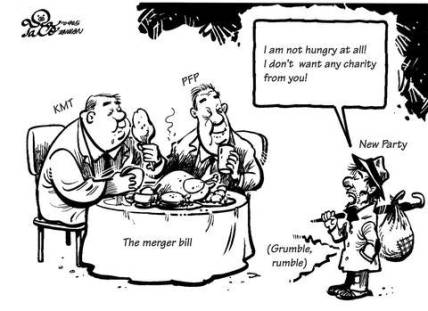
We have also seen 90 percent of Mainlanders vote for Chinese Nationalist Party (KMT) Chairman Lien Chan and People First Party (PFP) Chairman James Soong, and then interpret the defeat of these candidates as a crisis that could mean the demise of nation, party and family.
Radicals came out for "a final struggle," while Lien and Soong relied on rumor and exaggeration to create social disorder and destroy Taiwan's international image. They did not even stop at violence, and should be condemned by all Taiwan.
As a result of the KMT's past authoritarian rule and the White Terror, some actions resulting from the DPP's "tragic" mobilization and unification of the public may have brought harm to some Mainlanders, but only in an extreme minority of cases. As the remnants of the old authoritarian system bring daily accusations of ethnic division and "green terror," they should bring out the names of the victims or remain quiet.
The fact that the representatives of the 12 percent of Taiwan's population made up of Mainlanders can receive almost 50 percent of the vote is proof that localization activists do not look down on Mainlanders.
Following Taiwan's democratization, it is only natural that the interests of those privileged Mainlanders who relied on the Chiang family have been weakened. This doesn't mean there is a policy to exterminate them.
Clinging to old feelings of superiority, they will eventually become irrelevant. Although the children of Mainlanders, they will gradually become integrated with Taiwanese society. There is nothing Soong can do about that.
Paul Lin is a commentator based in New York.
-----------------------------------------
On May 24, 2004 ……
-----------------------------------------
On May 24, 2004 ……
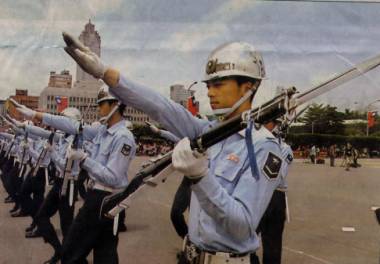
We stand on Guard
Above: Taipei, Soldiers march during preparations for last week’s
inauguration ceremony for President Chen Shui-bian.
During his inauguration speech last week, Chen said that, “Faced with an ever-increasing military threat from across the Strait, it is imperative for all the people [of Taiwan] to forge a strong will to defend ourselves.”
-----------------------------------------
On May 24, 2004 ……
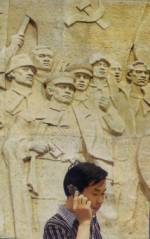
Shanghai, China. A man passes by an engraved stone wall featuring
Chinese Communist Party revolutionaries carrying their hammer-and-sickle
emblem.
On the eve of Chen Shui-bian’s re-inauguration, China tried to apply pressure on Taiwan but failed to gain any ground on the issue of the “one Taiwan, one China” stance held by Chen’s government.
-----------------------------------------
On May 24, 2004 ……
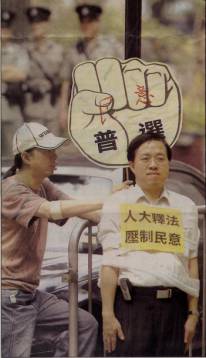
One country, Three systems?
Hong Kong. A pro-democracy protester outside Hong Kong’s Legislative Council building has his hands tied with a sign saying, “China’s interpretation of Basic Law suppresses public opinion.” Over the last few weeks Hong Kong’s pro-democracy legislators have been threatened with violence. Beijing has said that the “one country, two systems” formula under which Beijing governs Hong Kong is Taiwan’s destiny.
-----------------------------------------
On May 24, 2004 ……
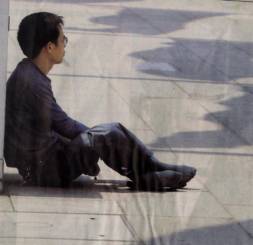
Shadow of doubt
Beijing, China. A man sits by shadows of flags in Tiananmen Square.
As the 15th anniversary of the 1989 crackdown on democracy demonstrations approaches, China’s Communist Party leadership is trying to make sure nothing like the Tianamen Square democracy protests ever happen again.
-----------------------------------------