20040527
=======
Defense minister on May 27, 2004 ……
Nation able to retaliate: minister
PREPAREDNESS: Minister of Defense Lee Jye said Taiwan is prepared to take action if Chinese military aircraft cross the center line of the Taiwan Strait
By Jimmy Chuang, STAFF REPORTER
Minister of National Defense Lee Jye said yesterday that Taiwan would launch a counterattack within five minutes of any strike by China on Taiwanese soil, including Penghu, Kinmen and Matsu.
He also threatened to shoot down Chinese military aircraft should they cross the "middle line" of the Taiwan Strait.
"Whenever their aircraft or vessels are approaching the middle line, our aircraft and vessels will be standing by," Lee said.
"Once they keep going east and enter our `hunting zone,' we will take care of them," he said. "However, peace remains across the Strait and no war is necessary."
Lee was responding to questions from lawmakers about what the military would do if Chinese aircraft cross the middle line of the Taiwan Strait.
Lee told the lawmakers the military would react in three to five minutes of the first bomb hitting the nation.
"I would be the one to give that order. In the meantime, I would brief the president and the chief of the general staff, who would be the ones to carry out that order," Lee said. "We will definitely fight back."
When asked why it would take three to five minutes for Taiwan to fight back, Lee said, "We have to look before we leap."
Lee also told lawmakers that the middle line runs from 23? north latitude, 119? east longitude to 27? north latitude, 123? east longitude, as defined by the US in 1951.
"I have no idea whether the Chinese authorities realized the existence of such an area and asked their soldiers to follow certain procedures during their military activities. But, according to their movements in the past, I believe they did," Lee said.
He added that the state of peace between China and Taiwan has not changed.
According to Lee, China monitors how many of Taiwan's aircraft take off and land each day, just as Taiwan keeps tabs on China's forces.
"There is an implied agreement and nobody wants to break that rule," he said.
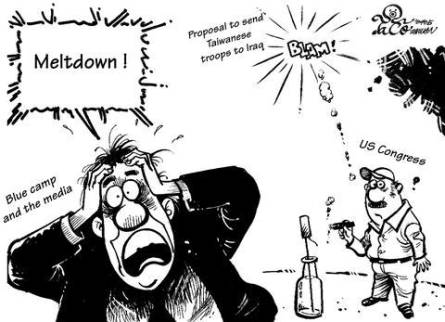
On US House representatives Dana Rohrabacher and Jim Ryun's proposal that Taiwan send troops to Iraq, Lee said the ministry does not have a plan to contribute militarily. He said any dispatch of Taiwanese troops would have to follow certain rules.
According to Lee, military personnel sent overseas would have to be volunteers. Any dispatch of troops would not be allowed to interfere with domestic defense requirements.
He added that maintaining peace is the only goal of Taiwan's military and that soldiers will not participate in attacking other countries.
"The Legislative Yuan has the final authorization to decide whether this country sends its soldiers to fight in other countries," Lee said.
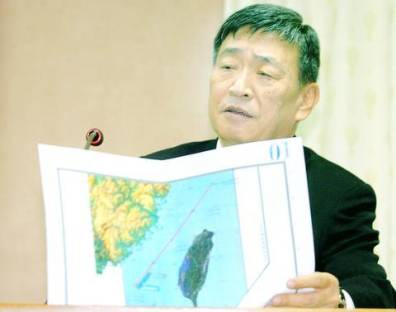
Minister of National Defense Lee Jye holds a map of the Taiwan Strait during a legislative question-and-answer session yesterday, confirming the location of the so-called ``middle line'' of the Taiwan Strait. According to Lee, the line was drawn by the US in 1951 in order to maintain peace and stability in the region.
-----------------------------------------
On May 27, 2004 ……
Amnesty International slams US war on terror
ANNUAL REPORT: The human-rights group said the `war on terror' has produced the most sustained attack on people's rights and international law in 50 years
REUTERS AND AP , LONDON
Washington's global anti-terror policies are "bankrupt of vision" as human rights become sacrificed in the blind pursuit of security, the human-rights group Amnesty International charged yesterday.
The US-led war on terror against extremist groups such as al-Qaeda has produced the most sustained attack on human rights and international law in 50 years, Amnesty said in its annual report released yesterday.
Irene Khan, Amnesty's secretary general, condemned terrorist assaults by groups such as al-Qaeda, saying they posed a threat to the security of people around the world.
Amnesty also rapped partners across the world in the US' self-declared "war on terror" for jailing suspects unfairly, stamping on legitimate political and religious dissent, and squeezing asylum-seekers.
"The global security agenda promoted by the US administration is bankrupt of vision and bereft of principle," Khan said.
"Violating rights at home, turning a blind eye to abuses abroad and using pre-emptive military force where and when it chooses has damaged justice and freedom, and made the world a more dangerous place," she said.
Specifically, Amnesty lashed Washington for unlawful killings of Iraqi civilians; questionable arrest and mistreatment of prisoners in Iraq, Guantanamo Bay and Afghanistan; and opposition to a new global criminal court.
"The world is crying out for principled leadership," Khan added, saying the negative effects of US-led anti-terror policies had spread far and wide.
"Governments are losing their moral compass, sacrificing the global values of human rights in a blind pursuit of security," she said.
"By failing to protect the rights of those who may be guilty, governments endanger the rights of those who are innocent and put us all at risk," Khan said.
In Europe and Asia, Amnesty criticized regressive anti-terror legislation, attacks on refugee protection and restrictions on freedom of association and expression.
It singled out Britain for holding 14 foreigners without charge, Spain for closing a Basque-language newspaper, the EU for ignoring human rights in its asylum thinking, and Uzbekistan and Turkmenistan for internal repression.
In China, India, Malaysia, Pakistan and Thailand "the belief ... that human rights could be curtailed under the `war on terror' umbrella was particularly apparent," with hundreds of detainees left in legal limbo, Amnesty's report said.
Arab nations also came in for criticism for allowing the transfer of people between states without judicial proceedings.
"While some states, such as Egypt and Syria, had long-standing states of emergency in place, the `war on terror' was used as a pretext to legitimize existing practices, such as long-term administrative detention and unfair trials by special courts whose procedures fell far short of international standards," the annual report said.
"Other states, such as Morocco and Tunisia, introduced new `anti-terrorism' laws during the year, which posed a further threat to basic human rights."
Amnesty also condemned the "callous, cruel and criminal attacks" by armed groups such as al-Qaeda.
The combined effect of those attacks and states' violations of rights was to create the most serious assault on rights and humanitarian law in half a century and make "a world of growing mistrust, fear and division", it said.
With Iraq and anti-terror policies dominating, world attention has been diverted from old wars, the group also noted. Conflict in Chechnya, Colombia, the Democratic Republic of Congo, Sudan and Nepal remain "a breeding ground for some of the worst atrocities."
Khan said she was heartened by millions of people who took to the streets in capitals around the world to protest the war in Iraq, Spaniards who marched following the March 11 terrorist attacks in Madrid and the World Social Forum in Brazil.
"Governments need to listen," she said. "In times of uncertainty, the world needs not only to fight against global threats but to fight for global justice."
-----------------------------------------
On May 27, 2004 ……
Pro-independence groups demand new constitution
By Chang Yun-ping, STAFF REPORTER
Pro-independence supporters led by former president Lee Teng-hui have started a campaign to push for a new constitution.
The activists are upset with President Chen Shui-bian's inauguration speech, in which he backed away from a pledge to create a new constitution, opting instead to amend the existing Constitution.
Ng Chiau-tong, chairman of the World United Formosans for Independence, also the convener of the Hand-in-Hand Taiwan Alliance, said yesterday the alliance has started a campaign to establish a Taiwan constitution -- something Chen had campaigned on ahead of the March 20 election.
Ng said Lee had agreed to organize the campaign, while Examination Yuan President Yao Chia-wen would also offer advice.
Chen has said he did not backtrack from his constitutional reform plan and merely treated it with caution to take into account various interests. But Ng said drafting a new constitution is needed to specify Taiwan's independent status.
Ng said the campaign is a private effort and "has nothing to do with Chen's ideas."
Legislative discord
Criticizing Chen's plan to amend the constitution through the existing legislative process, in which 75 percent of lawmakers have to approve amendments, Ng said, "Basically it's impossible to get three fourths of the legislative body to agree on the amendment."
Ng said that what Chen wants to change through constitutional amendments, such as whether the country should have a three-branch or five-branch system or whether to adopt a presidential or parliamentary system, are just minor problems. The most important issue is whether the sovereignty issue is addressed, according to Ng.
"What we want is to create a new constitution through a referendum and we hope that sovereignty issues, such as the scope of Taiwan's territory, will be addressed. [It should state] that Taiwan's territory is Taiwan, Penghu, Kinmen and Matsu," Ng said.
Ng said the title "Republic of China (ROC)" only isolates Taiwan in the international community and that country must change its name to "Taiwan."
National territory
He said if it is too much trouble to tackle the controversial sovereignty issue in the constitutional reform project, the section of the Constitution dealing with national territory should be dropped.
"Japan does not mention its territory in its constitution, nor does the US, so we could also do without it," Ng said.
Ng dismissed Chen's inauguration remarks in which he said issues related to national sovereignty, territory and unification versus independence, on which the public has yet to reach a consensus, be dropped from the constitutional re-engineering project, saying the pro-independence campaign will promote a social consensus.
He said the campaign will be conducted both domestically and internationally.
Based on the organization of the Hand-in-Hand Taiwan Alliance, which created a 2-million person human chain on Feb. 28, Ng said, seminars and discussions will be held across the country and efforts to gain international media attention and foreign support would also be made.
-----------------------------------------
On May 27, 2004 ……
Siew says KMT can accept a new view
"The KMT no longer stresses
unification, but opposes Taiwan's independence." --- Vincent Siew,
KMT vice chairman
SECURITY SEMINAR: In the opening speech of a seminar about cross-strait relations and Taiwan's security, the KMT official appeared to step away from his party's platform
By Stephanie Wen, STAFF REPORTER
The 228 Hand-in-Hand Rally, which attracted more than 1 million participants, has confirmed the existence of a Taiwanese consciousness in the majority of people in Taiwan, Chinese Nationalist Party (KMT) Vice Chairman Vincent Siew said yesterday.
"The impact [of a Taiwanese consciousness] could also be seen as the result of this year's presidential election. Even changes within the KMT can reflect that," said Siew.
"The KMT no longer stresses unification, but opposes Taiwan's independence. They emphasize loving Taiwan, and stress recognition of Taiwan's sovereignty, rather than of China's sovereignty." Siew continued.
Siew made the remark while delivering the opening speech as the president of the Chung Hua Institution of Economic Research.
Politicians from both the ruling and opposition parties spoke of the certainty of a Taiwanese consciousness yesterday at a conference entitled "New Vision of Taiwan Strategic Security based on Taiwan Entity," which was organized by the Cross Strait Interflow Prospect Foundation.
Siew said that while President Chen Shui-bian's inauguration speech showed his good intentions about generating ethnic harmony, the more important thing is the realization of such policy, "so as to strengthen internal cooperation within the country, and appear strong in the international arena."
Siew said that the seven claims raised by the Taiwan Affairs Office of China's State Council on May 17, though they made acceptance of "one China" a pre-requisite for resumption of cross strait dialogue, undeniably has some points that are advantageous to Taiwan's interest.
"How we find a balanced approach between these is our assignment," Siew said.
Democratic Progressive Party (DPP) Deputy Secretary-General Lee Ying-yuan, a guest speaker at the conference, said that the president's speech had four messages: "peace, harmony, development and continuation."
"While internal ethnic conflict is unavoidable in our multi-ethnic society, the government has made it its priority to calm ethnic tension in society. We make our election open and fair; not only do we conduct a vote recount but we verify each vote too. Though this comes with a cost, we hope to use the rule of law and legal system to calm the conflict and tension in the society," Lee said.
On the topic of constitutional revision, Lee said that "President Chen has never changed his position on the 12 aspects of the Constitution he proposes to change. The president, however, was willing to answer the opposition party's request regarding the procedure of constitutional amendments in an effort to show sincerity in the calming of internal conflicts -- so that we can get on with the international development of the country, and increase the competitiveness of Taiwan.
Chiou Chwei-liang, policy advisor to the presidential office, said that the protests aroused by the proposal that Taiwan send marines to Iraq showed how difficult the issue of Taiwan identity is.
-----------------------------------------
On May 27, 2004 ……
`Consciousness' is key, experts assert
By Stephanie Wen, STAFF REPORTER
"Consciousness" was the key word at the first round of yesterday's conference "New Vision of Taiwan Strategic Security based on Taiwan Entity" -- "the consolidation of Taiwan's consciousness after March 20."
"Whether you call it Taiwanese entity, Taiwanese subjective consciousness, or Taiwanese identity, these are all surrogate to the constant controversial Taiwanese identity," said Shih Cheng-feng, a professor at the department of Public Administration and Institute of Public Policy at Tamkang University.
And the identity is here to stay, contrary to the common belief that Taiwan's growing economic integration with China will increase political acceptance of China, said Yan Jiann-fa, an associate professor at the Southeast Asia Institute at Tamkang University and a consultant for the Mainland Affairs Council. "Hong Kong's `one country, two systems' model -- rather than serving as a showcase as China intended it to be -- is a lesson for Taiwan, which we should cautiously learn from," said Yan.
Agreeing with the Taiwanese professors, Thomas Gold, a professor of sociology at the University of California, Berkeley, elaborated on the existence of Taiwan consciousness and stressed the need to provide scientific evidence of its existence in order to convince "our friends on the other side of the Strait."
Gold said that while many people, including himself, have no doubt about the existence of Taiwan consciousness or identity, the fact that such an idea rises from below is a difficult concept to grasp for Chinese officials, who believe that any idea comes from the top of the social system, ie the government. "That's why they believe that the concept of Taiwanese identity is a result of the manipulation of the DPP government," Gold said.
However, Gold also warned about the danger of the destructive capability of campaign rhetoric. Pointing out that while President Chen's inauguration speech was a constructive and positive approach to Taiwan's identity, as the year-end elections draws near, political parties in Taiwan should be cautious of the danger of negative rhetoric on Taiwan's identity that could result in a divided society.
NEW CONSCIOUSNESS
Agreeing with Gold, Shelley Rigger, an associate professor of political science at Davidson College, said that campaign rhetoric mustn't be allowed to confuse or sour internal harmony of the country.
On the other hand, Rigger queried whether Taiwan is a polarized or deeply divided society in the wake of the election, but rather, a superficial polarization stimulated by few political extremists.
BETTER COMMUNICATION
Rigger urged better communication with the US administration and the international community to reduce any unnecessary negative reaction from these bodies when Taiwan has justifiable agendas -- such as the constitutional amendment and the referendum -- which aren't aimed at resolving the sovereignty issue.
Rigger said that Taiwan's government should be more cautious about what it says to its citizens, as it is also taken seriously by the international community. However, this is not to say that the fault in miscommunication lies completely with Taiwanese government, said Rigger, "The US has been even worse in the communication process. The recent flap regarding Taiwan sending troops to Iraq is an example of the incoherent communication of people in the US creating problems for people in Taiwan."
-----------------------------------------
On May 27, 2004 ……
Washington and Taipei need better discourse
BY Melody Chen, STAFF REPORTER
Washington and Taipei should consider establishing a regular communication channel for high-ranking officials in order to increase mutual understanding and avoid surprises, Lin Wen-cheng, senior advisor to the National Security Council, said yesterday.
Speaking at the conference, which was entitled "New Vision of Taiwan Strategic Security Based on Taiwan Entity" and was hosted by the Cross-Strait Interflow Prospect Foundation, Lin reiterated President Chen Shui-bian's desire to improve Taiwan's relations with the US.
Saying that Taiwan-US ties were in trouble due to poor communication, Lin said Taipei is afraid Washington might sacrifice Taiwan when it needs China's support.
"Taiwan believes the Bush administration is gradually tilting toward Beijing," the official added.
Facing military threats from China, Taiwan has imported more than US$20 billion worth of weapon systems in the past decade and will spend about US$20 billion to buy the Patriot PAC-3, command and control system upgrades, and eight submarines in the coming years, according to Lin.
Qualitative superiority
China has dramatically increased its defense budget and has begun acquiring advanced weapons systems from Russia and Israel since 1989, he said.
"Many experts have estimated that Taiwan's armed forces, which are overwhelmed quantitatively by the People's Liberation Army (PLA), will also be surpassed qualitatively in a decade, unless Taiwan can further streamline its defense industry or acquire more sophisticated weapons from foreign suppliers," Lin said.
Taiwan's missile defense system can be overwhelmed by the PLA's ballistic missiles. At present, Taiwan has deployed 200 modified "Patriot" PAC-2 anti-missiles in northern Taiwan to protect the capital. According to some projections, it will take two PAC-2 missiles to intercept one Chinese ballistic missile.
Despite the deployment, Lin voiced concern about Taiwan's defensive capabilities. "Even if Taiwan's anti-missile defenses achieve 100 percent interception, they can only knock down 100 missiles from China. Unfortunately, there is no guarantee that the PAC-2 or PAC-3 batteries can do a perfect job," Lin said.
To improve the country's counter-strike capability Lin said Taiwan will bolster its missile defense system by improving passive defense measures and deploying additional PAC-3 batteries.
Theater defense
"In addition, Taiwan has expressed its interest in joining the theater missile defense system being developed for Northeast Asia. But offense is the best defense. Taiwan needs to develop some kind of offensive capability," Lin said.
"To develop medium-range ballistic missiles is one of the options that Taiwan should consider to increase its deterrent power," he said.
Analyzing Taiwan's military preparadeness in the event of a possible Chinese attack, Lin said for China, a military strike would be very costly.
"There is no guarantee [a Chinese attack] can succeed. Even if China takes Taiwan by force, it might face more problems than it has solved in the nation," he said.
Beijing's interest is best served by unifying with Taiwan without shedding blood. Watering down Washington's support for Taiwan is one of Beijing's tactics to achieve unification with Taiwan, Lin said.
Lo Chih-cheng, executive director of the Institute for National Policy Research, said the US, beleaguered with the situation in Iraq, might not be able to put previous levels of resources and energy into the Asia-Pacific region.
At the same time, said Lo, China's rising power and influence are playing an increasingly significant role in "a democratizing Asia," which, in the course of this year, has seen and will see a series of elections in a number of countries.
-----------------------------------------
On May 27, 2004 ……
Time for a cross-strait framework
`The only solution is to establish a negotiation platform and a stable framework for communication so that the two sides can understand each other.'
By Tung Chen-yuan and Hsu Szu-chien
Now that the presidential election is over, risks and opportunities abound in cross-strait relations. Governments on both sides of the Taiwan Strait must seek to resolve structural problems to break the vicious circle of mutual antagonism. In this way, both governments can gradually and pragmatically establish a stable framework for peaceful cross-strait interaction.
Faced with President Chen Shui-bian's re-election, China may simultaneously step up its military threats against Taiwan and gradually draft Taiwan-friendly policies that reflect public opinion in Taiwan. However, the issue of Taiwan's constitutional reforms, which Chen proposed during his election campaign to be put to a referendum in 2006, has unnerved China.
Moreover, the election campaign language, too acrid for China's taste, has prompted a surge of nationalism in China. This nationalist sentiment conditions China's Taiwan policy, restraining China from formulating a moderate policy to ease cross-strait tension. Furthermore, similarly provocative rhetoric may appear during the year-end legislative elections. The political situation may well change, but China is unlikely to make any significant policy changes before the year-end elections. In such a political climate, we may have to wait till next year, or even till Taiwan's constitutional reforms become clearer, before we can embark on a new course of interaction.
Cross-strait relations are like a two-level, three-sided race. Both Chinese and Taiwanese policy-makers must consider internal demands and external conditions. At the same time, the cross-strait situation is a delicate equilibrium between China, Taiwan and the US -- a status quo any unilateral action cannot alter. From this perspective, it is still impossible for Taiwan to unilaterally realize de jure independence, but Taiwan will stress its de facto independence.
Likewise, it is impossible for China to unilaterally invade Taiwan by force to meet its end of unification. With its domestic development and stability in mind, China may even prefer to maintain stability across the Strait. Nevertheless, it is equally improbable that China will renounce its goal of unification. As a result, China will still continue to intimidate Taiwan with military threats, lever the US to bridle Taiwan's independence and pin their expectations on the people of Taiwan.
Meanwhile, the US will not spontaneously propose a resolution to the cross-strait standoff or pressure one side to accept the other's claim, but it must manage to sustain the status-quo of neither unification by force nor independence for Taiwan.
Third, the foundation of mutual trust is now weak. We can see this from two angles. First, the gap between China's and Taiwan's positions is too wide. As China persists in unification and Taiwan pursues an independence course away from the People's Republic of China, skepticism towards each other's policies is strong from the start. Secondly, the mechanisms of policy-making in China and Taiwan are different. Also, the cycles of power transfer in Taiwan and China differ, resulting in misunderstandings.
For example, each time Chen puts forth a policy geared to improving cross-strait relations, Taiwan anxiously awaits China's response. Yet, due to the long process of decision making in China's government and its prioritization of stability and continuity, Taiwan usually fails to harvest the expected results in the short term. When its goodwill comes to naught, Taiwan has no choice but retreat to its original position. On the contrary, China constantly perceives Chen as fickle in his cross-strait policy. Every time China is busy formulating a response, the government in Taiwan already sends forth an opposite signal, making any response a slap in China's face.
Finally, devoid of communication channels, cross-strait relations fall into the "prisoners' dilemma." Without a channel for mutual communication, both China and Taiwan fail to precisely interpret the other party's intent. They often interpret each other's policies in a relatively negative light and thereby aggravate mutual mistrust. Consequently, both create a stereotype of each other's government and continue to respond in the worst ways.
Since the US plays the role of inspector in the cross-strait standoff, China and Taiwan hope to endear themselves to the US for fear of being double-crossed by the other. As a result, neither side of the Strait wins, and the US gains the most short-term benefit. However, deteriorating cross-strait relations would also damage US interests and could even lead to everyone losing out. The only solution is to establish a negotiation platform and a stable framework for communication so that the two sides can understand each other and compromise with each other. Otherwise, as in a typical "prisoners' dilemma," a rash attempt at testing the opponent's policy could worsen relations.
Many factors push Taiwan and China toward a self-fulfilling prophecy: the hostility during Taiwan's election, the severe lack of trust, the discrepancy between Taiwan's and China's decision-making mechanisms, the different paces of power transfer, and the absence of communication. China doubts Taiwan's new policies, thinking that they need to take time to observe policy consistency.
On the other hand, restrained by the
power cycle and its concerns about consolidating power, Taiwan's government
must adjust its China policy when China offers no timely response. This has
prompted China to presume that Taiwan is trying to deceive rather than to
sincerely improve cross-strait relations. China and Taiwan therefore have moved
further apart and become more reluctant to make concessions. The impetus in
this vicious circle pushes both Taiwan and China toward more conflict.
Based on this analysis of structural risks, it seems there is a long way to better cross-strait relations. However, the accumulated experience of frustrations allows China and Taiwan to understand the limitations in the other party's position and situation and helps both sides deal with problems in a more pragmatic manner and face the urgency of handling potential risks.
In this light, we think that an interaction framework, built on a mechanism to tackle lesser issues, will facilitate communication and allow trust to accumulate. Tailored to the interests of the three parties and lowering risks, the focus on lesser issues could be a departure point for better cross-strait relations in the future.
Tung Chen-yuan is an associate research fellow at the Institute of International Relations at National Chengchi University. Hsu Szu-chien is an assistant research fellow at the Institute of Political Science, Academia Sinica.
-----------------------------------------
On May 27, 2004 ……
-----------------------------------------
On May 27, 2004 ……
-----------------------------------------