20040528
=======
Chinese and PRC’s threat on May 28, 2004 ……
Chinese officials `threatened' HK radio host
"A lot of people, including
mainland officials, pressured me to keep quiet. I refused to soften my views
... so I quit." --- Allen Lee, talk show host
IN DANGER: Former anti-Beijing radio host and politician Allen Lee said he quit over the threats, adding that Beijing was very nervous about the elections in September
AFP AND REUTERS , HONG KONG
An outspoken radio talkshow host told Hong Kong legislators yesterday that he quit his show because Chinese officials told him he would be in danger if he did not stop airing anti-Beijing comments.
Allen Lee, also a veteran politician, said he refused to give in to the threats.
"A lot of people, including mainland officials, pressured me to keep quiet," Lee told a specially convened legislative panel meeting. "I refused to soften my views ... so I quit."
Lee resigned from his Teacup in a Storm radio show soon after two other high-profile talkshow hosts stepped down saying they had received threats of violence because of their anti-Beijing views.
The resignations sparked fears in the largely-autonomous former British colony, which was handed over to China in 1997, that Beijing had launched a crackdown on subversive media figures.
Lee said a "retired Chinese official" and other people including a friend had tried to persuade him to tone down his comments.
"This mainland friend wanted to see me but I refused ... because he wanted to speak to me about the matters about my show," Lee said. "I felt that there was no need to talk about it because ... there was nothing more to talk about."
Lee, the former leader of the business-backed Liberal Party and a leading Cabinet member during British rule, is the only one of the three hosts to speak to legislators. The other two, Albert Cheng and Wong Yuk-man, refused, saying they feared for their safety.
Lee said China's motive behind the intimidation was September's legislative elections, which democrats critical of China are tipped to win.
"No one in this room would know how nervous they [China] are about this year's election," Lee said. "This nervousness is unprecedented."
A pro-Beijing legislator, however, poured scorn on Lee's comments, saying there was no proof China was behind the threats.
"We shouldn't make any conclusions until the police have finished their investigation," said Wong Yung-kan of the Democratic Alliance for the Betterment of Hong Kong party.
He also scoffed at suggestions freedom of speech had been harmed.
"No one has told any editors not to publish any stories, even on Teacup in a Storm they still criticize the government," Wong said.
Pro-democracy legislator Margaret Ng said Lee's revelations were "frightening."
"Freedom of speech means freedom from fear," she told reporters after the hearing. "If you have to be defiant and think that you must risk your life to speak out on perfectly normal political views, it is frightening."
Meanwhile, 400 academics yesterday put their names in a full-page advertisement in the mass-circulation Apple Daily newspaper, expressing "shock and concern" over the resignations.
"Today there is growing alarm at the threat to the freedom of speech and we need to be vigilant against the signs of its erosion," it read.
"We firmly believe that the freedom to speak one's mind publicly should be treasured and defended," it said.
Fears of a crackdown on free speech have added to growing mistrust of mainland authorities following Beijing's hardline ruling earlier this month against a swift transition to full democracy in Hong Kong.
The intervention followed months of conflict between Beijing officials and pro-democracy figures, who claimed that Hong Kong's mini-Constitution provided for full elections of the territory's leader by 2007.
-----------------------------------------
On May 28, 2004 ……
Dissident-aid documents `are forged'
"Apparently Beijing wants to
portray all overseas Chinese democracy activists as spies for Taiwan."--- Wang Dan,
former Tiananmen democracy activist
HIGHLY QUESTIONABLE: Documents supposedly outlining financial aid provided by the DPP to Chinese dissidents are obvious forgeries, the National Security Bureau said
By Melody Chen, STAFF REPORTER
The Presidential Office and the National Security Bureau (NSB) yesterday categorically denied media reports that the Democratic Progressive Party (DPP) government has systematically provided financial aid for overseas Chinese dissidents over the past four years.
NSB Deputy Director Huang Lai held a press conference to dismiss as fake the three "classified documents" Beijing claimed to have obtained from his agency and the Military Intelligence Bureau.
"I urge our people not to be misled by these documents and reports," Huang said.
Photo images of the three documents, which allegedly record details of when and how the DPP government gave money to overseas Chinese democracy activists, appeared in the Chinese-language China Times newspaper yesterday.
The newspaper said the documents were provided by China's Ministry of State Security, which accused President Chen Shui-bian's administration of recruiting Chinese dissidents and their relatives to collect intelligence for Taiwan.
Accusing the Beijing authorities of using Taiwan's media outlets to smear the NSB, Huang said China has been attempting to link overseas Chinese dissidents with Taiwan's pro-independence activists in order to reduce the dissidents' influence at home.
According to the documents, overseas Chinese activists sponsored by the DPP government included Wang Dan, a student leader in the 1989 Tiananmen Square demonstrations, Wang Juntao, Wen Jingsheng and Yang Jianli.
Government Information Office Director-General and former Cabinet Spokesman Lin Chia-lung, Straits Exchange Foundation Deputy Secretary-General Yen Wan-ching and former NSB Director Ting Yu-chou were among the Taiwanese officials involved in the financial aid program, according to the documents.
One document said Yen met with Wang Dan and Wang Juntao in Boston in 2001 to discuss the aid. After the meeting, Yen allegedly sent a report to the NSB on Sept. 11, 2001, which was signed by Ting.
Ting, responding to the media reports, said he became the secretary-general of the National Security Council (NSC) in August 2001.
"As NSC head, it is impossible for me to sign any letters presented to the NSB," Ting said, adding he was in an emergency meeting at the Presidential Office on Sept. 11, 2001, to discuss how to react to the terrorist attacks in the US.
"The authenticity of the documents is highly questionable," Ting said.
Yen insisted yesterday the documents were "absolutely manufactured" and questioned Beijing's motives in publicizing them.
One characteristic of the documents suggested it is possible the papers might be faked: The papers contained simplified Chinese characters, which are not used in government correspondence in Taiwan. Official letters here use traditional Chinese characters.
Wang Dan, who is now in Canada, questioned Beijing's motivations in releasing the documents just a week ahead of the 15th anniversary of the Tiananment Square bloodshed.
Wang Dan dismissed Beijing's allegations of Taiwan's financial aid for him and his friends as "completely groundless."
"Apparently Beijing wants to portray all overseas Chinese democracy activists as spies for Taiwan," he added.
Secretary-General of the Presidential Office Su Tseng-chang said China wanted to create chaos by publicizing the papers.
-----------------------------------------
On May 28, 2004 ……
NGOs want WHO membership
NOT SO EASY: Key leaders in Taiwan's failed WHO bid support the call to apply for full membership in the health body, but officials think it might be a bad idea
By Joy Su, STAFF REPORTER
Taiwan should apply for full membership in the World Health Organization (WHO) next year instead of requesting observer status, officials of several non-governmental organizations (NGOs) said yesterday.
"Taiwan is already a sovereign state. Whether pushing for observer status or full membership, the bid is a difficult one. Why not fight for full membership?" said Chen Lung-chu, head of the Taiwan United Nations Alliance and a presidential advisor.
Key leaders in Taiwan's WHO bid, which was defeated last week -- including Foundation of Medical Professionals Alliance in Taiwan President Wu Shuh-min, Presbyterian Church in Taiwan General Assembly General Secretary William Lo, former director general of the Department of Health Twu Shiing-jer and Taiwan Medical Association President Wu Yun-tung -- yesterday called on the government to forgo reservations about seeking full membership in the world health body.
Medical Professionals Alliance Executive Director Lin Shih-chia cited Article 3 of the WHO constitution, pointing out that as a sovereign state, Taiwan should be welcome at the organization. Article 3 states that "membership in the organization shall be open to all states."
"Observer status only lasts six days each year; full membership ensures healthcare benefits all year round," Lin said.
The WHO constitution does not directly define observer status, referring only to the power of the World Health Assembly (WHA) "to invite any organization, international or national, governmental or non-governmental, which has responsibilities related to those of the Organization, to appoint representatives to participate, without right of vote, in its meetings or in those of the committees and conferences convened under its authority."
In recent years, Taiwan has unsuccessfully applied for WHO participation as an observer to the WHA, the organization's highest decision-making body.
"Michael Kau, [Foreign Affairs vice minister] always says that [Taiwan's participation in the WHO] is just a technical problem, but if that is the case, Taiwan could just participate as a member of China's delegation," Lin said, urging the government to address the political aspects of Taiwan's bid.
However, Maysing Yang, chairperson of the Ministry of Foreign Affairs Research and Planning Committee, said that it was unlikely that the government will seek full WHO membership in the near future.
"While their [the NGOs'] views are on the right track, there are many difficulties that stand in the way," Yang said.
She explained that a lot of progress was made this year, with the US and Japan voting for the inclusion of Taiwan's application in the WHA agenda. Switching gears and calling for full membership could possibly set Taiwan back in terms of US and Japanese support.
"A lot of countries are, for commercial interest among others, afraid to go against China ... politics is higher than international law and human rights in this case," Yang said.
Yang also said that observer status would mean more than just participation in the health body's annual six-day summit, pointing out that observer nations would be invited to other conferences and committees throughout the year.
"It's not bad for them [NGOs] to voice more radical opinions. However, the government needs to take a more practical stance," Yang said.
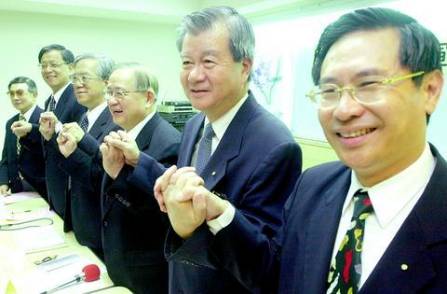
Twu Shiing-jer, far right, former director general of the Department of Health, and other members of Taiwan's WHO bid hold hands at a press conference in Taipei yesterday. Key members of the delegation have suggested that Taiwan should directly seek full membership after an eighth failed attempt to obtain observer status in the UN body.
-----------------------------------------
On May 28, 2004 ……
Chen made good; now it's the turn of the KMT
By Bruce Jacobs
With his inauguration speech, President Chen Shui-bian has successfully negotiated several dangers which the Americans, the Chinese and the Taiwanese people themselves have created. For example, Chen has received considerable criticism from both the Chinese and the Americans about his plan for a new constitution. The Chinese complained this amounted to a declaration of independence and the Americans urged caution so as not to upset the Chinese. The inconsistency of the Chinese, who have had at least four state constitutions since the establishment of the People's Republic of China in 1949, has become lost in the rhetoric.
Taiwan clearly does need a new constitution. A Constitution written for a dictatorship of half a billion people in 1947 does not work for a democracy of 23 million people in the 21st century. Some two-thirds of the Constitution's articles require revision or excision. In addition, the new constitution will need to account for changes in institutions as Taiwan adapts its government to its new democratic climate.
Clearly, a new constitution will require substantial support within Taiwan to be legitimate. This important process of gathering consensus in both the preparation and the approval of the document cannot be rushed.
In order to gain this consensus, Chen has compromised. Rather than have the new constitution approved by referendum, he has declared that the new constitution should be approved by the processes laid out in the current Constitution, which use the National Assembly. Chen hopes that the new constitution will incorporate the use of referendums for future constitutional revisions.
In addressing China, Chen also expressed moderation. He reiterated the "five noes" when he "reaffirmed the promises and principles set forth in my inaugural speech in 2000." He restated that the new constitution would not change Taiwan's national sovereignty or territory or touch on issues of unification and independence, in part because Taiwan itself has not reached consensus on these issues.
Chen noted that the future of the relationship with China remained undetermined and there could even be unification between the two sides. However, he stressed that any decision about Taiwan's future must have "the consent of the 23 million people of Taiwan."
Chen stated he would establish a committee with people from all political parties and various walks of life to outline plans for peaceful development across the Strait. Again, he is seeking to broaden agreement across society as a whole.
A considerable part of Chen's speech attempts to bring together the divided people of Taiwan. Even though it was clear on election night that the pan-blue camp required new leadership, the ongoing saga of the recount -- which Chinese Nationalist Party (KMT) Chairman Lien Chan prolonged by his continuous adding of new conditions -- has postponed these changes. The old leadership of Lien and People First Party Chairman James Soong continues to attempt to extend its rule through such maneuvers as unification of the blue parties and mandatory attendance at the protest rally on inauguration day.
A vibrant democracy requires a strong opposition. Clearly the KMT needs to rejuvenate itself and certainly it cannot do so if it relies primarily on Mainlanders for support.
Let us hope, for the sake of Taiwan's democracy, that the pan-blue camp can reinvigorate itself so that the Dec. 11 legislative elections prove both fair and competitive.
Bruce Jacobs is professor of Asian languages and cultures and director of the Taiwan Research Unit at Monash University in Melbourne, Australia
-----------------------------------------
On May 28, 2004 ……
You want me to believe this?
By Mark Bruce, Touliu
The pan-blue camp's propaganda machine really needs to be given an award for outstanding devotion to degenerate advertising. From President Chen Shui-bian being likened to Adolf Hitler and Osama bin Laden, to the nonsense that appeared in an advertisement in the Taipei Times on May 20 on page 5. "Truth for Bulletgate," it says.
From what this piece of propaganda says I take it to mean that the assassination attempt on the president was staged. This robbed the pan-blue camp of victory and the country should remain without a president until the truth is revealed.
Let's stop a moment and see what is "known" at present. From the evidence, it seems that a person or persons on a Tainan street fired homemade ammunition from a handgun at the presidential Jeep, wounding the president and vice president. Examination of the scene supports this theory. The president's wound has been confirmed as a gunshot wound.
To me, this appears as an assassination attempt but the pan-blue camp wants me to believe that the pan-green camp found an amazing sharpshooter who, with a moving target, a crowd, homemade low-quality ammunition and a vehicle's windscreen (notorious for deflecting projectiles) in the way, was able to fire two shots from a handgun. The bullets grazed Chen's stomach and, through the windscreen, inflicted a minor wound on the vice president's knee. So these two "staged" bullets were able to change the outcome of the election? Wow!
Now, if the attempt on the president's life was real, then the rest of what they claim is misguided and inappropriate. As the opposition, they should be concerned that there was an attempt on the lives of the president and the vice president, and the implications that this has for the nation.
The pan-blue camp didn't challenge the appropriateness of holding the election when the incident occurred, but now sees fit to do so.
The effect of the shooting on the election results can never accurately be determined, but the peoples' decision must be respected.
Lastly, the problem with "Taiwan's troubled democracy" is that the opposition doesn't understand the word "democracy," and thus doesn't know how to function in one.
I would suggest the pan-blue camp reads the May 20 Taipei Times editorial and Chiou Chwei-Liang's article ("When the opposition is not loyal," May 20, page 8) as an enlightening insight as to how to function as the opposition, and whether Taiwan really should remain without a president until the truth is known.
If they had done that in Sweden in 1986?
Well, you decide.
-----------------------------------------
On May 28, 2004 ……
No more fantasies about China
The recent focus on the "middle line" of the Taiwan Strait reveals a few things very important to the people of Taiwan -- the delicate and volatile nature of the relationship between the two sides of the Strait, and the potential threat that China poses to Taiwan. Unfortunately, way too many people in this country do not seem to realize the true nature of Taiwan's relationship with China and continue to harbor unrealistic expectations and fantasies about a "Chinese motherland."
What caused the sudden interest in the middle line was a news story published on Monday by a newspaper in Hong Kong, the Wen Wei Po, alleging that Chinese fighter jets had successfully fended off a group of Taiwanese fighter jets that tried to cross the middle line. The newspaper then went on to quote a high-ranking Chinese military official as saying that Taiwanese naval aircraft would be "crushed" if they dare any provocation.
In view of the highly sensitive, if not strenuous, relationship between China, the US and Taiwan over the past months, and the compromising attitude demonstrated in President Chen Shui-bian's inaugural speech with respect to major issues of concern to both countries, it is virtually impossible to believe that there can be any deliberate provocation on the part of Taiwan. In fact, the Ministry of National Defense has already denied the story -- that there had been any crossing of the middle line, whether deliberate or inadvertent, by any of its aircraft.
However, all the recent discussions about the middle line has revealed that, although it did not happen this time, an inadvertent crossing of the line by either side is a possibility that cannot be ruled out. The middle line is an imaginary line drawn by the US in the middle of the Strait in 1951. While Taiwan's government knows about its location, pilots of fighter jets typically have to rely on instructions from the control tower to avoid crossing the line inadvertently. As for whether the Chinese government knows about it, upon inquiry by lawmakers in the Legislative Yuan, Minister of National Defense Lee Jye answered "I don't know." However, he went on to explain that, judging from the consistent flight patterns of Chinese fighter jets, the other side "ought to" know about it.
In other words, although the US in all likelihood had communicated to Beijing the location of the middle line, the two sides of the Strait had been relying on "tactful understanding" about where this critical line is, in the absence of any direct confirmation from the other side. In view of China's hostility toward this country -- as evident from the large number of Chinese missiles targeting Taiwan and the threats by the Taiwan Affairs Office in recent days -- one cannot help but wonder whether peace in the Strait is hanging by a very thin thread.
If China intends to start a war in the Strait, one cannot rule out the possibility that it may do so by claiming provocative crossings of the middle line by Taiwanese fighters or by attacking such jets in alleged self-defense. In particular, since Wen Wei Po is known as a mouthpiece of Beijing, the coercive undertone of the news story in question cannot be overlooked.
What the incident should reveal to
the people of Taiwan is that, in reality, China is an enemy state that could
barely be kept behind a middle line, the location of which most people did not
even know about until Lee made it public this week. Yet, under the
circumstances, many people continue to feel a confused sense of national
identity. The middle line of the Strait goes a long way in revealing the
genuine nature of the cross-strait relationship. The problem is some people
just don't want to face the reality.
-----------------------------------------
On May 28, 2004 ……
-----------------------------------------